The definitive duties are 9.5% for India, 27.9% for Japan, 20.7-27% for Taiwan, 3-7.8% for Turkey and 16% for Vietnam.
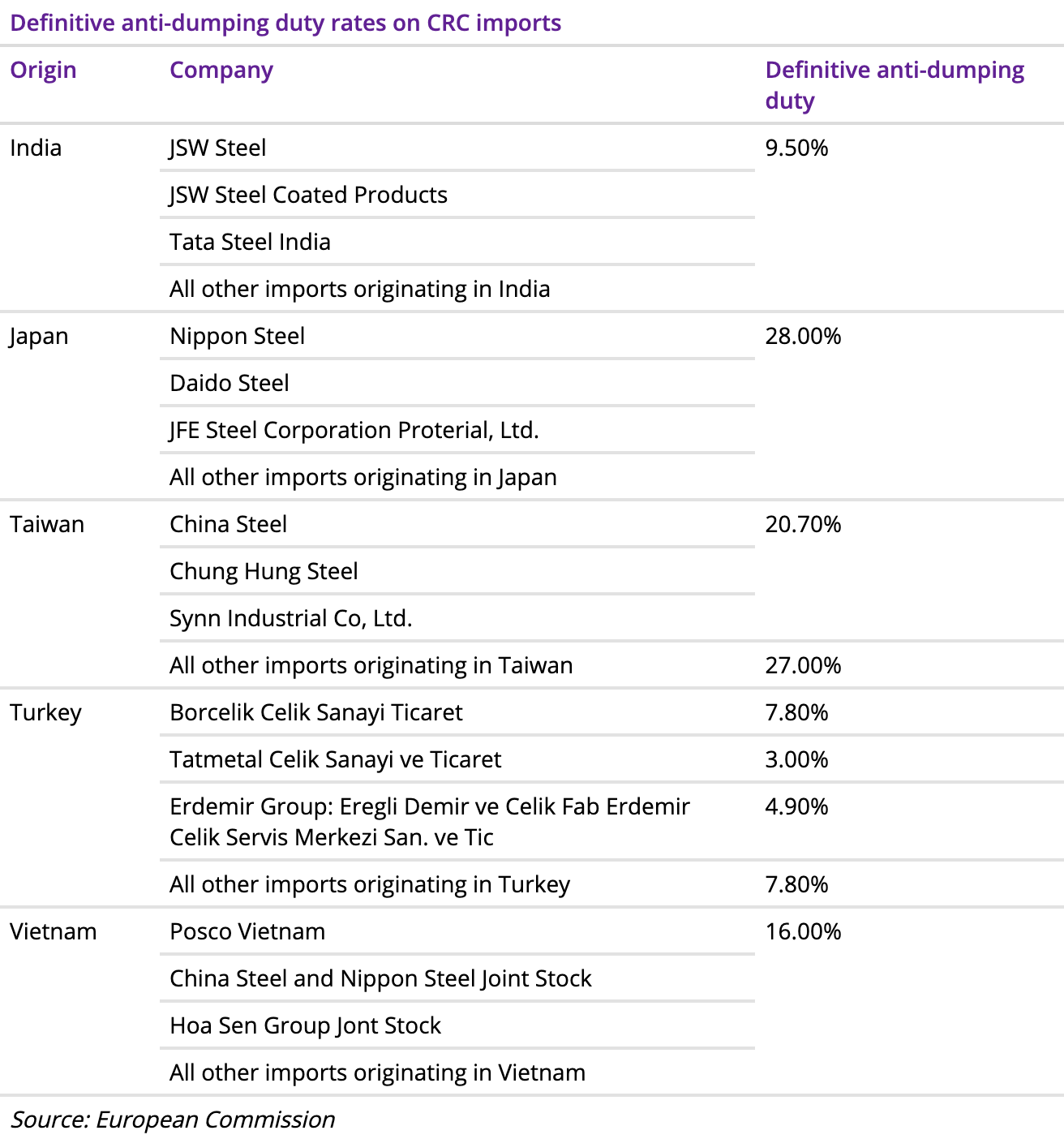
Imposition of the duties followed an investigation started in September 2025, which found that cold-rolled flat steel products from these origins were entering the EU at dumped prices.
This probe is the first in which the Commission has established the existence of Particular Market Situations in some of the markets investigated, the Commission said.
“As such, the Commission considers this investigation to be of systemic importance for trade defence, beyond the products and industry sectors it concerns. This investigation demonstrates the Commission’s ability to develop credible, evidence-based and innovative solutions to address evolving trade-distorting practices,” it added.
A Particular Market Situation arises when conditions in an exporting country’s domestic market prevent a fair comparison between domestic and export prices. Under EU anti-dumping rules, the Commission may calculate a constructed normal value rather than rely on domestic sales prices when such market distortions are established, subject to applicable legal provisions.
In this investigation, the Commission established Particular Market Situations in India and Taiwan. In India, government measures were found to have influenced domestic iron ore prices, affecting a key raw material used in cold-rolled flat steel production. In Taiwan, excess steelmaking capacity in China led to increased imports of Chinese cold-rolled flat steel, putting downward pressure on domestic prices and weakening the profitability of Taiwanese producers. The Commission subsequently introduced corrective measures to address these distortions.
The EU imported 1.7 million tonnes of CRC in the first nine months of 2026, according to Global Trade Tracker data. That was down by 13.26% from 1.96 million tonnes in the same period of 2025. The EU imported 2.9 million tonnes of CRC in full-year 2025.
The Commission announced preliminary duties in August this year.
Nevertheless, market sources said buying activity had been cautious well before that.
The introduction of a new safeguard system in July 2026, and of the Carbon Border Adjustment Mechanism (CBAM) since the beginning of the year, also had an effect.
Market sources expect the official imposition of the anti-dumping duties to result in “further tightening of CRC supply from abroad”.