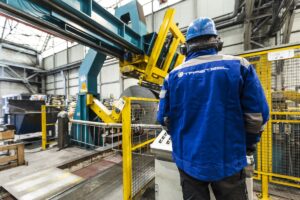


McCloskey hosted a Green Steel Day networking event in Düsseldorf, Germany, on 16 September, where we shared our views on the current developments in the European and global steel markets, the legislative agenda in the EU and longer-term decarbonization trends. In this article, we present a summary of the main topics discussed.
European steel and green steel market overview
Domestic steel coil price recovery in the EU slowed in August, with buyers pushing back against further increases. However, the upcoming implementation of the Carbon Border Adjustment Mechanism (CBAM) in 2026, along with the expected introduction of tougher steel safeguard measures around the same time, continued to lend support to prices.
Interest in new import purchases has largely dried up, as longer lead times discouraged fresh bookings. Buyers are instead focusing on clearing available volumes through customs in 2025—even if that means exceeding import quotas and paying duties of up to 25%. Importers prefer to operate under the familiar safeguard system with its predictable risks, rather than commit to 2026 shipments before final CBAM regulations are clarified.
European green steel trading remains limited, held back by the lack of standard definitions for “green” steel and the weak overall steel market. Distributors have shown growing interest in low-CO2 products but remain reluctant to hold stock without a committed buyer.
Premiums for European hot-rolled coil (HRC) with green attributes currently range from €60/t to €300/t. Lower levels apply to mass-balance material, while the highest premiums are achieved in direct sales from trial plants to end users willing to absorb the additional cost.
Meanwhile, overseas mills have become more active in marketing green steel to the EU with significantly lower premiums than domestic suppliers. Some exporters have already secured Environmental Product Declarations (EPDs), while others promote coil produced via the direct reduced iron-electric arc furnace (DRI-EAF) route as “green,” with EPD certification expected soon. On average, premiums for Turkish and Chinese green HRC with CO₂ content below 1t (Scopes 1–3) were around $20/t.
European steel industry in the global context
China remains the main driver of steel industry trends due to its rising exports, which are triggering response from legislators worldwide. Since McCloskey launched its Steel Trade Measures Database in February, the number of active trade cases against Chinese steel products rose from 353 to 397, excluding universal measures like safeguards or tariffs. Despite this, in the first eight months of 2025, Chinese exports have risen by 10% y/y, reaching 77.5 mt. Most trade cases were introduced against flat steel products, and Chinese mills adapted in response. In the January-July period, exports of semi-finished products rose more than fourfold, to almost 7.5 mt, while long steel shipments surged by 49% y/y.
We don’t believe this trend can continue. Chinese steel production is declining – we expect it to be down by about 2% this year to 980 mt, and to fall to around 930 mt by 2030. More trade protection measures are also being introduced around the world, with a growing focus on anti-circumvention measures and “melt-and-pour” clauses. However, there is still potential for China to increase volumes going into Africa and South America, and there will be a rise in green steel exports from China as more producers gain the required certifications, keeping export volumes at historically high levels.
In the US, although prices have been under pressure due to tariff uncertainty, steelmakers increased their market share. In the first eight months of 2025, imports declined by 7%, while domestic capacity utilization rates are lingering just under 80%, up from low 70% at the start of the year. US mills are also committing to significant capacity expansions, and according to McCloskey estimates, over 15 mt of new capacity is currently planned, under construction, or being ramped up in the country.
Meanwhile, the European steel market continues to suffer from weak demand, weighing on price levels. This has translated into lower mills margins and led to blast furnace closures, which by September reached 23.3 mt.
McCloskey expects to see a change of direction in Europe next year, forecasting a 5% rise in regional crude steel production in 2026, with domestic output partly replacing imports displaced by CBAM and tougher trade protection barriers. There will be a boost from the German stimulus spending on infrastructure, but we are cautious about the near-term upside. Spending is likely to face hurdles such as a slow planning process, tight labour market, and some estimates suggest a 10% shortfall in infrastructure and defence plans because of the bottlenecks.
European Steel and Metals Action Plan
The implementation of executive commitments under the European policy environment are lagging behind industry requirements. Signalled support in the European Steel and Metals Action Plan (ESMAP) – agreed as necessary to preserve domestic stakeholder competitiveness – has been slow to start and, in some cases, is intensifying rather than mitigating uncertainties within the European steel supply chain.
Pressures from global overcapacities are undermining European steel decarbonisation pathways and competitiveness. Yet despite wide-ranging support proposed by ESMAP, substantive progress remains thin and largely limited to industry consultation and debate.
That said, technical clarifications scheduled for the end of the year do show some promise in giving the market a stronger foundation to recover, aligned to improved demand forecasts for 2026. Impending legislation or substantive proposals surrounding lead-market generation for low-carbon steel via public procurement and green standardisations, renewed trade protection mechanisms to support underlying investment cases, and long-awaited details core to calculations of cost exposures generated by the upcoming CBAM’s definitive stage are all scheduled before the end of 2025.
Overall, the market is still awaiting the regulatory push it needs to secure transition-dependent competitiveness. Confidence in European authorities is patchy, but the combination of legislative signals and executive commitments is flickering a light at the end of the tunnel, hopefully in time for a better 2026.
Ongoing and planned decarbonization projects
Steel decarbonisation pathways vary across regions, which have different legal requirements, composition of steelmaking capacities and access to resources.
In Europe, where the pace of decarbonization is regulated by law, more than 40 projects have been announced, and some are at an advanced stage of implementation. These include greenfield projects, but most initiatives aim to replace carbon-intensive blast furnace – basic oxygen blast furnace (BF-BOF) capacity.
According to McCloskey estimates, by 2045, the EU could produce more than 80 mt of green steel per year from new EAFs, which are expected to replace around 70 million tonnes of BF-BOF capacity. New EAF-based projects are mainly focused on flat steel production, which requires DRI to feed the EAFs, along with steel scrap. However, our estimates also show that by 2045, European steelmakers will produce only half of the DRI needed, thus relying on supplies from other regions.
This is why we are now witnessing the beginning of the DRI boom in the Middle East and North Africa (MENA) region, where two-thirds of new projects are greenfield installations and most are hydrogen-ready DRI facilities, running on natural gas as the reducing agent until hydrogen becomes available and affordable.
DRI projects in the MENA region are still taking shape, with many yet to receive final investment decisions. However, according to industry sources, some projects can be scaled up to 10 mt per year and will focus on exporting hot briquetted iron (HBI) to European steelmakers.
The renaissance of DRI in the MENA region is also attracting iron ore giants, including Brazilian Vale. Its strategy is to establish iron ore briquette production hubs near DRI/HBI producers. Vale claims that these briquettes can replace DR pellets in DRI shaft furnaces.
Similar developments are starting to emerge in Asia. China, Japan and South Korea are mostly focused on environmental improvements of their relatively modern BF-BOF capacities, but at the same time they are moving towards scrap-EAF or DRI-EAF production, with dozens of new EAF installations in China alone. This motivates Australia to invest in DRI/HBI capacities targeted at the emerging Asian green steel market.
The emerging green steel market is growing rapidly, with new projects being announced regularly and existing ones being modified or even cancelled. Each year, the still-elusive contours of this new green steel industry become clearer, attracting new players, investments, and technologies, and potentially reshaping the status quo of the global steel industry.
McCloskey will be closely monitoring this constantly changing market, collecting and analysing all available data. We look forward to presenting our insights to you at events like the one we have organised for our clients and friends in Düsseldorf.
Benjamin Steven Journalist, Steel
Maria Tanatar Associate Director, Steel and Green Steel
Marina Maliushkina Associate Director, Global Steel Analysis
Sergey Babichenko Senior Research Analyst