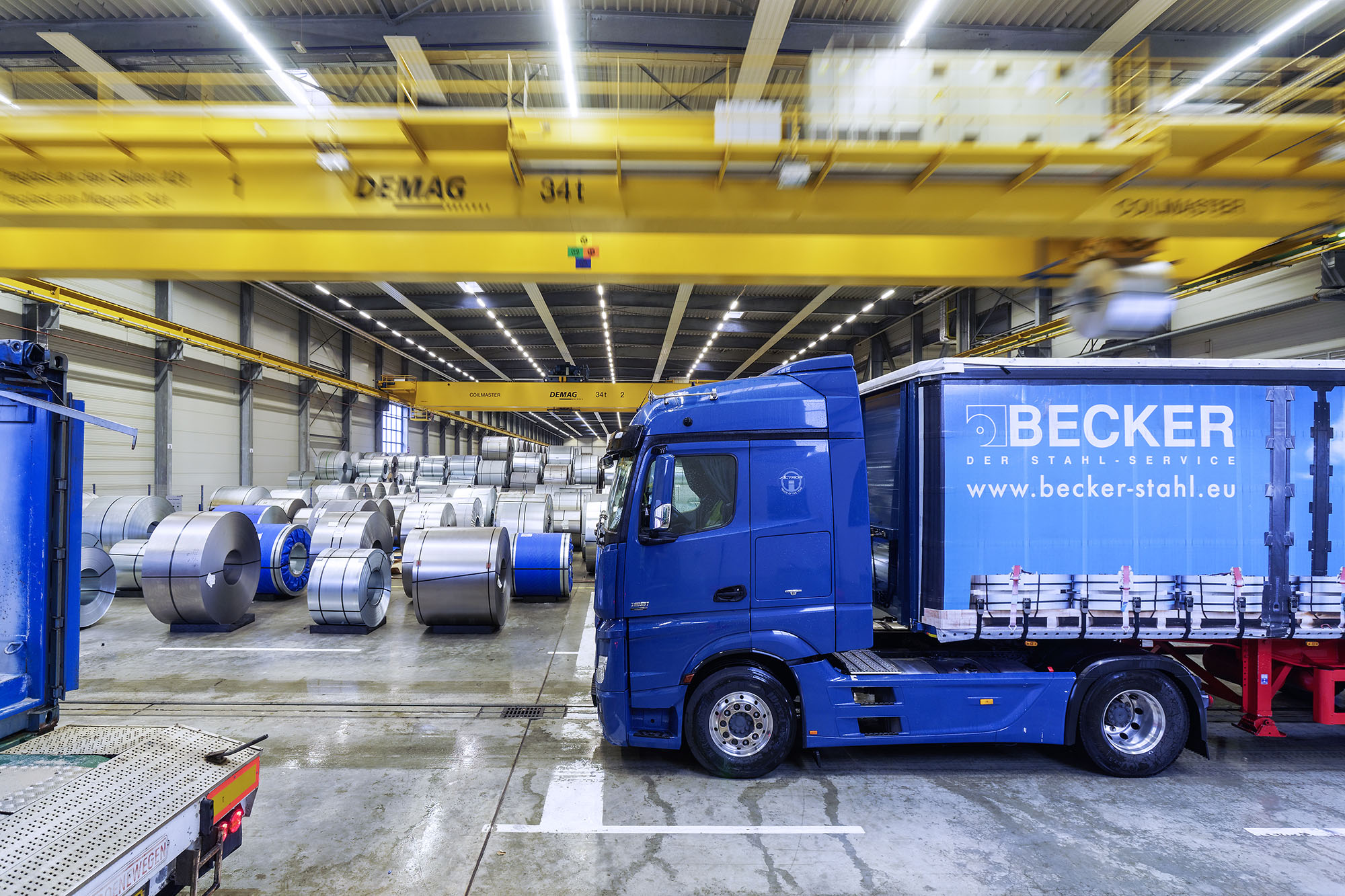
Klöckner & Co intends to divest Becker Group
Klöckner & Co announces its intention to sell Becker Group, one of the largest multi metal platforms in the flat steel sector in Europe.
The Management Board of Klöckner & Co reached this decision after a comprehensive analysis and assessment of possible strategic options for Becker Group.
With this move, Klöckner & Co aims to enable the Becker Group’s participation in industry consolidation in Europe under new ownership, while placing a sharper focus on higher value-added products and services.
Klöckner’s Q3 shipments increase, high-margin focus continues
Klöckner & Co lifted shipments in the third quarter but revenue dropped due to depressed pricing. Focus continued on expanding higher-margin steel sales share.
Q3 shipments were at 1.1 million tonnes, a slight increase of 1.9% on-year, Kallanish notes.
Revenue however decreased by 2.2% on-year to €1.6 billion ($1.83 billion) due to price factors. Ebitda adjusted before special effects was €43 million, marking a considerable increase than the previous year’s €21m and thus continuing the positive trend from the first two quarters of 2025, the enterprise claims.
In the first nine months, Klöckner & Co raised shipments by 1.5% on-year to almost 3.5mt, mainly thanks to a continued positive trend in the Kloeckner Metals Americas segment.
Revenue decreased to €4.9 billion compared to €5.1 billion. Ebitda before special effects amounted to €150m compared to €104m in January-September 2024.
“In a challenging market environment, we have once again shown that our strategy is working by doubling our operating income in the third quarter,” says Klöckner & Co chief executive Guido Kerkhoff. “We have continued the positive trend in the Kloeckner Metals Americas segment, and our sharpened focus on higher value-added and service centre business will continue to permanently strengthen our earnings profile. The sale of eight US distribution sites is another key step in the targeted reallocation of capital to higher-margin areas.”
Additionally, the company has further expanded its capabilities as a technology partner in the defence and infrastructure sector in Germany. At the beginning of the year, Klöckner & Co’s German subsidiary acquired and successfully integrated Ambo-Stahl, a provider of high-quality processing services for the defence and infrastructure sector.
Building on this acquisition, Klöckner & Co has expanded its service portfolio and obtained official certification in Kassel for processing armour steel in accordance with German Federal Armed Forces (Bundeswehr) specifications. The expansion of capabilities is a further step towards profiting more from increased defence expenditure across Europe, the steelmaker concludes.
For fiscal year 2025, Klöckner & Co continues to expect Ebitda of €170m to €240m before special effects. Furthermore, the company continues to expect a significantly positive cash flow from operating activities.
Svetoslav Abrossimov Bulgaria


Klöckner & Co: The green transition needs steel
Germany-based steel and metal supplier Klöckner & Co SE highlighted the critical role of the steel industry in the green transition. Speaking at EUROMETAL’s 75th Anniversary conference, the company’s CEO, Guido Kerkhoff, emphasized that environmentally friendly steel production plays a key role in combating climate change.
Kerkhoff pointed out that compared to alternative materials such as carbon fiber, steel is less harmful to the environment and contributes to the circular economy thanks to its recyclability. Kerkhoff noted that “green steel,” produced with modern technologies, significantly supports sustainability through its low carbon emissions during production processes.
According to company data, the use of green steel can substantially reduce carbon emissions in sectors such as automotive, household appliances, construction, and energy projects — all while only causing a marginal increase in final product prices. “Green steel can offer over 20% CO₂ savings with cost increases of just up to 1%,” Kerkhoff stated.
Guido Kerkhoff also warned that demand for green steel in Europe is rapidly increasing and that production capacity may fall short of meeting demand by 2030. He highlighted potential mismatches between green steel types and customer expectations.
Underlining that customers aiming to meet climate targets need products with genuinely low carbon footprints, Klöckner & Co is expanding its portfolio of sustainable products and services. The company has developed a system under the Nexigen® brand that ensures carbon emissions are measured and reported transparently.
Thanks to Nexigen®, the carbon footprint of each product is calculated and shared in detail with customers. The system covers emissions throughout the entire supply chain — from raw material procurement to final delivery — and is certified according to international standards. This allows customers to view carbon data for past orders and explore lower-emission alternatives.
Kerkhoff noted that transparent carbon accounting across the supply chain provides a strategic advantage for both companies and customers. Pointing to the rising demand for low-carbon steel products over the next 5 to 10 years, the CEO stated, “Only products with verified and transparent carbon data will be able to meet this demand.”
Klöckner & Co continues to focus on low-carbon steel supply and sustainable solutions with the ambition of being a pioneer in the green transition.


Kloeckner remains unconcerned about US tariffs
Steel distribution group Klöckner & Co feels relatively immune to the impact of tariffs imposed by the US government, its chief executive Guido Kerkhoff said during a conference call on Wednesday.
The Germany-based group has operations in the USA as well as Mexico, which together make up a larger share of revenue than Klöckner’s European operations, in Germany and Switzerland. For its US sites, Klöckner sources 97% of product tonnage from US mills. Hence, “the penalty duties affect us only indirectly, if our customers are affected,” Kallanish heard from Kerkhoff. The firm’s pricing is not affected at all, he added.
Given the US government’s target of near-shoring the manufacturing industry, Klöckner’s local business range would in fact grow bigger. “We are a local player, after all,” Kerkhoff maintained.
Regarding the company’s warehouses in Mexico, 45% of the material can be sourced within Mexico, and another 25% is sourced from the USA. “Our sites are approved by the USMCA [United States-Mexico-Canada Agreement], so that we can enter the US market,” he explained. Many of Klöckner’s competitors, but also customers like some carmakers, are much more dependent on sourcing from overseas, he noted.
The company recently completed the acquisition of Haley Tool & Stamping near Nashville, Tennessee. The move expands Klöckner’s manufacturing capabilities with the addition of stamping presses, allowing it to leverage operational synergies across its locations in the region.
Christian Koehl Germany
Kloeckner intends to sell Brazilian operations to Gerdau
Klöckner & Co is moving forward with the divestment of its Brazilian operations, confirming negotiations with Gerdau for the sale of Kloeckner Metals Brazil (KMB).
“Our intention is to divest KMB and focus on our core markets in the US, Mexico and the DACH region (Germany, Austria and Switzerland),” the company tells Kallanish. “We are currently in firm negotiations with Gerdau. However, the intended sale is still subject to approval by Brazil’s antitrust regulator.”
The financial details of the transaction have not been disclosed.
For Gerdau, the deal represents a strategic move to strengthen its position in Brazil’s domestic market, aligning with its broader expansion strategy. The acquisition will help diversify and enhance its flat steel supply, particularly from its Ouro Branco plant in Minas Gerais.
Kloeckner Metals Brazil operates in Araucária, Paraná, and has been in the Brazilian market since 2011. The company primarily supplies hot-rolled coils, sheets, heavy plates and structural profiles.
Todor Kirkov Bulgaria
Klöckner plays down Europe price recovery
Klöckner & Co is remaining low-key about the pace of price recovery in Europe. Its chief executive, Guido Kerkhoff, says he is hesitant to describe the development too positively, given the market is still shaky in its effort to stabilise.
“I do not yet see a positive trend on the horizon,” he told Kallanish during a conference call on Wednesday. Prices are picking up but very slowly, because customers remain reserved with making big investments. “The market is still delicate and needs to be preserved and nurtured with care, so to speak,” he said.
It would take a government investment incentive programme to ensure activity picks up. The German-based company is therefore pinning its hopes on the new German government. This is currently being formed in a coalition of the conservative CDU and social democrat SPD parties, as well as possibly one further partner party.
Obvious sectors for investment are residential construction, infrastructure and defence, Kerkhoff said. The latter field is cited increasingly as a cause for public spending. Klöckner recently installed an advanced laser facility in Kassel, mainly targeting agricultural machinery, mechanical engineering, and defence. Moreover, if the war in Ukraine came to an end soon, and the county regained peace, its reconstruction would be a task for foreign steel suppliers, Kerkhoff noted.
The company’s US business had to concede even steeper price falls than in Europe last year, by 40%, but managed to handle them reasonably well due to its shift to higher value-added services. “This would not have been possible six or seven years ago,” Kerkhoff concluded.
Christian Koehl Germany
Klöckner sports new image as metals processor company
Klöckner & Co is promoting a new image as it is developing from a steel distributor to a service centre and higher value-added business company.
The German-based group “is seen as a steel distributor, but actually we have become a metals processor company,” chief executive Guido Kerkhoff said during a conference call on Wednesday.
The company has in recent years significantly shifted its focus to its higher-value processing and metalworking business in its core markets of North America and the DACH region – Germany, Austria and Switzerland. It divested the distribution-only sites in western Europe and in Brazil. In 2024, the group already generated over 80% of its sales from the steel service centre and higher value-added business.
Through targeted investments, distribution centres were transformed into production and processing hubs for higher-value metal solutions, Kerkhoff pointed out. “Despite the difficult environment last year, we have continued our investments, rather than postponing them, which sent a positive signal,” he said.
In Switzerland, a country with a night ban for road haulage, the company optimised logistic links between railway and road haulage, using trains at night, and reloading to trucks for close-range delivery in the morning. That allowed it to close several warehouses used only for close-range distribution.
The group’s many activities in North America, especially, have spurred the development, Kallanish heard Kerkhoff say during the call. One major move there currently is the firm’s investment in a flat-rolled aluminium processing facility on the campus of Aluminum Dynamics LLC (ADL), a subsidiary of Steel Dynamics Inc. (SDI).
Another signal for Klöckner’s new image is the relocation from Duisburg to Düsseldorf, although it did not highlight this during the call. Duisburg, the unofficial capital of Germany’s rust belt, was Klöckner’s headquarters for decades. Along with the demise of the city’s steel industry and overall social environment, Klöckner moved to a new home in Düsseldorf last year, a city known for arts, fashion, and techno culture.
Christian Koehl Germany
German distributors still postponing restocking: Klöckner’s Kerkhoff
Distributors in Germany remain reserved when buying larger volumes of steel for their inventories, according to Klöckner & Co chief executive Guido Kerkhoff.
The point of replenishing the shelves has not yet been reached, Kerkhoff said during a conference call on Wednesday when asked by Kallanish for the status quo of distributor and service centre buying behaviour. Regular business with a continuous turnover of products is not yet in sight. “I think the status quo is that people buy only as much as they are expecting to sell,” he replied.
He alluded that prices are starting to see some gentle recovery, but real demand is yet to improve. Nevertheless, he is not completely pessimistic. “Warehouses are still relatively empty, but, yes, I do believe that the point of return to business will come,” he noted.
His estimation is reflected in the outlook the company gives for the fourth quarter, and ultimately for the whole of 2024. In Europe, it sees a drop in real steel demand by 1-3%, with the transport/automotive segment pointing more steeply downwards than construction, mechanical engineering, or household appliances. The one sector with relatively stable demand is energy. “It does not look like activity will increase, but we are at an already low level,” Kerkhoff said.
The group is overall more upbeat about performance and prospects in its other big market, the USA, but here, too, sees a slight dip of between 0% and 1% in demand from its customer industries. However, “this is quite normal in an election year with the insecurities this brings,” he concluded.
Christian Koehl Germany
Klockner & Co Q3 shipments rise, sales fall on low steel prices FY24 look positive
In Q3 Klockner & Co increased shipments to 1.1 million tons, up 2.8% on the prior-year quarter and up by 3.4% to 3.4 million mt in the first nine months of 2024, the Company announced on Nov 6 in its earnings.
The year-on-year shipments increase is mainly due to the acquisitions in Mexico and the US, but due to the lower steel prices, the company’s sales fell to Eur1.6 billion in Q3 down from the Eur1.8 billion recorded in the same period of 2023 and down by 3.8% to Eur5.1 billion in the first nine months of the year.
Despite the continued weak demand in Europe and the steel price correction during large parts of the reporting period, Klockner & Co expects an overall positive fiscal year 2024.
Klöckner & Co continues to forecast EBITDA between Eur120 million and Eur180 million and expects a strong and significantly positive cash flow from operating activities, although this is likely to be below the prior-year level. From January to September the company’s EBITDA reached Eur179 million, down by Eur86million resect the same period of the year before.
“In a challenging market environment, we have made major progress in implementing our Group strategy,” Guido Kerkhoff, CEO of Klöckner & Co SE said. “Through targeted investment in selected sites in the US and Germany, we have been able to expand the higher value-added processing and metalworking business.. In addition, winning the German Sustainability Award once again is a great confirmation of our success in decarbonizing the steel industry.”
Klockner & Co expanded its higher value-added business, in the US, targeted investments have enabled the Charlotte and Dallas sites to evolve from a pure distribution operation to a higher value-added fabrication and metalworking operation. Further progress was also made in Germany, for example with the investment in a fully automated sawing and drilling system in Landsberg, aiming to increase Klöckner & Co’s profitability and reduce its dependence on volatile commodity markets.
On digitalization and automation the quantity of digital quotes increased by more than 27% in the first nine months of 2024 compared to the same period of the previous years the company continues in its progress towards its vision of “zero-touch” and minimum manual intervention.
Platts, part of S&P Global Commodity Insights, assessed hot-rolled coils, down in Q3 from Eur635/mt registered on July 1 to Eur545/mt recorded on Sept 30.
Since the beginning of the year, HRC prices dropped by Eur135/mt from Eur690/mt registered on Jan 02 to Eur555/mt ex-works Ruhr November 5, down Eur5 on the day.
Klockner & Co SE is one of the largest producer-independent distributors of steel and metal products and one of the world’s leading steel service center companies. With its distribution and service network of around 120 sites, primarily in North America and the “DACH” region (Germany, Austria and Switzerland), Klockner & Co supplies more than 60,000 customers.
Klöckner sees increasing low-emission steel products acceptance
Steels that are certified as low-carbon-emission products have so far been demanded mainly in Europe and by big users, but are gaining ground in other segments and regions, Klöckner & Co observes.
When asked about buyers’ acceptance of CO2-reduced product premiums, chief executive Guido Kerkhoff said during a recent conference that it was “good in principle”, but varied by segment and region. Comparing the distribution group’s two main markets, he explained the level of acceptance in Europe is better than in the USA, “but they [US buyers] are catching up”.
Also, “green” steel is primarily a domain of the big user groups like the automotive industry, while small and medium-sized customers are content with receiving “some kind of certificate”, he added. However, “inquiries are increasing and interest is becoming more profound,” Kallanish heard him say during the conference.
“The wind is changing in the USA as well, so in the premium segment you will not be able any more to offer only grey and black standard products,” he observed.
He did not elaborate on the short-term future, when more costly CO2-reduced material in Europe could face a hard time amid continued sluggish demand. In a different context, he stated that “on the domestic market, we need to prepare for rough competition for low volumes”.
Last year, Klöckner introduced its own low-CO2 steel brand under the name of Nexigen. In spring, it launched the Nexigen PCF Algorithm, which can be used to determine the Product Carbon Footprint (PCF) for almost all its products. More recently, it presented a tracking solution that allows customers to view their emissions history for products purchased from the company.
Christian Koehl Germany