


180 participants at EUROMETAL Steel Net Forum Iberia in Barcelona
EUROMETAL Steel Net Forum Iberia in Barcelona was attended by 180 participants. Undoubtedly another successful proof of close collaboration with the Spanish national federation UAHE.
Delegates from all the steel value chain, gathered in Barcelona to learn matters such as safeguard measures in steel trade, cybersecurity, the impact of the Russian-Ukraine conflict on the European distribution, the implications of CBAM and the challenges facing the distribution of steel in Iberia.
It was announced at the end of the event the intention to organise the next Iberian forum in Algarve (Portugal) in March 2023.
Here are the articles published by the journalists present:
- With embedded CO2, steel scrap vital for green steel production: EUROMETAL’s Espada
- Ukraine war makes EU safeguard removal possible: Yuriy Rudyuk
- Iberian distributors expect challenging 2022: conference
- Demand for low carbon emission steel increasing: SSAB
- EU safeguards detaching fast from reality of steel trading: Van Bael & Bellis
- Spain’s steel sector remains cautious over market recovery
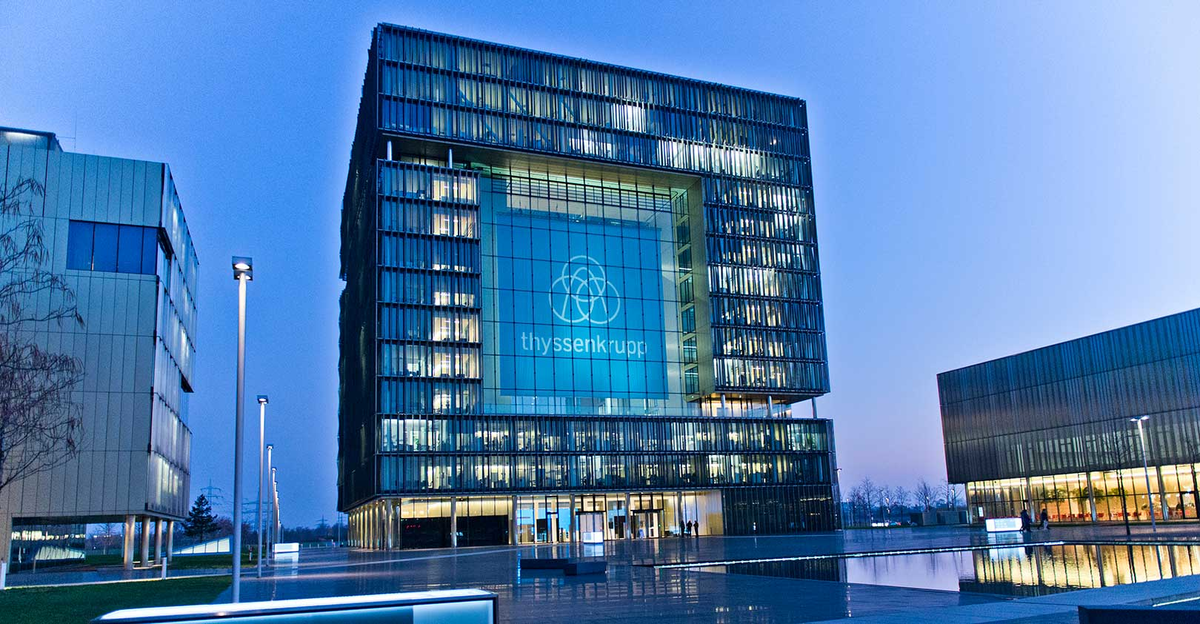
Thyssenkrupp Ulm service centre starts new production hall
Thyssenkrupp Schulte has announced the start of a new production hall with multi-strip cut-to-length line at its unit Jacob Bek in Ulm, southern Germany.
The new facility will allow for the processing of up to 60,000 more tonnes/year of material, and for coil weights of up to 30t, as Kallanish reported one year ago when construction began. Project participants were construction company Goldbeck and plant manufacturer Salico. The production hall has an area of around 2,500 m2 and is equipped with two modern crane systems with a lifting capacity of up to 32t.
According to parent group thyssenkrupp Materials Services, the sustainable aspect was the focus of the new building: in addition to electric forklifts, there are parking spaces for e-cars as well as charging stations for e-bikes. Furthermore, the building is tempered by a heat pump heating system. With these measures, Jacob Bek is contributing to supporting thyssenkrupp Materials Services’ goal of climate neutrality by 2030, the parent company notes.
Christian Koehl Germany


ArcelorMittal Bremen introduces short-time work: reports
ArcelorMittal Bremen is introducing short-time work in July for part of its staff, local news portal Buten un Binnen writes. The measure will include the hot-rolling as well as cold-rolling mills, while the blast furnace-oxygen converter steel melting operation will continue.
The measure comes as a reaction to low demand from the automotive and the construction industries, ArcelorMittal gets quoted as saying. The group was contacted by Kallanish for confirmation and details, but did not reply by deadline on Monday.
According to Buten un Binnen, short-time work was already envisaged by the mill for June, but the works council stood up against it. However, union IG Metall reportedly said that measures probably cannot be prevented going into the third quarter, which seems to be the case now.
Some weeks ago, market players spoke of a one-and-a-half-week production stop at ArcelorMittal Eisenhüttenstadt, the other big strip mill of the group in Germany. The company has neither confirmed nor denied the rumours.
Christian Koehl Germany

Turkey sees no major change in steel trade with UK following safeguard extension
Turkish steel exporters and traders do not expect major changes in their steel trade as a result of the UK’s July 1 extension of its steel import safeguards system for a further two years, despite recent fluctuations in shipment levels of some products, sector representatives told S&P Global Commodities Insights.
Ugur Dalbeler, vice president of the Turkish Steel Exporters Union (CIB), said late last week he is not expecting any significant change as Turkish exporters have been facing this kind of protectionist move in many countries in recent years.
“We have entered into a protectionist system globally,” he added.
After several EU nations, Turkey has nonetheless remained one of the biggest steel exporters of iron and steel products to the UK in recent years. It ranked in seventh position overall in 2021, with 375,100 mt out of the UK’s total imports of 6.37 million mt.
A trading company manager said July 4 that as steel trade with the UK has remained slow in recent years, the extension of steel safeguards probably will not have a significant effect on Turkish mills’ export volumes to that country.
“For the UK side, exports to the US are currently their main focus,” he said.
Steel imports into Turkey have meanwhile grown in recent years while Turkey’s overall steel shipments to the EU, US and some of Turkey’s top export destinations have fallen significantly due to trade barriers, the Turkish Steel Producers’ Association (TCUD) said in a statement.
Flat steel imports into Turkey have risen substantially in recent months, TCUD noted. Flat steel imports from the UK rose significantly by 592% on-year to 139,000 mt in May, TCUD said.
However, as quotas formerly allocated to Russia and Belarus under the UK’s steel import safeguards system have been reallocated to other countries in the extended safeguards system effective July 1, Turkey will be among the beneficiaries, together with Ukraine, the EU and Taiwan, the UK’s Trade Remedies Authority or TRA, said July 1.
According to the latest Turkish Statistical Institute data, Turkish mills’ flat steel exports to the UK remained low in the first five months of 2022. This may be due to the start of a turndown in demand. However, rebar exports to that country reached 75,000 mt in Jan-May 2022, significantly higher than the 2,300 mt exported in the same period the previous year.
Turkish mills’ steel sections exports to the UK remained relatively stable at 32,500 mt in Jan-May 2022, while welded steel pipe exports to that country fell slightly by 3.5% on year to 100,000 mt.
Turkey imported 858,000 mt of ferrous scrap from the UK in Jan-May 2022, down 32% on year, while semi product imports from that country also declined by 30% on year to 21,000 mt, the data showed.
— Cenk Can


EU HRC buyers await trend clarity before restocking
European hot-rolled coil buyers followed a wait-and-see strategy July 4, awaiting certainty as to the price direction and floors before engaging in any substantive restocking.
Platts assessed HRC in Northwest Europe stable on the day at Eur840/mt ex-works Ruhr, according to data from S&P Global Commodity Insights.
Distribution sources talked about the tradable value in a range of Eur800-850/mt EXW Northern Europe, though transactional activity remained scarce. A mill source considered the Eur850/mt level as workable, seen as a minimum offer level, with offers sitting at Eur850-900/mt EXW Northern Europe.
Unconfirmed deals were heard in the market at Eur800-850/mt EXW Northern Europe, though sources continued to consider deals and offers in the said range as atypical of general trade and non-representative of the market price.
“Market activity is quiet, almost dead, and there’s no real clarity as to pricing,” said a service center source. “Most think that the price decrease has stopped, and it’ll stabilize around Eur850/mt, but inventories remain high, and no one will be looking for large quantities any time soon.”
Import offers seem to have stabilized, with South Korean material heard offered at Eur780/mt CIF Antwerp on the day.
In the Southern market, HRC was also assessed stable at Eur765/mt EXW Italy.
A trader source heard deals at Eur760-770/mt EXW Italy. The source saw potential for Italian prices to move lower on decreasing scrap costs, benefitting from better margins on production from scrap than other raw materials.
— Benjamin Steven, Maria Tanatar
German steel market less bearish on pricing, expects production cuts: survey
German steel producers, traders, and buyers foresee a continuation of bearish pricing trends over July alongside clear expectations of reduced production, data from S&P Global Commodity Insights’ monthly steel sentiment survey shows.
The July pricing index was at 29 points, up 9 points from June, with production and distribution respondents seeing prices as lower, but to different extents. The price index for distribution respondents for July stood at 20 points, unchanged from June. However, producer sources were less bearish on the month, with the producer index rising 18 points to 38.
“There is no point in mills cutting prices further, it wouldn’t help return buyers to the market,” one flat steel distributor said. “Price isn’t an issue now — demand is.”
Demand for steel products remains muted across Europe on strong inventories due to panic buying following Russia’s invasion of Ukraine in February, logistical delays to the arrival of import material, reduced end-user demand, and reluctance to restock against pricing downtrends — independent of the traditional relaxation of activity in the summer period.
“Everyone is depleting stocks at the moment and there’s hesitation to restock while prices plummet,” said another flat steel producer. “There’s been no need to place large orders with prices going down every week, but soon buyers will need to reserve for September, so we’ll see some demand return albeit at more limited volumes than usual.”
In the flat steel market, Platts assessed hot-rolled coil in Northwest Europe down Eur135/mt on month July 1, at Eur840/mt ex-works Ruhr, according to S&P Global data.
For long products, Northwest European rebar moved down Eur165/mt, assessed at Eur1020/mt ex-works, June 29.
Production down, mixed expectations on inventories
Despite weakened end-user activity, stock levels have reportedly been decreasing across Europe, with some demand revival expected in July.
Consequently, the overall index for July inventories still predicted a decrease in stock levels, standing at 40 points, up 5 from June. Producer respondents remained unchanged at 25 points, but distribution sources increased 10 points from June to 55 points, suggesting expectations of an increase, perhaps tied to restocking sentiments.
The overall production outlook fell 7 points to 18 points for July, with distribution respondents unchanged at 20 points. Producer expectations for July almost halved, however, with the producer index at 17, down from 30 points in June.
Market sources throughout June have reported a need for production cuts to balance supply with currently muted demand. Leading producer ArcelorMittal has announced the idling of two blast furnaces in France and Germany, while prime mill Salzgitter has elected to delay the restarting of one of its furnaces. Other mills have been heard as running at near-minimum capacities or preferring to extend scheduled summer maintenance, in lieu of other equipment stoppages.
Further output cuts are predicted by sources for July, in line with July’s production index of 18, with flat steel sources in particular expecting mills to announce decreases in output.
“Not everyone has decided the full actions to put in place in response to current market conditions — namely low demand and high costs,” said a flat steel producer. “There’s minimal trade in the summer anyway so many will elect to extend maintenance periods — but I’d expect some surprise additional cuts in the coming weeks.”
— Benjamin Steven, Rabia Arif, Maria Tanatar

Industry expects China to announce 2%-3% reduction in 2022 crude steel output
China is likely to announce a 20 million-30 million mt, or 2-3% year on year, decline in its steel output cut target for 2022 in July, according to industry sources.
The steel output cuts at this level may not provide much upside momentum to the Chinese steel market, as annual steel demand, undermined by a debt-strapped property sector, may drop even faster.
Some sources expect Chinese steel prices to continue to fluctuate in the second half of the year but in a narrower range than in H1.
China’s annual steel demand in 2022 would drop at least 5% on the year, which means in order to lower steel inventories and give a real boost to steel prices, China has to reduce its annual crude steel output by around 50 million mt on year, some sources said.
“But it is impossible for China to target anywhere near 50 million mt of annual crude steel output cuts, as that will trigger unemployment and put great downward pressure on GDP growth,” a source said.
If China sets to reduce its crude steel output in 2022 by 20 million mt to 30 million mt on year, its annual crude steel output will decline to around 1.005 billion mt to 1.015 billion mt. That means the average daily crude steel output during June-December will be around 2.665 million mt to 2.711 million mt, down 13% to 14.5% from May’s daily level, but still 1.4% to 3.2% higher than in the same period of 2021.
Some market sources said China’s crude steel output already retreated in June, and the decline in steel output will accelerate in July, as currently most steel mills are already lossmaking and steel inventories at both mills and on the spot market are high.
Steel output cuts in July will stop steel prices from falling further or even trigger some upward corrections, but they will remain too modest to really reverse the downward trend due to poor steel demand, according to the sources.
Steel demand in the manufacturing and infrastructure sectors has gradually improved since June, but the slowdown in property-related steel demand has been too steep and is also unlikely to improve at least in the third quarter.
China’s property sector, the most important steel demand driver in China, may see its home sales and investment bottom out in the third quarter, according to some market observers.
However, even if new home sales begin to increase on a yearly basis in the fourth quarter, developers will divert most of the money to securing project completions rather than launching new home starts, which will benefit commodities like glass or copper but not steel.
— Staff

Kaltenbach.Solutions: substantial increase in growth thanks to 4th generation IoT solution
As a market-leading provider of web-based applications for performance management in the manufacturing industry, Kaltenbach.Solutions GmbH has now brought the fourth generation of the BoosterBOX digital measuring device to market maturity. The further development of the innovative hardware and software solution reliably creates transparency at machine and manual workstations and will be available from July 2022.
Interrupted supply chains for hardware components provided the impetus to consistently develop Kaltenbach.Solutions’ innovative solution further in order to remain a reliable supply partner for companies in the manufacturing industry in the future. Another critical factor were the often unstable local networks at the customers’ sites. In addition, the new BoosterBOX was to become usable as an embedded system for the manufacturers of machines and plants.
The basis for the BoosterBOX 4.0 is a milled aluminum housing that can accommodate 60 different variants. Thanks to the modular design, IoT hardware and software are almost infinitely scalable. The digital traceability of all installed components ensures maximum product transparency; fully automated test routines ensure the achievement of high process and product quality. Network stability has also been optimized: For data transfer without interruptions, the boxes are designed with LTE and WiFi network communication. The continuous power supply with the help of a UPS allows a controlled shutdown of the devices at any time in the event of a power failure.
The BoosterBOX 4.0 is only half the size of its predecessor and finds space in the control cabinet even under tight conditions. To simplify the entry into IoT-based performance management for the manufacturing industry, the company is switching to a rental model. Starting in 2023, Kaltenbach.Solutions expects to sell 160 units per month. Complementary, ready-to-install solutions for machine and plant manufacturers, including the MQTT raw and production data servers required for operation, will be available for purchase. The global market launch of the BoosterBOX 4.0 will take place in July 2022.