


Biden imposes melted-and-poured requirement on Mexican steel
US President Joe Biden has ordered that steel items imported from Mexico must be melted and poured in Mexico, Canada or the US to be eligible for Section 232 exemptions. This effectively slaps a 25% tariff on any steel trans-shipped through Mexico that originated in China or other sources outside North America.
“In my judgment, these measures will provide an effective, long-term alternative means to address any contribution by Mexican steel articles imports to the threatened impairment of the national security by restraining steel articles imports to the United States from Mexico, limiting transshipment, and discouraging excess steel capacity and production,” Biden says in a White House statement seen by Kallanish.
In a presidential proclamation Wednesday, Biden says US domestic steel production utilisation rates remain below the recommended 80% threshold due to the effect of imports. The administration is monitoring unfairly traded foreign entries and circumvention of existing tariff orders.
Commerce Secretary Gina Raimondo has determined that “steel articles are being imported into the United States in such quantities and under such circumstances as to threaten to impair the national security of the United States,” the proclamation states.
In particular, “imports of steel articles from Mexico have increased significantly as compared to their levels at the time of Proclamation 9894,” which was issued by then-President Donald Trump in 2019.
Biden’s new duty order is effective immediately, the proclamation specifies.
The presidential proclamation states that importers will be required to inform US Customs and Border Protection of the melted-and-poured origin of their steel and derivative steel items. That rule will be implemented “as soon as practicable”.


European HRC market remains largely stable, while mills raise their offers for October rolling
European domestic prices for hot-rolled coil remained largely stable July 9, even as some European mills were heard to have raised their offers.
“Some European mills are increasing offers for October rolling,” a service center source said.
Sources said that the prices were largely stable, and market activity was limited due to the summer holidays, noting that the situation is unlikely to improve until end of August.
“Nothing is really happening in the market,” a Germany-based mill source said. “Production is too high, and demand is too low, almost 20% less than last year.”
“Demand is still very poor,” a distributor source said. “It will probably remain the same till end of July/August holidays.”
Platts assessed Northwest European stable on the day at Eur620/mt ex-works Ruhr July 9.
Offers were heard at Eur630-645/mt EXW Ruhr.
Meanwhile, Platts assessed domestic HRC prices in South Europe stable on the day at Eur620/mt EXW Italy.
Tradable values were heard at Eur640-650/mt delivered Italy.
Interest in imported HRC remained low due to changes in the safeguard measures and longer lead times. The quotas for countries subject to the safeguard measures had already been exhausted on the first day of the new quarter, according to official data.
Sources noted that buyers may custom clear only the part of material that they don’t have to pay duty on, while the rest might remain at the ports to avoid paying duties.
“First of all, the buyers have to manage the relevant quantity of materials already arrived in the ports before thinking about demand from imports,” the distributor source said.
Platts assessed imported HRC in Northwest Europe at Eur595/mt CIF Antwerp, down Eur5 on the day.
Offers were reported at Eur600/mt CIF Antwerp for material originating from Turkey, including antidumping duties.
Meanwhile, Platts assessed imported HRC in South Europe stable on the day at Eur605/mt CIF Italy.
For Turkey-origin material, offers were reported at Eur610/mt CIF Italy, including antidumping duties. For Asia-origin material, offers were reported at Eur600/mt CIF Italy.

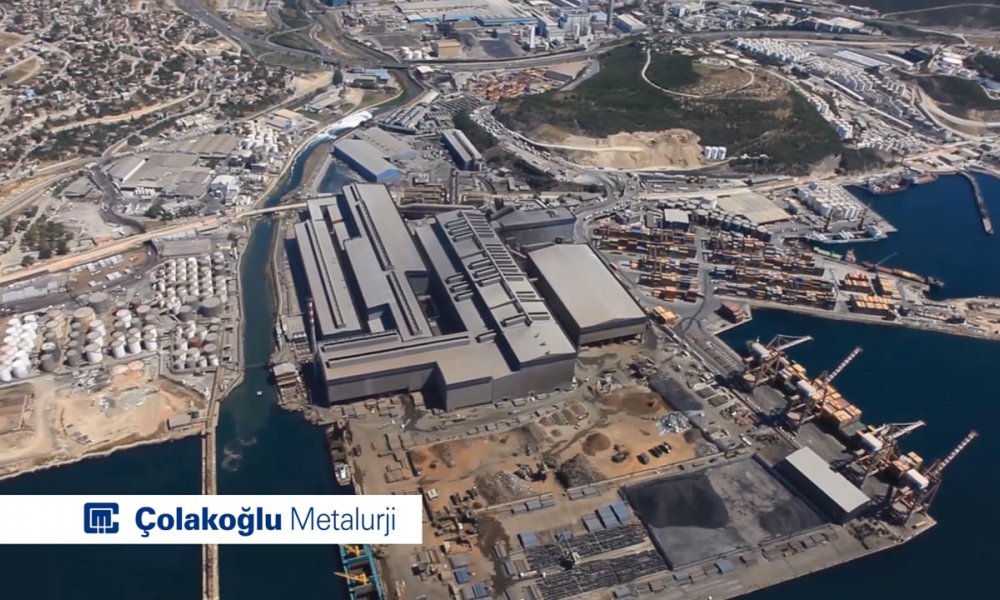
Çolakoğlu focuses on AI-supported sustainable steelmaking projects
Large Turkish steelmaker Çolakoğlu Metalurji has focused on artificial intelligence-supported sustainable production projects while increasing its renewable energy investments, Operations Director Ozgur Ozsoy said.
According to a July 5 statement from Çolakoğlu, citing Ozsoy’s comments to local magazine ST industry’s July edition, the company has new projects to reduce energy consumption and carbon emissions by using AI-connected digital solutions and new renewable energy investments.
“We have reached the final stage in our AI-supported process control project in our meltshop, which will ensure process stability in production,” Ozsoy said.
Çolakoğlu had achieved a heat size of 298.2 mt at its new vacuum degassing plant, Ozsoy said, adding that it has also reached a carbon content of 5 parts per million (ppm) after decarburization, a world record.
He did not, however, provide the company’s current carbon emission levels.
Çolakoğlu is currently able to produce special steels like IF grades, ULC grades and stainless steel at its plant.
Colakoglu commissioned its second reheating furnace in June to increase its hot-rolling capacity and meet demand more effectively.
The company currently has a bar output capacity of 1 million mt/year and an HRC production capacity of 4.5 million mt/year.
Platts, part of S&P Global Commodity Insights, assessed Turkish domestic HRC at $585/mt EXW on June 28, down 18.2% since the start of 2024.

European HRC prices lack clear direction despite positive producer sentiment
Many European mills have started aiming for higher HRC spot prices, trying to take advantage of the limited availability of cheap imports due to the implementation of new EU safeguard measures on July 1, Fastmarkets understands.
In the HRC market, the major change was the addition of a 15% per-country cap in relation to access to residual HRC quotas, which is expected to lead to a reduction in import volumes under the “other countries” category of around 1.0-1.5 million tonnes.
Vietnam, Japan, Taiwan, and Egypt have previously been the principal suppliers of HRC to the EU under the “other countries” category, with the Asian suppliers offering the most competitive prices.
“It is almost impossible now to get an offer from Vietnam, Taiwan or Japan,” a buyer source told Fastmarkets.
Mills in Northern Europe therefore started to add €10-20 ($11-22) per tonne for July/August delivery HRC, with offer prices reaching €640-650 per tonne ex-works.
“The mills in Northern Europe are in a slightly better position now, with order books a little bit fuller,” a second buyer source told Fastmarkets, adding that customers who previously bought from “third countries” were now getting higher offer prices than regular customers.
It is yet to be seen if buyers will accept the higher offers, sources said.
Market participants estimated the workable level for HRC in Northern Europe at €620-640 per tonne ex-works on Tuesday.
Fastmarkets calculated its daily steel hot-rolled coil index domestic, exw Northern Europe at €633.13 on Tuesday, down by €0.62 per tonne from €633.75 per tonne on Monday.
The index was up by €4.38 per tonne week on week but down by €0.62 per tonne month on month.
Some market participants told Fastmarkets they expect to see even higher offer levels for September-delivery material.
One seller source told Fastmarkets that, given that prospect, many customers might decide to accept the current higher offers – although they also reported that buying activity was currently limited, with most customers in “wait-and-see” mode.
But the first buyer source told Fastmarkets that the economic situation in Europe had yet to improve and said demand for flat steel products “remains soft.”
In Southern Europe, Fastmarkets calculated its daily steel hot-rolled coil index domestic, exw Italy at €628.33 per tonne on Tuesday, up by €2.08 per tonne from €626.25 per tonne on Monday.
The index was up by €8.33 per tonne week on week, but down by €4.58 per tonne month on month.
In Italy, sources said that HRC was on offer at €640-650 per tonne delivered, which nets back to €630-640 per tonne ex-works.
However, trading remained quiet.
Market participants estimated the workable market level at about €620-640 per tonne ex-works.
Published by: Darina Kahramanova


Blastr chooses Primetals and Midrex for greenfield mill
Blastr Green Steel has selected Primetals Technologies as its technology partner for the planned steel plant in Inkoo, Finland, which will produce 2.5 million tonnes/year of ultra-low-CO2 steel.
The partnership encompasses the design of a direct reduced iron plant, an electric steelmaking melt shop, an Arvedi ESP line, and a continuous pickling and galvanizing line. Primetals will develop the up to 100% hydrogen-based DRI plant in collaboration with Midrex Technologies.
The Midrex H2TM plant, powered by up to 100% green hydrogen, will produce hot DRI for direct charging, as well as hot-briquetted iron, enabling Blastr to provide iron feedstock for customers.
Primetals will be responsible for the full electrics and automation, including advanced automation systems and solutions for optimised production management. “The production process will be optimised with digitalisation, enhanced use of robot technology, and advanced solutions for remote control,” says Andreas Viehboeck, head of Upstream Technologies at Primetals.
The secondary metallurgy equipment, consisting of a ladle furnace and an RH vacuum degasser, will enable Blastr to produce top-quality steel grades for the automotive sector, among other industries, Kallanish understands. In addition, Primetals will provide a system to treat off-gases and a plant to recover waste heat for the electric steel plant, ensuring energy is reused efficiently.
Christian Koehl Germany

Outokumpu appoints Kati ter Horst as CEO
Outokumpu has appointed Kati ter Horst as president and chief executive, with effect from 9 October at the latest.
She will be located in Outokumpu’s headquarters in Helsinki, Kallanish learns. She joins Outokumpu from Belgian company Aliaxis, a leading fluid management systems company, where she has held the position of divisional ceo for the EMEA region since 2022.
Kati ter Horst has already been a member of the Outokumpu board of directors since 2016 and vice chairman since 2022. Following her appointment, she will resign from the board at the end of September 2024.
“Kati ter Horst has a strong track record in process industries and extensive international leadership experience from complex business environments. Outokumpu’s board of directors is confident that she is the right person to lead the company ahead,” says Kari Jordan, chairman of the board.
On 2 May, Outokumpu announced that incumbent ceo Heikki Malinen had decided to leave the steelmaker to pursue a career opportunity elsewhere.
Christian Koehl Germany

US steel associations applaud introduction of ‘Prove It’ Act
Two US domestic steel associations are supporting this week’s congressional introduction of the so-called “Prove It” Act, which would verify the carbon intensity of steel from various sources, Kallanish learns from association statements.
The American Iron and Steel Institute (AISI) and the Steel Manufacturers Association (SMA) applaud the formal introduction of the “Providing Reliable, Objective, Verifiable Emissions Intensity and Transparency Act” to the US House of Representatives on 9 July.
The Prove It Act authorises a comprehensive study by the Department of Energy to compare the greenhouse gas (GHG) emission intensities of certain goods, including steel, produced in the US to those produced internationally. The study is expected to provide detailed, specific and transparent data on emissions to assess the environmental standards of foreignly produced products.
AISI president and chairman Kevin Dempsey explains that passing the Prove It Act protects US domestic steel producers and their investments in emissions-reduction efforts.
“The Prove It Act would do as its name implies by creating an official source to verify the superior carbon efficiency of vital American industries, like steel, and give policymakers the data needed to make the case for action,” states Dempsey.
Dempsey notes that US steel producers are at a disadvantage when inexpensive foreign products with fewer GHG restrictions are permitted to be sold in the US.
“Trade-distorting policies in many countries continue to contribute to massive global overcapacity in steel, much of which is from countries that are producing steel that is much more carbon emissions-intensive than American steel, including China, India, Indonesia and other Southeast Asian nations,” Dempsey mentions.
SMA president Philip Bell applauds the effort by both major political parties to bring the legislation to the US House.
“SMA supports the bipartisan Prove It Act because we know that it will demonstrate conclusively that American steel has the lowest carbon emissions in the world. A US Department of Energy study determining the emissions intensity of domestically produced goods will show the world that American steelmakers have a significant carbon advantage over their counterparts in Europe, Asia, the Middle East and everywhere steel is made. We look forward to working with Congress to make sure we get the best bill possible,” states Bell.
Republican Representative John Curtis of Utah and Democratic Representative Scott Peters of California introduced the Prove It Act to the US House of Representatives. Earlier this year, Republican Senator Kevin Cramer of North Dakota and Democratic Senator Chris Coons of Deleware introduced the bill in the US Senate Environment and Public Works Committee (see Kallanish 16 May).
Kristen DiLandro USA