


Free trade agreement between Turkey and Ukraine comes into force
The Free Trade Agreement signed between Turkey and Ukraine Feb. 3 has come into force with a presidential decree published in Turkey’s official gazette Aug. 2.
According to the Turkish Trade Ministry’s official fact sheet on the agreement, some customs duties imposed on Turkish goods by Ukraine will now be removed, while other customs duties would be removed following a transition period.
Turkey will also remove customs duties on imports of Ukraine-origin agricultural and industrial products.
“It has been decided to apply tax reductions and tax reductions within the scope of quotas for some agricultural and iron and steel products that are sensitive for our country, and some products have been excluded from the scope of the agreement, taking into account sectoral sensitivities,” the Turkish Trade Ministry said.
More details are expected from the ministry in the coming days.
Ukraine’s Ministry of Economy previously said Turkey would set a zero import duty on 510 of 840 metallurgical products with the free trade agreement. Import duties at lowered rates would also apply to another 130 products.
To facilitate development of the domestic metallurgical sector, Ukraine, however, reserved the right to charge customs duty on scrap metals exports, the Ukrainian ministry noted.
Turkey’s finished and semi-finished steel and ferrous scrap imports all declined substantially following the start of the Ukraine-Russia war.
Platts, part of S&P Global Commodity Insights, assessed Turkish imports of premium heavy melting scrap 1/2 (80:20) at $386/mt CFR Aug. 1, down $2/mt on the day.


European HRC prices soften amid subdued market
European domestic hot-rolled coil prices softened Aug. 2 as the week closed with subdued market activity and sluggish demand.
“There is very little activity,” a mill source said. “Customers are not interested in booking significant tonnages.”
“Prices [remain] stable at lower levels,” a second mill source said.
Demand for material remains low due to high inventory levels, sources said. They added that customers are re-stocking as per requirements, and are actively avoiding building up inventory, especially as the summer holiday season is in full swing.
“Customers have enough material to cover the rest of the year,” a distributor source said. “Customers will re-stock as required without building inventory.”
“Most [market participants] in Germany are closed,” a third mill source said.
Platts assessed Northwest European HRC at Eur615/mt ex-works Ruhr Aug. 2, down Eur5 from Aug. 1.
Tradable values were reported at Eur610-630/mt EXW Ruhr, with one tradable value reported at Eur600-620/mt EXW Northwest Europe. Offers were reported at Eur640-660/mt EXW Ruhr.
Meanwhile, Platts assessed domestic HRC prices in Southern Europe at Eur615/mt EXW Italy Aug. 2, down Eur5 on the day.
Offers were reported at Eur630/mt EXW Italy. Tradable values were reported at Eur600-620/mt EXW Italy, while tradable values for larger tonnages were reported at Eur590-600/mt EXW Italy.

Italian plate producers seek increases
Italian heavy plate producers are increasing prices by €30/tonne ($32) compared to last month for S275 and S355 grades. Sources tell Kallanish the market is quiet due to the sector’s August hiatus.
Local re-rollers are requesting €700/t ex-works for S275 grade and approximately €730-740/t for S355. Last month, they made significant efforts to lower their prices, resulting in import offers no longer being competitive.
According to a mill source, prices have hit rock bottom and are expected to rise in upcoming contracts. Given the current cost of production and imported slab values, it is evident that July contract prices are not sustainable for producers, as they are operating with minimal profit margins. Certain producers are starting to reject selling at the low levels seen in July.
During July, customers of all sizes showed a reluctance to make purchases, and sales volumes have been consistent but low. Various buyers took advantage of competitive import prices in June, resulting in a decline in local sales volumes. Last month, the cost of Asia-origin material was at around €600-620/t cfr Italy.
According to information from distributors, there is a continued stagnation in demand downstream. The current booking price for Asian slab is at approximately $550/t cfr Italy. However, for larger volumes, there are discussions about a slightly lower price of $540/t cfr. As of now, domestic S275 grade transactions are taking place at approximately €650-660/t ex-works in Italy. S355 is meanwhile being traded at around €680/t, sources suggest.
Natalia Capra France

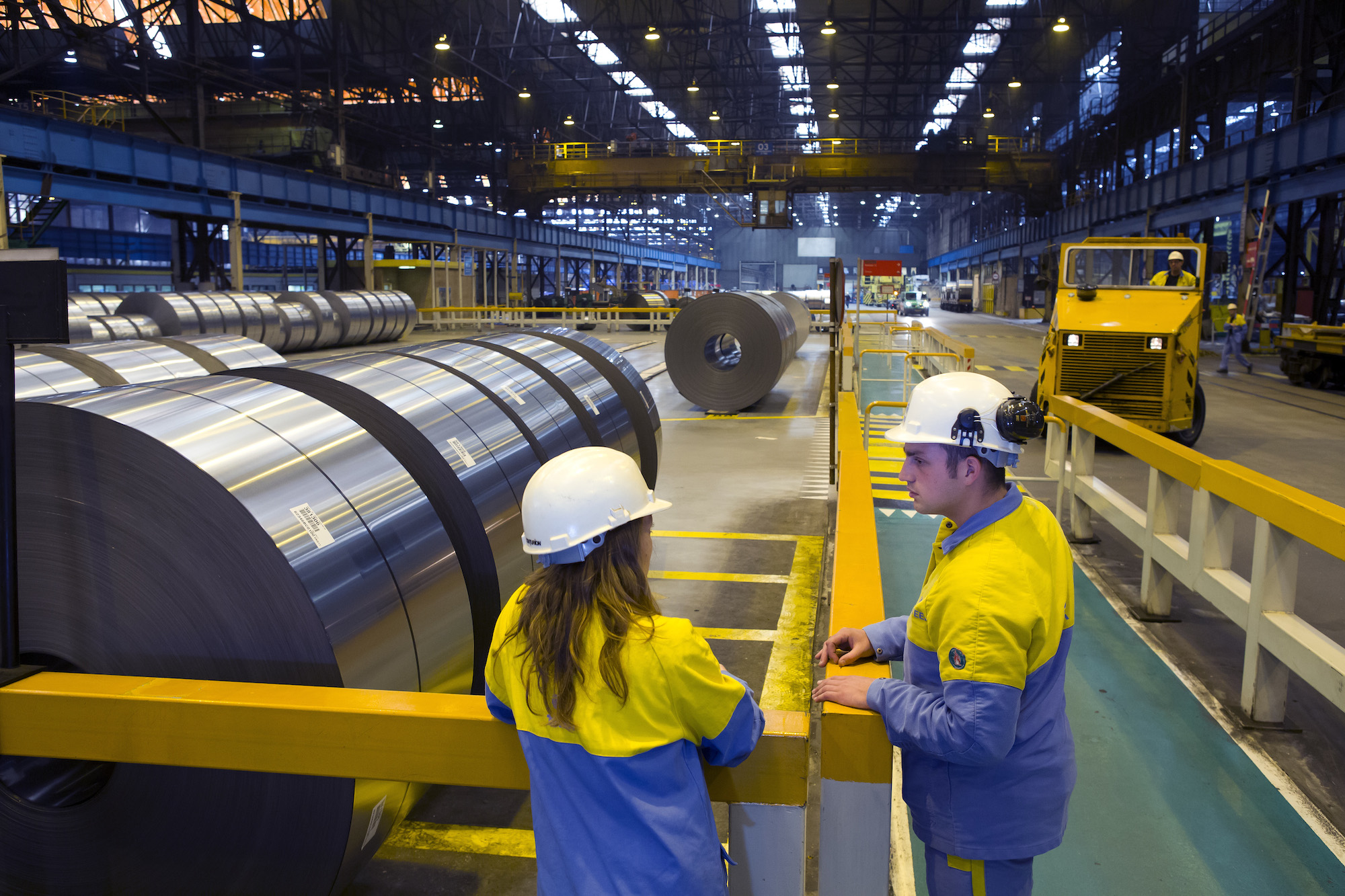
Tata Netherlands profitability improves, UK sees stock buildup
Tata Steel Netherlands reported dramatically improved profitability in the June quarter, despite higher raw material cost, while production and deliveries also rose, Kallanish notes.
Deliveries rose 7% on-year and 3% on-quarter to 1.47 million tonnes after the reline of BF6 was completed. Liquid steel output rose 80% from a year earlier and was up 14% on the March quarter to 1.69mt.
Revenue fell 6% from a year earlier but rose 2% on-quarter to INR 14,167 crores ($1.69 billion), while raw material cost was higher on increased coking coal and iron ore consumption cost. Change in inventories was negative on stock build-up during the quarter.
Ebitda was nevertheless at positive INR 453 crores versus losses each a year and quarter earlier, thanks to the stabilisation of operations.
EU steel spot spreads witnessed a decline exceeding 10% during the quarter, Tata Steel says in a presentation. EU steel demand was subdued, with construction and machinery being adversely impacted by high interest rates. Steel imports remained high and led to the European Commission extending safeguards with additional measures.
At Tata Steel UK, deliveries and profitability declined in the June quarter, while raw material cost increased significantly.
Deliveries fell 9% on-year and were flat on-quarter at 680,000t, while liquid steel production slumped 20% from the previous year to 680,000t, but this was up 3% on-quarter.
Revenue fell 12% on-year and was flat on-quarter at INR 6,810 crores ($813 million), while raw material cost surged over 30% in each case due to increased purchases of finished and semi-finished goods. The decline in change in inventories deepened. Ebitda loss more than doubled on-year and on-quarter to INR 955 crores.
Given the planned closure of blast furnaces in the UK, there was a steel stock build-up for the downstream operations which impacted working capital, says Tata Steel chief financial officer Koushik Chatterjee. “We are proceeding as per previously announced timelines for the closure of the [Port Talbot] heavy end,” he adds. “We are working closely with the recently elected UK government on finalisation of grant funding process for the new electric arc furnace project.”
Tata closed blast furnace no.5 at Port Talbot in early July and plans to close BF4 by end-September.
Adam Smith Poland

ArcelorMittal Europe boosts shipments but selling prices slump
ArcelorMittal Europe steel shipments grew 4% on-year in the second quarter to 7.4 million tonnes, driven by a 7% jump in long steel deliveries, Kallanish notes.
On-quarter, flat steel sales fell, but longs deliveries surged 14%, ensuring 2% overall shipments growth.
Crude steel production surged 18% on-year to 8.04mt, also up 6% versus the previous quarter.
Average steel selling price dropped 11% on-year and 2% on-quarter to $929/tonne. Despite higher volumes, therefore, sales fell 10% on-year to $7.8 billion in Q2, although this was flat on-quarter.
Operating income more than halved on-year to $194 million. However, it rose on-quarter as lower costs more than offset lower average steel selling prices, while shipments grew. Ebitda, at $462m, followed a similar trend.
The firm said European steel prices were at below marginal cost in Q2, impacted by excess Chinese capacity resulting in “aggressive” exports from the country.
ArcelorMittal Europe’s first-half-of-2024 shipments inched down 1% on-year to 14.7mt, although crude steel output grew 8% to 15.6mt. Sales fell 12% to $15.7 billion and operating income dropped 65% to $263m.
Europe saw continued real demand deterioration, with weakness across most end-use markets. In January-May, light vehicle assembly was down 3.3% on-year, manufacturing output down 3.4% and machinery output down 6.9%, the steelmaker points out.
ArcelorMittal has lowered its apparent flat steel demand growth forecast for Europe in 2024 to 0-2%, down from the previous 2-4% forecast.
Adam Smith Poland

EPCG completes tk Steel stake acquisition
Germany’s thyssenkrupp says it has completed the sale of 20% of its thyssenkrupp Steel Europe division to Czech energy company EP Corporate Group (EPCG), Kallanish notes.
The transaction had previously been approved by both the supervisory board of thyssenkrupp AG and all relevant authorities. The closing “is an important step towards the independence of the steel business and a resilient, cost-efficient and climate-friendly steel production,” says thyssenkrupp chief executive Miguel López.
From the side of the buyer company, EPCG board member Jiří Nováček says that “as EPCG, we will contribute our transformation expertise to the benefit of thyssenkrupp Steel.”
The parties are already discussing the acquisition of a further 30% stake in thyssenkrupp’s steel business by EPCG. The aim is to form an equal 50/50 joint venture.
Christian Koehl Germany

German mechanical engineering orders fall 12%
Orders for German mechanical engineering and plant-building companies declined in the first half of 2024 by 12% on-year in real terms, according to industry association VDMA.
Domestic orders fell especially harshly, by 18%. Foreign orders fell by 9%, with euro countries falling more sharply (-14%), and non-euro countries by 7%. In June alone, the trend continued, with orders down 9% year-on-year. Domestic orders fell 8%, while orders from abroad dropped 10%, with euro countries down 12% and non-euro countries down 8%.
VDMA traditionally states its comparison in “real terms”. While nominal terms compare the straight sales figures, VDMA deducts the price inflation for a more comparable basis. “This year, the difference from prices was not that much at +2%, while last year it was +9%,” VDMA chief economist Ralph Wiechers informs Kallanish.
He explains that the calculations try to consider increases in intake materials and services, and to what extent they can be handed down. He also points out that the trend is currently opposite in China, which is seeing deflation and a decline in prices because of high inventories. He also mentions lower steel prices due to subsidisation in China.
“The order situation is disappointing overall,” Wiechers writes in VDMA’s statement on the figures. “A turnaround is not yet in sight, and what’s more, the economic stabilisation that was still emerging at the beginning of the year has recently suffered a setback,” he continues. In this context, he demands a supply-oriented policy for more investment and innovation, “to ensure that the first signs of a foreign-driven cyclical recovery are not thwarted”.
Christian Koehl Germany

Polish steel rebar prices inch downward on low demand, oversupply
Fastmarkets’ weekly price assessment for steel reinforcing bar (rebar), domestic, cpt Poland, was 2,680-2,730 zloty ($674-686) per tonne on Friday, widening downward by 20 zloty per tonne from 2,700-2,730 zloty per tonne the previous week.
Polish mills were heard to be hoping to achieve 2,750 zloty per tonne CPT, but lower offers at 2,700 zloty per tonne CPT were available in the market this week, sources told Fastmarkets.
Market participants estimated the tradeable market price at 2,680-2,730 zloty per tonne CPT.
According to some sources, even lower prices at 2,600-2,650 zloty per tonne could be achieved for large volumes exceeding 1,000 tonnes. But these were not included in this week’s assessment because they were not in line with Fastmarkets’ methodology.
“Demand [in Poland] is currently… moderate, but there is oversupply in the market, and that is why the prices are going down,” a distributor source told Fastmarkets.
According to a second distributor source, only the cut-and-bend sector in Poland was performing well at the moment, but demand in general remained low.
A producer source agreed that demand for rebar in the Polish market remained comparatively low, with the summer holiday period also having an effect.
“No significant changes are expected in August,” the producer source added.
In terms of any future developments in Polish rebar prices, the first distributor source said that, in summer, even significant price decreases would not revive the market.
“I am afraid that in September, when mills come back to the market, and demand is still not so good, there could be more price decreases,” the first distributor source said.
The same source added that more significant funding from the EU for infrastructure projects, which could eventually support the local demand for rebar, would come no earlier than next year.
In terms of imports, offers of rebar from Germany were heard at €625-635 ($675-686) per tonne CPT.
Ukrainian material was offered to Poland at €570-580 per tonne DAP border, sources told Fastmarkets.
Kametstal to offer new rebar grade to Polish market
Kametstal, a subsidiary of Ukrainian steel producer Metinvest, has received international compliance certificate No. 020-UWB-3057/W, which will allow it to supply B500B rebar in diameters of 8-32mm to the Polish market, the company has announced. The certificate will be valid until 2028.
This means that Kametstal will be able to expand its product portfolio in Poland.
According to Fastmarkets’ sources, the first volumes of this material have already been traded in the Polish market.


US Steel Kosice to idle one blast furnace in August
“In August, we have a planned shutdown of one of the blast furnaces due to maintenance work,” the spokesperson told Fastmarkets.
USSK has three blast furnaces with a combined capacity of around 4.5 million tonnes per year of pig iron. All three are operational, the spokesperson said.
The company produces hot-rolled, cold-rolled and hot-dipped galvanized coil.
BF No2 at Kosice steelworks was idled for a planned maintenance in March and resumed operations in June, Fastmarkets reported.
The spokesperson did not specify which BF will be shut down this time and for how long.
“The subsequent production configuration depends on the development of market conditions. In any case, we will meet the requirements of our customers to the maximum extent,” the spokesperson said.
European flat steel market down in 2024
Economic environment in the European flat steel market, where USSK is active, has been deteriorating in the past months, with steel prices under pressure.
In February, Fastmarkets’ steel hot-rolled coil index domestic, exw Northern Europe averaged €738.28 ($797.42) per tonne ex-works.
In March, the monthly average slipped to €691.99 per tonne ex-works, and prices continued to decline in April to an average €638.32 per tonne ex-works.
Since May, HRC prices in Europe have been largely stable, despite steelmakers’ attempts to push for higher offers.
The monthly average in July was €629.12 per tonne ex-works, and the latest calculation of Fastmarkets’ daily Northern European HRC index was €620.74 per tonne on Thursday.
Industry sources have been describing the European flat steel market as “heavily oversupplied,” and suggested that more steel output cuts might follow in the fourth quarter of 2024.
“If real steel demand doesn’t pick up [in September], we might see tumbling prices in end-2024,” a steel distributor in Norther Europe said.
“European mills have already been faced with a similar situation last year and reacted with massive steel output cuts in end-2023, maybe we will see similar scenario this year,” he added.