


EUROMETAL contributes to high-level European Commission Dialogue on Environmental Assessments and Permitting
At the invitation of Commissioner Jessika Roswall, European Commissioner for Environment, Water Resilience and a Competitive Circular Economy, EUROMETAL took part in a high-level Implementation Dialogue on Environmental Assessments and Permitting.
The event convened key institutional and industry stakeholders to explore how to improve environmental permitting processes across the EU, with a focus on efficiency, predictability, and alignment with Europe’s green and industrial objectives.
Representing EUROMETAL, President Alexander Julius shared insights from Europe’s steel distribution, processing, and manufacturing sectors, emphasising that streamlined environmental assessments and permitting are critical not only for large industrial projects, but also for enabling innovation and investment across the wider manufacturing ecosystem.
The dialogue highlighted key challenges faced by EUROMETAL members, including fragmented procedures, limited administrative coordination, delays in grid connection approvals, and a shortage of qualified environmental professionals. These issues were further illustrated through concrete member experiences submitted ahead of the event.
In response, EUROMETAL presented a set of strategic recommendations to the European Commission, aimed at modernising and harmonising permitting frameworks, promoting digital tools, clarifying end-of-waste criteria, and aligning procedures with the EU Taxonomy for sustainable investment.
In her concluding remarks, Commissioner Roswall outlined the Commission’s priorities for reform, including better access to data, improved administrative capacity, process digitisation, clearer EU-level guidance, and stronger public engagement. She reaffirmed the EU’s commitment to continuously improving permitting procedures in support of environmental protection and industrial competitiveness.
EUROMETAL remains fully committed to working with EU institutions and Member States to ensure that permitting processes become a strategic enabler of Europe’s green and industrial transitions, not a bottleneck.


President von der Leyen issues statement on US Tariffs Pause
European Commission President Ursula von der Leyen issued a statement today following U.S. President Trump’s decision to pause reciprocal tariffs — a move she described as “an important step towards stabilising the global economy.”
President von der Leyen stressed the importance of clear and predictable trade conditions for the functioning of global supply chains, reiterating that “tariffs are taxes that only hurt businesses and consumers.” She reaffirmed her ongoing support for a zero-for-zero tariff agreement between the European Union and the United States, aimed at restoring balance and certainty to transatlantic trade.
In her statement, von der Leyen confirmed the EU’s commitment to constructive negotiations with the United States to achieve frictionless and mutually beneficial trade, while also underscoring the need to diversify trade partnerships. The EU continues to deepen its engagement with countries representing 87% of global trade, based on shared values of open, rules-based commerce.
These points reflect concerns raised by EUROMETAL and other industry stakeholders during recent consultations with the Commission, where the risks of escalating trade barriers — particularly in the steel, aluminium, and derivatives sectors — were clearly highlighted.
President von der Leyen concluded by stating: “My team and I will continue to work day and night to protect European consumers, workers and businesses. Together, Europeans will emerge stronger from this crisis.”
The statement reinforces a shared vision for open trade, strategic autonomy, and long-term industrial resilience in Europe.
Statement by President von der Leyen on US tariffs

UK steel service centre Malcolm Clarke to close
Manchester-based steel service centre Malcolm Clarke will close by summer this year, the company said in a letter to customers and suppliers.
The company said any existing and new orders will be fulfilled in full and on time, ahead of its target closure date of June 2025. The closure may be slightly later than this date after its “orderly winding down”, the company said. Suppliers will be paid before the closure, it added.
Malcolm Clarke in its financial results to June 2024, published on 2 April, announced that it would cease trading, so its accounts had been prepared “on a basis other than going concern”.
“The business environment in which we operate has become increasingly unstable, with unpredictable shifts in market and regulation making it very challenging for small- to medium-sized participants in the day-to-day spot market,” the company told Argus.
“Despite our best efforts to adapt and evolve, we do not envisage a short- to medium-term future where the situation is likely to improve significantly,” it added, suggesting changes to the market were structural and permanent.
The business, which was incorporated in September 1970, has two heavy decoiling lines and also sells reversing mill plate.

Source: argusmedia.com

Trump eases, delays most ‘reciprocal’ tariffs, supersizes China’s
US President Donald Trump has pulled back his so-called “reciprocal” tariffs to 10% for most countries, whilst increasing the amount charged to China to 125%, Kallanish learns from a Trump social media post.
The latest adjustments, unveiled on Wednesday afternoon, pause higher reciprocal tariffs for 90 days on countries that have not directly retaliated against the US.
“More than 75 countries have called Representatives of the United States, including the Departments of Commerce, Treasury, and the USTR, to negotiate a solution to the subjects being discussed relative to Trade, Trade Barriers, Tariffs, Currency Manipulation, and Non Monetary Tariffs, and that these countries have not, at my strong suggestion, retaliated in any way, shape, or form against the United States, I have authorized a 90 day PAUSE, and a substantially lowered reciprocal tariff during this period, of 10%, also effective immediately,” Trump announces in his message.
The tariff increase on imports from China to 125% is also effectively immediately. Earlier in the day, China had announced a boost in its tariff on US-origin imports, raising the levy to 84% from 34% (see separate story).
“China is the most imbalanced economy in the history of the modern world, and they are the biggest source of the US trade problem, and indeed, they are a problem for the rest of the world,” states US treasury secretary Scott Bessent.
Canada and Mexico are still subject to a 25% tariff on goods that do not comply with the United States-Mexico-Canada Agreement as well as the 25% tariffs on steel, aluminium and foreign autos.
“The world is ready to work with President Trump to fix global trade, and China has chosen the opposite direction,” US commerce secretary Howard Lutnick adds.


Deutsche Bahn hesitates over low-emission rail sourcing
Deutsche Bahn (DB) has been slow with its offtake of low-emission steel rail or even to buy any notable tonnages so far. Germany is lagging behind other European countries such as France, Austria, Belgium in terms of sustainable steel procurement for transport infrastructure, says Saarstal Acoval and Saarstahl Rail chief executive Nadine Artelt.
The latter unit of German steelmaker Saarstahl secured in February a significant contract valued at €1 billion ($1.1 billion) to supply railway operator SNCF with low-emission rail over six years.
A similar deal with Deutsche Bahn is not within sight, Kallanish heard from Artelt during a discussion panel at the Zukunft Stahl conference in Essen in March. Deutsche Bahn has an “enormous demand” for rails that she says is similar to that of SNCF, between 180,000-200,000 tonnes/year. “Still, starting talks was much easier in France and Austria,” she noted.
DB’s head of sustainability, Max-Christian Lange, conceded during the discussion that DB has not made the decisive move forward in this respect, despite its defined target to become climate neutral by 2040.
DB tenders for suppliers are preceded by discussions with its main owner, the German state. Lange alluded that talks at this level proceed sluggishly. With a view to sourcing CO2-reduced steels, therefore, “at the moment we at DB are still only in a position of a future supporter of the cause.”
Saarstahl Rail has an annual output of 400,000 tonnes of steel producing a variety of rail profiles, including vignoles, switches, grooved rails and rail tracks.

Van Leeuwen reports profit despite weak market
Dutch pipe distributor Royal Van Leeuwen posted positive 2024 performance despite difficult market conditions, Kallanish learns.
Market volumes in 2024 were at a lower level compared to the previous year and prices continued to decrease throughout the year, the company notes. However, revenue in the energy segment was strong due to several large projects in Europe and Asia.
Overall revenue amounted to €1.3 billion ($1.76 billion) versus €1.6 billion in 2023. Operating result amounted to €22 million, down from €60m, and the net result was €14m, down from €43m.
Project activity in the energy market was at a good level, Van Leeuwen notes, and it booked various large contracts worldwide. This included the supply of material for the ethane cracker in the port of Antwerp.
Several investments aimed at improving storage capacity and productivity were completed last year. The company commissioned a monorail system at its main site in Zwijndrecht. At 315 meters in length, it is the largest pipe sorting centre in the world, Van Leeuwen claims.
On 9 April, Peter Rietberg stepped down as chairman of the management board, to be succeeded by Joop Sassen, who has been with the company since 1992.
The firm has 70 branches spread across 32 countries throughout Europe, the Middle East, Asia, Australia, and North America, with 2,250 employees.

EU origin rule could reshape trade, impact Turkey
If implemented by the EU, the “melted and poured” rule would mark a departure from existing trade flows, posing serious challenges for Turkish processors and global supply chains, Fabrizio Di Gianni said at this week’s EUROMETAL Steel Day and 10th YISAD Flat Steel Conference in Istanbul attended by Kallanish.
The EU is considering a shift to a “melted and poured” regime, where origin is linked to where the steel was first melted. In this case, steel melted in China and later transformed in Turkey would still be considered Chinese for trade defence purposes.
Traditionally, origin has been based on the last substantial transformation – for example, if Chinese hot rolled coil was processed in Turkey, the final product would be considered Turkish.
On the sidelines of the conference, a market participant said: “If this measure is implemented, targeting Chinese-origin inputs, it could reshape trade flows and force Turkish slab and HRC buyers to rethink their sourcing strategies. This could be the next black swan event – we need to watch closely, as it may come before year-end.”
The introduction of the “melted and poured” rule would aim to more accurately trace the true origin of steel products. While current anti-dumping and anti-subsidy measures apply to direct imports, they can be circumvented by routing semi-finished goods through third countries. These goods undergo further processing before being shipped to the EU, thereby avoiding trade duties.
The European Commission wants to close this loophole and strengthen trade defence tools. If applied, the new rule would remove the possibility of altering a product’s origin through minimal processing and provide clearer traceability. The goal is to ensure that duties apply based on the actual source of steel production – especially when that source benefits from non-market conditions and excess capacity that distort global trade.
Meanwhile, a trading source noted that with existing uncertainty over increasing global tariffs, anti-dumping measures, and EU tariff-rate quotas on finished steel, demand for semi-finished products like slab and billet is rising. “We’re preparing for increased semis intake into the EU,” the source said, noting that preference will likely shift towards electric arc furnace semis, especially with CBAM enforcement beginning in the EU in 2026.
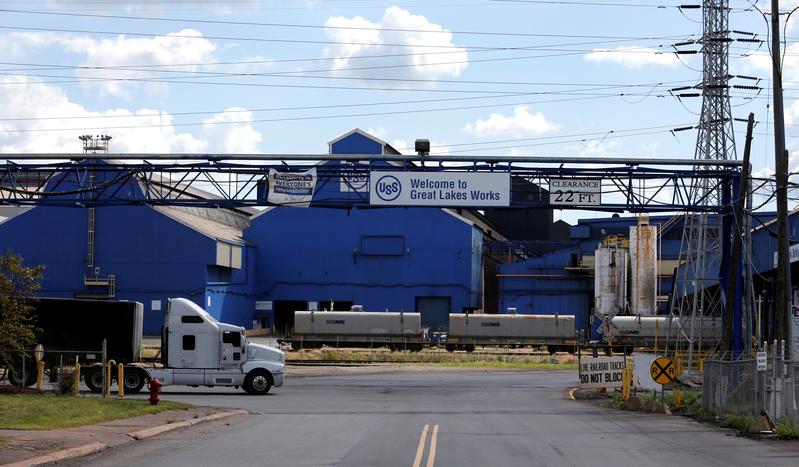
Trump gives sale of US Steel to Nippon Steel a second chance
US President Donald Trump has ordered the Committee on Foreign Investment in the United States (CFIUS) to conduct a new review of the bid submitted by Japanese steelmaker Nippon Steel to acquire US Steel, according to a statement released by the White House.
Accordingly, CFIUS will begin a fresh and confidential review to identify potential national security risks in relation to the transaction and to provide the opportunity to the parties to respond to such concerns. Also, it will help Trump determine whether further action in this matter is appropriate.
As SteelOrbis reported previously, the first lawsuit filed by the companies back in January this year had accused former US President Joe Biden of ignoring the rule of law to please the United Steelworkers (USW) union and to support his political agenda, and of influencing CFIUS to advance his political agenda, which resulted in a biased process depriving Nippon Steel and US Steel of their rightful opportunity for fair consideration.


EUROMETAL & YISAD Conference: Steel service centers need investments to keep up with competition
During the panel moderated by SteelOrbis general manager Murat Eryılmaz at the fourth session of the Eurometal Steel Day & YISAD Flat Steel Conference held at Istanbul Marriott Hotel Asia on Tuesday, April 8, in cooperation with SteelOrbis, the role of steel service centers in the flat steel trade was discussed.
Stating that production in Europe has changed due to the increase in costs resulting from the energy crisis that started with Russia’s invasion of Ukraine, Alexander Julius, president of EUROMETAL, said that investments in many segments in Europe, especially green transformation, have decreased. He emphasized that the reason that 2024 was a bad year is actually the developments in previous years such as pandemic and war between Ukraine and Russia.
Regarding the role of steel service centers, Alexander Julius stated that steel producers and steel service centers should work in synchrony to create a complete value and supply chain. The EUROMETAL president said that, with this value and supply chain, customers with emission targets would be able to follow the emission values and quality of products.

Next, Uğur Usta, deputy general manager of UMS Metal, stated that 2024 was a year of losses due to falling steel prices, Turkey’s economic outlook, high interest rates and the shrinking demand in Europe. He went on to say that producers could not conclude sales easily and could not achieve profit margins when selling. Regarding the rest of 2025, he noted that the dynamics of the market have changed with Donald Trump’s new taxes and that it is not possible for these taxes to be sustainable. He predicted that, even if demand is not high, prices will no longer fall below a certain level. Stating that the Asia-Pacific region is in first place in terms of overall capacity of steel service center services, followed by the EU, the Americas and the Middle East, Usta said that the revenues of steel service centers reached $350 billion by the end of 2024 and is expected to reach $450 billion within the next 10 years. In addition, he stated that steel service centers in Turkey need to invest in value-added products in order to compete with major producers.
Kaan Sarnıç, sales director at Yücel Group, stated that 2023 was not too bad in terms of budgets and profits, but that he could not say the same for 2024, noting that energy and labor costs increased during the year, while dollar-based product prices fell due to exchange rate fluctuations, and the steel sector suffered losses. Pointing out that steel service centers in Europe make money from processing rather than materials, however this is not the case in Turkey, Mr. Sarnıç stated that the availability of commercial quality products and therefore competition are high, and that steel service centers in Turkey must stock materials of varying qualities to overcome competitive disadvantages.
Evaluating last year, Mehmet Ali Fincan, general manager at Yametaş Flat Metal Products, commented that 2024 was not an easy year as China, which has insufficient local demand, continued to export in every segment, while there was a slowdown in the EU, Turkey experienced economic difficulties, and costs increased. Regarding the advantage of working with a steel service center, Fincan stated that various services can be provided from a single source, and that this saves time and costs for buyers. Regarding the difficulties faced by steel service centers, which provide a competitive advantage thanks to their flexible structure as well as stock and logistics management, Fincan highlighted that fluctuations in raw material prices, increasing costs and price pressure affect competition, and that steel service centers need to stay up-to-date in terms of technology and continue their investments given the competition in the market.

Trump offers 90-day pause on tariffs to 75 nations willing to negotiate
US President Donald Trump offered a 90-day pause in previously announced tariff rates for 75 nations that offered to negotiate with the US to lower tariffs and remove other obstacles facing US exporters, according to an announcement on the president’s social media on Wednesday April 9.
The US imposed tariffs on all trading nations on April 2, a day called “Liberation Day” by Trump, in a negotiating strategy designed to give the US “maxmum leverage” and bring trading partners to the negotiating table, Treasury Secretary Scott Bessent said in a press event following the announcement.
The temporary pause in the tariff rates was provided because several nations offered to negotiate and because trade negotiations “take time,” and the US wants to give each nation the time needed to find a “bespoke” solution, Bessent said.
Participating nations will have temporary tariffs of 10 percent placed on them, effective immediately — substantially lower than the tariff rates announced a week earlier.
In the same social media post announcing the tariff pause, Trump raised the US’ total tariffs on China to 125%, after China imposed a second retaliatory tariff.
“China will realize that the days of ripping off the USA and other countries is no longer sustainable or acceptable,” Trump wrote.
Bessent echoed the president’s view, stating, “China is the most imbalanced economy in the history of the modern world, and they are the biggest source of US trade problems and, indeed, they are problems for the rest of the world.”
China’s neighboring countries have been among the earliest and most determined to seek negotiations, Bessent said, with talks beginning with Vietnam on Wednesday to be followed by talks with Japan, South Korea and India.
The trade talks may also address other matters, including potential collaboration with the US on investing in a potential liquid natural gas (LNG) project in Alaska that could supply gas to South Korea, Japan and Taiwan.
The US’ Section 232 tariffs on steel and aluminium, as well as automotive tariffs, are not part of the trade talks, Bessent said.
“That’s going to remain,” he said.
