


ArcelorMittal Poland completes ZAM coil coating line
ArcelorMittal Poland (AMP) has completed adding a new line for zinc, aluminium and magnesium (ZAM) coil coating at the galvanizing plant no.2 of its Krakow cold rolling mill, Kallanish notes. Production will begin after obtaining certification and approval in 2026.
The project was first announced in 2024 (see Kallanish passim).
The “Optigal” coating gives better plasticity and corrosion resistance than existing alloys, being a perfect fit for sandwich panels and corrugated sheet, the steelmaker says.
“As part of this project, we built two new galvanizing tanks as well as a transport and lifting system for them. Currently, one tank, with a capacity of 200 tonnes, is galvanizing sheet metal using the existing alloy, while the other – 180t – is galvanizing using the new Optigal alloy,” explains Wojciech Fras, project manager for the galvanizing plant modernisation.
The main contractor for the investment was Spanish company GHI.
“Our recent investments in Nowa Huta [Krakow mill] demonstrate that we consider Krakow to be one of the pillars of our processing operations. Despite the many challenges in the global steel market, we have already invested nearly PLN 2.7 billion [$742.6 million] in our two rolling mills,” notes AMP chief executive Wojciech Koszuta.
Earlier this year, the firm commissioned nine hydrogen batch annealing furnaces at its cold rolling mill in Krakow, which have eliminated ammonia from the annealing process. It is also building a natural gas-based hydrogen plant at its Krakow site to feed the two galvanizing lines at the location. The PLN 100m plant, being set up by Linde, will see hydrogen production begin at the end of 2026.
However, last month it announced it will close its Chorzow-based plant, otherwise known as Huta Krolewska, by year-end. Despite the unit producing specialised products, the funds required to modernise the outdated equipment make it economically unviable to continue operations in the current European steel industry climate, the firm noted.

Minister eyes 4mt ADI run-rate by March
Acciaierie d’Italia (ADI)’s maintenance programme aims to restore a 4 million tonnes/year production run rate by next March, Italian Minister of Enterprises and Made in Italy Adolfo Urso said during a meeting in Rome last week. He met with local authorities including the Puglia Region, the cities of Taranto and Statte, the Province of Taranto.
The focus of the meeting was the industrial relaunch of the site that may include non-steel production related investment projects.
The minister informed regional and local authorities about the discussions initiated in recent months “with major industrial players that have expressed interest in investing in the Taranto area,” the ministry says in a note obtained by Kallanish.
The initial assessment identified more than 15 potential investment projects – in the sectors of advanced manufacturing, energy, logistics, digital technologies, and agri-industry. Employment impact would be primarily directed at the workforce of the former Ilva and its related supply chain.
“These projects and their employment effects will be further examined with the region and local entities in a dedicated technical working group to be convened shortly,” the ministry adds.
The investments may be located in various areas including portions of the former Ilva plant no longer in use for steel production, including 140 hectares immediately available and 30 requiring remediation, 210 hectares of port authority land under concession and 240 not under concession. Also included are decommissioned or soon-to-be-decommissioned military land amounting to over 350 hectares; as well as 2,000 industrial hectares already available. No timeline for these potential projects was provided.
Urso however reiterated that the decarbonisation process remains a priority. No increase is envisaged in the number of workers placed under redundancy schemes or training programmes. The production continuity of the northern ex-Ilva sites will be ensured exclusively through the supply of coils from the Taranto plant.
According to an informed source, the government is merely buying time, and the long-term plan for the former Ilva site is its permanent closure. Restarting the blast furnaces to reach 4mt of output would increase emissions, a prospect strongly opposed by local authorities, who have consistently pushed for shutting down the Taranto facility.
On the sale process, multiple sources say there is no genuine interest from any buyer willing to invest billions into ADI, particularly at a time when steel consumption in Europe is expected to continue declining.

Hilco seeks FNSteel longs mill equipment buyer
The wire rod & bar-in-coil rolling mill belonging to Dutch company FNsteel has been put up for sale by Hilco Industrial, the selling firm informs Kallanish.
The mill was supplied originally in 1965 and has since undergone numerous upgrades, with involvement from Danieli, SMS and Primetals, among others. It was fully operational until it was mothballed in July this year.
With documented production of up to 500,000 tonnes/year and recent technology upgrades completed in 2024, the facility offers a dual-line configuration covering a 5.5-30mm diameter range. Its control systems feature recently upgraded motors, drives, and quality measurement technology, Hilco says. It can handle cold heading, bearing steels, tool steels, spring steels, free cutting steels, welding, and PC steels.
“The mill system offers buyers a strategic pathway to enter or expand in high-demand wire rod and bar-in-coil markets,” Hilco says.
FNSteel was bought last month by Germany’s Saarstahl, following its purchase in 2017 by British Steel (see Kallanish passim).
Author: Christian Koehl Germany


Thyssenkrupp, Salzgitter conduct tense HKM stake sale talks
Talks between Salzgitter and thyssenkrupp about their respective participation in Duisburg mill Hüttenwerke Krupp-Mannesmann (HKM) continue amid tensions, thyssenkrupp chief executive Miguel López told journalists during the group’s annual press conference on Tuesday.
The principal positions appear clear in so far that thyssenkrupp Steel wants to pull out of HKM, while Salzgitter could potentially become the sole owner. A critical point of contention seems to be a lawsuit brought by Salzgitter against thyssenkrupp currently at an arbitration court. The procedure was revealed by a journalist and not denied by López, who however refused to comment on or explain the case, which reportedly concerns a claim of around €1.6 billion ($1.9 billion).
“Legal procedures are certainly not helpful along the way” as thyssenkrupp is interested in advancing the talks towards a solution, he said during the conference monitored by Kallanish.
HKM is owned by thyssenkrupp Steel for a 50% stake, Salzgitter at 30%, and Vallourec at 20%. The French group has been meaning to withdraw for some years, but a solution between the three owners is yet to be found.
In the case that thyssenkrupp transfers its stake to Salzgitter, it would not end its commitment immediately, but participate in restructuring measures. To that purpose, it has built up reserves in the lower three-digit million range, executives said.
Author: Christian Koehl Germany
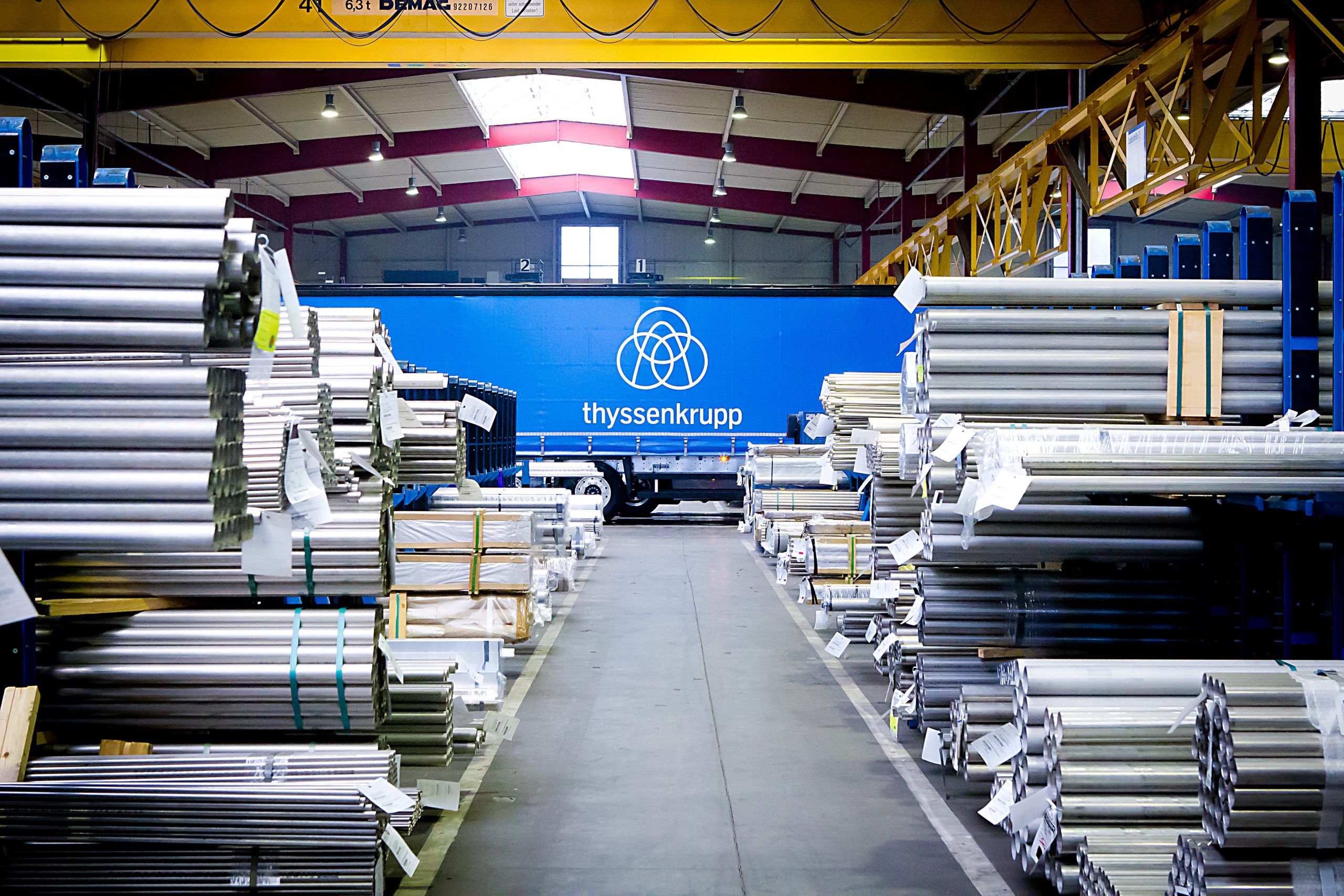
Thyssenkrupp Steel ‘good fit’ for Jindal, says López
Thyssenkrupp group chief executive Miguel López remains upbeat on the prospect of tk’s Steel division being bought by Jindal group.
During the German group’s annual press conference on Tuesday, López confirmed Jindal is currently carrying out due diligence, examining thyssenkrupp Steel’s financial structure and contracts in depth. Some two weeks ago, thyssenkrupp was still reluctant to confirm the due diligence when it was rumoured in the press.
Other than the previous buyer candidate for tk Steel, the Czech EP group, López pointed out that Jindal “is a true professional in steel”, including mining assets, so that it covers the entire production chain. Jindal would therefore be a good fit for tk Steel, just as tk Steel would be a good fit for Jindal.
After Mittal and Tata, Jindal would be the next Indian player to take over a major traditional European steelmaker. “Jindal is not active in Europe yet. So it [tk Steel] is an attractive object,” López said during the conference monitored by Kallanish. He noted that Jindal has pledged to continue tk Steel’s project of building a DRI plant in Duisburg, which he said complements Jindal’s own project of a DRI plant in Oman.
One point not yet clear, and questioned by attending journalists, is if Jindal is aiming for a full or only partial acquisition. The negotiations for now “are targeting a takeover of the majority”, said executive Volkmar Dinstuhl, who is in charge of mergers & acquisitions. “What majority means will show as we go along,” he added.
Dinstuhl was also confronted with the detail that the bidder for tk Steel is not the actual Jindal Steel mill group, but Jindal Steel International, a unit based in Mauritius. Observers have already expressed scepticism if a complex structure with little financial transparency can be trusted. Dinstuhl described it as “a warrantor company that is a backup for the company that wants to make an acquisition”.

Assofermet pushes EU for transitional CBAM exemptions
Italian steel traders association Assofermet is calling on the European Commission to rethink the current CBAM framework, warning that the mechanism risks generating severe disruption for EU industry.
In a letter addressed to commission vice-president for prosperity and industrial strategy Stéphane Séjourné and trade and economic security commissioner Maroš Šefčovič, the association urges the adoption of transitional measures. These proposals have already been submitted to Italy’s foreign affairs ministry (MAECI) and the Ministry of Enterprises and Made in Italy (MIMIT). Such measures are needed to ensure a fair and workable CBAM rollout and to “avoid serious repercussions on the EU economy,” states Assofermet’s note, seen by Kallanish.
Assofermet is specifically requesting a temporary exemption from CBAM certificate purchases for all steel imports cleared from 1 January 2026 until five months after the publication of the final Benchmark and Default Value parameters.
The association highlights the situation of uncertainty currently affecting trade, distribution and first steel processing sectors “due to the absence of final parameters for calculating CBAM costs (Benchmarks and Default Values), which will likely be published only in the first quarter of 2026. This lack of information prevents operators… from assessing the actual cost of supplies to be delivered in 2026, as the related CBAM charges will only become known in February 2027,” Assofermet continues.
The assocation further contends that the lack of clarity creates market instability forcing companies to operate “in the dark,” with potentially significant economic consequences for the entire European steel, aluminium and manufacturing supply chain.
Assofermet reiterates its readiness to cooperate with European and national institutions so that the transition to the new regulatory mechanisms is effective, gradual, and consistent with the needs of the European production system.
European coil and semi-finished steel importers are waiting for clarification of the CBAM parameters outlined in the leaked European Commission document circulating the market last week. As the calculation criteria stand, sources say it remains difficult to determine the real cost of importing, particularly because the figures currently available are default values. If importers can demonstrate actual values, those should apply instead, one source notes.
Another market participant estimates that CBAM costs for material from “virtuous” or relatively low-emission producers could be €30-60/tonne, depending on the source. Large buyers are now working closely with their third-country suppliers, effectively “training” them on how to report every element of their production process. Asian mills must provide responsible, and above all verifiable, data for all production phases, starting with energy use and energy type (see Kallanish 24 November).

Worthington Steel, Klöckner confirm takeover talks
Steel distributor Klöckner & Co SE has revealed that it is in negotiations with US company Worthington Steel regarding a voluntary public takeover offer for Klöckner.
In an as-hoc announcement on the weekend, German-based Klöckner said it confirms rumours to that effect. Worthington Steel has made progress to the point that it is in the phase of conducting a due diligence review, Klöckner states.
In a subsequent statement of its own, Worthington Steel confirms the negotiations, noting that no investment decision has been made. The Columbus, Ohio-based processor says the discussions may not necessarily result in a transaction, and that it would not comment further.
The news is surprising as Klöckner over the years has carried out numerous acquisitions and spin-offs, but has never been an object for a takeover itself. Klöckner is Germany’s only stock-market listed steel distributor, with annual revenue of more than €6 billion ($7 billion), achieved with activities in Germany, Switzerland and the US. The tonnage it handles has become slimmer over the years, from some 6 million tonnes/year before 2020, and less than 5m t/y nowadays.
This may be partly caused by economic fluctuation, but is largely a consequence of the group’s efforts to move from pure tonnage and commodities into processing and value-added services. It has made various investment, divestments, and acquisitions to that effect in the recent years especially in the US (see Kallanish passim).
This of course fits fine with Worthington’s activities in carbon flat-roll steel processing, electrical steel laminations and tailor welded solutions. The company has approximately 6,000 employees, and highlights its value-added processing capabilities including galvanizing, pickling, configured blanking, specialty cold reduction, lightweighting and electrical lamination. Worthington Steel operates 37 facilities in seven states and ten countries.

German associations warn against EU’s ‘scrap patriotism’
Three German associations have addressed a joint letter to European regulators in protest of prospective export restrictions on steel and metal scrap, Kallanish reports.
Germany’s Association of Steel Recycling and Waste Management Companies (BDSV), the Association of German Metal Traders and Recyclers (VDM), and the Federal Association for Secondary Raw Materials and Waste Management (bvse) include a detailed legal opinion on economic and competition law. The recipient is Teresa Ribera, executive vice-president of the European Commission and Commissioner for Competition..
In the corresponence, the associations frame the export curbs under discussion in Brussels as a massive intervention in functioning recycling markets – with significant risks for climate protection, the circular economy and investments.
The criticism focuses, amongst other things, on the new Waste Shipment Regulation, the Critical Raw Materials Act, and the European Steel and Metals Action Plan. From the associations’ perspective, these initiatives amount to politically restricting or effectively preventing scrap exports to third countries.
“Here, they’re pretending that structural and cost problems in the primary steel industry can be solved by restricting the sales markets of the recycling industry, even though there’s no shortage of scrap metal at all. It’s simply an attempt to drive down market prices,” says BDSV managing director Guido Lipinski. “Anyone who over-regulates functioning scrap markets not only endangers thousands of medium-sized businesses but also risks destroying a functioning circular economy. That would do significantly more harm than good to the European steel industry.”
The German and European steel and metal recycling sector is a key industry for the decarbonisation of manufacturing: In the EU, around 59% of steel production already comes from recycled scrap
“Of all companies, those that have been practicing genuine circular economy principles for decades are now supposed to pay the price for short-sighted industrial policy,” bvse managing director Eric Rehbock contends. “Instead of expanding recycling capacities, Brussels is sending the signal that investments in modern processing and sorting technology are a risk because markets can be shut down politically at any time. That is the opposite of a secure future for the transformation.”
The associations warn against misusing export restrictions as a seemingly simple solution to the competitive problems of individual industries.
“What is needed are reliable and investment-friendly framework conditions to enable additional recycling capacities, higher quality products and innovative technologies – especially in light of the transformation towards ‘green steel’,” they claim.
The three associations appeal to the European Commission to give significantly greater consideration to the interests of the recycling industry in the ongoing proceedings and to refrain from market-shielding export bans or de facto export restrictions.

European domestic HRC prices decrease slightly, market awaits new regulations
According to sources, the market still awaits more clarity on impending regulations, including the EU’s Carbon Border Adjustment Mechanism (CBAM), which is set to enter its definitive phase on January 1.
In Northern Europe, estimates of workable prices for HRC were heard around €610 ($709) per tonne ex-works.
No deals were reported during the day.
Fastmarkets’ daily steel hot-rolled coil index domestic, exw Northern Europe was calculated at €619.58 per tonne on Wednesday, down by €3.23 per tonne from €622.81 per tonne on Tuesday December 9.
The index was up by €2.08 per tonne week on week and by €9.58 per tonne month on month.
In Italy, estimates of workable prices were heard within the range of €600-610 per tonne ex-works. No fresh deals were heard.
Fastmarkets’ daily steel hot-rolled coil index domestic, exw Italy was calculated at €612 per tonne on Wednesday, down by €1.75 per tonne from €613.75 per tonne on Tuesday.
The index was up by €11.17 per tonne week on week and by €15.75 per tonne month on month.
