

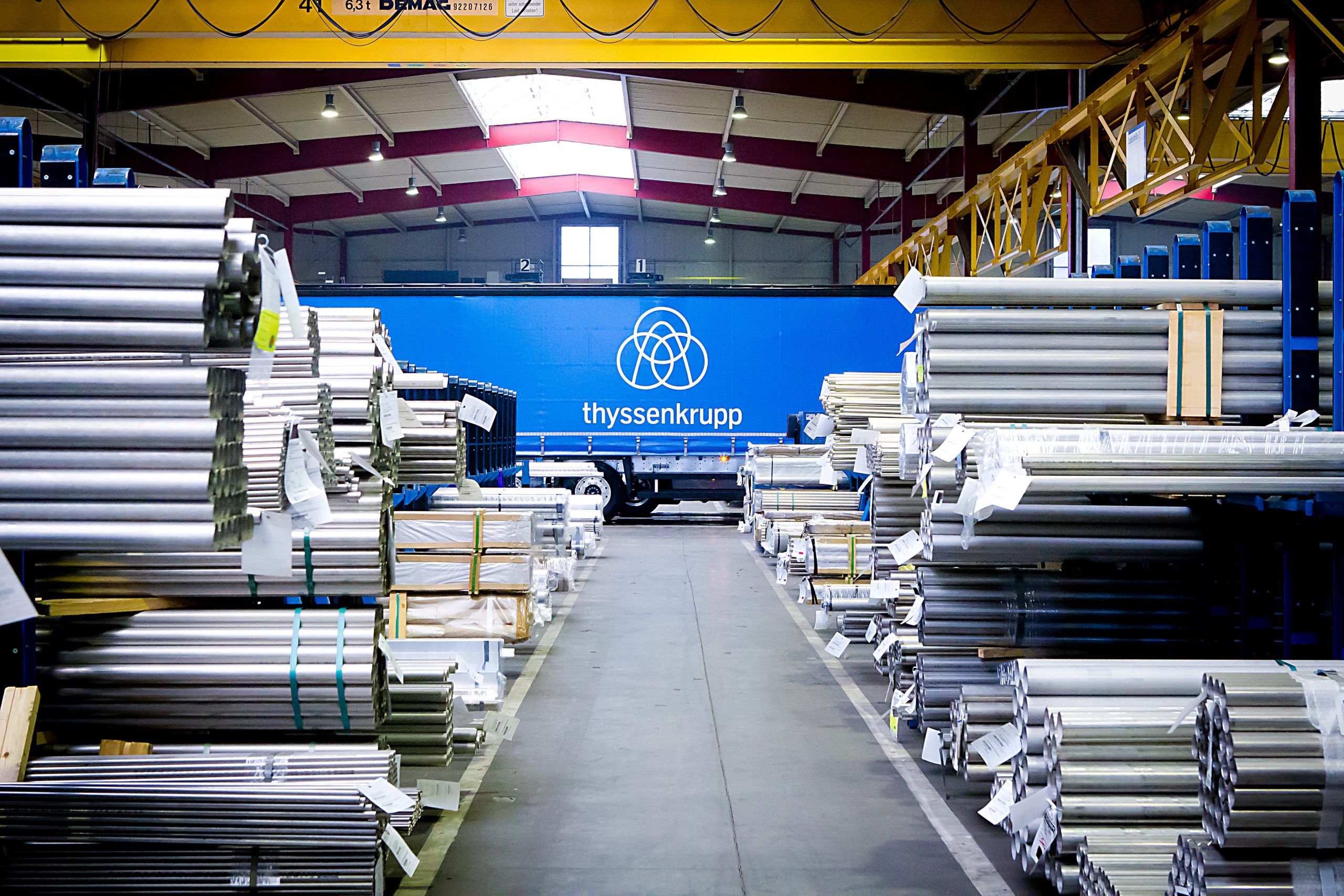
Thyssenkrupp invests into DR feedstock research
As part of its transformation towards climate-neutral steel production, thyssenkrupp Steel is upgrading the testing laboratory at its Duisburg-Schwelgern site to study iron ore feedstock for direct reduction.
The metallurgical laboratory in Schwelgern already has extensive testing capacity for traditional blast furnace feedstocks such as sinter, iron ore pellets, lump ore, and blast furnace coke. To meet the new requirements of hydrogen-based direct reduction, the existing laboratory is now being expanded, the company states.
While blast furnaces are characterised by CO-rich process gases and temperatures well above 1,000 degrees Celsius, the direct reduction process operates with hydrogen-rich gases at temperatures of around 1,000 degrees Celsius or lower.
The pellets and lump ore used must therefore be tested in accordance with ISO standards for direct reduction processes, tk Steel explains. The focus is on their stability under direct reduction conditions, Kallanish understands. Among other things, tests examine whether they tend to stick or agglomerate during reduction, how strongly they tend to break down during reduction, and how well they can be reduced.
The test atmosphere of the new test facilities is modelled on future operating conditions: while blast furnaces currently contain only about 2% hydrogen in the process gas, the direct reduction route is already being tested with around 45% hydrogen during natural gas operation, tk Steel notes.
The upgrade contract has been awarded to Heat & Power, which has already designed and built a pilot plant for sinter production at tk Steel. The contract has a value of €2.4 million ($2.8m).


Benteler expands tubes production
Benteler group is pursuing further investment at its location in Paderborn, Germany, Kallanish hears from the maker of tubes and automotive components.
The group is lining up approximately €17 million (20m) for expansion of tube manufacturing at the Schloss Neuhaus plant in Paderborn. It is thereby responding to rising demand for seamless and welded steel tubes, particularly from the automotive industry, it says.
“With this investment, we are strategically expanding our capacities for seamless and cold-drawn tubes – especially for automotive applications such as airbag tubes and rotor shafts,” says Thomas Michels, chief operating officer of Benteler’s Steel/Tube division. He adds the expansion will increase production capacity at the site by around 15%.
The investment includes a completely new production line for drawn tubes with a drawbench, expanded heat treatment capacity, plus a combined straightening, testing, and sawing system. The line, to be commissioned at end-May, will be complemented by systems for quality control, preservation, and packaging, In addition, capacities for sawing short tube sections will be expanded.
The expansion will create 30 new jobs at Schloss Neuhaus. Currently some 1,100 employees at the site make around 160,000 tonnes/year of tube, which equals roughly 250,000 tube units per day.
Benteler’s Steel/Tube division performed “significantly better” in 2025 than in the preceding year, improving its adjusted earnings to €162 million, up from €116m. Stable demand in the energy sector as well as positive momentum in the North American business for tubes for the oil and gas industry supported performance, Benteler notes.
Together with the much larger Automotive division, the group lifted its operating profit by 8% to €641m, on revenue that remained roughly on par year-on-year at €8.1 billion.

Defence sector deserves closer attention in Europe: conference
Steel for military defence, safety and protection is gaining in importance against the backdrop of warfare, especially in Ukraine, European representatives stated at the recent Zukunft Stahl conference, attended by Kallanish.
Amid the ongoing war in Ukraine, Western Europe “sports an attitude that is more relaxed than I deem adequate,” said Matthias Puschnig, colonel at Germany’s armed forces, and representative of the Defence Ministry.
Puschnig made the comments during a panel focused on steel for safety, along with speakers from SSAB, Salzgitter AG and defence technology supplier Rheinmetall.
On the army’s requirement for steel, he said “the thinner it is, the lower the weight, the better.”
He cited SSAB ceo Johnny Sjöström, who remarked in his presentation that “speed matters in war”.
Sjöström gave the example of Finnish-made tanks that save several tonnes in weight, and reach a speed of 100km/hour. He also noted that the capacities for thinner plate with the necessary microstructure are limited in Europe, and that “there is not a single army vehicle in Europe” without SSAB steel.
Meanwhile, Mirko Loos, vice president at Europe’s largest producer of military technology, Rheinmetall, underlined that his company will keep sourcing its steels domestically.
“We shun the risk of sourcing steel from far outside Europe,” he said. He noted that the technology is not an easy one, and that he had to reject approaches from makers of automotive parts trying to jump the line. “There is a wave building up, and many things are changing at present,” he said.
Another company increasing its activities in defence steels with several approvals received last year is Salzgitter, represented at the debate by Thorsten Gintaut, managing director of plate mill Grobblechwerke der Salzgitter.
In terms of volume and sales, defence makes only a one-digit percentage of the German steelmaker’s business, “and will remain a niche market”.
However, it is the one sector of application with tangible growth potential, “and we can participate in that – with plate, with components, and by means of external acquisition”.
At a separate event, Salzgitter ceo Gunnar Groebler said during the company’s annual press conference that he was astonished by the quick pace at which certain approvals for military purposes were granted last year.
For these activities, he said: “2026 for us will be a year of transition and test supplies; the volumes will follow in 2027.”

Increasing circumvention undermines steel trade measures: OECD
Trade cases are delivering results against record high Chinese steel exports but their effectiveness is being undermined by growing circumvention activity, the OECD Steel Committee concluded after its 99th session this week.
Although global steel demand is set to recover in 2026, except for China, meanwhile, the extent of the impact of the current conflict in the Middle East on global steel markets is highly uncertain.
In 2025, a total of 75 antidumping and countervailing duty investigations were initiated against China, and the stock of steel AD/CVD measures climbed higher.
However, significant transhipment activity has been identified between China and some Southeast Asian countries of steel subject to trade measures taken by OECD countries.
“Exporters are increasingly resorting to a widening range of circumvention techniques … including by slightly modifying the products, by investing in steel plants abroad to change the origin of the steel, and by exporting steel in the form of steel-intensive downstream products that are not subject to the trade measures,” the Committee notes in a statement seen by Kallanish.
Market-distorting subsidies also remain a challenge. The median Chinese firm received 15 times more subsidies relative to its asset size than a median firm elsewhere, compared to ten times more in previous years. Moreover, China’s steel subsidy rate has nearly doubled since 2019, the Committee continues.
“Capacity swap programmes to replace BF-BOF with EAF and other low-emission technologies are not delivering the expected net capacity reductions, as new low-emission capacity is being added without equivalent retirement of existing capacity,” it adds.
Excess capacity increased to 640 million tonnes in 2025, exceeding total OECD steel production by more than 200mt.
Meeting delegates welcomed Global Forum on Steel Excess Capacity efforts to develop the key elements of a comprehensive framework for joint action by June 2026 and additional steps to help combat and address the problems associated with global excess capacity. These include enhanced monitoring of non-market policies and practices and building capabilities to enhance import monitoring and address circumvention.

EU parliament approves US trade deal with strict safeguards
The European Parliament voted in favor of implementing the trade agreement reached last year between the EU and the US, but with amendments contingent on Washington’s compliance.
In a plenary vote March 26, the EU assembly adopted by 417 votes in favor and 154 against, with 71 abstentions. MEPs approved conditional tariff reductions on US industrial goods, agricultural products and seafood, setting strict safeguards that could suspend the deal if Washington imposes new duties on EU exports.
The so-called suspension clause could be activated if the US “undermined the objectives of the deal, discriminated against EU economic operators, threatened member states’ territorial integrity, foreign and defense policies, or engaged in economic coercion”, as reported in the MEPs’ statement and underlined in the press conference.
The framework eliminates most tariffs on US industrial goods while granting preferential access for American farm products and seafood, following the July 2025 Turnberry agreement between US President Donald Trump and European Commission President Ursula von der Leyen.
Metals provisions
Under a “sunrise clause” introduced by members of the European Parliament, tariff preferences only take effect if the US reduces duties on EU products with steel and aluminum content below 50% to a maximum 15%. For products exceeding 50% steel and aluminum content, EU tariff preferences on US exports of steel, aluminum and derivative products would cease six months after the regulation’s implementation unless Washington cuts its tariffs to 15% or below.
In steel, the effects of the US tariffs on EU steel applied since March (25%) and June (50%) had a further destructive impact on the sector that was already hit by the effects of global steel overcapacity. According a report by Eurofer, the European steel association, the largest surpluses for EU finished steel exports in 2025 were recorded with the US at 165,000 mt per month, albeit much lower than 2024 when it stood at 219,000 mt/month.
Safeguard mechanism
The parliament strengthened suspension mechanisms allowing the European Commission to withdraw trade preferences if the US imposes additional tariffs exceeding the 15% ceiling or introduces new duties on EU goods. A safeguard provision enables suspension of new tariffs if US imports rise 10% or more for specific product groups, threatening EU industry.
The regulation expires March 31, 2028, requiring a new legislative proposal and impact assessment for extension. Rapporteur Bernd Lange said parliament would only support the deal with “very strong and clear safeguards” after full US compliance.
Energy trade
US and EU leaders also agreed to significantly boost energy trade as part of the deal discussions last summer. The EU pledged to purchase $750 billion in US energy resources — including LNG, oil and nuclear resources — through 2028.
Analysts have widely described the headline figure as unrealistically high. The European Commission has also stressed that private companies, rather than Brussels, drive the commercial decisions behind added trade.
Market watchers have therefore interpreted the energy commitment more as a signal of the EU’s intention to deepen energy ties with the US, rather than a binding pledge.
LNG has become a particular linchpin of EU-US energy relations, with the US growing into the EU’s dominant supplier amid the continent’s pivot away from Russian natural gas. In 2025, it shipped some 57% of the EU’s imports of the superchilled fuel, or about 60 million metric tons, according to data from S&P Global Energy CERA.
That was the first time on record the EU sourced over 50% of its annual LNG volumes from one country.
European leaders, however, have grown increasingly queasy over the continent’s reliance on overseas energy suppliers, doubling down in recent weeks on a desire to boost domestic energy production amid the trade disruptions from the war in the Middle East.
Time frame
Negotiations with EU member states on final legislation begin immediately.
Parliament halted ratification last month after the US Supreme Court declared some of Trump’s so-called reciprocal global tariffs illegal.
The process had already been delayed by Trump’s threat to impose tariffs on European countries in a dispute over Greenland.
A spokesperson for the European Parliament said the trade deal could be signed “before the summer as a realistic expectation.”
Author: Annalisa Villa, Matt Hoisch

New technology could cut steel production costs 20%, Hertha CEO says
Hertha Metals has developed a new technology that it says can replace traditional coal-based steelmaking. To that end, the sustainable steel startup is preparing to break ground on a new plantagainst a backdrop of rising support for domestic steelmaking capacity.
Hertha was founded in 2022 by CEO Laureen Meroueh, who invented the company’s technology, which enables single-step steel and high-purity iron production. The process, yet to be commercially proven at scale, uses any grade of domestic iron ore to produce steel that’s more than 20% cheaper with 50% fewer emissions than traditional steelmaking methods,according to the company.
Hertha will break ground on a 10,000 metric ton/year plant in July, located next to its operating Texas pilot plant. It will be operational by the end of next year, Meroueh said.
Meroueh spoke to Platts, part of S&P Global Energy, on March 26 at the CERAWeek by S&P Global energy conference in Houston. The following is an edited transcript of the conversation.
Platts: Can you describe this new technology and how it works?
Laureen Meroueh: Our technology is within one furnace, which is continuously charged and semi-continuously tapped. You’re charging iron ore and what comes out is a refined liquid iron or steel.
We realized that at scale, you need really efficient heating and melting. Electric arc furnaces already exist at scale. We use them every single day to recycle our scrap steel. They’re very efficient in heat transfer, and so we have no issue with heating in the steel industry. What we have a challenge with is being able to process any grade of iron ore in any form.
Today, to make steel, you first have to sinter or pelletize the iron ore and it has to be of a certain grade, which results in a large reservoir of iron ore in our grounds that is unusable.
We need to be able to leverage abundant resources that the world has, and therefore, we looked at how do we make a system work with any form in any grade. That’s how we realized doing everything in the molten phase is the most efficient.
How do you compete economically with this technology?
We can produce steel that’s more than 20% cheaper than the incumbent process. That is not true for other leading innovations. We are one of a handful of startups working on this problem and it is a very important problem to solve — reintroducing competitiveness and the sustainability in primary steelmaking.
Hertha’s whole game is we want to have a negative green premium, because we are in a commodity industry, and the only way you’re going to really take market share in steel production is through price. That’s the only way the billions in capital investment already in the ground are going to eventually switch over to this cleaner technology.
How do you see tariffs impacting the steel market and the work you’re doing?
Steel is more than just a commodity. Steel is a matter of national security. The production of steel is a signal of economic strength. There’s far more to it than just, “We’ll import the cheapest steel available.” We have to be able to make steel domestically and so these tariffs are a protectionist measure to allow the industry to continue to thrive domestically.
You have countries that are selling steel at a loss. China, for the last two years, has been selling up and down at negative margins. How can any steel mill compete with steel that’s being sold at a loss? I can do as much as I want to lower the cost of production, but if you’re going to just keep lowering it and sell it at a loss, there’s nothing you can do.
Tariffs, to a degree, are necessary until countries stop overbuilding and then selling at less than the cost of production.
What kind of policy action could help support these innovative steelmaking efforts?
It is funding. Whether that’s funding through the form of loans, credit or debt financing, non-dilutive funding, or very large funding deals in exchange for equity.
There needs to be support for the innovators trying to make steel production more competitive due to the capital intensity. This is not a venture capital-style business. Who else will step up to ensure that the country you operate in is more competitive? It needs to be administrative support.
How do you see the steel market evolving in the next five to ten years?
Definitely increased domestic production. No doubt that we’re going to do whatever we can to increase domestic production. We already see announcements for new builds of iron-making facilities and restarting blast furnaces that were previously idled. Without a doubt, domestic production is going to increase.
On the innovation side, I’m not positive where it will go because we have some unfortunate examples out there for steel innovation. There have been a lot ofburns due to technologies not scaling — going 10 times over the budget when they get to scale. That’s why I’m really uneasy about the outlook of more innovation coming online until we have a success.
We’re working so hard to be that success story as soon as possible, to encourage investors that this can happen, and there are innovations in steel that can get to scale and be more cost-competitive. That’s what we’ll do.
Author: Rachel Looker

EU initiates GOES, transformer steel safeguarding investigation
The European Commission has initiated a safeguard investigation concerning imports of grain-oriented electrical steel (GOES), as well as transformer laminations and cores.
These products were not covered under the existing EU steel safeguard measures. Their inclusion in a new investigation marks a notable development in the evolution of EU trade defence policy.
Grain-oriented electrical steel is a critical input for the manufacturing of transformers and plays a key role in supporting Europe’s electrification and energy transition objectives. The investigation will assess whether increased imports are causing or threatening serious injury to EU producers.
European steel plate prices stable as cost pressures persist
This followed earlier increases driven by rising production costs for re-rollers.
Southern Europe
A producer reported local sales of plate in Italy at €760-770 ($875-886) per tonne ex-works, while most offers in the market were heard at €800 per tonne ex-works. These levels were broadly unchanged from offers of €750-800 per tonne ex-works reported a week earlier.
One trader reported lower prices of €720-750 per tonne ex-works on Monday. But according to the latest market trends, rising production costs for re-rollers, including higher natural gas costs and slab feedstock prices, have pushed workable plate prices up to around €750-760 per tonne across much of Europe.
Fastmarkets’ weekly price assessment for steel slab, import, cif Italy, was $550-580 per tonne on Thursday, widening upward by $20 per tonne from $550-560 per tonne a week earlier.
On March 19, Fastmarkets heard that some re-rollers could face production stoppages. When asked about this, a producer said that, in a worst-case scenario, some extended stoppages could occur in July-August, although this was not certain.
During the second quarter of 2026, mills will continue to use slab purchased at relatively low prices, the producer said, and the recent jump in slab prices was expected to be felt in the third quarter of the year. Supply shortages could also become an issue, particularly if the conflict involving Iran persists, the source said, because the country was a major exporter of slab to the Middle East, South Asia and Southeast Asia.
In addition, the upcoming reduction in EU import quotas for steel products could affect trade flows [LINK], market sources said, potentially lowering the volume of finished flat steel products imports from July onward.
But a second trader said that as long as energy remains available, production will continue, noting that most mills purchase energy through a mix of yearly, quarterly and floating contracts, which reduces the risk of production disruptions.
Fastmarkets’ weekly price assessment for steel domestic plate, 8-40mm, exw Southern Europe, was €750-770 per tonne on Thursday, unchanged week-on-week.
No new prices were heard for plate imports in Southern Europe during the week while market activity remained muted.
Japan was offering S235-grade material at €680 per tonne CFR to both Northern and Southern Europe on March 19, but no recent trading has been reported.
Fastmarkets’ weekly price assessment for steel plate (8-40mm), import, cfr main port Southern Europe, was €650-664 per tonne on Thursday, unchanged week on week.
Northern Europe
Prices for domestic plate in Northern Europe also remained stable during the week. The first trader reported an offer at €720-750 per tonne ex-works, adding that workable prices could vary by €15-20 per tonne. No significant new deals were heard.
Offers were reported at €800-830 per tonne ex-works on March 19, when a deal was also heard at €750-770 per tonne ex-works in Germany. Market sources said at the time that re-rollers in the country reacted to the rising production costs by raising their prices for plate.
Fastmarkets’ weekly price assessment for steel domestic plate, 8-40mm, exw Northern Europe, was €750-770 per tonne on Thursday, unchanged week-on-week.
The plate imports market in Northern Europe also remained quiet during the week. Import options were limited and costly on March 19, when Indian mills offered plate at €637-645 per tonne CFR Antwerp for June shipment.
Fastmarkets’ weekly price assessment for steel plate (8-40mm), import, cfr main port Northern Europe, was €637-650 per tonne on Thursday, unchanged week on week.


European green steel demand stalls as buyers resist premiums, spot activity dries up
Buyers across Europe have remained reluctant to pay significant premiums for low-carbon steel, pointing to weak market conditions and continuing structural challenges facing the region’s steel industry.
Under Fastmarkets’ definition, European green flat steel is steel made with combined Scope 1, 2 and 3 emissions of no more than 0.8 tonnes of CO2 equivalent per tonne of steel produced.
Scope 1 covers direct emissions from production, while 2 and 3 refer to indirect emissions linked to energy use and the wider value chain.
Market participants said premiums quoted by European mills capable of meeting that emissions threshold were generally in the range of €200-300 ($231-346) per tonne, broadly unchanged from recent months.
Discounts were possible for larger volumes, seller sources said, but no transactions were concluded in the assessment week.
According to seller sources, buyer interest exists at an initial stage, but resistance increases sharply once discussions turn to price, particularly when premiums move into the triple-digit range.
On the demand side, buyers continued to indicate lower workable levels, most commonly around €100-150 per tonne in the week to Thursday. Some market participants said spot business could be done at even less than €100 per tonne, with one source estimating the premium at €0 per tonne, arguing that premiums were more likely to be achieved through longer-term offtake deals rather than in the spot market.
Sell-side estimates for realistic premiums on green flat steel were reported at €150-170 per tonne.
Against that backdrop, Fastmarkets’ weekly assessment for the green steel domestic, flat-rolled, differential to HRC index, exw Northern Europe was €100-170 per tonne on March 26, narrowing from €100-180 per tonne in the previous week.
In contrast, sentiment in the long steel segment was described as even weaker, with market sources reporting almost no appetite for paying extra for greener products.
One supplier said customers were unwilling to pay any premium at all for green long steel, noting that the company’s conventional long products were already widely viewed as low emission because they are made via electric-arc furnace routes supported by relatively clean power mixes in the countries where production assets are based.
Fastmarkets’ methodology defines European green long steel as steel produced with Scope 1, 2 or 3 emissions at a maximum of 0.5 tCO2e per tonne of steel.
The aftermath of the US-Iran conflict was said to be another factor contributing to a stronger decline in demand for green long steel. The rise in oil and gas prices resulted in higher transportation costs as well as higher production costs inside Europe, which is expected to strengthen inflation. The financial sector was also affected, with banks increasing interest rates.
The combination of inflation and higher interest rates will result in higher construction costs, which may lead to a slowdown in construction activity and thus affect demand for regular steel.
“In such conditions people will be trying to cut costs as much as possible so ecology will not be the priority,” one trader said.
A second mill source, however, said he believes the conflict in the Middle East should have only a temporary effect on demand for green steel and that demand should return to previous levels in the near term.
Fastmarkets’ weekly green steel, differential to steel reinforcing bar (rebar) domestic, delivered Northern Europe was €0-50 per tonne on Wednesday March 25, stable week on week.
Offers varied within the wide range of €30-50 per tonne, while estimates of workable prices varied within the wide range of €0-50 per tonne.
The trader source noted that demand for green long steel is coming mainly from specific projects in Nordic countries and the size of the premium is negotiated individually.