

WV Stahl: German steel output falls in Sep as blast furnace production falters
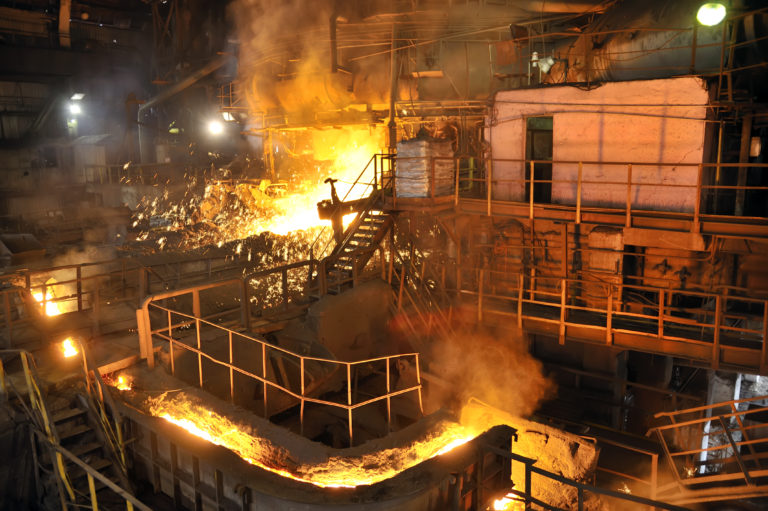
Crude steel production in Germany fell significantly in September, declining 13% year on year to 2.63 million metric tons, mainly due to the slump in blast furnace route production, according to realized data from the German steel federation, WV Stahl, published on Oct. 22.
The steep monthly decline has forced a significant downward revision to the country’s full-year production outlook, as the recovery in production has now cooled off noticeably.
Based on production figures from the first nine months of the year, the projected total for the full year now stands at 35.4 million mt, rising just 4% from the same period in 2025, according to the association’s extrapolation. That figure marks a sharp deterioration from the trajectory implied by first-half data, when the equivalent annualized projection stood at 37.3 million mt, 9% higher on the year.
Steel production using blast furnace and basic oxygen furnace technology in September fell 20.2% year on year to 1.7 million mt, while electric arc furnace output rose 4.3 % to 929,000 mt. From January to September, BF steel production increased 3.8% year on year to 18.16 million, and EAF output rose 4.3% to 8.37 million mt.
The figures underline the fragility of the recovery in Germany’s steel sector, a cornerstone of the country’s manufacturing economy and a critical supplier to its automotive, machinery and construction industries.
September pig iron production fell 19.9% year on year to 1.56 million mt, while output of hot-rolled steel products declined 10.6 % to 2.32 million mt. Both categories nevertheless recorded modest growth over the first nine months, rising 2.6% and 2.5% on the year, respectively.
Author: Annalisa Villa

Euroblech: European coil mills express optimism over annual contracts
European coil mills are confident that time is on their side during negotiations for annual supply contracts with OEMs and other large buyer companies this autumn.
A customary starting point for price discovery are the German autumn sheet trade fairs Euroblech and Blechexpo. At this year’s Euroblech in in Hanover, taking place this week, some players have started their talks. Others dismiss the fair as too early in time, especially as several mills have declined to participate this year.
Those who obtained an early impression heard offers for contracts at roughly €100/tonne ($111) above current spot prices. This would mean €840-860/t for hot-rolled coil, and €940-960/t for hot-dip galvanized coil, mill and buyer sources confirm to Kallanish.
One mill manager cautions that extended rounds of talks will likely be accompanied by a trend of rising prices powered by a “QCC” factor, as he calls it. With this, he refers to the influence of import quotas, the Carbon Border Adjustment Mechanism (CBAM), and rising costs for production.
Such a gap between tabled offers and spot prices is not unusual, given that the long-term contracts warrant stable supply and quality over the term. However, one buyer of a re-roller’s manager finds that “a gap of €100 between spot and contract is clearly too big in the current market situation”.
He argues that quotas and CBAM influence the spot market, but not necessarily long-term contracts, which are the mainstay of European mills and their European customers who value a domestic supply base.
Still, the mill manager touches a painful point when looking three years back. Between October 2023 and February 2024, spot prices surged by more than €120, and the happiest buyers were those who had struck their deals by December.


Italian rebar prices under upward pressure as strikes in southern Italy threaten logistics
Deals and workable levels in northern Italy were heard at €730-760 ($820-853) per tonne ex-works, with one source expecting prices to reach €770 per tonne ex-works due to higher energy costs. This higher level, however, was not supported by transactional activity.
“There are attempts to move the Northern market towards €770/t, mainly supported by higher energy and production costs, but as far as I am aware there have not yet been significant transactions concluded at that level,” a buyer source told Fastmarkets.
“Ever-rising energy and transport costs are pushing a trend towards further increases for November,” a seller source told Fastmarkets.
“Producers’ intention is to go on in uptrend, because high energy and fuel costs keep pressure strong, but customers don’t have the same sentiment,” a trader source told Fastmarkets.
Demand, however, remained weak, limiting producers’ ability to achieve higher prices.
“Demand is currently very low and pretty much everyone is just relying on existing inventory and stocks,” another buyer source told Fastmarkets.
Meanwhile, in southern Italy, the latest deals and offers were reported at €750-780 per tonne ex-works during the week. Higher offers were also heard at €790-800 per tonne ex-works, but no transactions were reported at those levels.
Market participants said truck driver strikes were making transportation to southern Italy more difficult.
“In the South, recent protests and transport strikes linked to high fuel and energy costs, as well as the broader increase in the cost of living, have also caused significant disruption on the roads, with deliveries slowing considerably over the past few days,” a buyer source told Fastmarkets.
As a result, Fastmarkets’ weekly price assessment for steel reinforcing bar (rebar), domestic, exw Italy, was stable week on week at €730-780 per tonne on October 21.
Fastmarkets’ weekly price assessment for steel reinforcing bar (rebar), domestic, delivered Spain, remained unchanged at €750 per tonne on October 21.
In Northern Europe, the latest deals and offers were heard at €680-700 per tonne delivered, while market participants reported workable levels at €660-680 per tonne delivered.
One producer source also reported limited material availability in Germany.
Fastmarkets’ latest weekly price assessment for steel reinforcing bar (rebar), domestic, delivered Northern Europe, was therefore €660-700 per tonne on October 21, widening upward from €660-690 per tonne the previous week.
Sources indicated workable levels for wire rod in Southern Europe at €670-680 per tonne delivered, unchanged from previous levels.
Fastmarkets’ weekly price assessment for steel wire rod (mesh quality), domestic, delivered Southern Europe, was €670-680 per tonne on Wednesday, stable week on week.
In Northern Europe, wire rod was indicated at €705-715 per tonne delivered, also stable compared with previous prices heard in the market.
Fastmarkets’ weekly price assessment for steel wire rod (mesh quality), domestic, delivered Northern Europe, was therefore unchanged week on week at €705-715 per tonne on October 21.
European beams and sections
The latest deals and offers for domestic beams in Northern and Southern Europe were heard at €850-860 per tonne delivered, with workable levels reported by market participants at €840-860 per tonne delivered.
As a result, Fastmarkets’ monthly assessment for steel beams, domestic, delivered Northern Europe, narrowed upward to €840-860 per tonne, from €810-860 per tonne the previous month.
Workable levels for steel sections were reported at €850-870 per tonne delivered in both Northern and Southern Europe.
Fastmarkets’ monthly assessment for steel sections (medium), domestic, delivered Southern Europe, therefore narrowed upward to €850-870 per tonne, from €800-870 per tonne the previous month.
Author: Nia Radenkova

European domestic, import hot-rolled coil markets largely quiet, prices stable
In Northern Europe, tradable levels continued to hover within the range of €740-750 ($830-842) per tonne ex-works, versus offers at €750-760 per tonne ex-works.
While trading activity was muted, most offers reported were for December delivery, and some sources said some regional suppliers were already sold out until the end of the year.
However, other sources disagreed, saying customers’ stocks are high, some service centers have enough inventory not to restock heavily even in 2027, and mills are ready to sell HRC at €720 per tonne ex-works. This information was excluded from the October 22 index calculation as uncorroborated.
Fastmarkets’ daily steel hot-rolled coil index, domestic, exw Northern Europe, was calculated at €748.00 per tonne on October 22, up by €1.33 per tonne from €746.67 on October 21.
The index was up by €3 per tonne week on week and by €4.25 per tonne month on month.
The Italian market was also quiet, with indications of the tradable level at €730 per tonne ex-works during the day, while earlier in the week they were at €730-750 per tonne ex-works, with remarks that only limited tonnages were traded at the upper end of the range and €730 per tonne ex-works was called more realistic.
Fastmarkets’ daily steel hot-rolled coil index domestic, exw Italy was calculated at €738.75 per tonne on October 22, down by €3.75 per tonne day on day from €742.50 per tonne on October 21.
The index was down by €5 per tonne week on week but up by €3.50 per tonne month on month.
The supply situation in Italy should improve soon, as Arvedi reportedly restarted the hot-rolling line that was stopped at the end of September due to technical issues.
Meanwhile, the Italian government has allowed Acciaierie d’Italia to keep the hot-end facilities at its Taranto plant heated until no later than December 15 to prevent irreversible equipment damage, while the company challenges a court-ordered shutdown, but the measure does not authorize normal steel production.
Central Europe was the only region where suppliers tried to increase prices, but they still faced significant resistance. The absence of Ukrainian material, due to disruption of production caused by severe equipment damage from Russian attacks on Ukrainian mills, was one of the factors supporting a stronger position for European mills.
The market leader announced new offers at €790-800 per tonne CPT, equivalent to €770-785 per tonne ex-works, but these have not yet materialized in deals.
Another supplier in the region was heard to have achieved €765-775 per tonne CPT in recent transactions, netting back to €745-760 per tonne ex-works.
As a result, Fastmarkets weekly price assessment for steel hot-rolled coil domestic, Central Europe, was €745-760 per tonne ex-works on October 21, up from €740-750 per tonne ex-works a week earlier.
On the import side, the hot-rolled coil market in Europe was also largely quiet, with just a few deals heard during the week, as quotas for the current quarter from the key suppliers, Turkey and India, have already been exceeded.
Egyptian HRC was heard sold at $750 (€667) per tonne CFR, with the country’s fourth-quarter quota now said to be filled.
Turkish material was still heard available at €595 per tonne CFR, although the quota for this year was earlier said to have been exceeded by more than 100,000 tonnes.
Similarly, Indian coils continued to be offered at $740-760 (€659-667) per tonne CFR.
Fastmarkets weekly assessments for steel hot-rolled coil import, cfr main port Southern and Northern Europe, were €595-670 per tonne on October 21, narrowing upward from €590-670 per tonne on October 14.
On a DDP basis, offers were heard mainly from Asia, varying within the range of €760-790 per tonne.
A cargo of Chinese material was heard sold to Europe at €780 per tonne DDP.
Estimates of Turkish and Indian prices, including the duty payable for exceeding the quarterly quota, were at €720-740 per tonne DDP.
Author: Vlada Novokreshchenova

Dutch Staalfederatie raises concerns over uneven customs treatment of steel imports
The Koninklijke Staalfederatie has highlighted concerns that differences in the application of customs rules across EU Member States are creating an uneven playing field for stainless steel importers.
In a publication dated 22 October, the Dutch steel distribution federation reports that feedback from its members points to differences in the handling of import duties and quotas, including in Italy and Spain compared with the Netherlands. Importers in some Member States may have greater opportunities to access available quotas, potentially leaving Dutch companies facing higher import costs.
The federation warns that the consequences could extend beyond individual importers, affecting the wider steel supply chain, manufacturing businesses and the Netherlands’ position as an import hub.
The Staalfederatie has raised its members’ concerns with Dutch business organisations FME and VNO-NCW and submitted a complaint concerning differences in the application of import rules. It is also pursuing clarification through the Dutch customs–business consultation platform, Overleg Douane Bedrijfsleven (ODB).
Together with its members, the federation is compiling a dossier covering the products and metal types concerned, trade volumes and financial impacts. Around 26 product groups are expected to be examined.
For Europe’s steel distribution and trading sector, these concerns underline the importance of transparent procedures and consistent customs implementation throughout the EU. Common European rules must deliver fair and predictable conditions for businesses across the Single Market.
Read the original publication by the Koninklijke Staalfederatie (in Dutch).

Euro area construction output up 1.8% in August 2026 from July
According to first estimates released by Eurostat, the Statistical Office of the European Union, in August this year the seasonally-adjusted production of the construction sector in the European Union member states (EU-27) increased by two percent compared to July this year and rose by 2.6 percent compared to the same month of 2025. In July, production in the construction sector had moved down by 0.1 percent month on month.
In the euro area, the seasonally-adjusted production of the construction sector in August increased by 1.8 percent month on month and moved up by 1.4 percent year on year. In July, production had increased by 0.2 percent month on month.
Building construction in the EU-27 in August moved down by one percent month on month and down by 4.1 percent year on year, while civil engineering output in the region decreased by 0.2 percent month on month and increased by 2.8 percent year on year. In the euro area, building construction decreased by 0.4 percent month on month and was down by 3.7 percent year on year, while civil engineering output in the region fell by 2.1 percent both month on month and remained stable year on year.
As compared to July, construction output in August increased by 14.0 percent in Hungary, by 9.3 percent in Germany, and by 7.2 percent in Romania, while it decreased by 5.1 percent in Slovenia, by 4.9 percent in Slovakia, and by 2.9 percent in Italy.
As compared to August 2025, construction output in August this year increased by 39.0 percent in Romania, by 22.0 percent in Hungary and by 12.7 percent in Finland, while it decreased by 7.8 percent in France, by 4.9 percent in Slovakia and by 4.3 percent in Spain.


Local HRC prices edge higher in Italy on limited import options; Northern Europe stays quiet
Daily steel hot-rolled coil (HRC) prices rose slightly in Italy as the absence of cheaper imports supported domestic prices, sources told Fastmarkets on Wednesday October 21. The market was mostly quiet in Northern Europe, as many participants were attending an industry event.
In Italy, sources said imported material was no longer a main factor in domestic coil negotiations.
“It’s clear that it’s impossible to get import material significantly cheaper than domestic,” a producer source said on Wednesday.
The same source said workable prices for local HRC were in the range of €730-750 ($820-842) per tonne ex-works, adding that the upper end of the range was linked to very limited activity, while quoting €730 per tonne ex-works as a more realistic level.
The producer also said that it was harder to get higher prices for orders scheduled for delivery in December because “many customers minimize accepted deliveries due to year end accounting.”
A buyer source said on Wednesday that announced prices in the market were in the range of €740-750 per tonne ex-works, in line with previous indications reported by sources on Tuesday.
However, the same buyer said achievable levels for HRC were within €730-740 per tonne delivered, which nets back to €710-725 per tonne ex-works after deducting delivery costs of €15-20 per tonne.
This price range was discarded from the final index calculation due to a lack of corroboration from other sources and a lack of details about these levels.
As a result, Fastmarkets’ daily steel hot-rolled coil index domestic, exw Italy was calculated at €742.5 per tonne on October 21, up by €1.67 per tonne day on day from €740.83 per tonne on October 20.
The index was down by €2.50 per tonne week on week but up by €8.75 per tonne month on month.
While Acciaierie d’Italia and Ilva were challenging a Milan court order requiring the shutdown of the hot-end facilities at the Taranto steelworks, the Italian government issued Decree-Law 185/2026 on Friday October 16, allowing the producer to keep the hot-end area heated to avoid potentially irreversible damage from cooling.
The measure does not itself authorise normal steel production and is intended only to preserve the equipment. It applies until the reasons for the court’s ruling are published, or no later than December 15, 2026.
An official parliamentary dossier dated October 20 said the court had not yet ruled on the appeal. In the meantime, the producer should continue monitoring emissions into the atmosphere, according to the Italian government’s Decree-Law.
Northern Europe
In Northern Europe, market activity was very quiet on Wednesday, with many participants attending the Euroblech fair in Hanover on October 20-23, limiting the availability of pricing data.
One buyer provided an indication of workable levels within the range of €740-750 per tonne ex-works during the day.
A second buyer said trading activity was slow but could not provide workable market levels. No other price points were received during the day, linked to the industry event.
On Tuesday, market participants said producers in the region were under pressure due to high energy costs, citing this as a major problem in the industry. Buyer sources reported indications for HRC within €740-750 per tonne ex-works on the same day.
As a result, Fastmarkets’ daily steel hot-rolled coil index domestic, exw Northern Europe was calculated at €746.67 per tonne on October 21, down by €0.83 per tonne day on day from €747.5 per tonne on October 20.
The index was up by €0.67 per tonne week on week and by €1.67 per tonne month on month.


Thyssenkrupp’s largest shareholder nods to Steel spin-off
Foundation Krupp-Stiftiung, the largest shareholder in thyssenkrupp AG, has signalled its approval in principle for a spin-off of the steelmaking division thyssenkrupp Steel.
The Essen-based foundation is thyssenkrupp AG’s anchor in the group’s roots on the Ruhr. In the past, it used to hold a stake of above 25%, and now still holds 21%.
Its chairwoman, Ursula Gather, in an interview has signalled goodwill for the AG’s plans to make tk Steel an independent company: This involves the possibility of a partial flotation on the stock market, or a partial sale (see Kallanish passim). Parent tk AG intends to keep half in tk Steel.
“I think the time is right for such a step,” Gather said in an interview with daily Westdeutsche Allgemeine Zeitung (WAZ). She noted that the restructuring of the steel division has gained progress, the sale of the 50% in mill Hüttenwerke Krupp-Mannesmann (HKM) to Salzgitter has been finalised and European steelmakers are currently enjoying protection from the EU’s safeguard measures.
“This dynamic environment should be used,” she was quoted as saying.
The foundation’s expression of goodwill alone is unlikely to advance the spin-off of tk Steel. Previous attempts by the parent company to sell or partner the business, including with Tata and Jindal, have failed. While prospects of thyssenkrupp’s steel distribution arm, tk accelis, appear relatively strong, the outlook for tk Steel remains far less certain.
The foundation, however, typically avoids involvement in thyssenkrupp’s operational and management decisions and can remain absent from public view for extended periods. Given the rarity of interviews with its representatives, Gather’s remarks should be viewed as a vote of confidence in the spin-off process.

Tubos Reunidos parent company liquidation begins, production unaffected
The board of Spanish seamless tube supplier Tubos Reunidos (TR), in agreement with the insolvency administrator, has requested the Court of Vitoria-Gasteiz open the liquidation of TR’s parent company, TRSA.
The decision relates solely to the listed company and does not affect the company’s assets, its production operations or its employees, Kallanish understands from TR.
No offers have been received for TRSA and, therefore, the company is no longer part of the divestment plan. The action aims to facilitate the sale process of the production units, in line with the published procedure, with five bidders being approved last week.
The court is expected to issue its decision on TRSA’s liquidation in the coming days.
The parent company currently has eight employees, who will continue working, focusing mainly on supporting the sale process for the group’s production units. The corporate office in Madrid will be closed.
ADI requests layoffs for almost entire workforce
Acciaierie d’Italia (ADI)’s special commissioners have asked the government to increase until February the number of workers falling under temporary layoffs from 4,450 currently to 8,622, almost the entire workforce of the company, union sources confirm to Kallanish.
The move, which follows the start of the shutdown of Taranto’s hot end, has sparked a strong reaction from workers, with strikes and protests occurring in Taranto and at the Genoa plant in northern Italy. ADI employs around 10,000 workers directly.
Meanwhile, Italy’s Supreme Court held a hearing on 20 October on the appeal submitted by ADI’s special commissioners against the Milan Court of Appeal ruling. That ruling ordered ADI to shut down the hot end at Taranto by 28 October. The Supreme Court reserved judgement and will rule at a later date.
Blast furnace no.2, the only one still running at Taranto, stopped producing pig iron in early October after ADI ran out of raw materials, union sources say. It is now in preheating mode, kept at minimum temperature without production. Blast furnaces no.1 and no.4 are already out of service.
Under the government decree approved on 13 October, the hot-end plants can be kept warm until the Supreme Court publishes the reasoning for its ruling, and no later than 15 December. This avoids an irreversible shutdown.
ADI’s special commissioners are looking for ways to keep material flowing to the company’s downstream plants in Genoa and Novi Ligure, and of filling the rolling schedule at Taranto.
After several days of strikes and protests, the commissioners met unions and signed a document on 14 October committing to a supply plan. Under the plan, the Genoa, Taranto and Novi Ligure plants will continue rolling and processing activity. The Genoa Cornigliano plant is set to receive 35,000 tonnes of coils monthly to be processed on behalf of third parties who will guarantee the supply. Of this, 25,000 t/month will go to the galvanizing and pickling lines and 10,000t to the tinplate line (see Kallanish passim).