


Italy’s crude steel production increased by 3.5% in the first half of the year


Polish long steel market stagnant amid seasonal slowdown
Polish domestic long steel prices showed mixed trends in the week to Friday July 24, with rebar prices adjusting downward while wire rod levels remained stable amid weak demand, low buying appetite and subdued trading activity.
“The market is stagnant; it’s the holiday season,” a distributor source told Fastmarkets.
Buyers largely maintained a wait-and-see approach, while liquidity remained thin and transactions were limited.
In the rebar segment, workable levels were reported at 2,650-2,700 zloty ($697-710) per tonne CPT.
Fastmarkets’ weekly price assessment for steel reinforcing bar (rebar), domestic, cpt Poland, narrowed downward to 2,650-2,700 zloty per tonne on Friday, from 2,680-2,800 zloty per tonne a week earlier.
Wire rod trading activity remained limited during the assessment week. Market participants reported tradable levels at 3,000-3,100 zloty per tonne delivered, with offers heard at those levels.
Fastmarkets’ weekly price assessment for steel wire rod (drawing quality), domestic, delivered Poland, remained unchanged at 3,000-3,100 zloty per tonne on Friday.


German sections buyers facing price hike efforts
Buyers of steel sections have heard of price hike efforts in Germany and adjacent markets, but do not anticipate a big change going forward.
Sections prices are little changed so far this summer, and for most weeks have scarcely been seen much higher than €820/tonne ($933/t) for category 1, delivered. Last week, ArcelorMittal was reportedly heard striving for an increase of €25/t across Europe. First heard in Italy and France, the attempt is confirmed from Germany, with figure of plus €30/t, Kallanish learns from one source.
One northern manager believes that such an announcement should easily be echoed by the domestic German producers, to which ArcelorMittal does not count, although its Luxembourg mill is an important player. “If a filling station downtown lifts its petrol prices, the ones nearer the motorway won’t hesitate long,” he says.
He adds that he would not have bought at the price levels of €820-830/t which have has prevailed for a while. He points out that prices achieved from consumers downstream are too low to make replacement purchase from mills at current prices, and still be profitable. That puts the effectiveness of higher mill prices in question.
The weakness on the selling side is confirmed by a buyer at a larger distribution group. They note that cheap offers by distributors are mostly made from inventories bought before the price peaked above €830/t in May.
“You really have to draw a line here. New material cannot be sold with a reasonable profit, but many distributors are willing to make low offers from stock material, to keep the cash flow going.”
On the price hike announcement, they see little chance for €25-30/t but do not rule out that €10-15/t could be achieved, “And that would at least be a small step towards stabilisation,” they conclude.


The world’s number one event for long steel products is in Belgrade!
The SteelOrbis Fall 2026 Conference & 95th IREPAS Meeting will bring together leading representatives of the global long steel industry in Belgrade on September 27-29, 2026.
SteelOrbis and IREPAS will hold their second gathering of 2026 at the Metropol Palace Belgrade. In addition to providing valuable insights into the latest developments in the markets, the conference will offer participants the opportunity to establish new international business connections and strengthen existing relationships.
The conference will feature discussions on the outlook for the long steel market, the role of HBI in the raw materials market, developments in the Balkans and Eastern Europe, compliance and implementation processes under the Carbon Border Adjustment Mechanism (CBAM), the impact of geopolitical shifts on steel markets, and the outlook for global freight markets.
Speakers:
- Alex Gordienko, Export Director, Celsa Group
- Vincent F. Chevrier, General Manager / Technical Sales and Marketing , Midrex Technologies, Inc.
- Branko Zecevic, President, Metalfer Group
- Jerónimo Casas, Global Product Manager for Climate Change and Sustainability Solutions, SGS
- Velina Tchakarova, Geopolitical Strategist and Founder, FACE For A Conscious Experience
- Maria Bertzeletou, Senior Market Analyst, The Signal Group
The event will bring together professionals from across the steel value chain, including steel producers, raw material suppliers, trading companies, end-users, logistics and finance companies, as well as plant, equipment, technology, and machinery companies.
Early Bird Registration: Discounted registration fees will be available until August 21, 2026. To benefit from the €200 early registration discount per participant, both registration and payment must be completed by this date.
For more information: Conference Agenda | Registration Fees | Attendee List | Online Registration
E-mail: events@steelorbis.com
More information about IREPAS
IREPAS was started almost 43 years ago as the result of a meeting with Celsa and Gerdau. Ricardo Hugas created IREPAS to develop understanding between producers, traders, and consumers of rebar around the world. Today, IREPAS unites producers, traders, and professionals from the shipping and finance industries. IREPAS meets every six months in different locations worldwide, helping all members gain access to useful information about the markets around the globe, meet new parties to create business opportunities, and create a better atmosphere for fair business. www.irepas.com

Ferrexpo reports logistical disruption after drone strike on cargo vessel
Swiss-headquartered iron ore pellet producer Ferrexpo said a vessel carrying its premium product was struck by drones while sailing in Ukrainian waters of the Black Sea, and that it is seeking at least $100 million in financing, although it has sufficient net accessible cash to operate until the end of August, according to a July 28 statement.
Ferrexpo said the vessel carrying 55,000 metric tons of its direct-reduction-grade pellets remained afloat, although its structural integrity is unknown.
The London-listed company currently has about 189,000 mt of pellets designated for shipment, including 90,000 mt of DR-grade material in stockpiles, representing about $20 million in production and delivery costs, according to the statement.
“As a result of ongoing drone and missile attacks in and around the port, as well as on loaded vessels departing Ukrainian ports, the group does not expect to be able to load additional vessels via this export route for the foreseeable future, given [that] shipowners have provided advance notice of cancellation of their vessel fixtures,” Ferrexpo said.
When contacted by Platts, part of S&P Global Energy, on July 28, Ferrexpo said that it had not disclosed the timing of the incident for security reasons.
The company had planned to increase DR-grade pellet sales via Black Sea ports in the second half of 2026 as part of its strategy to optimize its product mix toward higher-quality material, according to the statement.
Ferrexpo said its board is evaluating operational and financial scenarios to mitigate the impacts, while working with advisers to launch an equity capital raise of at least $100 million.
The company’s liquidity forecast remains subject to volatility in iron ore pricing, operating expenses, including energy costs, and other factors, according to the statement.
Ferrexpo said it has notified insurers and is working to advance claims related to the incident.
Author: Annalisa Villa


Türkiye’s HRC exports fall 15.4% in the first five months


EU approves measure to facilitate Turkish companies’ access to EUR 2 trillion public procurement market
German production rises 9%, but demand remains low
Crude steel production in Germany recovered significantly in the first half of 2026 compared with the same period last year, Kallanish hears from national steel federation WV Stahl.
Output in H1 amounted to 18.6 million tonnes, around 9% higher than the previous year’s level. However, there is no sign of a sustained turnaround yet, the federation warns. Extrapolated over the whole year, crude steel production, at around 37mt, would remain below the 40mt mark required for economically viable capacity utilisation.
Even more serious is the exceptionally low level of steel demand in Germany, the federation points out. The main customer sectors – construction, mechanical and plant engineering, and the automotive industry – have shown only weak growth so far this year.
“Production figures are on the rise, but a genuine recovery will only begin once real demand for steel returns,” says Kerstin Maria Rippel, managing director of WV Stahl. “The increases are primarily a reflection of a technical rebound, such as the replenishment of stock levels.”
Public procurement is a key lever in this regard, the federation states. “Anyone investing billions in taxpayers’ money must not focus solely on the cheapest supplier from the Far East,” says Rippel. Public procurement law must be shaped by Brussels and Berlin in such a way that local industrial value creation is also taken into account.
“A binding ‘Made in the EU’ criterion is of central importance here,” Rippel adds.
The increase of crude steel output at German mills during H1 is more notable in oxygen-route mills, which gained 11.5% to 12.8mt, while the EAF production rose by only 3.5% to 5.9mt. That divergence had equalised by June, when both routes showed a year-on-year increase of around 9%.
Flacks revises ADI bid, plans new company
Flacks Group is revising its bid to acquire troubled Italian steelmaker Acciaierie d’Italia (ADI) and intends to establish a new company, with hopes of the Italian government taking a stake, ceo Michael Flacks confirms to Kallanish.
The new company, named Flacksider, intends to guarantee production continuity at the Taranto steelworks, build a direct reduced iron plant on-site to feed new electric arc furnaces (EAF), and gradually phase out the existing blast furnaces. Flacks expresses frustration at the length of Italian bureaucratic processes and the slow pace of government decision-making.
His intention is to progressively re-employ all direct workers while also relaunching activity for indirect workers and contractors. Flacks says he expects a government response to his proposal but notes that the summer holiday period is slowing the process as the sector approaches its complete August shutdown.
In response to the rival bid by Jindal Steel International, Flacks says the Indian company intends to turn Taranto into a re-rolling facility, with redundancies for the majority of workers and decarbonisation achieved by effectively shutting down the blast furnaces and heavily relying on semi-finished product imports from outside the European Union.
“I am so sorry for all the workers who would effectively lose their job,” he says, adding that his own project would gradually reinstate workers and production, with any workforce reduction being only temporary. Flacks forecasts annual output of 4 million tonnes of green steel at full capacity.
Flacks previously spoke of talks with Metinvest and Italian equipment maker Danieli as possible partners. Danieli confirmed its involvement to Kallanish while Metinvest did not comment publicly. Sources believe both companies could be involved in the new company, Flacksider.
Earlier this year Flacks created a technical committee to update its existing industrial plan for ADI’s relaunch.
Meanwhile, the Italian government is said to be in advanced talks with Jindal Steel for leasing ADI. The proposal submitted by Jindal would focus mainly on downstream re-rolling activity. Taranto’s production would heavily rely on imported slabs, which Jindal would supply from a future green steel complex in Oman. Decarbonisation of the site would be achieved through the shutdown of primary steelmaking (see Kallanish passim).
Weak demand, summer slowdown push European domestic HRC prices lower
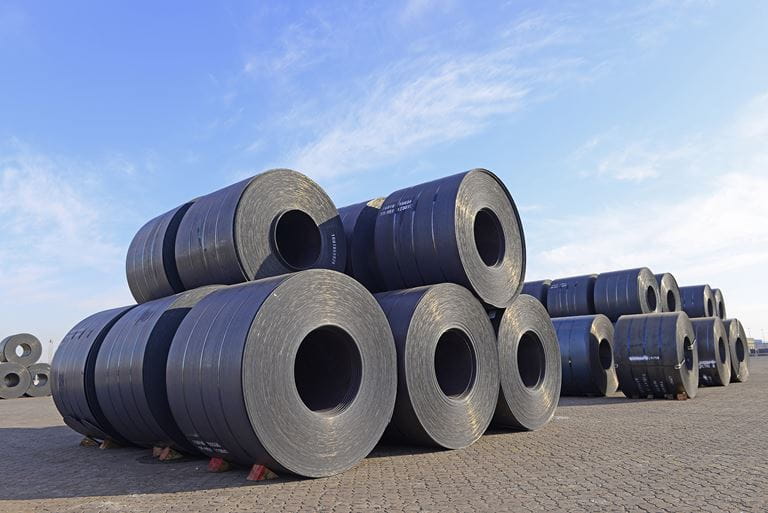
Daily prices for local steel hot-rolled coil edged down in both Northern Europe and Italy on Friday July 24, with slow demand and the summer vacation period weighing on market activity, market sources told Fastmarkets.
In Northern Europe, a buyer indicated workable prices for HRC at €700-710 ($796-808) per tonne ex-works on Friday, saying that the market remained very slow with “extremely weak” demand.
“Also, with the summer holiday time, some companies [are] closing to save some money for workers now,” the buyer said, adding that although producers were trying to increase prices, this was not coming through yet, with consumers continuing to negotiate lower levels.
A supplier source reported offers were at €740-750 per tonne ex-works, but added those levels were not workable in the market yet. The same source said that the latest transaction levels at €710 per tonne ex-works were no longer available.
Due to a lack of fresh inputs on Friday, price points collected on Thursday July 23 were carried over to July 24’s index.
On Thursday, a buyer source reported an indication of achievable levels at €700-710 per tonne ex-works and a transaction at €710 per tonne ex-works.
Fastmarkets’ daily steel hot-rolled coil index domestic, exw Northern Europe was calculated at €706.67 per tonne on July 24, down by €3.55 per tonne from €710.22 per tonne on July 23.
The index was down by €3.33 per tonne week on week but up by €22.50 per tonne month on month.
Meanwhile, the Italian HRC market was also quiet on Friday, with market participants continuing to point to slow demand and limited trading activity ahead of the summer holiday period.
One buyer source said they had purchased a very small volume of HRC, around one truckload, earlier in the week at €680 per tonne ex-works. The deal was not included in the July 24 index because it fell outside the assessment period.
The same buyer indicated workable levels at €700 per tonne delivered (€685 per tonne ex-works), and said that producers were largely absent from the market for the time being. According to the market participant, many mills were expected to pause activity and deliveries between August 1-17 during the summer vacation period.
“Every mill is looking for maximum utilization, [and] with low demand they don’t have it. Italian mills are out of the market because they can’t sell their capacity,” the buyer said.
Meanwhile, a producer said achievable prices for standard commodity-grade HRC were no higher than €720-730 per tonne delivered (€705-715 per tonne ex-works), while mills were continuing to target €740-750 per tonne delivered (€725-735 per tonne ex-works).
“[The increase] might be achieved if decent quality means some exclusive positions in the specifications,” the same source said on Friday.
As a result, Fastmarkets’ daily steel hot-rolled coil index domestic, exw Italy was €704.38 per tonne on July 24, down by €2.50 per tonne from €706.88 per tonne on July 23.
The index was down by €0.62 per tonne week on week but up by €26.88 per tonne month on month.