

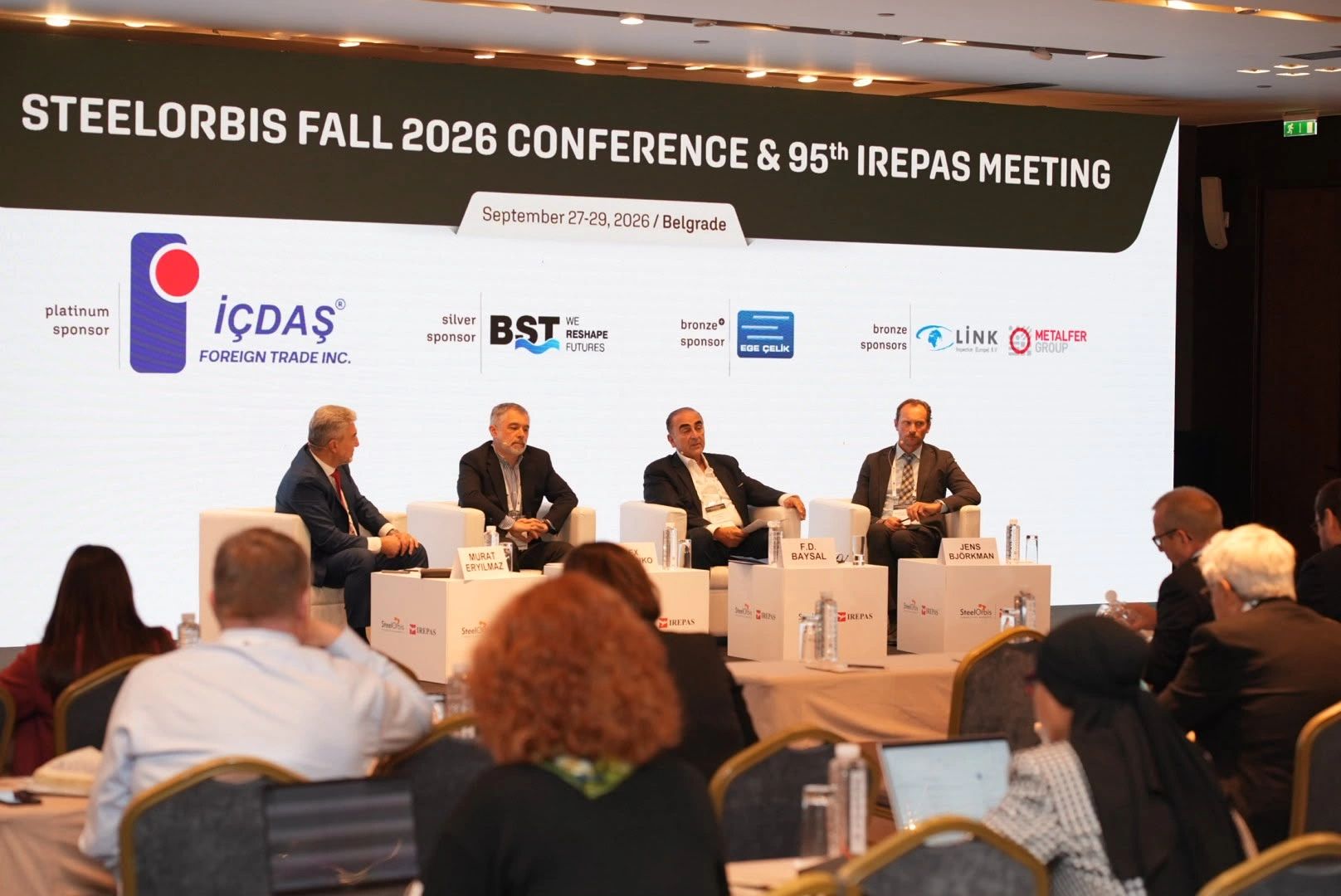
Global GDP growth of 3.1%, according to the International Monetary Fund (IMF), has not translated into stronger steel demand, Alexander Gordienko, export director of Spanish electric-arc furnace (EAF)-based steelmaker Celsa Group, said during his presentation.
“This is not the kind of growth which creates growth in demand,” Gordienko said.
While the global economy continues to expand, the distribution of that growth has become increasingly important for steel markets. Stronger economic growth remains concentrated in Asia, particularly India, which recorded GDP growth of 6.5%, while Europe grew by just 1.3%.
Gordienko said that despite solid global GDP growth, the steel market remained oversupplied and highly competitive. Faster-growing economies were also expanding their own steelmaking capacity; however, GDP growth somewhere in the world does not automatically become export demand for steel.
Construction remains key steel-consuming sector
Construction remains the most important end-use sector for steel, but regional trends differ significantly.
Europe’s construction sector remains constrained by weak residential activity despite persistent housing shortages. Infrastructure projects provide some support, but according to Gordienko, the challenge is not the absence of demand for housing, but the difficulty of converting that need into actual projects through faster planning, approvals and reduced bureaucracy.
In contrast, the United States is witnessing significant investment in infrastructure linked to artificial intelligence (AI), including data centers, power generation and transmission networks. While residential construction remains relatively soft, AI-related infrastructure investment has emerged as a key source of steel demand growth.
China remains main structural weakness
China, meanwhile, remains the main structural weakness for global steel consumption, according to Gordienko. The country’s property sector has yet to show a meaningful recovery, leaving domestic demand unable to absorb the country’s steelmaking capacity and maintaining pressure on export markets.
“The problem is that if Chinese demand is not saved, then the Chinese domestic market cannot absorb the enormous Chinese steel production. It has to go for export.”
India presents the opposite picture, with infrastructure investment continuing to support genuine steel demand growth. However, Gordienko cautioned that increasing domestic steel production means India should not automatically be viewed as a major future import market.
Regional divergence becoming more visible
Global steel production remains close to pre-pandemic levels, but production trends are increasingly diverging by region.
While output has declined in China and Russia, production has increased in countries including India and the US.
At the same time, Chinese steel exports continue to exert pressure on international markets. While trade measures may alter trade flows and destinations, Gordienko said they do not eliminate export pressure.
Long steel consumption declined by around 2% in the first half of 2026, according to estimates by CRU Group presented during the conference.
While such a decline may appear modest, it is enough to intensify competition in a market with significant available capacity, said Gordienko.
The decline in rebar consumption remains concentrated in Asia, particularly China, while Europe has remained broadly stable and North America has recorded stronger demand.
From a global steel cycle to regional cycles
While technologies such as AI are spreading globally, the physical infrastructure required to support them is concentrated in regions with access to capital, energy and project development capabilities.
As a result, investment growth is becoming increasingly concentrated geographically.
This trend, combined with growing trade barriers and diverging regional demand patterns, suggests that steel markets are becoming increasingly fragmented.
“On some level, the world is moving very rapidly into the future. On another, physical level, it appears to be returning to the past. Our business is operating in both worlds at the same time,” said Gordienko.
Raw materials continue to trade globally, while finished steel markets are becoming more regional.
Demand growth is concentrated in specific regions such as India, while large-scale AI-related investment is concentrated in the US.
Gordienko argued that traditional global steel cycles may be breaking down into multiple regional cycles, where one market can remain oversupplied while another experiences tighter conditions.
“Maybe we should stop talking about the global steel cycle, and we should start talking about regional cycles,” Gordienko said.


