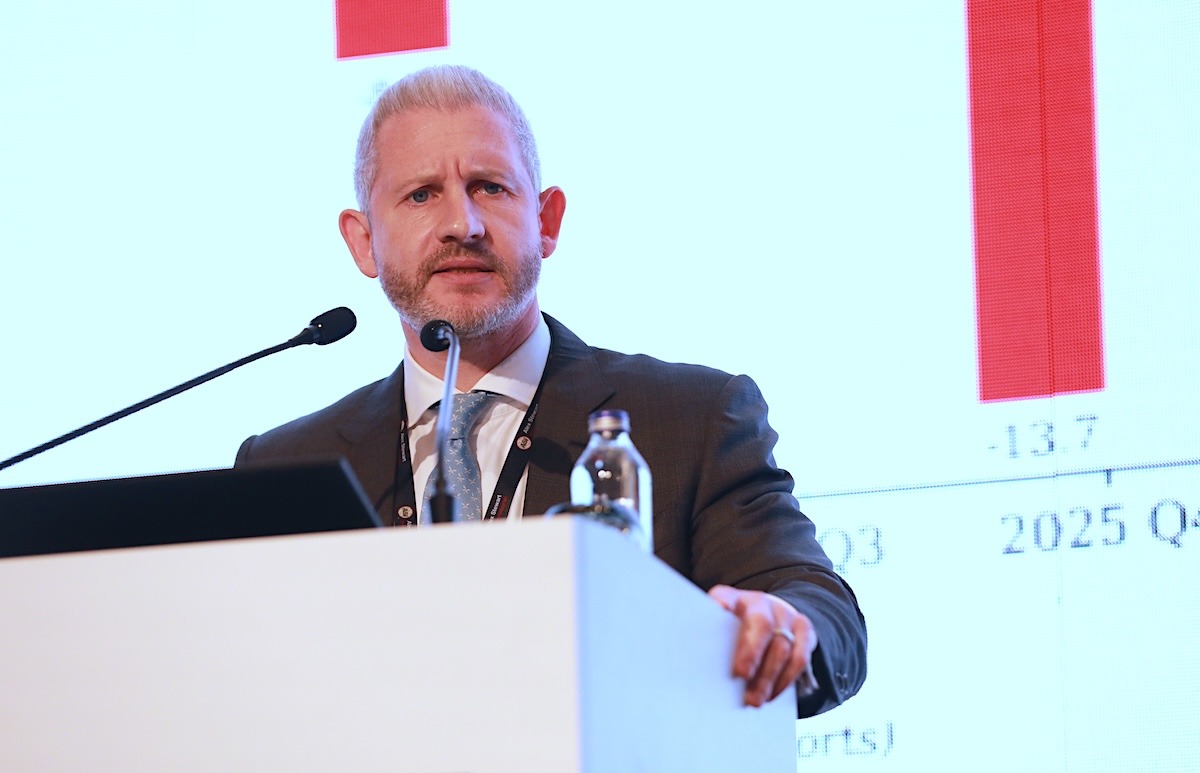
World Steel Dynamics (WSD) expects global steel demand in 2026 to materialise at considerably lower levels than World Steel Association forecasts, as Chinese consumption falls faster than expected.
China’s apparent steel consumption was down almost 6.5% through August, chief executive Philipp Englin said during his keynote at this week’s Steel Networking Summit in Istanbul attended by Kallanish. A 2% decline “doesn’t appear to be likely to be the number. I think it will be significantly lower than that,” he projected.
International hot-rolled coil prices have been driven primarily by Chinese exports over the past three to four years, leaving steelmakers both inside and outside China losing money, Englin said.
Chinese finished steel exports have receded slightly this year, but including semi-finished products, exports have grown again in 2026. The growth in semis is primarily a substitution for Iranian semis in international markets and shows how quickly China can fill any gap in supply, he noted.
Outside China and India, steel demand has barely grown in the past decade and is “really just absorbing the net exports out of China”, Englin said. The Middle East conflict is weighing on demand, while India and, to a lesser extent, Vietnam are the only regions where consumption is growing appreciably.
Developing economies now find it almost impossible to follow the traditional route of building steel and manufacturing sectors, as China is capturing global manufacturing as it has steel, he observed. Some estimate Chinese net exports of steel-containing goods at 130-150 million tonnes, in addition to its finished steel exports.
Raw material support for steel prices has also eroded, with iron ore well off its peak and facing further headwinds, Englin said. Coking coal’s recent gains on Chinese mine curtailments have slowly unwound.
In the US, 50% tariffs have produced the highest sustained prices the market has seen, but the resulting arbitrage is drawing imports back. Sheet imports are approaching an annualised 8 million tonnes from about 5.5mt, while slab imports have jumped to almost 8mt annualised in recent months from a traditional 3.5-4mt, he said. This creates “a massive arbitrage opportunity for the re-rollers”.
In Europe, Englin called it “almost astounding” that prices have not improved more given the fall in imports, pointing to weak demand or inventory liquidation. Underlying demand indicators are not “flashing some kind of red disaster”, he said. WSD still sees some upside for European domestic prices as imports fall and supply is cut “quite aggressively”, assuming the tariff-rate quota (TRQ) system works.
For 2027, downside forces outweigh upside ones, he said, citing higher inflation, higher energy costs and more Chinese exports. He described steel-intensive stimulus and output discipline in China as unlikely. However, with “okay” demand growth outside China and slightly declining Chinese exports, “we might see another moderate increase in international steel prices,” Englin concluded.
Author: Burak Odabasi Türkiye