

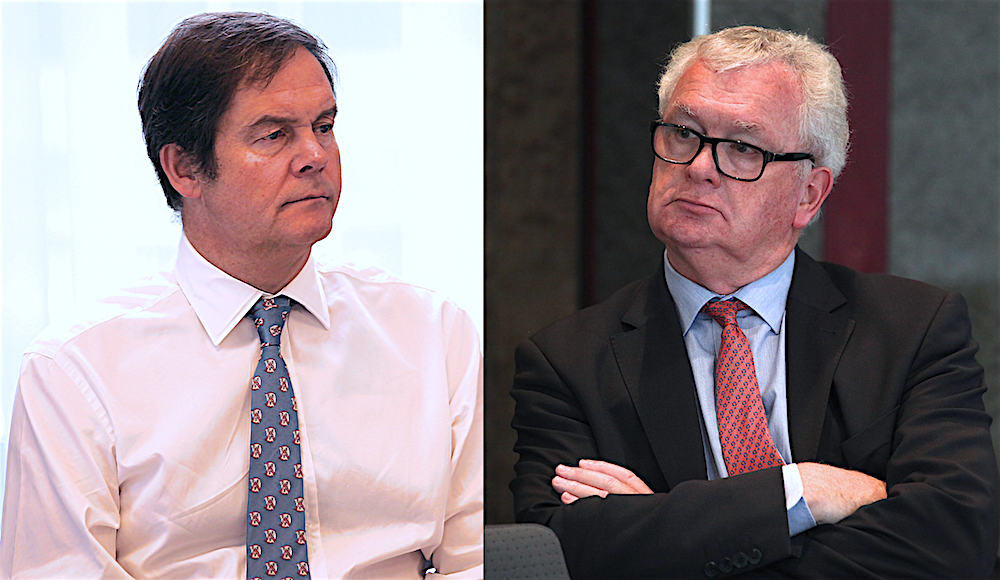
Daniel Guinabert and Julian Verden join the board of EUROMETAL Presidency
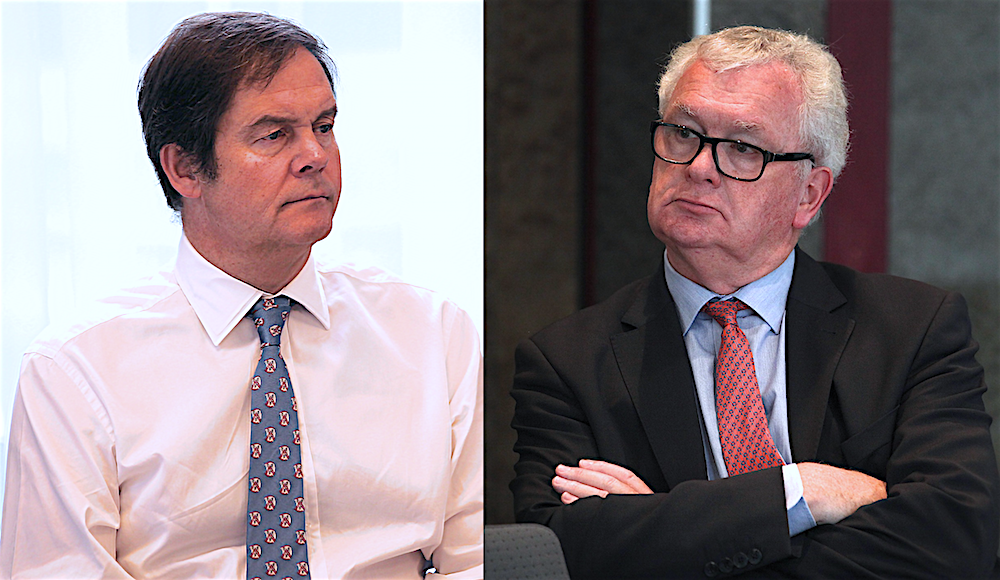
EUROMETAL are pleased to announce that the two vacant seats on EUROMETAL Presidency board have now been filled, by approving to nominate Daniel Guinabert and Julian Verden to it at a recent EUROMETAL Presidency meeting held on 21 st June 2016 in Frankfurt.
Daniel Guinabert is CEO of ARCELORMITTAL DISTRIBUTION SOLUTIONS BD Downstream. Daniel is a former president of French steel distribution federation FFDM.
Julian Verden is Managing Director of STEMCOR Europe and a former chairman of ISTA, the London based International Steel Trade Association
Welthandel – Chance Schweiz (Update 6/2016)

Der Welthandel verändert sich immer mehr. Die Gründe: Das Vakuum durch die Schwäche der WTO. Die Lösung für die alten Wirtschaftsmächte USA und Europa:
Neue Freihandelsräume im pazifischen Raum und im transatlantischen Raum. Und vermehrt investieren Unternehmen aus USA und Europa in Schwellenländer, um in diesen wachsenden Märkten tätig zu sein. Global gesehen gibt es zwei grosse Treiber: Die historisch tiefen Rohstoffpreise, die sich bei einer Veränderung sehr rasch auf die Wirtschaftsströme auswirken. Und Afrika mit einem geschätzten Potenzial von 4 Mrd. Einwohnern in den nächsten 50 Jahren. Seine Wirtschaftskraft entspricht heute schon in vielen Ländern derjenigen von Indien oder Polen. Da ist es sicher interessant für Handelsbetriebe und für Volkswirtshaften, Afrika sehr weit oben auf die Agenda zu setzen und genau zu verfolgen, was in Afrika abgeht.
Mehr im Video-Interview…
Ihr Kaspar Engeli
Direktor Handel Schweiz
PDF: Welthandel – Chance Schweiz – Newsletter Handel Schweiz

German stockholders enjoy rising sales, prices in April
Germany’s stockholding distributors reported outsell price increases for all products in April, with some of them being significant, according to their federation BDS.
The upwards movement began in March, albeit with a delay from the hikes that were initiated by the mills, and gained traction in April. Sales of rolled steel products by distributors in April totalled 954,000 tonnes, Kallanish hears from a BDS report.
April thus showed some volume recovery from a March which had seen a year-on-year dip mainly because of the early Easter holiday this year. An upward trend had begun in February and has continued. The March dip was slight in absolute terms therefore despite more non-business days, and was evened out by a better April.
With a volume of 3.671 million tonnes, the first four months of the year in terms of sales are on par with the corresponding period in 2015. Inventories, which stood at 2.06mt on 31 December, and thus -9% below those at the end of 2014, have been moderately replenished and had reached 2.32mt at the end of April. This narrowed the y-o-y gap to 3%, BDS data show. At 72 days of sales in both March and April, the inventory levels were down from a figure 78 days in the same period of 2015.
US service centres tread fine margin line
US service centres are managing their businesses carefully to balance rapid mill increases and moderate demand, Kallanish learns from market sources.
“The smart ones have a balanced inventory,” says one Midwest service centre executive. “We either get our price or pass on the opportunity.”
There are still deals available from some mills, despite the prevailing hot-rolled price of $630-650/short ton, he adds.
“There is a lot of pushback and in many cases they find someone desperate enough to sell to them well below the going market price,” he says.
A second Midwest service centre executive says distributors are trying to keep pace with mill increases, but available inventory deals undercut that opportunity.
“Prices have moved up very fast at the mill level,” he says. “There are many more businesses who sell from inventory. This remains intensely competitive, but prices at distributors are moving up and chasing replacement costs. But it takes longer for all the prices to work through the supply chain.”
Trade defence measures could backfire, Assofermet warns
The excessive use of trade defence measures on countries other than China, could result in damaging the competitiveness of the European manufacturing industry, Italian steel trade association Assofermet says. The association’s stance was laid out by its president Tommaso Sandrini in an open letter addressed to European institutions and companies in, and associated with, the steel sector,and monitored by Kallanish.
The tariffs currently imposed on Chinese steel imports by the EU are supported by Assofermet, as these measures are “… dictated by necessity, common sense and fairness,” Sandrini says. However, Eurofer’s recent request to initiate a new investigation on hot rolled coils originating in Russia, Ukraine, Belarus, Iran, Turkey, Serbia and Brazil, could represent a threat for the regional industry, Assofermet warns.
The implementation of AD duties on other countries would create “… potential oligopolistic conditions in the European market,” and “… increased volatility,” which in turn would favour “… speculative behaviour,” Assofermet says.
With the exception of China, none of these countries could represent a real threat to European steel producers. This is due to “… the heterogeneous conditions in those countries which does not allow a coordinated commercial policy.” Moreover, “… none of these countries provides public subsidies comparable to those seen in China,” Sandrini adds.
If the EU follows this strategy, the regional industry could become a closed market. This would eventually favour local steel producers at the expenses of service centres, re-rollers, independent distributors, and, ultimately, the regional manufacturing industry, Assofermet says.
KallanishSteel

EUROMETAL STOCKHOLM: Focus is on regaining margin, participants say

Participants at the EUROMETAL Nordics regional meeting in Stockholm are considering the opportunities and challenges, including bigger profit margins, in the development of the region’s market through the course of 2016.
“For us, it’s about increasing margins and focusing on customers’ demands and needs, using a more market-driven approach,” Michael Anderson, md for Scandinavian distribution at Tata Steel, told Steel First on Tuesday April 26.
Tata Steel bought Swedish steelmaker SSAB’s steel service centres (SSCs) in Halmstad, Sweden, and Naantali, Finland, as well as its 50% interest in Norwegian service centre Norsk Stål Tynnplater, in February 2015.
The desire not to lose custom to cheap imports from outside the European markets has triggered a race to maintain market share at the expense of margins, participants said.
The need to move away from a volume-driven market strategy was discussed by many participants at the session, with others advocating the importance of adding value for end-users and tailoring business to the needs of customers.
“This could include digitising our service offering,” one delegate said on the conference sidelines.
“Collaboration across the supply chain needs to come back,” another participant said.
Other topics for discussion included tackling overcapacity in the Nordic region, and the need for consolidation.
Apparent steel consumption in the Nordic region – Denmark, Sweden, Finland and Norway – rose year-on-year to 9.5 million tonnes in 2015, up from 9.2 million tonnes in 2014.
On average, SSCs in the Nordic region reported a profit margin of 1.30% in terms of earnings before interest, taxes, depreciation and amortisation (Ebitda) in 2015, compared with 0.80% in 2014.
Viral Shah, SteelFirst
NASS Steel Industry Safety and Health Awareness Day
The National Association of Steel Service Centres (NASS) in conjunction with the Health and Safety Executive (HSE) and Wolverhampton City Council are hosting our annual Safety and Health Awareness Day (SHAD) aimed at tackling common health and safety issues in the Steel Service Centre and Stockholding Industry.
Wednesday 29th June 2015, 09.30 – 15.00
Tata Steel Training Centre,Steelpark, Steelpark Way, Wednesfield, WV11 3SQ
The HSE will be presenting on the subject of Heavy Lifting and explaining legal requirements, planning, examination and competence when using overhead cranes to handle steel stock as well as what to expect from a HSE inspection. The HSE will also be exploring eliminating risks involved Metal Working Fluids and what Inspectors will be looking for when with working with hazardous substances.
The EMF Comp Limited will focus on changes to risk assessments bought about by the Electro Magnetic Fields Directive due to come into force in October 2016 and what this means for Steel Manufacturing. Securus Health and Safety Limited will be conducting a practical session for Practitioners with emphasis on coaching others and collaboration with managers to support them in exercising their responsibilities. NASS will then be exploring whether we are oblivious to unsafe working procedures and looking at potential consequences
The Seminar will round up with a Question and Answer session with a panel comprised of representatives from the HSE, Metals Forum and the NASS Health and Safety Committee.
Please advise overleaf if you would like a question to be put to the panel.
The fee for this event is £60 for NASS Members and £70 for non NASS Members
For more information or to book a place, please fill in the Booking Form or contact joy.graham@nass.org.uk ( 0121 200 22 88)

Fondazione Promozione Acciaio – Maggio 2016
  |
|
||||

 |
|
||||
 |
|
||||
| DUE NUOVI SOCI PER FONDAZIONE PROMOZIONE ACCIAIO | |
 |
|
||||
 |
|
||||
| COSTRUIRE IN ACCIAIO | |
 |
|
||||
 |
|
||||
 |
|
||||
| PUBBLICAZIONI | |
 |
|
||||
 |
|
||||
| FORMAZIONE ED EVENTI | |
 |
|
||||
 |
|
||||
 |
|
||||
 |
|
||||
| APPALTI E CLASSIFICAZIONE SISMICA | |
 |
|
||||
 |
|
||||
Klöckner confident on extended pricing recovery
Steel distributor Klöckner is confident that there will not be any sudden price slumps this year, with price increases possibly extending beyond the third quarter, CEO Gisbert Rühl told Platts.
“The market is volatile of course, but there will not be continued price drops,” said Rühl at a press call on Wednesday, adding that he also does not expect a “bursting bubble” with sudden falls.
The European and US steel markets are recovering, thanks to anti-dumping measures plus increasing iron ore and scrap prices, said Rühl, highlighting, however, that the recovery is not being driven by growing demand.
In its outlook for 2016, Klöckner said it expects a growth in real steel demand of 2%, both in Europe and the US. Positive effects are forecast to come from the construction industry (with France being the only difficult market), the automotive sector and a fairly stable mechanical engineering industry. The energy industry is expected to decline further, especially in the US.
As reported, Klöckner will also see changes in its supervisory board this year, with ex-Tata Europe CEO Karl-Ulrich Köhler and investor Friedhelm Loh, who holds 25.5% in Klöckner, standing for election at the annual meeting next week.
Köhler joined Loh’s manufacturing company Rittal after leaving Tata in March. “I am very satisfied with Loh’s decision to take a seat on the board. I expect positive impulses coming from Loh and Köhler for the company. If Köhler had not joined Loh, we probably would have asked him ourselves to join the board,” said Rühl.
Laura Varriale, PLATTS
Klöckner sees upward movement in Q1, plans further cuts
Germany-based distributor and service center operator Klöckner is to streamline and centralise the management structure of its European distribution services, as the business area remains “problematic”, CEO Gisbert Rühl said on Wednesday, while reporting upward trends in the company’s first quarter results.
In Q1 this year, Klöckner increased its EBIDTA operating profit by €6 million year-on-year to €16 million. Owing to restructuring processes, which included the closure of 16 locations primarily in France and the UK, sales revenue went down by 18.3% y-o-y to €1.4 billion and shipments decreased by 6.3% to 1.6 million metric tons.
“We will centralise distribution and get rid of double functions within countries, working transnationally so that the European distribution can be self-sustaining,” said Rühl. Klöckner’s net income remained negative at €14 million, but saw a significant positive trend from last year’s first quarter when the net result was a loss of €22 million.
Klöckner wants to save around €25 million through continuing cost cutting, but said it would not close any more sites in Europe. “We cannot have CFOs and COOs on every country level. The reduced headcount will be noticeable in the organisational structure,” said Rühl, adding that he cannot rule out that job cuts in the management structure would exceed 100.
Looking ahead to the coming months, Klöckner said it is confident that it will increase its income further in Q2 and return to positive net income in its full-year results thanks to a stabilised market (see related article).
Laura Varriale, PLATTS