

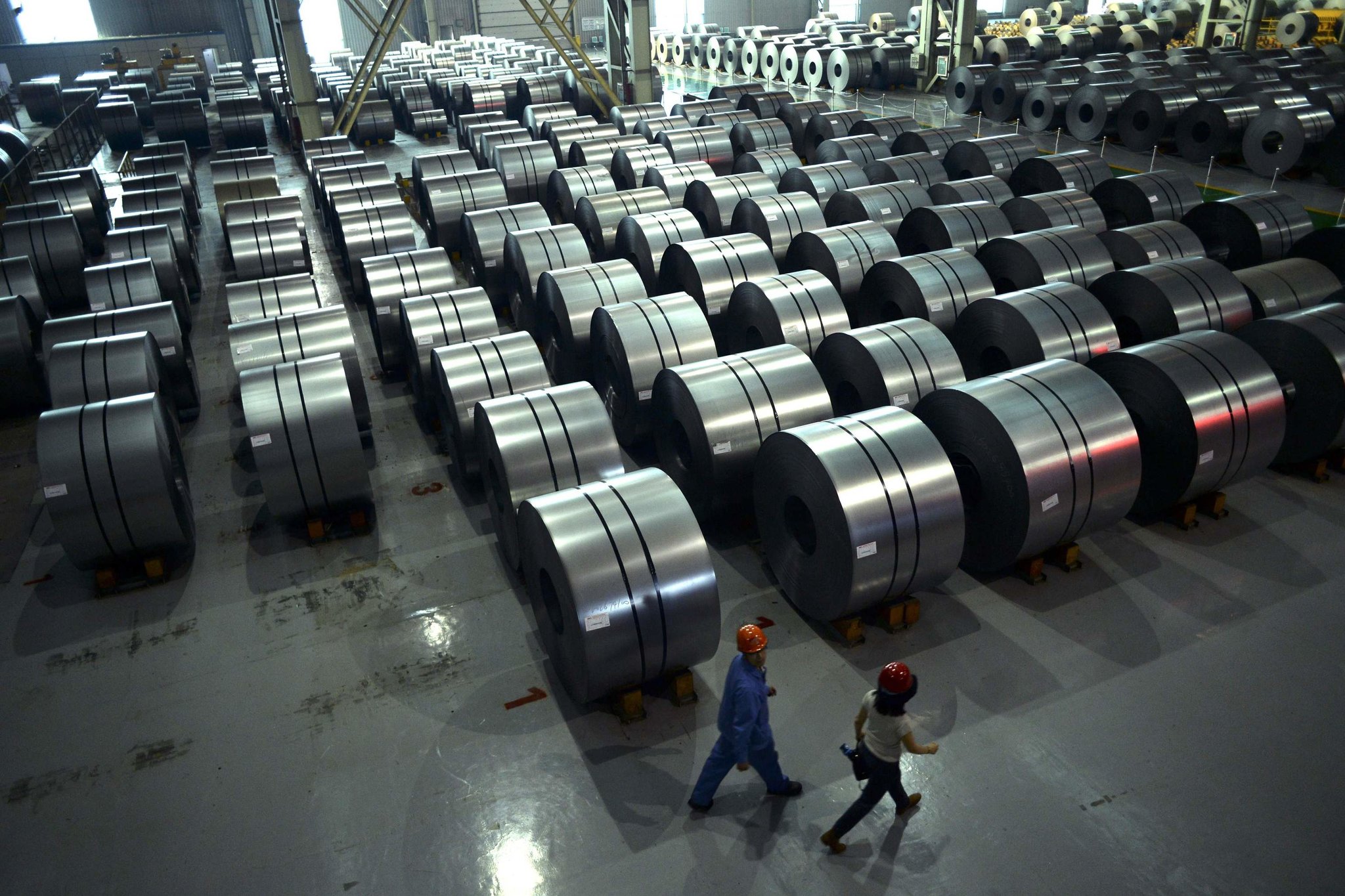
European HRC market seasonally quiet, post-holiday outlook pessimistic
The European hot-rolled coil market remained quiet on Wednesday August 17, with the post-summer outlook becoming increasingly gloomy, mainly because of the poor performance of the major consuming industries and chronic overstocking, sources told Fastmarkets.
Fastmarkets calculated its daily steel HRC index, domestic, ex-works Northern Europe, at €757.50 ($769.50) per tonne on Wednesday, down by just €2.50 per tonne from €760.00 per tonne on Tuesday.
The latest calculation of the index is down by €41.25 per tonne week on week and by €94.17 per tonne month on month.
Market sources estimated achievable prices to be at €750-770 per tonne exw on Wednesday, with a few transactions for small volumes reported within the range.
The market was seasonally quiet with buyers seen largely holding back from conducting business and assessing the post-holiday trend, Fastmarkets heard.
“Currently, it is a totally silent because most customers are on vacation until end of August,” a source at a steel-service center in Germany told Fastmarkets.
The post-summer outlook was largely pessimistic, however. Market sources said they did not expect a “booming recovery” of buying activity in September, mainly because of weak end-user demand and high inventories at buyers.
“Some carmakers in Germany have made announcements about production increasing from September, but it is very theoretical. In any case, buying activity [for HRC] might only recover in late September-early October with some restocking activity,” a trader in the Benelux area told Fastmarkets.
Fastmarkets’ calculation of its daily steel HRC index, domestic, exw Italy, was €743.75 per tonne on Wednesday, down by €11.25 per tonne from €755.00 per tonne the day before.
The latest calculation of the Italian index was down by €27.25 per tonne week on week and down by €26.25 per tonne month on month.
The calculation was based on buyers’ estimates of achievable prices reported at €720-750 per tonne exw and offers reported at €780-800 per tonne exw.
No trading activity was reported on Wednesday, with most mills and buyers currently out of the market.
Expectations for the post-summer market varied among buyers and mills; buyers expected HRC prices in the nation to drop further amid weakened demand and the availability of cheaper imports, while producers opposed the idea of prices trending lower owing to costs pressure.
Imports
The market for imported coil was also quiet in the week to Wednesday.
Buyers from Northern Europe estimated the tradeable level for imported HRC to be €650-670 per tonne cfr Antwerp, with the most recent offers reported closer to €700 per tonne cfr Antwerp from Turkey and Asia.
A booking of HRC from South Korea was heard late last week at €650 per tonne cfr Italy, sources said.
Fastmarkets’ price assessment for steel hot-rolled coil, import, cfr main port Southern Europe, was €650-680 per tonne on Wednesday, narrowing downward by €20 per tonne from €650-700 per tonne a week earlier.
Fastmarkets’ corresponding price assessment for steel hot-rolled coil, import, cfr main port Northern Europe, was €670-700 per tonne on Wednesday, down by €20-30 per tonne from €700-720 per tonne seven days earlier.
Both assessments were based on deals, the lower end of offers and buyers’ estimates of achievable prices.
Published by: Julia Bolotova


Steel sections prices in Europe stable during exaggerated summer lull
The prices for steel hollow sections in Europe were unchanged this week in what some sources described as a “quieter than usual” summer lull, Fastmarkets heard on Wednesday August 17.
Fastmarkets’ weekly price assessment for steel sections (medium), domestic, delivered Northern Europe, was unchanged at €1,140-1,200 ($1,158-1,219) per tonne on Wednesday.
The corresponding weekly price assessment for steel sections (medium) domestic, delivered Southern Europe, was €1,140-1,180 per tonne on Wednesday, also stable week on week.
The holiday season, plus the fact that most market participants held high stock levels, meant that demand was very low. When buyers have needed to make a purchase, the tonnages involved were usually small and they have had plenty of sellers from which to choose, putting pressure on prices.
“There’s nothing going on, more so than we usually see in summer. It’s really dead,” one distributor said.
But the market was keeping an eye on prices for hot-rolled coil, the feedstock for sections manufacture, which have decreased so far in August but which had gone up for much of July.
Fastmarkets daily steel hot-rolled coil index, domestic, exw Northern Europe, was €757.50 per tonne on Wednesday, down from €798.75 per tonne a week earlier.
Sources were looking to September for a pick-up in demand and activity, although some believed that the market was unlikely to revive until later in the month.
Gas prices continued to be a key concern for market participants, with rising costs putting pressure on producers’ margins, and a recent agreement by EU member states to cut demand for natural gas ahead of winter contributing to the higher prices.
Logistics were also a concern across Northern Europe with low water levels on the River Rhine hampering water-borne transport.
Steel plate prices stabilize in Italy, slide in Northern Europe
Steel plate prices in Italy flattened in the week to Wednesday August 17 amid the summer lull, while those in Northern Europe fell, market sources told Fastmarkets.
Northern Europe
Slow demand and chronic overstocking continued to put pressure on plate prices in Northern Europe this week, according to market sources.
A producer source in Germany was heard to be selling October-delivery plate at €1,140-1,170 per tonne during the assessment week.
At the same time, offers from integrated mills in the region were at €1,200-1,250 per tonne exw, sources said.
As a result, Fastmarkets’ weekly price assessment for steel domestic plate, 8-40mm, exw Northern Europe was at €1,140-1,200 per tonne on Wednesday, down by €50-60 per tonne from €1,200-1,250 per tonne on August 10.
Italy-origin plate was offered to the south of Germany at €1,000-1,050 per tonne cpt, depending on volume and chemistry.
And market sources said that an electric-arc-furnace-based mill in Poland had offered plate to Germany at €1,000 per tonne cpt, but could consider a lower price in case of a firm bid.
Italy
The Italian market was in holiday mode during the assessment week with most producers and buyers out of the market.
The most recent deals for plate in the country were reported in the spot market at €930-970 per tonne exw during the week ended August 12, market sources said. Some bids from large buyers were heard as low as €900-920 per tonne exw, however no trades at these levels were reported.
Despite subdued activity and an unclear market trend, sources suggested that Italy’s plate makers will likely attempt to push for higher prices in September to account for surging energy costs.
“[Production] costs have started to bite, so clearly, we will try to increase prices [for plate]. We will see how it goes,” a mill source told Fastmarkets.
An influx of cheaper overseas material could hamper the possible price rise, however, sources said.
Two sources reported boron-alloyed plate offers from India to Italy at €730-760 per tonne cfr.
The most recent bookings of plate from Asia to Italy were done at €850 per tonne cfr in early August, sources told Fastmarkets.
Published by: Julia Bolotova

Turkey, EU agree on January 2023 deadline for action on EU steel import safeguards
Turkey and the European Union have agreed to implement World Trade Organization rulings and recommendations related to import tariffs on Turkish steel, by January 16, 2023, the World Steel Association said this week.
The announcement follows the 2020 establishment of a WTO Dispute Panel to review a complaint from Turkey over EU safeguard measures on imports of certain steel products.
On April 29 2022, the WTO said the EU measures were inconsistent with the General Agreement on Tariffs (GATT) and needed to be realigned. And in May the WTO formally accepted Turkey`s complaints about the EU safeguard duties.
But on May 30, the European Commission decided to keep steel safeguard measures in place for a further two years, with certain adjustments to global quotas.
Turkey then imposed anti-dumping duties on hot-rolled coil from the EU and South Korea in July 2022.
And on August 9, the WTO said the reasonable time to implement recommendations and rulings on safeguard measures on certain steel products would expire on January 16, 2023.
Turkish steel market participants said adjusting the safeguard duties would help to increase demand from Europe, but added that the duties against Turkish steel still mean exports will be limited.
Turkey`s flat steel exports increased year on year in June after falling for the six months of 2022, according to the Turkish statistical Institute (TUIK).
Published by: Serife Durmus

EU HRC market sentiment turns gloomy on high stocks, poor demand
European hot-rolled coil market witnessed bearish sentiment Aug. 17 due to weak demand from end consumers and high stocks with distributors.
Some market participants expect that September would bring further price decreases instead of traditional restocking and price recovery.
“Risks of prices continuing to decrease are higher than the possibility that they would see a recovery, unfortunately,” a Northern European distributor said. “Distributors have high inventories, and they will not need more material soon, probably not until next year.”
In addition, demand from end consumers, including automotive and white goods industries, remained muted.
Availability of flat steel from the EU steelmakers is likely to continue to exceed the demand, sources said. Production cuts and furnaces stoppages across Europe have not been sufficient to bring balance to the market and to support the prices.
“European mills are desperately looking for orders and September might be another crash, though I don’t hope so,” a Northern European service center source said.
Platts assessed hot-rolled coil in Northwest Europe stable at Eur750/mt ex-works Ruhr Aug. 17.
Three distributors estimated tradable value at Eur750/mt ex-works and a trader reported achievable prices at Eur740-750/mt ex-works Ruhr. A fifth source reported offers at Eur750-800/mt ex-works Ruhr.
In the Southern market, the Platts HRC assessment also remained stable at Eur720/mt ex-works Italy.
Market participants reported tradable value for HRC from Italian mills at Eur710-720/mt ex-works.
Platts is part of S&P Global Commodity Insights.
— Maria Tanatar, Benjamin Steven


European CRC, HDG producers squeezed between declining prices and rising energy costs
European value-added coils prices remained on a slight downtrend Aug. 17, resisting upward pressures from rising energy costs.
In Northern Europe, prices for downstream coils edged down further, with particular pressure on galvanized material.
For hot-dip galvanized coil, market participants reported workable prices on a range of Eur860-900/mt ex-works Ruhr. Platts assessed HDG at Eur880/mt ex-works.
Some German mills have been heard as offering HDG at very competitive prices in order to secure volumes in the low demand market, requiring fresh orders to test new galvanizing lines. The market has followed these offers down to a sub-Eur900/mt tradable level, ex-works Northern Europe.
As a key industry for HDG, automotive continues to struggle with semiconductor shortages, though distributor sources reported a degree of recovery in the sector.
“The automotive sector is running relatively well given established issues,” said a distributor source. “They have full orderbooks for the next two years due to the pandemic and semiconductor problems, but it’s hard to say what will happen in the next six months.”
However, a service-center source clarified that the impact from better OEM orderbooks on steel consumption remained low due to a preference from automakers to prioritize production of more expensive, luxury models – where end-user demand is less degraded by the current macroeconomic picture.
In the cold-rolled coil market, the picture was bleak, with little to no trade heard on muted demand.
“There is nobody interested in CRC,” said the service-center source. “Thus, we have no price and no market.”
Due to rising energy and production costs, two smaller cold-rolling mills have been heard as imposing energy surcharges on orders due to exposure to rising natural gas prices – heard at Eur90/mt on the day.
Market participants widely expect some form of price increase in the near-to-mid-term due to increasing energy costs – though whether this will come as a base price adjustment or further surcharges is yet to be seen.
Buyers accepting higher prices is increasingly unlikely under current demand levels, source said.
Platts assessed CRC in Northern Europe unchanged on the day, at Eur870/mt ex-works Ruhr.
In South Europe, the market remains extremely quiet due to production stoppages and the traditional August holiday period. Downstream coils prices are at near parity with Northern levels, also moving down slightly on week.
South European CRC and HDG were assessed by Platts at Eur875/mt and Eur880/mt, respectively, both ex-works Italy.
Platts is part of S&P Global Commodity Insights.
— Benjamin Steven, Maria Tanatar

SMS upgrades Megasider’s Zaragoza merchant bar mill
Germany’s SMS Group is to upgrade Spanish long steel supplier Megasa’s merchant bar mill at the Megasider Zaragoza plant, Kallanish learns from the plant maker.
Megasa has agreed a contract with SMS to replace its existing rolling mill with equipment based on environmentally-friendly heating technology. The new facility will be designed to produce a wide range of merchant bar.
“We are proud that Megasider is relying on the future-oriented technology of SMS and will obtain a plant that sets standards in the environmentally friendly production of steel bars,” says Luigi Barbante, vice president of the SMS Bar & Wire Rod Mills unit.
The investment includes a walking beam furnace with capacity of 120 tonnes/hour. In addition, the company will supply the so-called SMS Prometheus Level 2 control, which ensures uniform temperature distribution and low oxidation and carbon enrichment of the steel.
It will also provide the SMS DigiMod combustion management system and ZeroFlame HY2 burners. These are capable of operating with both natural gas and a blend of natural gas and hydrogen in any ratio, making this furnace hydrogen-ready, SMS observes. Both burners and combustion management system will lower nitrogen oxide emissions to 45 parts per million, reduce scale formation to 0.4%, and cut fuel consumption to 27 Nm3/tonne, according to the supplier.
Megasider Zaragoza produces merchant bar, with a wide range of dimensions and grades of rebar and steel sections.
Todor Kirkov Bulgaria

Shipments from EU distributors continue negative trend
Shipments from EU distributors during the first six months of the year continued their negative trend, according to the latest data issued by Eurometal, seen by Kallanish.
Flat products service centres saw six-month shipments move down 1.1% year-on-year. In January-May the y-o-y change had still been slightly positive (+0.1%).
Stocks at flats service centres reached 79 days’ worth of shipments by the end of June, compared to 53 days in June 2021.
Shipments for multi-products and proximity distributors fell 12.8% y-o-y during the first six months of the year. The negative trend accelerated in June as during the January-May period the fall registered was 11% y-o-y.
Emanuele Norsa Italy
Swiss Steel launches new structure, joins SBTi
Swiss Steel will implement a new divisional structure for its group operation starting in September, Kallanish hears from the maker of special bar quality (SBQ) products.
Under the new structure, sales will be segmented by product category in the three divisions, Stainless Steel, Engineering Steel and Tool Steel. “This new organisation, which will go into operation in September 2022, allows a more holistic market approach and more effective and tailored customer service,” says chief executive Frank Koch.
He gives this “customer-centric organisation along product categories” as a main priority in the group’s outlook for the second half of the year (see separate story).
Another such priority is the group’s commitment to the Science Based Target initiative (SBTi) that encompasses a reduction of carbon emissions by around 42% over the next ten years. Swiss Steel is thus following other European steel companies, which have announced their participation in SBTi.
In June, Swiss Steel was announced as one partner in an alliance of five to reduce their CO2 emissions as part of a pilot project along the entire value chain for an automotive component. The others are bright steel manufacturer Andernach & Bleck, steel distributor Heine + Beisswenger, electromagnet manufacturer Magnet-Schultz and technology group ZF Friedrichshafen.
Christian Koehl Germany
European flat steel distributor shipments fall in Jan-Jun 2022
European distributors of flat steel products reported marginally lower year-on-year shipments for January-June 2022, the regional steel industry association EUROMETAL said on Tuesday August 15.
In the first six months of 2022, flat steel shipments in the EU fell by 1.1% year on year.
Eurometal’s stock index for flat steel service centers in the EU was 107 in June 2022, compared with 71 in June 2021. The index uses the 2018 average as its 100-point basis.
Stock levels at EU steel service centers averaged 79 days’ worth of supply in June 2022, compared with 53 days in the corresponding month of 2021.
In June 2022, European coil prices continued to drop amid persistently slow buying activity and chronic overstocking at distributors and steel service centers.
Despite a short-term stabilization of HRC prices in July, the downtrend has resumed with European producers taking an aggressive approach and cutting their offer prices to fill weak order books.
Fastmarkets calculated its daily steel HRC index, domestic, ex-works Northern Europe, at €770.00 ($785.69) per tonne on Monday, down by just €4.17 per tonne from €774.17 per tonne on Friday.
The latest calculation of the index was down by €53.75 per tonne week on week and by €81.67 per tonne month on month.
Multi-product distributor shipments in the EU and UK fell 12.8% year on year in January-June 2022, according to Eurometal data. During the review period all steel product shipment volumes fell.
In June 2022 alone, however, multi-product distributor stocks increased by 4.4% compared with June 2021, with only profile and merchant bar stocks dropping.
Published by: Julia Bolotova
Swiss Steel Q2 sales volume falls 12% on year, revenue rises 33%
Swiss manufacturer of tool steel and non-corrosive long rolled steel Swiss Steel reported a 12% year on year decrease in sales volumes over April-June, but revenues grew sharply thanks to achieved prices being 50% more than in the same quarter last year.
Swiss Steel sold 11.8% less steel — 457,000 mt — in the second quarter of 2022 compared with 518,000 mt in the same quarter of the previous year. This is attributable to an almost 8% decrease in the sales volume for quality and engineering steel and a 33% fall in stainless steel sales, although tool steel shipments gained 3%.
Meanwhile, the lower sales volume was compensated by considerably higher sales prices reflective of higher prices for raw materials and energy.
In April-June, the company’s average sales price at Eur2,442 ($2,475)/mt was 50% higher than in the same quarter last year, when it stood at Eur1,621/mt. Aside from increasing its base price, the steelmaker implemented an energy surcharge to pass on inflated energy costs to consumers.
As a result, Q2 revenue increased by 33% to Eur1.1 billion ($1.13 billion) versus Eur839 million in the prior-year quarter. It climbed in all of its markets, with the strongest gains in the US due to higher activity in the oil and gas industry.
Adjusted EBITDA for the second quarter was 47% higher, at Eur96 million.
In January-June, Swiss Steel sold 937,000 mt of steel, with the volume being 8.9% lower year on year, and at 48% higher average price of Eur2,290/mt. Its H1 revenue and adjusted EBITDA grew by 35% and 55.6%, respectively.
Geopolitical instability, inflation and potential economic slowdown confront companies with considerable challenges and are going to cause immaterial disruptions in the remainder of 2022.
“As we look to the second half of 2022, volatilities and uncertainties have increased,” said its CEO Frank Koch. “The unstable geopolitical situation persists, energy prices continue to skyrocket, and energy availability has become increasingly uncertain.”
As a consequence and faced with reduced growth forecasts in its end-industry markets, Swiss Steel expects lower market demand and a resulting decline in margins, amplifying the usual seasonal slow-down in activity in the second half-year.
The company is being reshaped toward consolidating operations into an integrated Swiss Steel Group under one brand.
It has reorganized its sales around the three divisions — Stainless Steel, Engineering Steel and Tool Steel with the new organization going into operation in September 2022.
Electric arc furnace-based Swiss Steel also aims to consolidate its position as a producer of CO2-reduced steel: the company has joined the Science Based Target initiative that promotes a reduction of carbon emissions by 42% over the next 10 years.
— Ekaterina Bouckley