
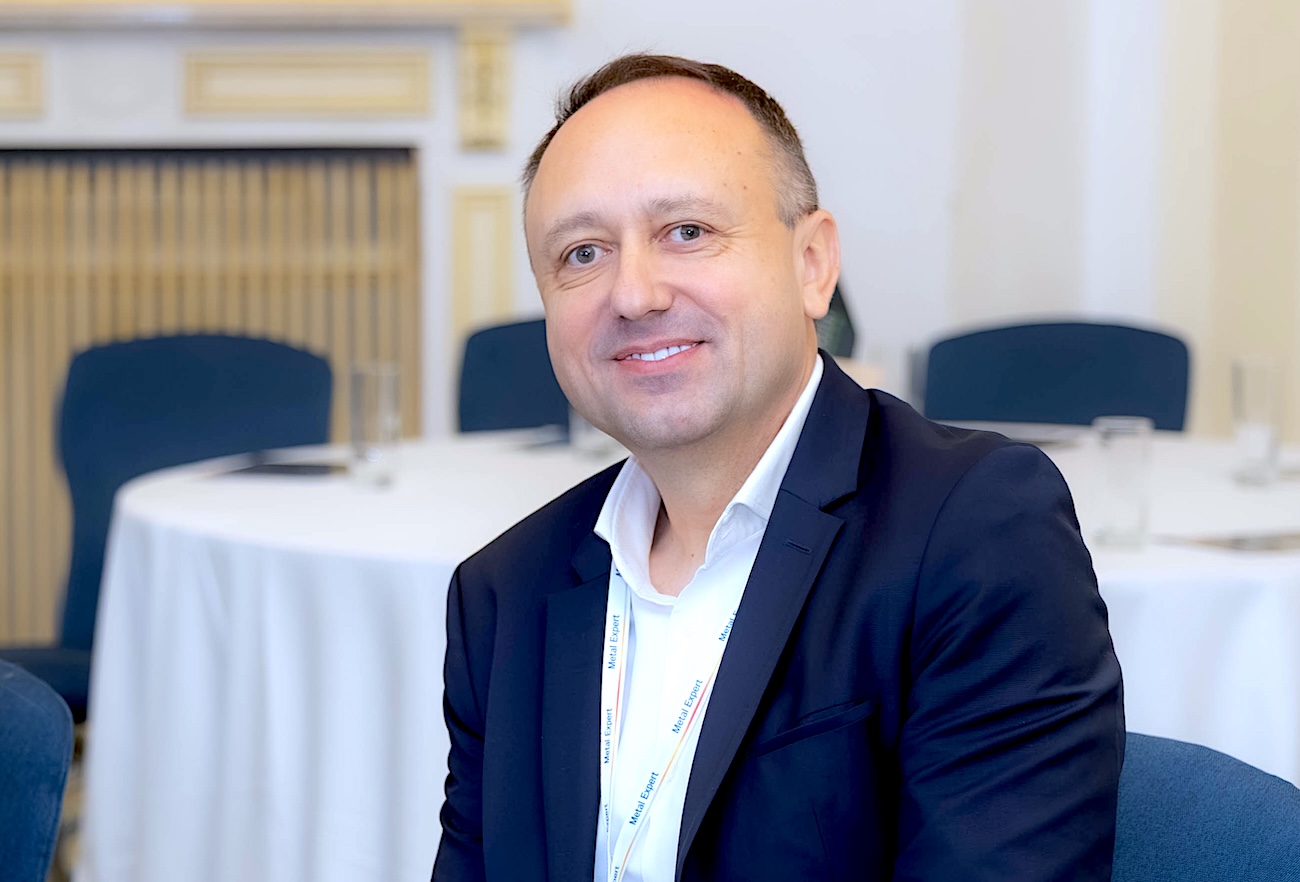
Dr. Eugen Carauleanu, CEO of tk accelis Materials’ operations in Romania, Bulgaria and Serbia, discussed the transformation of the Southeast European steel market, the impact of the EU’s import quotas and Carbon Border Adjustment Mechanism (CBAM) on sourcing decisions, and Türkiye’s position in the region in an interview with SteelRadar.
Could you first tell us a little about yourself and your professional background?
I have been working in the steel industry for 25 years, starting my career at thyssenkrupp.
I am also proud to be the second generation in my family to work in this industry. My father spent his entire professional life in the steel sector. Therefore, steel has been part of my life for much longer than my professional career.
Academically, I hold a PhD in Finance and an Executive MBA from the University of Washington in Seattle.
At thyssenkrupp, I initially worked at the steel plant in Galati, spending more than 10 years in the Mill Services business. I then spent over 10 years in Materials Distribution.
Today, I serve as CEO of tk accelis Materials Romania, tk accelis Materials Bulgaria and tk accelis Materials Serbia. We generally refer to this region as Southeast Europe. My operational responsibilities also cover our branches in Chisinau, Moldova, and Odesa, Ukraine. In total, we manage 11 locations, including warehouses and sales offices.
One of the aspects that makes our experience unique is that we operate in two European Union member states (Romania and Bulgaria) and three non-EU markets (Serbia, Moldova and Ukraine). Each market has its own characteristics, particularly in terms of international steel trade, business cultures and industrial structures. Operating across these different regulatory and commercial environments has given us valuable expertise in managing cross-border supply chains throughout Southeast Europe.
In addition, we have an active presence in other Western Balkan markets and Greece through our export activities. This broader commercial network gives us a perspective that extends beyond the five countries where we have direct operations and further strengthens our regional experience across Southeast Europe.
So, after 25 years, I can say that steel is not just part of my professional background. It is an industry I grew up in and continue to feel deeply connected to.
As we approach the end of the year, how has 2026 been for you and your company?
I believe the most remarkable development has been the transformation taking place across our region and the changing role of Southeast Europe in the European steel industry.
Southeast Europe is undergoing a structural transformation. For many years, the region was largely seen as a traditional steel trading corridor connecting producers, import routes and local consumption.
Today, however, I believe it is evolving into something much more significant: a value creation platform for European industry. The geography has not changed, but the economic dynamics of the steel industry have.
Southeast Europe offers an interesting combination of industrial demand, access to European production and neighbouring suppliers, connections through the Danube and the Black Sea, links with Türkiye and the Western Balkans, and, in the longer term, opportunities involving Moldova and Ukraine.
The opportunity is no longer simply about moving steel through the region. It is about retaining more added value locally through stock management, processing, project supply, logistics coordination and supply chain services.
Therefore, I see this transformation as a shift from moving steel to creating value.
How would you assess the current state of the Southeast European steel market? What is the outlook for demand and prices, particularly in Romania, Bulgaria and Serbia?
I believe it is important not to view Southeast Europe as a single, uniform steel market.
There are some challenges in terms of overall demand. However, at the same time, we are also seeing sectors with quite positive dynamics.
Infrastructure investment is a very good example. Ongoing infrastructure projects, particularly in Romania and Bulgaria, are generating significant steel demand and creating opportunities across different product groups.
Serbia, on the other hand, is showing a different dynamic. We are seeing notable activity there, particularly in industrial construction. This is also creating its own opportunities for steel demand.
For this reason, I would describe the current market not simply as weak, but as selective.
Opportunities exist, but they are increasingly linked to the right sectors, the right products and the ability to offer customers more than just material supply.
That is why, rather than focusing solely on overall market volumes, we pay close attention to where steel consumption is heading and which sectors will shape future demand.
There has been considerable discussion recently about the EU’s new steel import quotas and the Carbon Border Adjustment Mechanism (CBAM). How are these developments affecting the Southeast European market? What kind of feedback are you receiving from your customers?
CBAM and the new steel import quotas are fundamentally changing the calculations involved in sourcing.
In the past, sourcing decisions were largely driven by price, availability and logistics. Today, however, we have to manage many more factors simultaneously: price, freight costs, origin, quota availability, carbon costs, delivery times, inventory and working capital.
I believe this is also changing the role of steel distribution.
The next generation of distributors cannot simply be companies that buy and sell steel from stock. Our role is increasingly becoming about building resilient supply chains for our customers by coordinating different sources of supply, inventories, processing capacities, logistics routes and information.
What customers increasingly expect from us is no longer just an answer to the question, “What is the price of steel?”
They want to know whether we can provide the right material, at the right time and at a competitive total cost, despite the uncertainties.
This is where I see our responsibility: we need to take on part of this complexity and turn it into resilience for our customers.
In this environment, the value of a distributor is no longer measured solely by the volume of steel it can supply, but by the reliability of the supply chain it can build around that volume.
Türkiye is an important steel supplier for Southeast Europe. Considering the EU’s new trade measures, how do you assess Türkiye’s position in the region?
Türkiye is a major steel producer and will continue to be an important player in Southeast Europe’s steel supply structure.
To better understand the scale of Türkiye’s industry, I would like to point out that it produced approximately 38 million tonnes of crude steel in 2025. This volume represented more than a quarter of the European Union’s total apparent steel consumption in the same year.
A steel industry of this scale, located right next to Southeast Europe, cannot easily be excluded from the regional supply equation.
Furthermore, we should not look at Türkiye solely through the lens of its trade with the European Union. Türkiye already has a strong presence and influence in the Western Balkans. This gives the country an important position in a broader regional steel ecosystem connecting Southeast European EU member states, the Black Sea, the Western Balkans, Moldova and Ukraine.
Therefore, Türkiye retains important structural advantages, including geographical proximity, an advanced and flexible steel industry, a broad product range and established commercial relationships across the region.
However, the conditions under which Turkish steel competes in the European market are changing.
Competitiveness can no longer be assessed solely on the basis of ex-works prices and freight costs. Buyers now need to consider the total cost equation, including quota availability, CBAM-related costs, carbon intensity, origin, trade measures, financing, delivery times and supply reliability.
This means that sourcing steel from Türkiye will likely become more selective. Türkiye will remain competitive for certain products and producers. In other cases, European sourcing may become more economically attractive when all factors in the purchasing equation are taken into account.
For this reason, I do not believe Europe will replace Türkiye. Instead, I believe supply portfolios will be optimised much more comprehensively.
Türkiye will remain important, but competitiveness will increasingly be assessed on a product-by-product, producer-by-producer and quota-by-quota basis.
What challenges do you think the steel industry will face in the coming period? What are your expectations for the Southeast European market in 2027?
I am optimistic about 2027 and believe the Southeast European steel market could have a better year.
The region continues to develop, and we are already seeing positive dynamics across many steel-consuming sectors.
Energy is one area where I see particularly interesting opportunities. I expect infrastructure investments to remain an important source of demand in Romania and Bulgaria. In Serbia and the wider Western Balkans, we are seeing promising developments in industrial investment and construction activity.
Of course, there is another important geopolitical factor for our entire region: the Black Sea.
We all hope that the current geopolitical situation will reach a swift and lasting resolution. A more stable Black Sea region would support confidence, investment and trade, potentially creating entirely new opportunities over time for Southeast European economies and the wider region.
For this reason, I look ahead to 2027 with confidence.
Southeast Europe is transforming. Investments are gaining momentum, industries are developing, and connections between the European Union, Türkiye, the Western Balkans, Moldova, Ukraine and the Black Sea are becoming increasingly important.
I believe our region has all the necessary elements to become an increasingly important industrial and value creation platform for Europe.
So, yes, there will be challenges in 2027. But there will also be opportunities, and I believe Southeast Europe is very well positioned to take advantage of them.