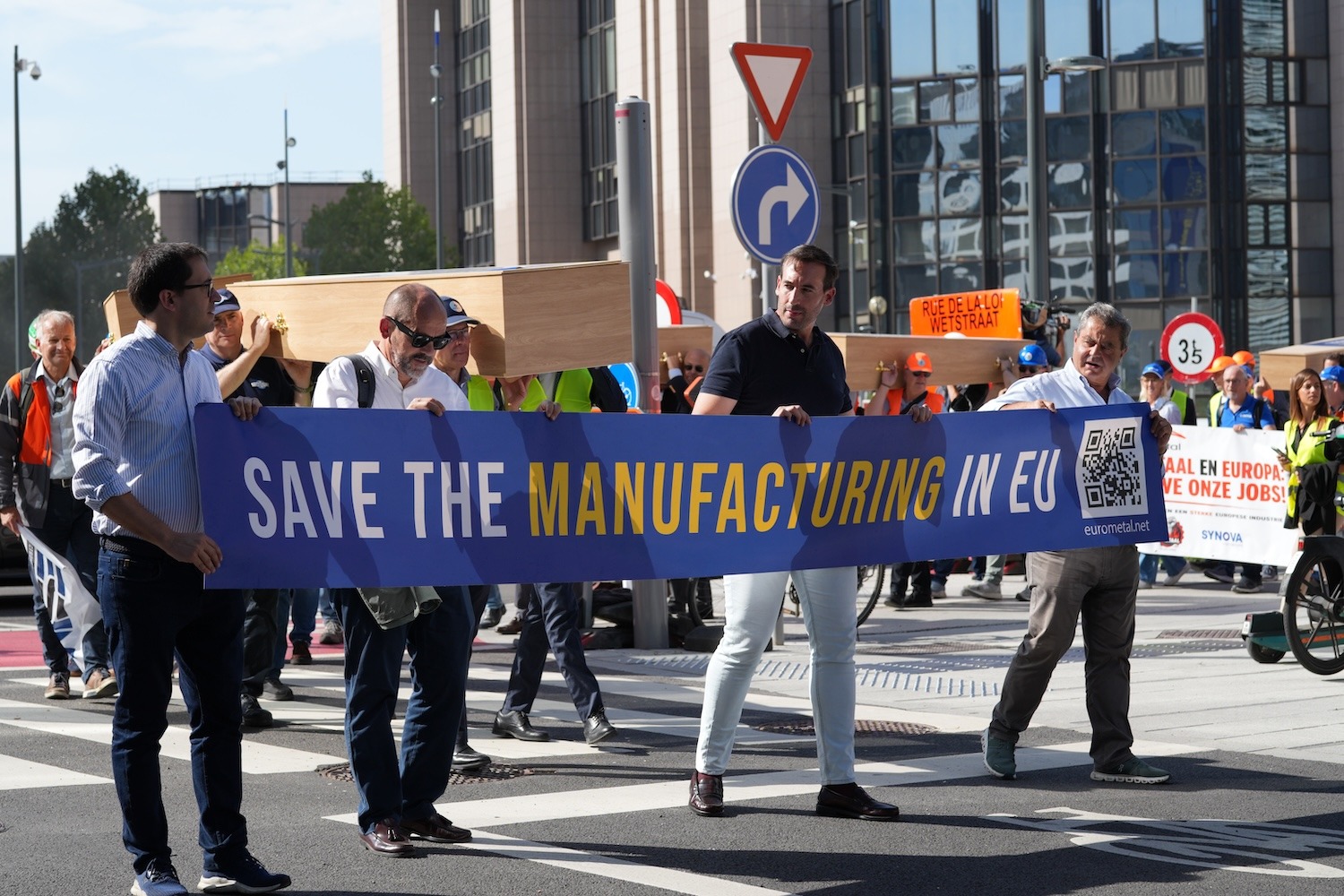
European manufacturers staged a dramatic protest in Brussels Sept. 7, carrying symbolic coffins around the European Commission’s headquarters, to warn that the continent risks losing critical industrial capacity unless policymakers close regulatory gaps that give cheaper, foreign-made goods an unfair advantage over domestically produced alternatives.
The European Convoy for Industrial Competitiveness, which brought together companies, workers, business associations and industrial stakeholders from across Europe, delivered what organizers called a “wake-up call” for EU policymakers.
The protesters highlighted a structural tension at the heart of EU industrial policy that has direct implications for commodity trade flows: while primary finished steel products such as hot-rolled coils, rebars and sections, are shielded from imports thanks to the new trade defense measures and the Carbon Border Adjustment Mechanism (CBAM), finished and semi-finished products manufactured from steel outside the EU are not and they can enter into the European market without facing equivalent obligations.
Steel-intensive finished products made outside the EU are not subject to the same carbon or trade requirements as those manufactured within the bloc. This disparity means European manufacturers bear higher production costs than competitors who import finished goods, a dynamic that is accelerating decisions to relocate production outside Europe and threatening what organizers describe as investment, industrial know-how, value creation and quality jobs.

EUROMETAL, the European associations of steel traders, service centers and overall main end users, said the convoy “does not call for protectionism” but for “fair competition,” arguing that extending appropriate trade and carbon measures to relevant steel derivatives and manufactured components would help establish “a genuine level playing field across the entire manufacturing value chain.”
The timing of the protest is significant. The EU’s CBAM, which entered its transitional phase in October 2023 and is due to become fully operational, currently covers direct imports of carbon-intensive materials, including steel, cement, aluminum, fertilizers and electricity. However, critics argue the mechanism does not adequately capture the carbon embedded in downstream manufactured goods that use these materials as inputs — a gap that EUROMETAL and its allies say distorts competition at the finished-product level.
If European manufacturers continue to face structurally higher input and compliance costs relative to non-EU producers of finished goods, demand for domestically produced steel and other industrial inputs could weaken over time as manufacturing activity migrates. That shift would have knock-on effects for European steel consumption, scrap flows and energy demand from heavy industry — all of which feed into refined products and industrial fuel markets across the region.
The EU’s new steel trade measure for primary finished steel products went into force July 1, with the commission presenting it as the first step toward regaining 34 million metric tons of steel production and capacity utilization lost since 2019.
Crude steel production fell 2.9% in 2025 to its lowest level on record, coming in almost 60 million mt below pre-2008 financial crisis levels, data from the European steel association, Eurofer, showed. Apparent steel consumption grew by 4.4% in 2025 in the EU, ending a prolonged downturn, although volumes remained well below pre-crisis levels. Last year, before the new measures were implemented, imports of semi-finished and finished steel products rose 14% year over year, reaching a record share of around 30% of EU steel consumption.
Author: Annalisa Villa