

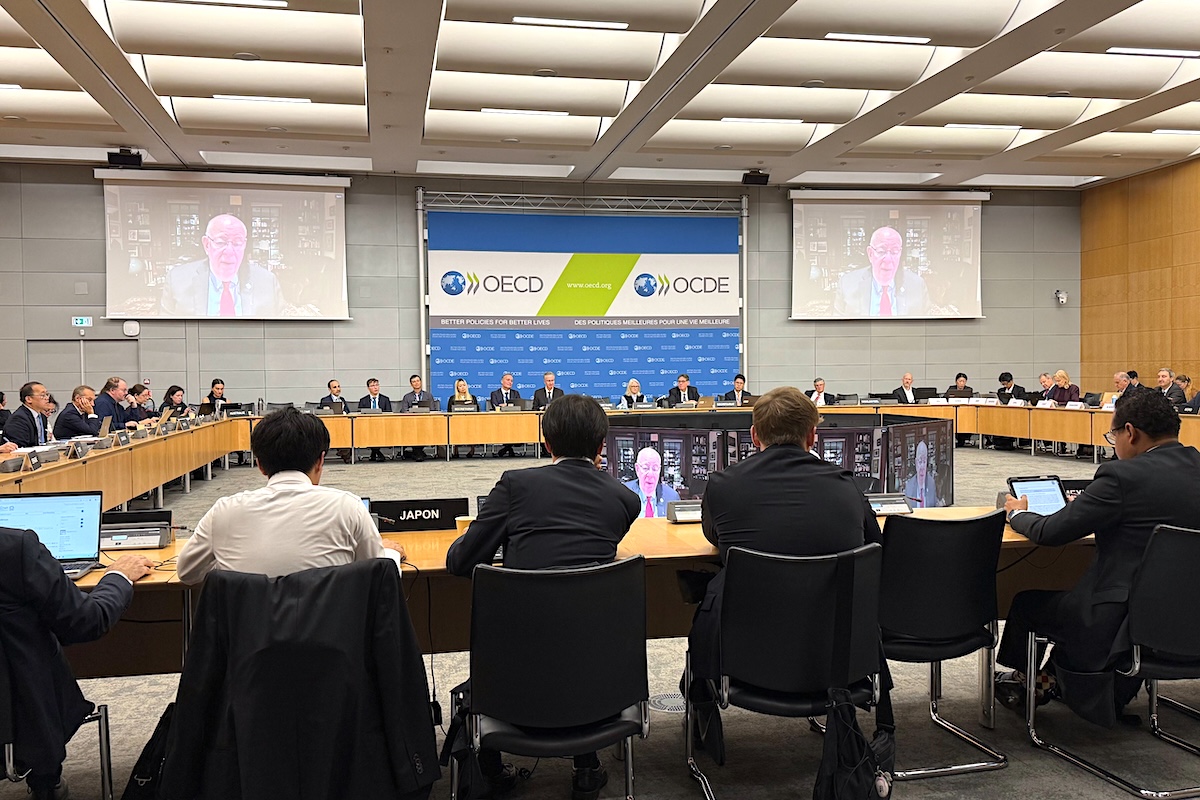
EUROMETAL attended the OECD Steel Committee’s 100th session in Paris
EUROMETAL Director General Ricardo Silva attended the 100th session of the OECD Steel Committee, held on 18–19 November 2026 at OECD Headquarters in Paris. He also participated in the Global Forum on Steel Excess Capacity (GFSEC) Stakeholder Event on 17 November.
The meetings brought together government and industry representatives to discuss growing global steel excess capacity, market-distorting practices and the need for stronger international cooperation.
The Steel Committee’s milestone session gathered 279 participants representing 46 delegations. According to the Chair’s statement, global steel excess capacity was on track to exceed 700 million tonnes by the end of 2026.
World steel demand fell by 1.6% year on year in the first half of 2026, while steelmaking capacity increased by an annualised 88 million tonnes, reaching a record 2,533 million tonnes. More than 90% of net capacity expansion occurred outside the OECD.
Delegates examined how stronger monitoring, enforcement and information sharing could help governments address the scale and underlying causes of these imbalances.
Downstream steel-intensive goods in focus
Of particular relevance to EUROMETAL, the Committee highlighted that steel from sources of excess capacity was increasingly reaching importing markets through downstream steel-intensive goods, including motor vehicles and machinery.
The discussions recognised the implications for domestic steel supply chains, alongside continuing challenges related to circumvention and trade diversion.
These findings reinforce EUROMETAL’s call for coordinated policies covering the entire steel value chain. Measures affecting steel inputs must be considered alongside the competitive pressures facing European processors and manufacturers, whose activities sustain steel demand.
Safeguarding steelmaking must go hand in hand with preserving competitiveness, investment and employment in distribution, processing and downstream manufacturing.
A coordinated international response
The Committee welcomed the GFSEC’s adoption of the Milwaukee Framework as an important step towards joint action on excess capacity and its root causes.
Delegates also examined subsidies and other non-market practices, overseas steelmaking investment, raw-material restrictions and supply-chain vulnerabilities. They underlined that the effects of excess capacity could not be addressed solely by targeting imports from a single country.
Looking ahead, the Committee discussed its proposed Programme of Work and Budget for 2027–2030, including broader subsidy analysis across the steel value chain, early warnings of suspicious trade patterns and an assessment of the effectiveness of trade measures.
Read the statement by the Chair of the OECD Steel Committee’s 100th session.

OECD Steel Committee: Global overcapacity hits record levels as China’s exports surge
At the 98th session of the OECD Steel Committee, held in Paris on 4-5 November 2025, a total of 249 government and industry representatives from 43 delegations gathered to discuss the structural challenges of the global steel market and potential policy responses. The meeting warned that rising overcapacity and non-market practices are once again destabilizing international trade.
In a joint statement, Committee Vice-Chairs Sheryl Groeneweg and Lieven Top noted that China’s steel exports have increased by 10% this year, reaching record levels. They emphasized that this surge has negatively affected producers and workers in market-based economies, weakening the financial performance of companies. The statement also revealed that around one-fifth of planned low-carbon steel projects worldwide have been suspended due to unfavorable market conditions and unfair competition.
According to OECD data, global steel overcapacity could exceed 680 million tons in 2025. Global crude steel production capacity has been rising for seven consecutive years and is expected to reach 2.547 billion tons by the end of the year. With additional projects scheduled to come online by 2028, the figure could climb to 2.656 billion tons. Most capacity expansions are concentrated in Asia and the Middle East, particularly in India and ASEAN countries.
Delegates highlighted that non-market measures—including energy subsidies, tax exemptions, low-interest loans, and preferential treatment for state-owned enterprises—are distorting competition and allowing inefficient plants to remain operational. The OECD’s monitoring report identified China, the Middle East–North Africa (MENA) region, and Southeast Asia as the areas where such practices are most prevalent. The Committee stated that these policies “distort market signals and discourage private investment.”
Trade distortions linked to overcapacity persist despite existing safeguard measures, the report noted. Chinese producers have reportedly increased exports of semi-finished and low value-added steel products to circumvent trade restrictions on finished goods, leaving Asian, African, and Latin American markets increasingly exposed.
Participants agreed on the need for more coordinated global action under the Global Forum on Steel Excess Capacity (GFSEC) framework. Referring to the resolutions adopted at the October GFSEC Ministerial Meeting, the Committee reaffirmed the goal of establishing a joint policy framework by June 2026 to address the structural roots of the global steel crisis. It also stressed that reducing excess capacity would not only restore market stability but also accelerate investments in low-carbon steel technologies.
