


Thyssenkrupp to install line for medium-wide strip
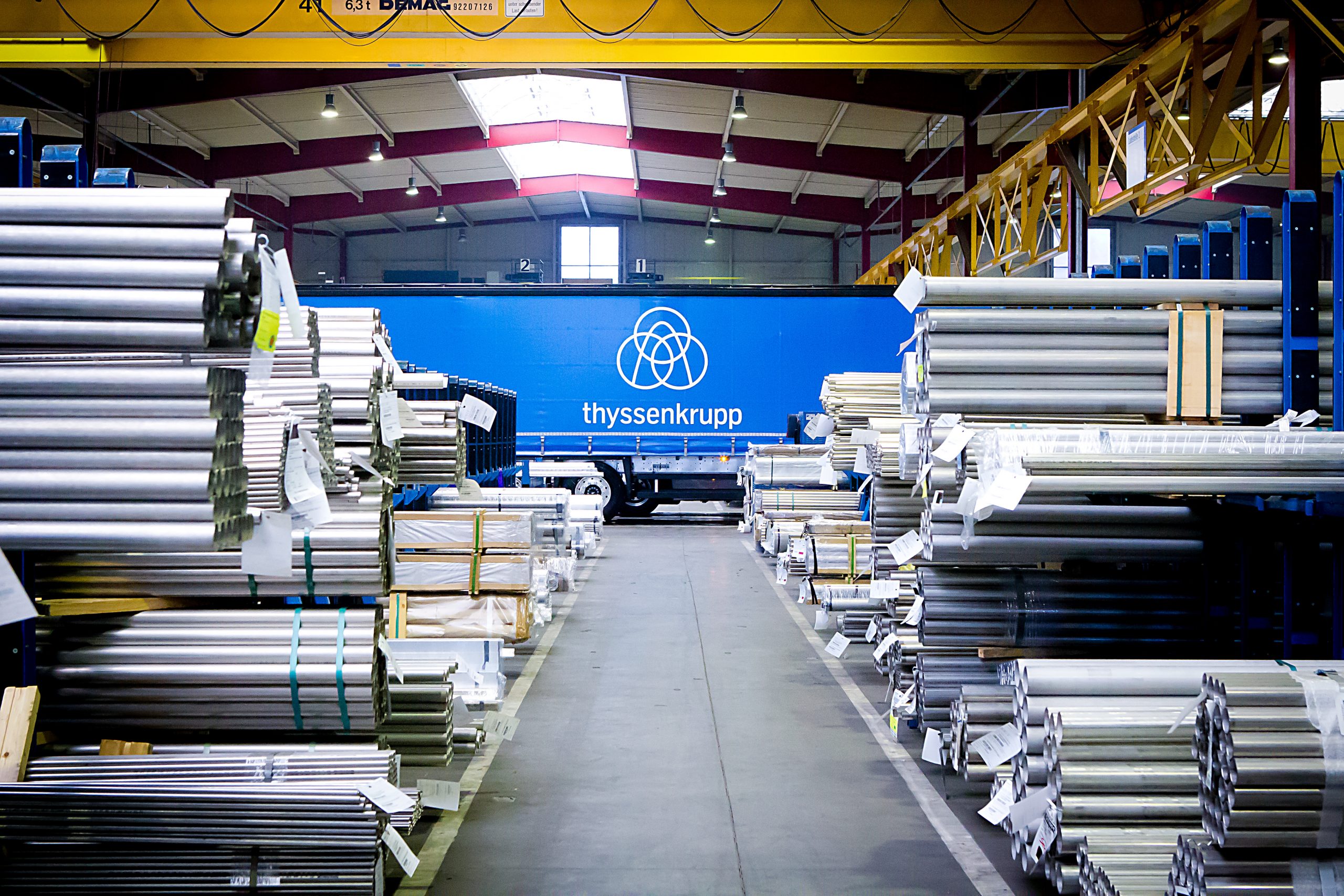
Thyssenkrupp Steel is planning to convert a continuous casting line at its Duisburg-Nord site amid changes to its offtake supplies for medium-wide strip steel.
A divider is to be installed, which will make it possible to cast the required narrow slabs, it explains. The necessary investment funds in the high double-digit million range have already been approved.
The steelmaker recently announced it will terminate the offtake of supplies from HKM after 2032.
The steelmaker has sourced narrow slabs produced by Duisburg mill HKM (Hüttenwerke Krupp-Mannesmann) to roll them at its Hohenlimburg site to medium-wide strip of 600mm width, used by automotive and other industrial customers.
According to a seasoned industry observer, medium-wide strip in the past used to be produced by various EU steelmakers. This has been widely replaced by normal-width strip, which is then slit into narrower strip.
“Making medium-wide strip with dedicated technology takes more effort, but it has advantages,” he tells Kallanish. For example, higher pressure can be exerted to roll harder steels with a higher carbon content, he says.
A spokeswoman at tk Steel concurs and notes that the final products are often small in terms of tonnage, but with tight tolerances when it comes to small precision parts, like blades, or certain parts used in cars.
Thyssenkrupp Steel is the only European steelmaker left to produce medium-wide strip on bespoke facilities, she says.
Christian Koehl Germany

ThyssenKrupp Steel Europe expects sales to decline amid global uncertainties
Thyssenkrupp Steel anticipates continued challenges due to geopolitical tensions and uncertainties in global trade policies but remains committed to its green transformation and sustainability goals, Germany’s second-largest flat steel producer said in a quarterly results statement May 15.
ThyssenKrupp Steel Europe is moving forward with its low-carbon production transformation, while maintaining cautious forecasts and anticipating sales declines of 3% to 6% for the fiscal year 2024-25 (October-September).
Steel Europe’s sales decreased by 8% year over year to Eur2.64 billion in the January-March quarter, while sales for the first half of the fiscal year fell 6% to Eur10.7 billion.
The steel unit faced weak demand and underutilization, particularly due to declining orders from the automotive industry. Price-induced effects contributed to lower sales revenues and capacity utilization.
In January-March, Thyssenkrupp produced 2.08 million mt of crude steel, down from 2.48 million mt in the previous quarter and from 2.697 million mt a year earlier.
“For Thyssenkrupp, fiscal year 2024/2025 is developing in line with our forecast. Strategically, it is a year for making decisions; financially, it is a year of transition,” said Miguel Lopez, CEO of Thyssenkrupp AG.
“Steel Europe is working resolutely on the planned restructuring of the business. We are consistently implementing the measures of our APEX performance program in all segments. By contrast, the persistently difficult market environment is reflected in our operational figures for the second quarter. In the second half of the year, we are expecting a more stable market environment and positive effects from the measures we have initiated. We therefore confirm our full-year forecast,” he added.
Steel Europe is moving forward with its realignment based on the existing industrial concept for the future. At the start of May, IG Metall, the metalworkers’ union, and Thyssenkrupp Steel reached an agreement in principle on the necessary restructuring. Further negotiations are expected to lead to a collective bargaining agreement by the summer.
A further key element of Thyssenkrupp Steel’s future positioning strategy is breaking the economic link with Hüttenwerke Krupp Mannesmann as it will reduce the capacity to 8 million-9 million mt a year, from the current 11.5 million mt a year. At the start of April 2025, Thyssenkrupp Steel initiated the implementation of this step by terminating the supply contract with HKM. As a result, Thyssenkrupp Steel Europe’s obligation to purchase around 2.5 million mt/year of steel will expire by the end of 2032 at the latest.
Platts, part of S&P Global Commodity Insights, assessed domestic HRC in Northern Europe at Eur640/mt ex-works Ruhr, stable day over day.


Thyssenkrupp Materials Services appoints Heather Wijdekop as CEO of Business Unit Processing
thyssenkrupp Materials Services has appointed Heather Wijdekop as the new CEO of the Business Unit Processing, effective July 1, 2025. She will also lead the Operating Unit Processing North America, succeeding Norbert Goertz, who will continue as interim CFO of Business Unit Solutions and oversee Corporate Functions at the North America headquarters in Michigan.
Dr. Wijdekop brings over 20 years of international industry experience, including leadership roles at Tata Steel Europe and Corus Group. Most recently, she served as Director Commercial at Tata Steel IJmuiden, contributing significantly to sales growth and portfolio expansion.
North America remains a strategic growth region for thyssenkrupp, with 70% of its investment over the past five years focused in the region. The Business Unit Processing operates in both Europe and North America, providing customized flat-rolled metal processing and supply chain management, with a strong focus on the automotive sector.
CEO Ilse Henne welcomed Dr. Wijdekop to the leadership team, highlighting her customer focus, global experience, and alignment with the company’s materials-as-a-service strategy.

Thyssenkrupp may sell distribution arm, sources say
Earlier this week, international media reported Thyssenkrupp’s intention to sell its distribution arm, Thyssenkrupp Material Services, as a part of a major restructuring effort intended to increase efficiency by divesting less profitable parts of the company.
“Our goal is to transform Thyssenkrupp into a high-performance and sustainable company with a portfolio of sectors geared to profitable growth,” the company’s spokesperson told Fastmarkets on April 11. “We want every single Thyssenkrupp business to develop in the best possible way and to achieve a sustainable competitive position.
“The declared aim is to generate a permanently positive value and cash flow contribution for the group, and a reliable dividend payment to our shareholders,” the spokesperson added.
“We will continue to pursue our strategy, with a focus on the separation of the Steel and Marine divisions. The primary aim for all sectors is to increase growth and performance. This may include growth through partnerships and portfolio activities, provided this makes sense strategically and technologically,” the spokesperson said.
In August 2024, the company sold a 20% share in its steel business to a Czech private energy company, and was discussing the sale of a further 30% stake.
Thyssenkrupp Materials Services is the group’s trading arm, offering a wide range of processing and logistics services, and employing around 16,000 people. In the fiscal year 2023/24, Thyssenkrupp Materials Services’ adjusted earnings before interest and taxes (EBIT) was €204 million ($231 million). The division’s sales for the same period were €12.1 billion.
By 2030, Thyssenkrupp, which is the largest steelmaker in Germany, intends to cut steel output by 2.5 million tonnes per year, with 11,000 jobs likely to be eliminated by the fundamental changes taking place across the European steel market.
Thyssenkrupp is currently building a 2.5 million tpy DRI module in Duisburg that was expected to have capacity for around 5 million tpy of low-CO2 steel by 2030.
In March 2025, Thyssenkrupp put on hold a hydrogen tender for its green steel plant due to elevated prices, but said that it was still committed to the Duisburg site’s green transformation.
Crisis in European steel market
According to the Organization for Economic Co-operation & Development (OECD), the nominal crude steelmaking capacity in Europe is well over 200 million tonnes per year, but actual output volumes have been lagging far behind that in recent years.
In 2022, crude steel production across Europe amounted to 136.30 million tonnes, down from 152.60 million tonnes in 2021, according to data from the World Steel Association (worldsteel). The decline was due to massive output cuts that were implemented by European mills in the third and fourth quarters of 2022, due to deteriorating demand and falling steel prices.
In 2024, steel output rebounded slightly to 129.5 million tonnes compared with 126.3 million tonnes in 2023, according to worldsteel. But the total volume was still below the 159.4 million tonnes recorded pre-Covid in 2019.
Steel production in Germany amounted to 37.23 million tonnes in 2024, up by 5.2% from 35.4 million tonnes in 2023.
But despite that slight rebound, steel production in Germany remained lower, and has been below 40 million tonnes for three years in a row, German steel federation WV Stahl said.
Earlier this week, Dutch steelmaker Tata Steel Nederlands (TSN) added to the problems in the European steel sector when it announced plans to undergo a large-scale transformation that will lead to the loss of about 1,600 jobs at its IJmuiden facility.
In March this year, the European Commission presented a Steel and Metals Action Plan to support the struggling industry, but it remained to be seen how the plan will be implemented and what results it will bring.
So far, the European Commission has focuses on tightening trade policies to protect the local market from unfair imports.
On April 1, the Commission introduced new, tighter, steel safeguard measures to support the domestic steel sector.
And from April 7, the EU has imposed anti-dumping duties on imports of hot-rolled coil from Egypt, Vietnam and Japan.
Europe’s steel sector was still at the heart of several regional economies, with approximately 500 production sites across 22 EU member states, the Commission said. According to EU data, the European steel sector contributes around €80 billion to the bloc’s gross domestic product and supports more than 2.5 million jobs.

Thyssenkrupp could sell Materials Services division
Germany’s thyssenkrupp AG is rumoured to be considering divesting its steel and materials distribution division, thyssenkrupp Materials Services.
The multi-industries group has for years strived to separate from its steel production division, tk Steel Europe. It is now in the process of selling a 50% stake in tk Steel to Czech group EPCG, which has already acquired 20%.
While tk Steel Europe has long been a problem child for the group, tk Materials Services has been performing reasonably well. It is one of the biggest steel distributors in Europe and beyond, with more than 300 sites across all continents, and an order volume of €12.1 billion ($13.5 billion) in the last fiscal year.
Good earnings in its international supply chain business led to an increase in adjusted Ebit last fiscal by 15% to €204 million. Tk Steel, on the other hand, posted negative Ebit of €770m.
If true, the divestment would sever thyssenkrupp’s ties to its history as a steel company, but would also generate cash for the other miscellaneous activities of the group.
Speculation over the sale was reported by Bloomberg earlier this week. In a statement sent to Kallanish, thyssenkrupp AG did not confirm the plan but did not explicitly deny it either.
A German industry observer tells Kallanish he heard of the rumour weeks earlier, with €2 billion touted as a target price, The price is fair in view of the division’s assets, he notes. Although he doubts the offer would lure too many bidders, he has heard of interest being expressed by Asian companies.

Thyssenkrupp breaks economic link with Hüttenwerke-Krupp Mannesmann
Thyssenkrupp Steel Europe, subsidiary of German steelmaker Thyssenkrupp Steel, is breaking its economic link with Hüttenwerke-Krupp Mannesmann (HKM), the joint venture between Thyssenkrupp Steel, German steelmaker Salzgitter and French pipe manufacturer Vallourec.
The company has announced that it has decided to terminate the supply contract with HKM. As a result, Thyssenkrupp Steel Europe’s obligation to purchase around 2.5 million mt of steel per year will expire on December 31, 2032, at the latest.
Last year, Thyssenkrupp Steel had declared that it intended to divest its stake in HKM as part of its restructuring plan, while the negotiations with Hamburg-based CE Capital Partners on the sale of Thyssenkrupp shares in HKM failed, as SteelOrbis previously reported.
“Due to market conditions, we will have to reduce our production capacities in the long term from the current 11.5 million mt of steel to a shipping target of 8.7 to 9 million mt. The separation from HKM is therefore imperative for us in order to achieve a competitive cost position, to maintain our location in Duisburg-Nord, and to make Thyssenkrupp Steel economically robust and geared up for the future. Irrespective of the termination of the supply contract, the sale of the shares in HKM remains our preferred option. We are open to discussions with all serious interested parties,” Dennis Grimm, spokesman of the executive board of Thyssenkrupp Steel, said.


Hydnum Steel to supply decarbonized flat steel to Thyssenkrupp’s service center subsidiary
Thyssenkrupp Materials Processing Europe, a service center subsidiary of German steelmaker Thyssenkrupp, has announced that it has signed an agreement with Spain-based Hydnum Steel to join forces to drive the transition to a decarbonized steel industry.
Accordingly, Hydnum Steel will supply Thyssenkrupp Materials Processing Europe with up to an annual 100,000 mt of decarbonized flat steel for an initial period of seven years. The products will be produced at the flat steel plant in Puertollano, Spain, currently under construction.
The agreement will enable Thyssenkrupp Materials Processing Europe, which has a wide range of customers in sectors including the automotive industry, construction and household appliances, to expand its range of environmentally friendly products and respond to the industry’s growing interest in sustainable solutions.

Thyssenkrupp Steel pauses German green hydrogen tender on high prices
German steel producer Thyssenkrupp has put its tender to buy green hydrogen for its Duisburg direct reduction iron plant on hold, as early price indications from bidders are “significantly higher” than the company expected.
Thyssenkrupp Steel launched the tender in February 2024 to purchase up to 151,000 mt/year of renewable and low-carbon hydrogen under 10-year contracts for pipeline delivery to its Duisburg steelworks in Germany, but higher-than-expected prices and slow market development have forced the company to reconsider.
“Our tender for hydrogen procurement is currently on hold because it is becoming clear that the offered prices will be significantly higher than assumed and that other framework parameters of the hydrogen economy, which is developing more slowly than expected, will change considerably,” Thyssenkrupp Steel told Platts, part of S&P Global Commodity Insights, by email March 24.
Platts assessed the cost of green hydrogen production via alkaline electrolysis in Germany, backed by renewable power purchase agreements, at Eur9.35/kg ($10.18/kg) on March 21, down from a peak of over Eur14.50/kg in mid-December.
The assessment reflects one possible pathway for producing EU Renewable Energy Directive-compliant green hydrogen.
“We will continue to use hydrogen as soon as it is technically and economically feasible and possible to do so.”
The company said the development did not affect its plans to construct the DRI plant.
“The construction and operation of the direct reduction plant in Duisburg are not directly affected by these issues because the plant can also be operated with natural gas,” a spokesperson said.
The company said that natural gas-fed DRI would avoid 50% of the CO2 emissions of conventional blast furnace operations.

Green hydrogen delays
Thyssenkrupp originally planned to use natural gas when the DRI plant is commissioned, as sufficient green hydrogen would not be available, with blue hydrogen acting as a bridge before renewable production ramps up.
However, the rollout of the green hydrogen economy in Europe has been pushed back multiple times as developers grapple with first-of-a-kind projects and a lack of existing infrastructure for the renewable energy carrier.
German gas grid operator Gascade is using conventional fossil-derived “gray” hydrogen to fill the first section of its “Flow – Making hydrogen happen” pipeline network under construction, the company told Platts.
Thyssenkrupp will discuss the insights from its tender regarding prices, quantities and conditions with the tender funding agency, the German government and the European Commission, it said.
“We will then intensify our efforts on the procurement concept and contact with suppliers” to take into account possible delays in the hydrogen ramp-up, Thyssenkrupp said.
The steelmaker had originally envisaged ordering 104,000 mt of hydrogen in 2028, rising to 143,000 mt/year over 2029-35 before reaching 151,000 mt/year over 2036-37 as it seeks to decarbonize the plant.
The tendered volumes were to meet the EU’s Renewable Energy Directive requirements for renewable hydrogen and low-carbon hydrogen under current provisions on CO2 emissions reductions.
The company planned to connect its Duisburg steel plant to Germany’s national hydrogen pipeline network at an early stage. The first sections of the national pipeline are under construction.
Thyssenkrupp is to construct a 2.5 million mt/year DRI plant to replace the four blast furnaces at Duisburg, with the first production to start from the end of 2026.
The DRI plant could avoid 3.5 million mt/year of CO2 emissions, Thyssenkrupp said previously. The company aims to complete a transition to carbon-neutral steel production by 2045 at the latest.
German steel decarbonization
The steel industry is one of the most effective applications of clean hydrogen for deep decarbonization.
The EU is targeting 10 million mt/year of domestic green hydrogen production by 2030, which could decarbonize 11% of global steel demand, according to S&P Global Commodity Insights analysts, saving 340 million mt/year of CO2 emissions.
Several other steel companies in Germany have launched tenders to buy green hydrogen volumes to decarbonize operations.
Salzgitter opened a tender to source up to 120,000 mt/year of green hydrogen for its Salcos low-carbon steel production in June, seeking supplies from 2027, subject to connection to the planned German hydrogen pipeline network.
And Stahl-Holding-Saar launched a tender in March 2024 to buy up to 50,000 mt of locally produced renewable hydrogen for its Dillinger and Saarstahl plants in Saarland.
Meanwhile in the refining sector, TotalEnergies has signed a hydrogen supply agreement with German power producer RWE to decarbonize its Leuna refinery in Germany.

Thyssenkrupp starts new electrical steel processing line
Thyssenkrupp Steel says it has enhanced its non-grain oriented electrical steel production after commissioning the new annealing and isolating line at its Bochum plant.
It invested €150 million ($156m) in the line, which has a capacity of 218,000 tonnes/year, depending on the portfolio, Kallanish understands. For strip widths of 700-1,350mm, the line enables production of 0.2mm to 1.0mm thin sheet with particularly homogeneous mechanical and magnetic properties. They are specially designed to meet the requirements of highly efficient motors used primarily in electric vehicles, the firm notes.
The rolling mill upstream of the annealing and isolating line, a double reversing stand, has already been completed. The two new units are set to be complemented by a new electrical steel inspection line and a finishing line for cutting and tailoring. The finishing line is scheduled to go on stream in 2026.
The overall investment at the Bochum site amounts to €300m. In the new plant, the structure of the cold-rolled strip is recrystallised during the annealing process. The appropriate texture can then be set, and the sheet is coated with an insulating layer after the annealing process.

Christian Koehl Germany

Thyssenkrupp sells Spain’s Galmed plant to Network Steel
Spanish coil processing company Network Steel (NS) has acquired ThyssenKrupp’s Galmed (FBA9) plant in Sagunto, Valencia, Kallanish notes. The facility can produce 450,000 tonnes/year of hot-dip galvanized coil. The material is mainly supplied to the automotive sector.
Thyssenkrupp could not be reached for comment. NS indicated in a brief note that it is growing its business but did not comment on the financial terms of the deal. Spanish government and trade union representatives also have confirmed the sale.
“The management of Thyssenkrupp Galmed informed us that the negotiations were successfully completed last week and that the transfer of shares is expected by the end of December,” the union CCOO says. The workers’ representatives have had no contact with NS yet, but, pending the industrial plan for the coming years, CCOO assures that employment and working conditions will be maintained.
“From the first moment, the Valencian government has been in dialogue with both companies providing the maximum support so that this operation could be carried out,” says Spain’s Minister of Industry, Marián Cano.
The German steelmaker closed the facility in November 2023 due to the significant worsening of the European automobile market and the consequent reduction in demand for galvanized steel products in Spain and southern Europe. Thyssenkrupp carried out a detailed analysis of the profitability of its ten lines and the result showed the closure of FBA9 was inevitable from an economic standpoint.
Todor Kirkov Bulgaria