


Quiet conditions persist in European HRC market amid seasonal closures
Fastmarkets’ daily steel HRC index, domestic, exw Northern Europe, was calculated at €644.58 ($708.89) per tonne on Friday, unchanged from the previous day.
The Northern Europe index was down by €1.25 per tonne week on week and down by €36.25 per tonne month on month.
Summer holiday absences resulted in no new trades being reported.
Earlier this week, on Wednesday, most buyers’ estimates of a tradable price were in the region of €620-650 per tonne ex-works, but one buyer source reported a higher estimate of €650-680 per tonne.
Fastmarkets’ calculation of the daily steel HRC index, domestic, exw Italy, was €633.68 per tonne on Friday, also unchanged from the previous day.
The Italy index was down by €2.57 per tonne week on week on Thursday, and down by €27.57 per tonne month on month.
Earlier in the week, buyers’ estimates of workable prices for HRC for delivery in September-October were reported at €630-640 per tonne ex-works.
No fresh import offers were reported on Friday.
Published by: India-Inés Levy


Steel rebar, wire rod prices stable in Poland amid lack of activity
Rebar
The most recent rebar offers from three local producers were heard at 2,660-2,680 zloty ($656-661) per tonne CPT (about 2,630-2,650 zloty per tonne ex-works), while estimates of workable prices were in the range of 2,600-2,650 zloty per tonne ex-works, depending on the tonnage.
No fresh bookings had been heard by the time of publication.
Consequently, Fastmarkets’ weekly price assessment for steel reinforcing bar (rebar), domestic, exw Poland, was 2,600-2,650 zloty per tonne on August 11, stable week on week.
Wire rod
Recent offers from local steelmakers of low-carbon, drawing-quality wire rod were reported at 2,800-2,900 zloty per tonne CPT, unchanged since late July, but the upper end of that range was considered unworkable by most customers.
Workable prices were estimated to be around 2,750 zloty per tonne CPT, with some deals from a key producer heard at this price.
Fastmarkets’ weekly price assessment for steel wire rod (drawing quality), domestic, delivered Poland, was 2,750-2,800 zloty per tonne on August 11, unchanged over the past month.
Offers of wire rod imports into Poland were also limited in the assessment week, with European mills out of the market for maintenance work or other stoppages.
Ukraine-origin mesh-quality wire rod was heard to be available at €600-610 ($660-671) per tonne CPT, depending on the supplier.
Published by: Vlada Novokreshchenova
Swiss Steel’s sales weaken in first half
In the first half of 2023, Swiss Steel’s business environment was negatively shaped by factors such as a slowdown in the global economy and rising interest rates to counter inflation.
“Our main customer segments, the automotive industry and the mechanical and plant engineering sector, continued to be affected by the global distortions,” Kallanish hears from the company. Incoming orders as well as order backlog continued to decline in H1, due to lower market demand combined with destocking by the company’s customers.
Sales volume decreased considerably, leading to lower revenue despite ongoing high prices.
Swiss Steel shipped 756,000 tonnes across all product groups and sites, versus 937,000t in the same period of last year.
Volumes decreased at all its divisions, with the strongest dip suffered by the Tool Steel Division, down 32%. The Engineering Steel Division was also considerably below the prior half-year, down 20%, on the back of a lower sales volume in the automotive industry. This particular drop could have been caused by the rise in electric car production, which requires fewer components of speciality long products as made by Swiss Steel.
After a prolonged period of price increases, prices per tonne of steel fell in H1. However, at €2,460/tonne ($2,704), the average sales price is still higher than that achieved in H1 2022 –€2,290/t. An improved product mix, with a higher share of stainless steel in the product portfolio, as well as higher alloy surcharges led to this effect.
The group’s revenue declined by 14% to €1.86 billion, spread across all divisions, with the strongest decline seen in the Engineering Steel Division, down by 22%. By region, revenue decreased in all markets, except in America. Adjusted Ebitda dropped from €171 million to €70m.
Christian Koehl Germany


SSAB implements layoffs at Finnish sites
SSAB says it has completed negotiations regarding temporary layoffs initiated by its Finland business unit in June. Layoffs of varying duration will take place starting in September, Kallanish learns from a statement sent upon request.
Continued weak market conditions for construction-related products caused the group to initiate what it called “change negotiations” at its Finnish sites in Hämeenlinna and Kankaanpää (see Kallanish 19 June). The negotiations concerned around 800 people in total at the two sites, excluding the pipemaking operations at Hämeenlinna. Allocation of layoffs depends on the function and development of the market and work load situation.
“During the negotiations, there has been no change in the market situation for the better, which is why we unfortunately have to implement layoffs in order to adjust the capacity and cost structure of the operations to match the predictable load situation,” says Anders Ek, SSAB Europe director responsible for production at the Hämeenlinna and Kankaanpää sites. Earlier, he noted that market conditions are especially difficult for colour-coated products for the construction industry.
SSAB employs about 4,700 people in Finland. The furloughs affect more than 700 employees at Hämeenlinna, and the entire personnel at the Kankaanpää plant.
Christian Koehl Germany
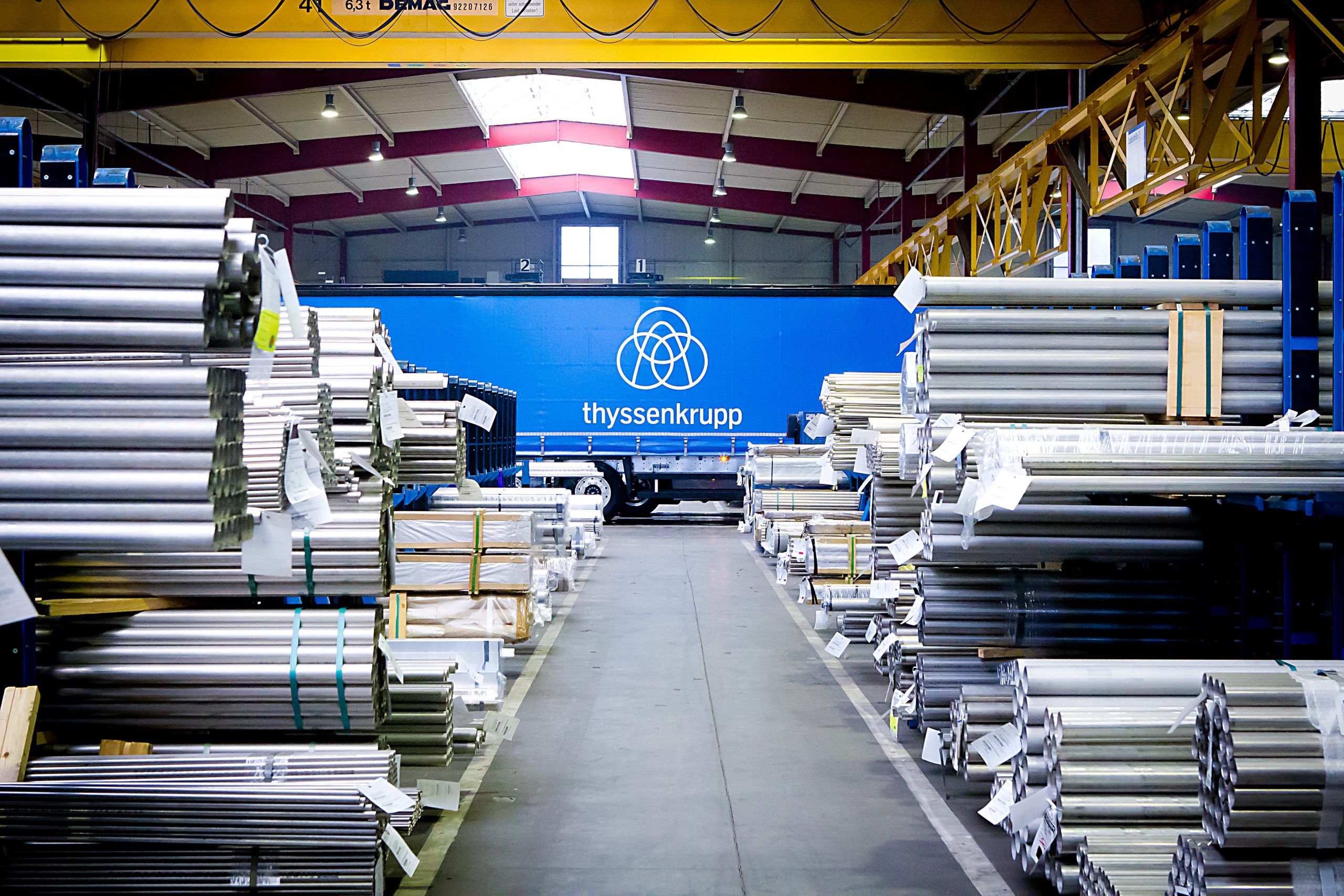
Thyssenkrupp’s steel businesses lift volumes, slash profit
Thyssenkrupp Steel Europe reported an increase in deliveries, but a decline in revenue and profit, on account of lower sales prices, in its third fiscal quarter through June.
The steelmaking division of thyssenkrupp AG increased its order intake by 4% year-on-year to €3.2 billion ($3.5 billion) due to “significantly higher order volumes”, especially from the automotive industry (see Kallanish 11 August).
Despite the increase in shipment volumes, revenue was 9% below the prior-year quarter at €3.3 billion. Lower spot market prices left their mark, but a stabilising effect came from the company’s big share of long-term contracts. Shipments came to 2.6 million tonnes, mainly due to higher order call-offs from the automotive industry and increased deliveries to trading and steel service centres, tk notes.
Due to lower earnings compared with the prior-year quarter, adjusted Ebit amounted to €190 million after €376m a year earlier. Lower raw material and energy costs, along with internal restructuring, had an alleviating effect, tk says.
Meanwhile, Materials Services, thyssenkrupp AG’s steel and metals distribution division, saw order intake of €3.3 billion, down from €4.1 billion in the prior-year period, due to lower prices, “as was expected”, the firm says.
Volumes of steel and other materials shipped remained constant overall, at around 2.3mt, but revenue dropped to €3.3 billion from €4.8 billion. Despite the pressure on margins as a result of price erosion, tk points out that Materials Services still posted adjusted Ebit of €50m – which was nevertheless significantly below the prior-year record of €386m.
It notes that the division’s direct-to-customer business was up, while warehouse and distribution volumes decreased.
Christian Koehl Germany

EU HRC prices inch down in the north; Italian mills mull higher offers
Domestic hot-rolled coil prices in Northwest Europe inched down Aug. 11 as some mills were willing to provide discounts to secure sales in a slow market, market sources said.
Some Italian mills have not been offering material due to seasonal maintenances and market slowdown in August, but they have said that they will look for higher prices in September.
Platts assessed domestic HRC prices in Northwest Europe down Eur5/mt on the day at Eur635/mt ex-works Ruhr on Aug. 11.
Market participants estimated tradable values in the Eur630-640/mt ex-works Ruhr range.
Platts assessed domestic HRC prices in South Europe at Eur635/mt ex-works Italy on Aug. 11, unchanged on the day. The assessment reflected tradable values heard in the market.
Italian steelmakers were likely to increase HRC offers to Eur700/mt ex-works Italy, according to some market sources.
Demand has been the main concern in the European market and steel consumption may not be strong enough in September to support price increases.
“The price rise is needed; the only question is — will there be demand to drive prices up?” a mill source said.
Significant volumes of imported coil booked at competitive prices and awaiting customs clearance or on the way to the EU have supported a negative sentiment in the market.
Platts is part of S&P Global Commodity Insights.


More Chinese steel mills receive output cut orders
More mills in China’s Shandong steel hub have received informal orders to limit their output, industry sources told S&P Global Commodity Insights Aug. 11, similar to the request made to China’s largest steelmaker Baowu Steel Group in July.
A major state-owned steel mill in the Shandong province recently received government orders verbally asking it to restrain its total crude steel output this year to 2022 levels, according to sources close to the matter.
Meanwhile, some market sources said another major mill in Shandong also received verbal orders to rein in its steel production. However, a source with the mill said his company was yet to receive any official order.
Other regions such as the Hebei and Yunnan provinces could be set to introduce steel output controls too, likely aimed at holding annual crude steel output this year to 2022 levels, some market participants said.
The Chinese steel market remains under pressure from oversupply despite news of the output restraint orders, with no indications as yet when mills will implement cuts and August steel output looing likely to be higher than in July, market sources said.
Blast furnace utilization rates continued to edge up in the week of Aug. 7-11 to around 91%, up from 90% at the end of July, according to sources.
Meanwhile, rebar inventories in the eastern trading hub Hangzhou as of Aug. 10 were about 18% higher from early July and 45% higher on the year, sources said.
Amid strong production and rising inventories, the Chinese domestic rebar prices in Beijing fell by Yuan 145/mt ($20.1/mt) from Aug. 1 to Yuan 3,711/mt on Aug. 10, S&P Global data showed.
Average daily crude steel output over September-December will have to fall by 19% from July-August levels to around 2.43 million mt/day in order to keep China’s annual crude steel output at par with 2022 levels, S&P Global calculations based on data from the National Bureau of Statistics and China Iron and Steel Association showed.
“I believe Chinese domestic steel demand will remain weak in the remainder of 2023, so even if China strictly keeps its crude steel output within 2022 levels, the Chinese steel prices are unlikely to increase significantly,” a mill source said.
Jing Zhang – Metals Market Specialist