


European steel hollow sections prices edge higher amid slow trade
“It’s been slow coming out of the summer period,” a trader in Northern Europe told Fastmarkets.
Mills have recently been targeting higher prices, but demand has remained weak in the second half of the year so far, sources said.
Fastmarkets’ monthly price assessment for steel sections (medium) domestic, delivered Northern Europe was €750-790 ($834- 879) per tonne on Wednesday, down by €15 per tonne from €750-775 per tonne a month earlier.
Similarly, Fastmarkets’ monthly price assessment for steel sections (medium) domestic, delivered Southern Europe was €750-790 per tonne on Wednesday, widening up by €15 per tonne month on month from €750-775 per tonne.
One distributor source told Fastmarkets that infrastructure projects were “more or less OK,” in terms of activity, but said that “in general, there is a problem of oversupply” in the hollow sections market.
And there was some bearish sentiment in the market due to falling hot-rolled coil feedstock costs.
Fastmarkets’ daily calculation of its steel hot-rolled coil index domestic, exw Northern Europe was €560 per tonne on Wednesday, down by €50.50 per tonne from €610.50 per tonne a month earlier.
HRC prices have been falling recently, dragged down by weak demand.
One distributor source said that while there had not yet been any lower offers for hollow sections, the reductions in HRC costs could add some downward pressure to prices.
Published by: Holly Chant


No sign of recovery for Northern Europe long steel markets, IREPAS says
There were no easy solutions to this mix of influences, and delegates at the conference – held in Paris, France, on September 15-17 – remained pessimistic for both the short and middle terms.
Prices remained broadly stable in the steel long markets in the week to Wednesday September 18, Fastmarkets heard.
Fastmarkets’ weekly price assessment for steel reinforcing bar (rebar), domestic, delivered Northern Europe, was €630-645 ($701-718) per tonne on September 18, widening downward week on week by €5 per tonne from €635-645 per tonne.
Market participants remained pessimistic about future demand trends.
“The construction sector across Germany and Northern Europe is at crisis point,” a trader source told Fastmarkets at the conference.
“There is huge demand for housing but a chronic lack of new projects being developed and completed. Developers face enormous uncertainty regarding regulation and taxation, and the rent they can charge is capped so they don’t want to take the risk,” he added.
“This year, there are 25-30% fewer applications [for projects]. But we are facing huge increases in demand for housing due to immigrant inflows and more single-person occupancies,” the source said.
High interest rates increased the cost of borrowing to build new housing, and high energy costs further intensified the issues that prevented new projects being started.
But scrap raw materials prices remained stable week on week on September 18.
Fastmarkets’ calculation of its daily index for steel scrap, HMS 1&2 (80:20 mix), North Europe origin, cfr Turkey, was $365.19 per tonne on Wednesday, unchanged since September 10.
Despite continuing discussions regarding imports of rebar, there was minimal demand for these due to low consumption and the comparable prices that domestic mills were offering.
“We have seen some very small tonnages [of rebar] from China and Algeria, but this has dried up due to depressed demand and weak domestic prices,” a second buyer source told Fastmarkets.
The weekly price assessment for steel wire rod (mesh quality), domestic, delivered Northern Europe, was €605-630 per tonne, also stable week on week.
Offer prices were steady in the wire rod market, Fastmarkets heard.
“Prices are unchanged from last week,” a producer source said, “but next week the market could start offering new October prices.”
Published by: India-Inés Levy

EU HRC prices remain stable as buyers await prices to bottom out
Domestic prices for European hot-rolled coil remained stable on Sept. 19, amid muted activity in the market, as buyers awaited prices to bottom out.
“The market is quiet,” a Germany-based service center source said. “European mills are struggling because prices have not bottomed out. I’m not seeing any big orders.”
Sources noted that from October onward, mills might hike prices in order to prepare for next year, however, nothing was confirmed yet. Market participants were already focusing on the first quarter of 2025.
“Mills will try to hike prices in October,” the source said. “September is bottom for prices, from October might see higher prices. Everybody is already talking about Q1 2025.”
Sources also noted that the only solution to support prices is to reduce capacities, adding that countries such as India have already reduced capacities by 20%, and that Europe should follow.
Platts assessed Northwest European HRC stable on the day at Eur555/mt ex-works Ruhr on Sept. 19. Offers were reported at a range of Eur560-570/mt ex-works Ruhr from buy-side sources.
Platts assessed domestic HRC prices in Southern Europe also stable on the day at Eur555/mt EXW Italy, with offers reported at Eur570/mt EXW Italy.
Interest in imported HRC remained weak due to rumors around additional antidumping investigations and concerns around longer lead times.
“Nobody is booking imports,” the source said. “Anti-dumping investigations are a big concern for imports.”
Platts assessed imported HRC in Northwest Europe stable on the day at Eur545/mt CIF Antwerp.
Meanwhile, Platts assessed imported HRC in Southern Europe at Eur535/mt CIF Italy, down Eur5/mt on the day.


Chinese steel outflows, output vexes global industry
China’s steel industry was among the main concerns in the global steel market amid growing steel exports.
At the Irepas steel industry conference held in Paris on Sept. 16, Wee-Jin Yeoh, secretary general of the South East Asia Iron and Steel Institute, said the rise of Chinese export volumes to Southeast Asia and planned capacity expansions in that region are “unsustainable,” making the next two years difficult for the region amid a trend towards “de-greening.”
China has increased exports in recent years due to capacity utilization at over 80% while domestic demand has been decreasing. On Aug. 13, China’s Baowu Steel Group warned that China’s steel industry is facing a more severe situation than seen in 2008 and 2015 amid plummeting domestic Chinese prices.
China predominantly exports flat steel products to Southeast Asia, amounting to 25 million mt, or 28%, of China’s total steel exports in 2023, according to SEAISI.
Overcapacity in Southeast Asia will lead to an “explosion” of carbon emissions in the region, Yeoh said. Southeast Asia still has relatively young blast furnaces, with comparatively high carbon emissions and will see new blast furnace-basic oxygen furnace capacities come on stream. SEAISI expects 83% of steel production in the region to be done in blast furnaces by 2030, up from 71% in 2024.
Trade barriers on the rise
China’s rapid increase in cheaply priced steel product exports to many regional markets over the past two years has heightened protectionism worldwide with further escalation possible, while global steel prices are likely to remain low, GMK Center, a Ukraine-based steel consultancy, said in a report Sept. 18.
Steel anti-dumping investigations worldwide rose to 14 as of early July from five in 2023, of which 10 and three, respectively, concerned Chinese products, according to GMK.
Among countries and regions already imposing restrictions or conducting AD probes against Chinese steel products are: the European Union, the US, Canada, Vietnam, Turkey, Mexico, Brazil, Thailand, South Africa, and Saudi Arabia, GMK said.
China’s finished steel exports in August rose 21.3% from July and 14.7% from a year earlier to 9.50 million metric tons, the third highest so far in 2024, the country’s customs data showed.
Over January-August, the Chinese exports increased 20.6%, or 12.03 MMt, from the year before to 70.58 MMt.
Its finished steel exports are on track to surpass 100 MMt in 2024 for the first time since 2016, after rising in August, market participants told S&P Global Commodity Insights.
“Under these circumstances, protectionist trade policies for steel products have become more evident not only in Europe and the US but also in Asia, and Japan is now in a situation where some concrete countermeasures are necessary,” Tokyo Steel said as it cut its October list prices in September.

Costs, low margins depress EU rebar market outlook
French rebar buyers anticipate no market improvement in the near term and throughout the whole of the fourth quarter, Kallanish hears.
Current market activity is characterised by a lack of momentum, shown by orders with reduced volumes.
This week at the Irepas event in Paris, various European rebar makers expressed their apprehension about diminished sales and significantly declining earnings last year. Two sources anticipated negative results for this year as well.
The forecast for rebar sales and pricing through year-end appears to be unfavourable. There are expectations mainly from buyers of a decline in prices in the upcoming months, linked with decreased domestic scrap values and the subdued performance of international markets.
In France, there was a brief period of somewhat higher sales during the summer, but there is no optimism for the future, with distributors noting that sales are still sluggish and customers are reluctant to commit to large quantities.
The overall volume performance for the year has been relatively stable, with slow purchases occurring back-to-back amid uncertainty. However, downstream financial results showed weakness, with margins facing significant pressure and profit close to zero.
Buyers insist on taking a cautious approach, and the market has only slowly resumed activity after the August break.
Rebar prices remain stable month-on-month in France, averaging at €610-620/tonne ($681-692) delivered, according to industry sources. In September, scrap prices in western Europe experienced an on-month decrease of €25-30/t, reflecting the downturn observed in the Turkish market.
The domestic construction sector is in the middle of a recession, as confirmed recently by national construction body Fédération Française du Bâtiment (FFB). However, sentiment among French construction companies improved slightly in August. According to L’Institut National de la Statistique et des Études Économiques (Insee), construction companies active in both structural works and finishings reported a slightly more positive business climate and an improved attitude towards their future (see Kallanish passim).
Natalia Capra France


Court overturns Czestochowa insolvency following Liberty appeal
The Czestochowa regional court has repealed its decision to start bankruptcy proceedings against Liberty Czestochowa following an appeal by Liberty, Kallanish notes.
The court declared the Polish plate maker insolvent in July following a protracted production stoppage in 2023-24 and a working capital shortage. Its appointed administrator subsequently launched a tender to lease the plant, with five companies reported to be in the running, including Metinvest and Weglokoks.
Liberty appealed, claiming the business demonstrated strong support from its largest creditor and was already undergoing a “robust” restructuring and restart process.
Liberty Steel Europe chief executive Thomas Gangl says: “This is a positive result and means we can continue to move towards a sustainable future for Liberty Czestochowa. We believe the business is well positioned to support Poland’s fast-growing defence and sustainable energy sectors with its green steel plate. Our restructuring plan will be the best route to secure sustainable employment and production at Czestochowa and the repayment of all of its creditors.”
Liberty Czestochowa has a 700,000 tonnes/year EAF and 1.2 million t/y heavy plate capacity.
It is one Liberty plant struggling to survive in Central and Eastern Europe, along with Liberty’s Czech steelworks in Ostrava – also up for sale – and its Dunaújváros mill in Hungary. Production at both units has been idled for some time. However, the Hungarian plant recently received China Export and Credit Insurance Corporation funding for its transformation to EAF steelmaking.
Adam Smith Poland

Stegra receives €100m from Industrial Leap Fund
Swedish greenfield venture Stegra, formerly known as H2 Green Steel, has been granted about €100 million ($111m) from Sweden’s Industrial Leap Fund for its establishment of a near-zero-emission mill.
In 2018, Sweden introduced a national climate law and implemented an “Industrial Leap Fund”, as a means to support the commercialisation of innovation in the industry, Kallanish learns.
Stegra points out that the financial grant helps to better balance the playing field, in relation to steel companies in Europe that have received large support packages. “This creates the prerequisites for us to build up a long-term sustainable and competitive industry in Sweden,” says Stegra chief executive Henrik Henriksson.
Stegra adds that its climate calculations are based on CINEA’s methodology. CINEA is the European Climate, Environment and Infrastructure Executive Agency – the European Commission agency which manages decarbonisation and sustainable growth. The calculations have been verified by an external expert, DNV, and all input data has been validated by independent auditor PWC, Stegra notes.
Christian Koehl Germany
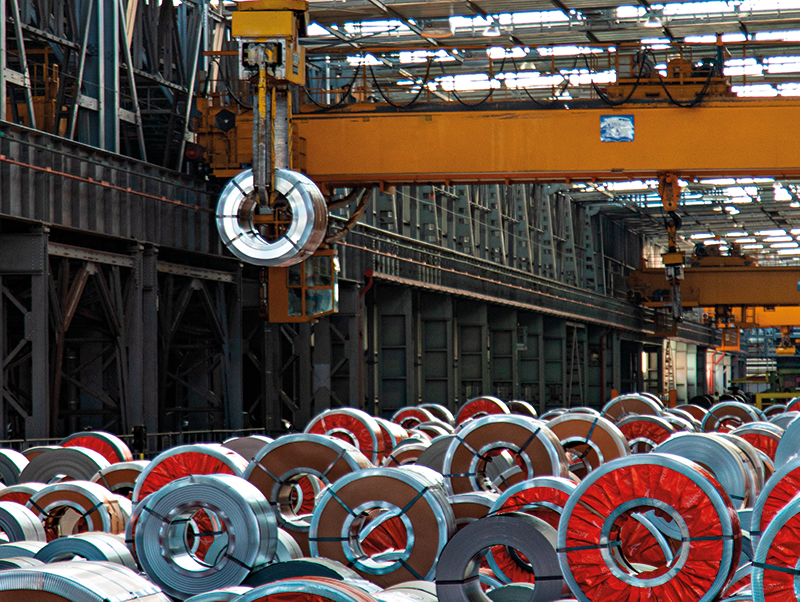
EU HRC market gears up for mill consolidation
The European hot-rolled coil (HRC) market is gearing up for potential consolidation over the coming year, as mills grapple with tough market conditions.
The share prices of key European producers have rallied in recent days, despite continued weakness in HRC prices. Global steelmaker ArcelorMittal’s shares traded above €22/share ($24/share) on the Luxembourg Stock Exchange at 12:30 GMT today, up from €19.70/share on 10 September. This strength is partly attributable to the expected release of economic stimulus measures in China, and the US Federal Reserve’s recent interest rate cut, sources suggest. But market strength could also be because of growing talk that a new wave of consolidation is on its way, fuelled by decarbonisation efforts and the strained positions’ of some mills.
There has long been talk that steel coil producer Tata Steel Netherlands could be sold, after the Dutch state agreed to contribute to its decarbonisation spend. Recent difficulties at Germany’s ThyssenKrupp have also sparked suggestions it could be an acquisition target. Czech Republic energy company EP Corporate Group (EPCG) recently completed its purchase of a 20pc stake in ThyssenKrupp’s Steel Europe division, and could increase this to 50pc in the near future. EPCG owner Daniel Kretinsky may be seeking a strategic partner to help run the business, sparking talks that other mills could bid for a stake in the company.
ThyssenKrupp shares were trading at €3.20/share on Deutsche Borse Xetra at 12:30 GMT today, up from €2.78/share on 10 September.
Concerns over strong positions in niche markets, particularly tin plate, saw Tata Steel and Thyssekrupp call off their proposed joint venture in May 2019. But the market is in a different position now. Some mills have reduced capacity but new entrants are trying to join the market as green producers. And the global market is oversupplied, putting European producers in a difficult financial predicament, especially given their capital-intensive efforts to decarbonise. In the case of ThyssenKrupp, expectations that the mill will reduce its production footprint could partially alleviate potential competition concerns in the event of a takeover.
