


Strategic steps for Steel: EU to outline long-term industry measures
On March 19, the EU plans to present an Action Plan on Steel and Metals, which will include additional sector-specific priority actions. This is stated in the report of the European Commission (EC) on the results of the Strategic Dialogue on Steel.
In addition, the plan will contain long-term steps to replace trade remedies that expire in June 2026. The document will also address a wide range of issues related to the industry, such as ensuring the commercial viability of clean steel production and responding to unfair trade practices.
The plan will include the results of a strategic dialogue with key representatives of the sector, which took place on March 4 under the chairmanship of EC President Ursula von der Leyen.
The strategic dialogue with the EC President brought together steel sector leaders and industry associations.
The European Steel Industry Association (Eurofer) welcomed the initiative. Eurofer CEO Axel Eggert said: “We are grateful that the Commission – at the very highest level – not only recognises these challenges but wants to work with our industry to find the right solutions».
The association continues to push for decisive action in four priority areas – trade defence measures, watertight CBAM, competitive energy prices and scrap retention in Europe.
Alexander Julius, President of EUROMETAL, which represents European steel, pipe and steel product distributors, emphasized during the dialogue that fair competition remains a crucial factor for the steel industry, and it is important for the EU to create a level playing field for the sector. In his opinion, this can be achieved by extending safeguard measures to semi-finished and finished products, which currently enter the bloc without hindrance. In addition, support for distribution, processing and manufacturing in the EU is important to stimulate innovation and create a basis for sustainable industrial activity, given Europe’s position between the US and China.
EUROMETAL also confirmed its willingness to actively participate in the CBAM working group.
As GMK Center reported earlier, on February 26, the European Commission presented the Clean Industry Agreement, a plan to support the competitiveness and future of manufacturing industries in Europe. The document positions decarbonization as a powerful driver for industrial growth. The Commission is also taking steps to make the regulatory environment more efficient, while reducing bureaucratic obstacles to business.


Spanish rebar prices keep moving up
Spanish rebar prices continue to rise, with levels gradually hiking by €15-20/tonne ($16.18-21.59) since the beginning of 2025. The recovery has been supported by increased demand in the construction sector, which is optimistic now at the start of the high season, sources tell Kallanish.
“Construction activity is resuming in Spain, with most private house building projects having started. The level of demand in the public sector is also higher. Increased activity is observed in the Valencia area, where recovery funds are already being used in the wake of the DANA [last October], Europe’s most catastrophic flood since 1967,” a market participant says.
The Spanish government is also prioritising large-scale infrastructure projects and works in the renewable energy sector, the source observes.
According to one distributor, rebar prices will remain stable in the coming weeks. “It is normal, at this time of the year, that purchases for small buildings improve. The end consumer is realising the market will not change much in March. April mill prices, however, will be subject to the current increase in scrap values,” he adds.
The monthly index for Spanish domestic rebar prices in February increased compared to the previous month, data published by the Spanish Chamber of Commerce show. The index stood at 190.51, up 1.34% on January. It was also up by 10.41% year-on-year. The index is based on a value of 100 in 2014.
16mm rebar is currently offered in Spain at €360-368/t ($353.3-360.5/t) ex-works base. An additional €262/t for size extras and loading expenses sees transaction values at €622-630/t delivered.
Todor Kirkov Bulgaria


ArcelorMittal’s Belval revamp approaches completion
ArcelorMittal’s SteelUp! project at Belval in Luxembourg is advancing to phase two and approaching completion. The brownfield project involves the modernisation of the site by relocating the production of semi-finished products fed to the Rodange sections mill – to reduce emissions and increase productivity.
New workstation installations will be operational, followed by a commissioning phase by year-end, Kallanish notes.
The project comprises a digitised “no man on the floor” electric arc furnace with increased safety, a 15% energy consumption reduction, and 15% heavy sections productivity hike. A new vacuum degassing system will reduce dissolved gas. The works include a continuous casting transformation system for new high-carbon steel grades and heavier beam blanks.
The scrap baskets will be enlarged to fill the furnace in one operation, boosting steel melting capacity each cycle. The company has completed the strengthening of the continuous casting.
“This reinforcement will enable the facility to produce a wide range of profiles, from 320 kg/m to 915 kg/m – a capability that typically requires two separate continuous casting lines at other steel plants. Additionally, the automation phase is now beginning, with the arrival of new extractors scheduled for September 2025,” the firm says. The new vacuum degasser will be commissioned by mid-2025.
The project also involves a new 150m² platform with a 100-tonne hot briquetted iron supply system. The HBI, used to make Rodange’s semi-finished products, is stored and distributed in a silo near the scrap yard. “This allows the creation of new metallurgical grades previously only achievable with blast furnaces.”
The modernisation will help to reach a certified low carbon footprint for steel of below 300kg per tonne, cutting CO2 by 200,000 t/year. The Belval site will obtain the XCarb label for rails produced from mill A.
The new Belval EAF costs about €67 million ($72.4m), including €15m from state subsidies.
ArcelorMittal Luxembourg produced 1.9 million tonnes of crude steel in 2023 and employs 3,368 workers. The new Belval EAF will increase ArcelorMittal Luxembourg production to 2.5m t/y of steel.
ArcelorMittal is investing in decarbonisation, product quality and increasing capacity at its Luxembourg long products facilities in Differdange and Belval.
Natalia Capra France
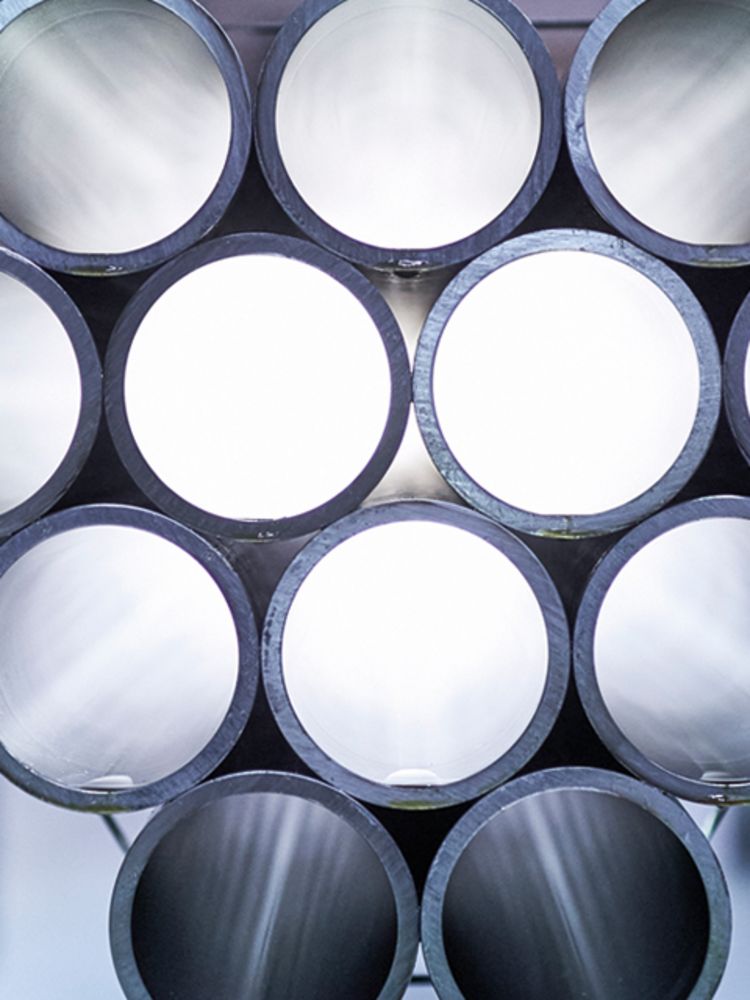
Wuppermann nears completion of new Austrian tube site
Wuppermann Metalltechnik GmbH (WMT) has celebrated the roofing ceremony for its new production hall in Altmünster, Austria, Kallanish hears from parent group Wuppermann AG.
With a total investment of around €39 million ($42m), the German processor is building a new plant for its specialist precision steel tube maker unit, WMT. The project was initially announced in mid-2023 and construction work started in April last year.
Two highly automated tube welding lines and fully automated primary material and finished goods warehouses will be installed in the new hall complex. The cranes and machinery for assembly are due to be delivered from mid-March.
With this investment, WMT says it will be able to produce complex profile shapes in future, significantly expanding both the range of dimensions and the strength spectrum of its products. During the ramp-up of the new profile line, the existing tube welding line will remain in operation, ensuring seamless supply to customers.
Christian Koehl Germany