


Voestalpine prepares tube segment cutbacks
Voestalpine will cut back on 150 jobs in its tubulars segment at the plant in Kindberg, Austria as a reduction measure caused mainly by the US import restrictions, company executives have said during its earnings conference call.
According to ceo Herbert Eibensteiner, the sales of seamless tubes have suffered from the US import duties, where the unit sells 15% of its production. Diversion to energy customers in the Middle East is not an option with war in Iran, Eibensteiner said. “We are aware of our social responsibility, and we are working on a redundancy plan with the works council until the end of November,” he added.
Not only are company’s exports from Europe to the US suffering, but also its operations in the US.
“There is a shortage of steel in the USA, so steel prices are skyrocketing, which affects our processing operations there,” cfo Gerald Mayer told Kallanish.
He noted that duties similar to the US were considered by Canada, but eventually dropped, “although the circumstances are the same as with the USA,” Mayer added.
At home in Austria, voestalpine is struggling with the Danube’s continued low water levels and continues to transfer transport to rail. Of 17 million tonnes/year of materials shipped to and from the plant in Linz, 10% come and go via the river. “That share used to be twice as much, so we have already achieved good progress in this regard,” Mayer noted.
Executives on the call also noted that its greentec project to transition to hydrogen-based direct reduced iron production is proceeding within the projected time frame and costs.
This comes as German producer thyssenkrupp Steel revealed the ramp-up for its own DRI plant will occur later than originally planned.


EU coil price targets cannot be passed down
Considerable price hikes for coil products from the northwestern European market leader have not caused a big stir among buyers yet. They maintain a reserved attitude, prefer to wait rather than buy, and point at the unwillingness of their customers to accept these hikes.
New prices heard in the market last week were confirmed this week by the mill to Kallanish at €820/tonne ($914/t) for hot-rolled coil, delivered, €900/t for hot-dip galvanized, and €940 for cold-rolled coil.
One trader finds it extremely hard to predict the actual demand of the next months that would justify such increases. “Stockholders want low inventories at year-end, and the question is, will there be a refill rally at the beginning of next year? And nobody can seriously tell,” he says.
Similar doubts are expressed by Scandinavian and German buyers, especially when it comes to handing the rises down. “We cannot push it through to our customers,” the Scandinavia states flatly.
On Dutch manager estimates that a premium of €30/t can be achieved until year-end, if taking a recent level of €760/t for HRC. But those regional sources find that this level has been passed now and see the price at €770/t and above.
Its possible that the announcement will suppress activity even more for a while, and lock buyers in their wait-and-see mode.
“The spot price for January/February delivery is only about to take shape,” one German service centre manager says. “I am certainly not shouting out loud that I want to buy,” he adds. “So, I am waiting for them to come knocking, but they have not come yet.”
UNESID present ten proposals to strengthen industry competitiveness
The Spanish steelmakers association UNESID has presented ten policy proposals aimed at strengthening the competitiveness of Spain’s steel industry, addressing high energy costs, unfair trade practices and the challenges associated with industrial decarbonization.
The proposals have been submitted to Spain’s main political parties ahead of the general elections scheduled for November 29, with the association calling on the next government to prioritize industrial competitiveness in its economic, energy and climate policies. Global steel overcapacity, high energy prices, competition from third countries and increasing regulatory requirements continue to threaten the sector’s competitiveness, according to UNESID.
Calls for electricity costs of €40/MWh for energy-intensive industries
Ensuring competitive energy costs for steel producers is among the association’s main priorities. Spain’s steel industry consumes approximately 10 TWh of electricity and 10 TWh of natural gas annually. To address high electricity costs, the association called for structural measures to bring final electricity costs for energy-intensive industries to approximately €40/MWh. The proposed measures include permanently reducing network charges and levies to the maximum extent permitted, reviewing electricity tariff periods and system adjustment costs, and maximizing compensation for indirect carbon emissions costs.
Specific support mechanisms for gas-intensive industrial consumers and emergency measures to address energy crises were also requested. In addition, the association emphasized the need to guarantee timely access to electricity grids, warning that insufficient grid capacity could delay industrial electrification and decarbonization investments.
EU ETS reform and stronger CBAM protection sought
Revisions to the EU Emissions Trading System (ETS) were also proposed to ensure that industrial decarbonization remains technologically and economically viable. In this regard, UNESID urged the EU to maintain sufficient free emissions allowances while carbon leakage risks persist, remove conditions that penalize industrial installations and prioritize reinvestment of ETS revenues in industrial transformation. Regarding the Carbon Border Adjustment Mechanism (CBAM), the association called for its scope to be extended as soon as possible to downstream steel products and for an effective mechanism to protect European steel exports.
It also proposed reviewing the timetable for phasing out free emissions allowances based on CBAM’s demonstrated effectiveness in preventing carbon leakage. Stimulating demand for low-carbon steel through public procurement, public support mechanisms and regulatory and fiscal incentives for private-sector consumption was also highlighted as a priority.
Global steel overcapacity prompts for stronger EU trade defense measures
Global steel overcapacity exceeds 640 million mt, creating pressure on European producers through subsidized imports and market distortions, according to UNESID. To address these challenges, the association called on the Spanish government to support the effective implementation of the EU’s new steel regulation and prevent future revisions from weakening its ability to address global overcapacity. The proposals also include extending the regulation’s scope in 2027 to products manufactured predominantly from steel, strengthening EU trade defense instruments and increasing resources for customs enforcement and market surveillance.
To strengthen demand for domestically produced steel, the association proposed introducing an effective European preference in public procurement, publicly funded investments and strategic industrial value chains. A target of at least 50 percent European-origin steel was recommended, with origin verified under the “melted and poured” principle.
UNESID also recommended applying technology-neutral low-emission criteria that recognize different steelmaking production routes. Any extension of the European-origin designation to third countries should be limited to reliable trading partners meeting equivalent European standards on labor, environmental protection, climate policy and fair competition, according to the association.
Spanish steel industry processes 9.3 million mt of scrap annually
Securing competitive access to steel scrap and other strategic raw materials was highlighted as essential to supporting low-emission steel production. According to UNESID, Spain’s steel industry processes approximately 9.3 million mt of scrap into new steel annually, recovers nearly 80 percent of its waste and byproducts, and recirculates more than 90 percent of the water used in production. The association also called for European policies supporting scrap availability, industrial recycling and the removal of unnecessary regulatory barriers to circular economy practices.
Other proposals include faster industrial permitting procedures, greater financial support for decarbonization investments and operating costs, and stronger innovation programs accessible to small and medium-sized steel companies. The remaining priorities include improving industrial employment conditions, workforce training and regulatory stability, as well as strengthening coordination between Spanish authorities responsible for customs controls and enforcement of EU trade and environmental regulations.
Author: SteelOrbis Editorial Team

Vattenfall uses SSAB Zero steel in German solar park, cutting carbon emissions by 67%
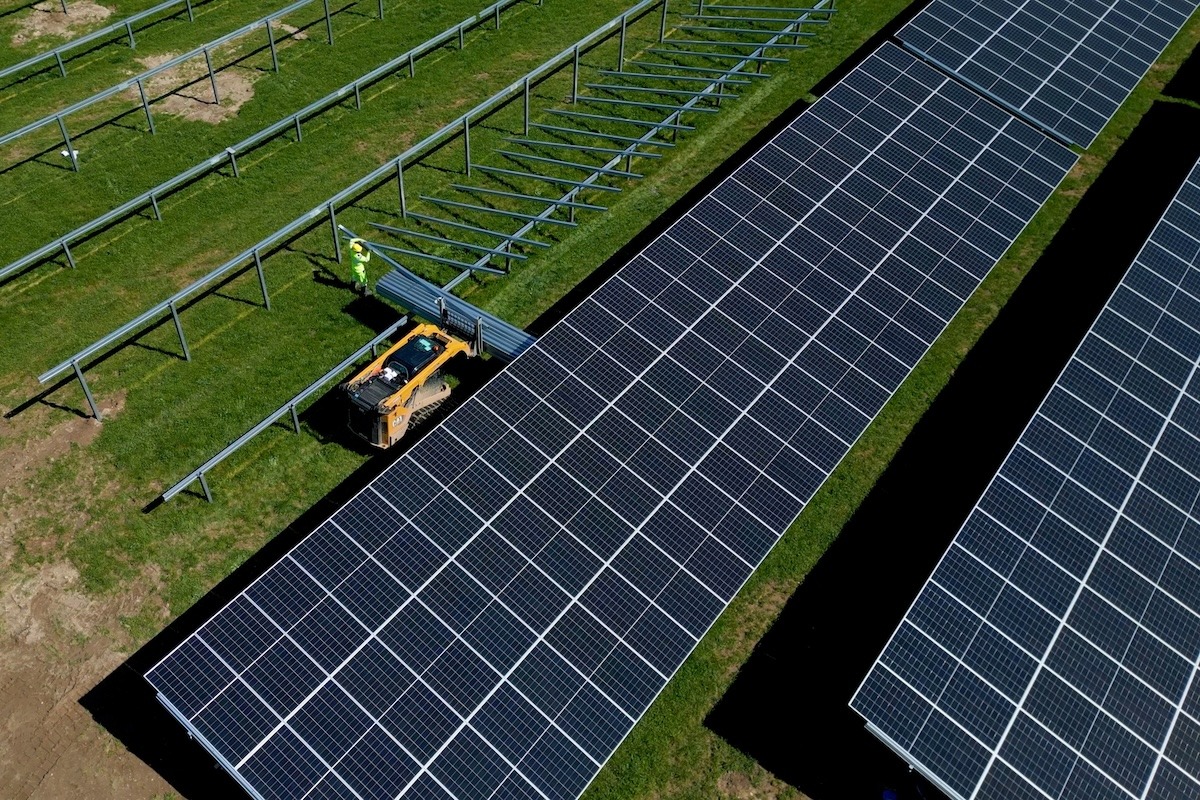
Swedish energy company Vattenfall has announced that it has used low-emission steel supplied by Swedish steelmaker SSAB for the solar panel mounting structures at its Juliusburg/Krukow solar park in Germany, reducing carbon emissions associated with the structures and their supply chain by 67 percent compared to conventional steel.
The 80 MW solar park in Germany’s Schleswig-Holstein state, was commissioned in the summer of 2026. Vattenfall has selected SSAB Zero steel for the solar panel substructures in the Krukow section of the project.
SSAB Zero steel offers 67% reduction in carbon emissions
According to Vattenfall, the mounting structures are manufactured using recycled steel produced by SSAB with fossil-free electricity. The company stated that technical evaluations showed SSAB Zero steel provides the same strength and quality as conventional steel, while the financial impact of using the material was considered reasonable in relation to the sustainability benefits.
Vattenfall noted that using lower-emission materials in solar park construction is part of its efforts to reduce emissions associated with renewable energy projects, including those generated during the construction phase and throughout the supply chain.
Solar park expected to generate up to 80 GWh of electricity annually
The Juliusburg/Krukow solar park has a nominal capacity of 80 MWp. According to Vattenfall, the facility can generate up to 80 GWh of fossil-free electricity annually.
Meanwhile, Vattenfall stated that it is also using low-emission steel in other renewable energy projects, including the Clashindarroch II onshore wind farm in the UK and the Nordlicht offshore wind cluster in the German North Sea.
SSAB stated that the use of SSAB Zero steel in the solar park demonstrates how lower-emission materials can be incorporated into renewable energy infrastructure while maintaining the performance and quality of conventional steel.
Author: SteelOrbis Editorial Team

Steel prices in Europe to increase in Q4, outlook stays positive: ArcelorMittal
Prices of flat and long steel products in Europe are expected to keep rising in the fourth quarter of 2026, adjusting to higher energy costs, global steel producer ArcelorMittal said in its report for the third quarter of 2026.
The company added that this would also affect the annual contracts for flat steel products, which represent more than 25% of Europe’s flat steel production volumes. The negotiations for the long-term contracts are still running, but Fastmarkets’ hot-rolled coil (HRC) indices have already shown an upward trend.
Producers in Northern Europe were heard seeking increases of €100-150 ($112-168) per tonne for long-term agreements for the first half of 2027 from levels agreed for the second half of 2026, but were unlikely to secure more than half of the requested increase, sources told Fastmarkets on October 30.
The average quarterly price of HRC in Northern Europe in the first quarter of 2026 was €671.70 per tonne, increasing to €695.13 per tonne in the second quarter and €723.87 per tonne in the third quarter of the year, Fastmarkets’ daily steel hot-rolled coil index domestic, exw Northern Europe showed.
A similar trend could be observed in Southern Europe. The average quarterly price of HRC in Italy was €659.86 per tonne in the first quarter, increasing to €685.56 per tonne in the second quarter and €713.57 per tonne in the third quarter, Fastmarkets’ daily steel hot-rolled coil index domestic, exw Italy showed.
EU trade measures to support the positive trend
ArcelorMittal also expects the growth of flat steel shipments in Europe to accelerate during Q4 of 2026, reaching a double-digit year-on-year increase. The steel producer added that the medium- and long-term perspective remained positive, with the implemented EU trade measures contributing to the optimistic expectations.
On June 30, the European Commission announced tighter steel import quotas, which came into effect on July 1. “Enhanced EU trade measures are beginning to rebalance European steel market fundamentals, reducing import penetration and supporting higher domestic capacity utilization,” ArcelorMittal said in its report.
The steel producer added that after the implementation of the new tariff rate quota (TRQ), the company has brought all its European blast furnaces back into operation.
“The additional policy measures to expand protection downstream could further strengthen European industrial competitiveness and, with it, domestic steel demand, building on the positive impact already seen from enhanced steel trade measures,” the steel producer added.
Q3 results of the European division
Despite the positive expectations, the European division of the company reported a 4% decrease in crude steel production to almost 7.25 million tonnes in Q3 of 2026 compared to the previous quarter of the year, when it was 7.55 million tonnes. Crude steel production in Q3 of this year was also slightly lower than in the corresponding quarter of 2025, when it was 7.25 million tonnes.
Crude steel production of ArcelorMittal Europe was 21.63 million tonnes in the first nine months of 2026, compared to 22.77 million tonnes in the same period a year earlier.
Flat steel shipments in Europe increased by 1.1% to 5.19 million tonnes in Q3 of 2026 compared to the previous quarter, ArcelorMittal said. According to the company, this was related to normal seasonal trends and reflected the early impacts of the new TRQ mechanism. ArcelorMittal Europe’s flat steel shipments in Q3 of 2026 were also higher than those reported in the same period in 2025, when they were 5.07 million tonnes.
For the first nine months of 2026, flat steel shipments amounted to 15.65 million tonnes, still slightly lower than in the same period in 2025, when they were 15.73 million tonnes, ArcelorMittal’s recent report showed.
Long steel shipments in Europe amounted to 1.72 million tonnes in Q3 of 2026, compared to 2 million tonnes in the previous quarter. The long steel shipments in Q3 of 2025 were 1.93 million tonnes.
For the first nine months of 2026, the long steel shipments in Europe amounted to 5.51 million tonnes compared to 6.12 million tonnes in the same period last year. ArcelorMittal said that the decline was linked to seasonal factors. In addition, the impact of lower imports was offset by inventory destocking.
The European division of ArcelorMittal reported earnings before interest, taxes, depreciation and amortization (EBITDA) amounting to $548 million in Q3 of 2026, compared with $697 million in the previous quarter of the year.
This reflects the impact of lower long product shipments and a temporary mismatch between rapidly rising input costs and realized selling prices, according to ArcelorMittal.
EBITDA in Q3 of 2026 was higher compared to the same quarter of 2025, when it reached $513 million.
For the first nine months of 2026, EBITDA of ArcelorMittal’s European division reached $1.7 billion compared to $1.5 billion in the same period of 2025.
Decarbonization in progress
ArcelorMittal underlined in its Q3 report that the energy transition remained an attractive opportunity for the company, with electric-arc furnace (EAF) investments playing a key role in the decarbonization of its steelmaking footprint.
The company added that its EAF project in Gijón (with planned capacity of 1.1 million tonnes per year) and the Sestao expansion were on track for commissioning in Q4 of 2026, with ramp-up through 2027.
The EAF at Dunkirk has moved into execution, the company added. At Dunkirk, ArcelorMittal is preparing to build a 2 million tonne per year EAF alongside a ladle metallurgy furnace (LMF), as part of its move toward lower-carbon steelmaking.
“Together, these projects are expected to add approximately 3.9 million tonnes per year of EAF capacity by 2029, supporting both decarbonization and long-term value creation,” ArcelorMittal said.
