


European HRC prices edge higher as mills seek increases for early 2027
European hot-rolled coil (HRC) prices edged higher on Friday November 6, as mills continued to seek price increases for early 2027 deliveries, sources told Fastmarkets.
In Northern Europe, a buyer source reported a deal at €770 ($865) per tonne ex-works for January delivery, with workable levels indicated at €760-780 per tonne ex-works.
No other price points were received during the day. For this reason, all prices from Thursday’s index were carried over to the following day, in line with Fastmarkets’ methodology.
A seller source provided an indication of tradeable levels for December production volumes at €750 per tonne ex-works, and at €760-770 per tonne ex-works for January production.
A buyer source reported an indication of tradeable levels for December production volumes at €750 per tonne ex-works and for the first quarter of 2027 within the range of €760-770 per tonne ex-works.
Another buyer source provided an indication of tradeable levels at €770 per tonne ex-works.
Fastmarkets’ daily steel hot-rolled coil index domestic, exw Northern Europe was calculated at €761.25 per tonne on Friday November 6, up by €1.67 per tonne from €759.58 per tonne on Thursday November 5.
The index was down by €10.50 per tonne week on week and by €16.25 per tonne month on month.
In Italy, a source from a large producer told Fastmarkets that material for January was being offered for €750-765 per tonne ex-works. A buyer source said that material was still available for €740-745 per tonne ex-works.
No other price points were received during the day or on Thursday.
On Wednesday, a source at a local mill said the producer had already closed its sales for the fourth quarter of 2026, with the latest deals done at around €740 ($828) per tonne ex-works. The same source added that the mill was aiming to defend €750 per tonne ex-works as the minimum level for the first quarter of 2027 deliveries.
On Tuesday, a buyer reported an offer at €760 per tonne delivered, which is equivalent to €740-745 per tonne ex-works after deducting delivery costs of €15-20 per tonne. The same source said they were hearing workable levels mainly in the range of €750-770 per tonne delivered, or around €730-755 per tonne ex-works.
As a result, Fastmarkets’ daily steel hot-rolled coil index domestic, exw Italy was calculated at €747.29 per tonne on Friday November 6, up by €1.79 per tonne from €745.50 per tonne on Thursday November 5.
The index was up by €1.98 per tonne week on week and by €2.29 per tonne month on month.


Italy local steel plate prices widen upward on latest deals; Northern Europe remains quiet
Local steel plate prices widened upward in Italy on latest deals for delivery in 2026 and remained stable in Northern Europe on limited market activity, sources told Fastmarkets in the week to Thursday November 5.
Italy
In Italy, latest deals for delivery in the last quarter of 2026 were reported within €740-760 ($831-854) per tonne ex-works by a local producer, who said its sales from December production were mostly closed.
It also reported booking plate for January delivery in 2027 at €780-820 per tonne ex-works, but this range was discarded from the assessment as it was linked to project orders.
The same producer said it heard other competitors selling plate at lower prices within €730-740 per tonne ex-works, but only for sizeable orders in Italy and other markets.
The lower end of the range at €730 per tonne ex-works was not considered in the final assessment due to a lack of details about the volume of the orders and a lack of corroboration among other sources.
Other market participants reported indications of tradeable levels within €740-750 per tonne ex-works for December delivery and said mills were targeting offers at €780 per tonne ex-works for January delivery. However, this level had not yet been achieved.
“Italian plate prices remain stable, with purchasing activity continuing at a steady pace. Market participants expect buying activity to remain at current levels in the coming weeks,” a trade source said during the week.
As a result, Fastmarkets’ weekly price assessment for steel domestic plate 8-40mm, exw Southern Europe was €740-760 per tonne on Thursday November 5, widened upward by €10 per tonne from €740-750 per tonne a week earlier.
On the plate import side, an offer was reported at €820 per tonne DDP Spain, but it was discarded from the CFR-based assessment, while there was also a lack of details about the origin and grade specifications.
Fastmarkets’ weekly price assessment for steel plate (8-40mm), import, cfr main port Southern Europe was stable at €710-750 per tonne on Thursday.
Meanwhile, a trade source said during the week that Russian steel slab deliveries to Italy were complicated due to the disruptions of shipments through the Black Sea, limiting the imports of slab more than 250 mm thick, which is used in the production of thick steel plate.
The Russian slab import quota reopened in October but was little changed by November 6, Fastmarkets reported on Friday.
Fastmarkets’ weekly price assessment for steel slab, import, cif Italy, was $580-600 per tonne on Thursday November 5, widened upward by $10 per tonne from $580-590 per tonne a week earlier.
Northern Europe
In Northern Europe, market activity was very slow, as most German mills were reportedly already fully booked for 2026 due to strong demand coming from pipe projects, sources said.
One trade source said that a local producer did not have much room to produce plates for the ordinary market due to the big orders for the pipe projects.
The same source reported an indication of workable levels within €840-880 per tonne ex-works, unchanged from indications reported a week earlier.
They added that mills were seeking increases of €30-40 per tonne for deliveries in the first quarter of 2027 but could not confirm the final figures.
For this reason, Fastmarkets’ latest weekly price assessment for steel domestic plate 8-40mm, exw Northern Europe remained stable at €840-880 per tonne on November 5.
No fresh information was heard regarding plate imports into the region, as sources were quoting high risks related to the Carbon Border Adjustment Mechanism (CBAM) costs.
Fastmarkets’ weekly price assessment for steel plate (8-40mm), import, cfr main port Northern Europe was €710-750 per tonne on Thursday, unchanged from the previous week.

Italian rebar prices rise on production cost pressure; demand remains weak
Italian rebar prices rose during the week to Wednesday November 4, with mills pushing for higher levels to offset rising energy and transport costs, while underlying demand remained subdued.
Market participants said the upward movement was primarily driven by increasing production costs rather than any meaningful improvement in buying activity.
“Demand remains relatively flat and subdued, and the main driver behind the recent increase in rebar prices appears to be the continued pressure from high energy costs,” one buyer source told Fastmarkets.
Electricity prices in Italy rose at the beginning of the week, while gas prices were also reported at significantly higher levels, adding further pressure to steelmaking costs, sources said.
“As a result, steel mills are taking an even firmer stance on pricing,” a distributor source said.
Sources added that rising production costs were prompting mills to seek higher prices for new orders to offset lower margins on previously accepted business, particularly in export markets.
Truck driver demonstrations in the previous week had caused logistical disruptions in southern Italy, resulting in delivery delays and material shortages at some construction sites.
“The transport situation appears to have returned to normal following the disruptions of last week,” one buyer source told Fastmarkets.
Transport costs nevertheless remained elevated.
“Transport costs remain extremely high, as truck operators are only willing to operate if they are adequately compensated,” a producer source told Fastmarkets.
In northern Italy, particularly around Brescia, workable levels and deals were reported at €760-770 ($850-862) per tonne ex-works, although some market participants indicated that prices could reach €780 per tonne.
In southern Italy, workable levels were heard at €770-790 per tonne ex-works, with a deal reported at €790 per tonne. Offers were heard at €770-780 per tonne, while mills were also pushing indicative offers higher, to €790-800 per tonne.
As a result, Fastmarkets’ weekly price assessment for steel reinforcing bar (rebar), domestic, exw Italy narrowed upward to €760-790 per tonne on November 4, from €750-790 per tonne one week earlier.
Fastmarkets’ weekly price assessment for steel reinforcing bar (rebar), domestic, delivered Spain, was unchanged at €750 per tonne.
In Northern Europe, one market participant reported a workable range of €700-740 per tonne delivered, but these levels could not be confirmed by other market sources during the assessment period.
Fastmarkets’ weekly price assessment for steel reinforcing bar (rebar), domestic, delivered Northern Europe, was therefore unchanged at €660-700 per tonne on November 4.
No fresh price indications for European wire rod were heard during the assessment period, amid limited trading activity.
Fastmarkets’ weekly price assessment for steel wire rod (mesh quality), domestic, delivered Southern Europe, was unchanged week on week at €670-680 per tonne.
Fastmarkets’ weekly price assessment for steel wire rod (mesh quality), domestic, delivered Northern Europe, was also unchanged at €705-715 per tonne on November 4.

247TailorSteel announces new ceo and further growth plans
Dutch service centre group 247TailorSteel has announced the appointment of Steven Ruijters as new chief executive. Ruiters comes from Dutch pipe distributor Royal Van Leeuwen, Kallanish hears.
He started his career in 1999 at thyssenkrupp Materials Nederland, where he took on responsibility as branch director after several roles. In 2017 he moved to Royal Van Leeuwen, and since 2024 had been regional managing director at Benelux, responsible for all business units in the Netherlands and Belgium.
At Van Leeuwen, he led several acquisitions and integrations, as well as major warehouse modernisation and digitalisation projects, 247TailorSteel notes.
Chairman of the supervisory board Remko Rosman said the company plans to continue expanding in the Netherlands and in its key growth markets, DACH and Belgium. While the company’s announcement does not mention his predecessor, Ruijters succeeds Carl Berlo, who became ceo in early 2021.
The company is a manufacturer of custom-made sheet products with six locations in the Netherlands, Germany and Belgium. It was one of few steel processors/distributors that exhibited at the Euroblech trade fair. At the same time as Ruijters, Hilko Pruntel joined the company as the new chief buyer of coil and strip.

Nordic steel demand continues slow improvement: BE Group
Steel demand in Europe’s Nordic region is likely to continue to improve at a slow pace, says Sweden-based distributor BE Group in its outlook on the fourth quarter.
The manufacturing industry is expected to show a positive development, Kallanish notes. Activity in the construction market will be driven primarily by industrial and infrastructure-related projects, while residential construction remains subdued, BE notes.
In Q3, the Nordic steel market was characterised by a gradual but uneven recovery. Activity in the manufacturing industry was more stable than in the previous year, but demand varied and planning horizons remained short, BE observes.
The listed company saw its revenue in the first nine months of the year increase to SEK 3.05 billion ($310 million), up by SEK 43m compared with the same period last year. Operating profit was SEK 10m, following a loss of SEK 61m in the previous nine-month period.
The items affecting comparability relate to restructuring costs for the consolidation of the sheet metal processing operations in Finland from Lahti to Lapua. BE expects the measure to strengthen its offering and competitiveness and improve Ebit by approximately SEK 20m annually, with full effect from 2028.
Joint venture ArcelorMittal BE Group SSC AB made a positive contribution to the group’s earnings, BE adds, without giving details.
German rebar prices take another leap
German rebar mills have this week communicated another price leap that will take their base prices to around €500/tonne ($561). Including the average size extra of €265, rebar could now be offered at as much as €765/t delivered.
“We had a quite turbulent two weeks,” one central German manager tells Kallanish. In this time, mills lifted their offers in two steps by a total of €70-90/t, depending on the earlier base prices achieved, which a month ago were still at €410-430/t. In addition, with effect from 1 November, mills lifted the surcharge for wire mesh for the first time in 15 years – by €25/t.
In October, Kallanish heard from one mill source that “the price level in Germany is now rising steadily, driven by clear cost increases for all producers.” Many buyers say they had been forewarned last week by the mills that prices would climb further, but were still taken by surprise by the size of the hikes.
According to the buyer of a large distribution group, energy costs are the mills’ prime argument for the hikes, especially for mills that depend on the spot market for power supply.
What remains unclear is the attitude of Italian mills towards their German customers, with respect to a pricing anomaly observed one month ago. In the first half of October, their base price offers to Germany, around €420/t, were much lower than those offered to domestic customers, at €480/t.
The result of this is unclear because Italian mills have left the market this week. “I’ve reached out to them, but they need to sort out the picture for themselves before making a move,” the buyer says.
Another manager notes: “The Italians are now following the German prices. Actually, the Germans are following the Italian prices; you can look at it both ways.”
Acciaierie d’Italia begins shutdown of blast furnaces at Italy’s largest steel plant
Italy’s Acciaierie d’Italia has begun the physical shutdown of blast furnaces at its Taranto steelworks, trade unions told Platts Energy on Nov. 3, in a move that marks the effective end of ironmaking at Italy’s once largest steel producer. The company informed union representatives on Nov. 3 that contractor LIZ Italia had begun switching off the burners used to maintain the cowper stoves of the blast furnaces in a preheating state, with all shutdown activities expected to be completed by the end of the week, unions said.
The move follows an Oct. 30 ruling by Italy’s Supreme Court, the Corte di Cassazione, which rejected extraordinary appeals filed by both Acciaierie d’Italia and Ilva in extraordinary administration against a Milan Court of Appeal order requiring the shutdown of the hot-end section of the steelworks on environmental grounds. The ruling covers all hot-end assets: blast furnaces N1, N2 and N4, as well as the coking batteries, all of which had been kept in preheating conditions.
The Taranto plant, formerly known as Ilva and once the largest integrated steelworks in Europe, has been at the center of a prolonged legal, financial and environmental dispute. Its curtailment carries significant implications for European flat steel supply and for trade flows of both raw materials — including coking coal and iron ore — and finished steel products such as hot-rolled coil.
While ironmaking operations are being wound down, unions said limited activity in the rolling division is still planned, though on an intermittent basis.
The intermittent rolling activity suggests the plant may be processing residual semi-finished steel inventory rather than material produced on-site, given that no pig iron has been produced at Taranto since the last operational blast furnace, BF N2, was halted in early October and subsequently placed in preheating mode. BF N1 has been inactive since May 2025, when it was seized without right of use by the Taranto public prosecutor’s office following a fire. BF N4 had been halted for maintenance and was originally scheduled to restart at the end of April, but the restart never took place.
The future of the facility remains uncertain ahead of a Nov. 9 deadline for binding offers to acquire the company. Antonio Gozzi, chairman of Federacciai and head of an Italian consortium evaluating a potential purchase of Acciaierie d’Italia, told S&P Energy by phone Nov. 3 that the group had completed its due diligence but was still weighing all available information because of the situation’s complexity.
Gozzi said that while importing semi-finished products for re-rolling could serve as a transitional solution, it is not thinkable for the business over the long term. “In the long term, there is the need for Acciaierie d’Italia to produce crude steel; for the time being and as a transitory solution it will be ok to import semi-products to reroll, but this should not be the long-term solution,” Gozzi said. “It is impossible for ADI business in the long run not to have a hot-end part there; it is important to have a hot-end decarbonized, so with Electric Arc Furnaces,” he said.

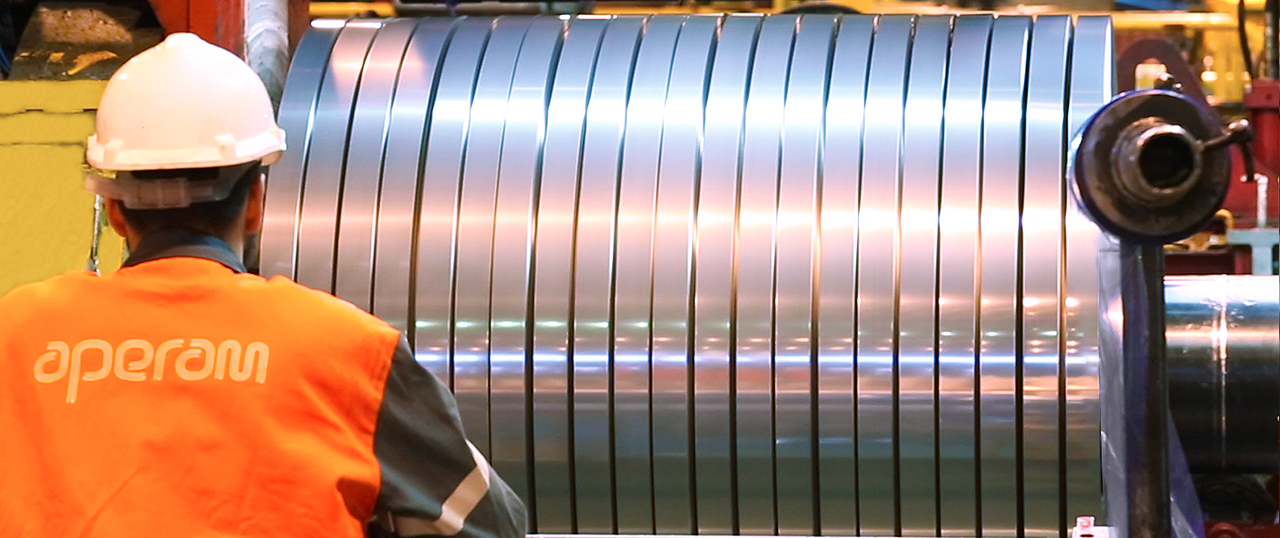
Aperam Jan-Sept steel shipments rise 1.7% on year
Stainless and specialty steel producer Aperam’s total shipments in the first nine months of the year rose 1.7% year over year to 1.76 million metric tons, it said in its third-quarter results released Nov. 6.
Aperam’s major stainless and electrical steel segment saw nine-month shipments fall 1.5% year over year to 1.23 million mt, with the average steel selling price at €2,331/mt, up from €2,241/mt a year ago.
The company said the lower steel shipments in the segment were linked to the European summer slowdown.
The services and solutions segment saw January-September shipments drop 7% year over year to 518,000 mt, with the average selling price remaining relatively steady at €2,867/mt.
It said the segment’s shipments had been affected by weaker seasonal demand in Europe in the third quarter.
In Aperam’s alloys and specialties segment, shipments were stable year over year at 46,000 mt, with the average steel selling price at €17,147/mt, down from €17,840/mt in Q3 2025.
Shipments in the recycling and renewables segment increased 9.3% year over year to 1.1 million mt, with the average selling price at €1,278/mt, up from €1,225/mt in Q3 2025.
Platts, part of S&P Global Energy, assessed European 18-8 stainless steel scrap solids at €1,324.20/mt on a CIF Rotterdam basis Nov. 5, up 12% since the start of 2026.
Aperam CEO Sud Sivaji said the third quarter of 2026 had seen the best Q3 performance in four years.
“This performance, in the context of the seasonality and the weak demand in Europe, reinforces our hard work as we invest in expanding Aperam beyond Europe and beyond stainless production,” he said in the results statement.

ArcelorMittal’s third-quarter EBITDA increases 34% year on year to USD 2.02 billion


European HRC mills seek higher Q1 prices; spot activity remains slow
The European local steel hot-rolled coil (HRC) market was moving up slowly, as mills pushed for higher prices in negotiations for the first quarter of 2027, but spot market activity was slow due to limited availability of material for shipment in the remainder of 2026, sources told Fastmarkets on Wednesday November 4.
In Italy, spot market activity was limited as producers were mainly focused on securing annual contracts for the first quarter of 2027, sources said.
A source at a local mill said the mill had already closed its sales for the fourth quarter of 2026, with the latest deals done at around €740 ($828) per tonne ex-works.
The same source added that the mill was aiming to defend €750 per tonne ex-works as the minimum level for Q1 2027 deliveries.
“However, in terms of Q1, the focus today is on the closure of the annual contracts (mostly index-based), only afterwards we expect some spot activity,” the producer source said.
No other price points were received during the day. On Tuesday, a buyer reported an offer at €760 per tonne delivered, which is equivalent to €740-745 per tonne ex-works after deducting delivery costs of €15-20 per tonne.
The same source said they were hearing workable levels mainly in the range of €750-770 per tonne delivered, or around €730-755 per tonne ex-works.
As a result, Fastmarkets’ daily steel hot-rolled coil index domestic, exw Italy was calculated at €745.50 per tonne on Wednesday November 4, down by €0.50 per tonne from €746 per tonne on Tuesday November 3.
The index was up by €3.87 per tonne week on week and by €3 per tonne month on month.
In Northern Europe, sources said mills were targeting higher prices amid strong order books and limited imports. However, buyers were slow in accepting them due to relatively muted demand.
A buyer reported an indication of workable levels at €780 per tonne delivered on Wednesday, equivalent to €760-765 per tonne ex-works after deducting delivery costs of €15-20 per tonne.
The same source said offers were in the range of €780-800 per tonne delivered, or around €760-785 per tonne ex-works.
The buyer added that it had previously booked volumes at lower prices and now needed two to three weeks to assess how much more material it would need for the first quarter of 2027.
No other price points were received during the day, as market activity was slow. Mills were also focusing on long-term contracts in the region, aiming to achieve increases of €100-150 per tonne for the first half of 2027 compared to levels agreed for the second half of 2026, sources said previously.
On Tuesday, two buyers reported an indication within the range of €750-760 per tonne ex-works.
A third buyer reported an indication of tradeable level within the range of €770-780 per tonne ex-works and offers for January-March production within the range of €800-830 per tonne delivered, which is equivalent to €780-815 per tonne ex-works.
The offers were discarded from the index calculation, as levels at the upper end of the range were for February and March production, while material with earlier production time was available.
The active prices from Tuesday were carried over to Wednesday’s index due to the limited fresh input.
As a result, Fastmarkets’ daily steel hot-rolled coil index domestic, exw Northern Europe was calculated at €764 per tonne on Wednesday November 4, up by €2.33 per tonne from €761.67 per tonne on Tuesday November 3.
The index was up by €12.75 per tonne week on week and by €20.67 per tonne month on month.
Vlada Novokreshchenova in Dnipro, Ukraine, contributed to this article.