

Italy’s Supreme Court orders permanent closure of Acciaierie d’Italia (ADI)
Italy’s Supreme Court ordered the permanent shutdown of the hot area of Acciaierie d’Italia (ADI) following an appeal, according to a ruling published on 29 October.
Earlier in October, the steelmaker had temporarily idled its furnaces, pending the Supreme Court’s decision, which was seen as the last hope of saving operations at the Taranto plant. Following the ruling, operations in the hot area must be stopped.
The final ruling followed a lengthy legal battle as ADI attempted to appeal earlier rulings ordering the closure of its liquid steel production facilities. On 11 September, Milan’s Court of Appeal upheld an earlier order to shut down ADI’s hot area. This ruling rejected an appeal against the previous decision to close the hot section of the Taranto plant.
On 27 July, the Milan Court of Appeal ordered ADI to shut down its operations within the next 90 days – by 24 October. According to the ruling, ADI was required to completely remove all asbestos present at the site and implement measures to reduce dust emissions to the regulated limits. The Milan court originally ordered the suspension of production at the plant on health grounds in late February 2026.
Although ADI’s steel output was around 1 million tonnes and its presence in the spot market had been limited, the order to close production came at a time when the EU had significantly restricted access to its market for imports through new quotas introduced on 1 July 2026. Overseas material had also become more expensive due to Carbon Border Adjustment Mechanism (CBAM) duties. European buyers had started relying more heavily on domestic supply, and the removal of ADI’s additional production volumes further supports price increases and raises concerns about potential shortages.
Italian buyers have already started sourcing slabs from China, India and Turkey, as imports of semi-finished products are not subject to EU quotas or other trade measures. Buyers plan to use domestic rolling capacities, notably ADI’s rolling mills, to produce coil and replace the missing import volumes.
Author: Maria Tanatar


EU backs AD duties on CRC from five countries
EU member states voted in favour of definitive anti-dumping duties on cold-rolled flat steel imports from five countries – India, Japan, Turkey, Vietnam and Taiwan, China – on 29 October, market sources told McCloskey.
Fifteen member states voted in favour of the measures, nine abstained and three voted against.
The measures will come into effect once the implementing regulation is published in the Official Journal of the European Union.
Earlier in October, the European Commission revised the proposed anti-dumping duty rates for the material originating from Turkish, decreasing them to 3.0-7.8% from the originally suggested 5.6-9.7%.
The European Commission initiated the anti-dumping investigation following a complaint lodged by the European steel association Eurofer in September last year. The EU authorities decided against imposing provisional duties, making the retroactive application of measures impossible.
Dow Jones Energy tracks steel trade protection developments in its Global Steel Trade Measures Database, which is updated monthly.
Author: Benjamin Steven
UK construction upping sustainable sourcing on EPD ties
While the UK’s construction sector is increasingly incorporating sustainability criteria into its steel procurements, it is unlikely that consumers will engage with overly-sophisticated green steel standards, Dow Jones Energy heard at ACI’s Future of Green Steel event in London 28-29 October.
The conference had strong representation from the UK’s construction operators, giving their perspective on the UK’s emerging green steel market.
Overall, sentiments were positive: attendees reported increased consideration in public tenders for the sustainability of a project bid, with low-carbon steel presenting a relatively simple means of reducing carbon footprints due to the weight of emissions embedded in, for example, foundational steel structures.
Private sector interest is less evident, though London was repeatedly cited as an outlier, demonstrating increased preference for lower-carbon bids for new residential and commercial developments. Construction attendees expected this trend to expand beyond London and across the UK as local authorities are pushed to incorporate non-price criteria.
The trend is developing, but nascent, as engineering firms estimated that sustainability factors would only be workable below 2% cost premium. As soon as low-carbon sourcing pushes project costs beyond 2%, bids win on price, limiting what buyers will pay for green steel and creating a preference for established scrap-based electric arc furnace (EAF) producers. Construction firms stated that they were not aware of ever having lost a public tender on sustainability criteria.
Of course, this 2% margin is spread across the entire project bid, so whether firms pass on a green premium for using low-carbon steel is assessed on a case-by-case basis. A construction company said that on one recent bridge project bid currently under consideration, green EAF slab processed into low-carbon heavy plate on a tolling basis was incorporated at a 5-10% price premium, while previous bids did not attempt to charge additional costs for EAF-based steel.
For direct spot sourcing, distributors and consumers continue to see little interest in paying extra to hold green steel stocks, especially while markets lack a clear definition or standard for what actually constitutes lower carbon steel.
Sessions at the conference explored the difficulties in harmonizing a global – or even national – green steel standard in great detail, as global scrap supplies are insufficient to support an entire sector transition, and integrated blast furnace producers arguably need some access to premium low-carbon markets to ensure they can survive long enough to see their transformation projects to completion. Green standards like those of ResponsibleSteel, or LESS, thus grant cleaner classifications to steel products the lower the share of scrap in their production, to incentivise transformative low-carbon ironmaking developments such as green hydrogen-based direct-reduced-iron (H2-DRI).
This is particularly relevant to the construction sector – a frontrunner in creating real demand for lower-carbon steels – as construction operators are already subject to sustainability criteria via legislation like the EU’s Construction Products Regulation (CPR), project certification requirements, local authority permitting policies, and more. As an example, British Steel has criticised that Welsh procurement criteria restricts their steel from consumption in infrastructure projects, imposing a carbon footprint limit within the UK’s domestic market that British Steel’s output is currently unable to satisfy.
For construction attendees, how ‘green’ a steel is considered to be is entirely set by its EPD value, and there did not seem to be much appetite to widen that definition to accommodate the complexities of the steel sector’s transition. In the words of construction representatives, green steel procurement is “simply looking for the lowest number on the EPD” as that is what is required for the tender. While downstream operators were surprised by the degree of sophistication, and potential impacts, of defining green steel in different ways – for example with scrap content-based adjustments – there was evident sentiment that this was not really their problem to solve, especially when steelmakers themselves have such difficulty in reaching a compromise on standardisation.
For example, the EU steel lobby has only recently reached a form of compromise on its preferred green steel definition: scrap content-based adjustments to classification thresholds would be limited to carbon flat steels, and select carbon long steels, with most long steel, and stainless steel products assessed on a product carbon footprint approach without adjustments.
The EU’s green steel label was originally to be contained in the Commission’s Industrial Accelerator Act proposal, but was cut and postponed to delegated acts of the Ecodesign for Sustainable Products Regulation (ESPR), disagreements on scrap-content adjustments playing a primary role. This delegated act was due for publication before end of year, though sources now expect delivery in H1 2027.
As discussed across the conference sessions, much of the debate comes down to what extent a green steel definition should stimulate decarbonisation of the steel sector directly – requiring process emission reductions from blast furnace steel’s polluting ironmaking stages – versus individual company operations. Different interpretations of ‘decarbonisation’ entail different standards, but increasing scrap-EAF steelmaking alone arguably redistributes, as opposed to reducing, overall steel sector emissions.
Construction steel consumers may appreciate the need for green ironmaking, but “who pays” remains the main question, and if they already have low-carbon EAF steel available and compatible with their existing sustainability requirements, then they are unlikely to want to pay more, especially for higher carbon blast furnace material allowed into green classifications as a CAPEX incentive for integrated steelmakers. Construction companies also generally secure their steel supply via distributor intermediaries, and so while green steel premiums may often be negligible against the cost of an entire project, premiums seen in Europe of EUR100-300/t are certainly not offering distributors much of a margin, if at all.
Scrap-based adjustment standards could also force consumers to source higher priced DRI-EAF steel imports to meet requirements, and scrap-based EAF steels consumed independently of sustainability mandates could see prices follow higher. Changing the core role of EPD certifications in construction steel trade would also be a large administrative hurdle, and so decarbonisation incentives for primary ironmaking may be better placed directly in public procurement policies for e.g the automotive sector, which has a stronger consumption base for flat steels, predominantly produced via the BF-BOF route in Europe.
Author: Benjamin Steven

European heavy plate round-up: EU heavy plate sideways, re-rollers fear slab constraints
The European heavy plate markets traded sideways in the week to 30 October. Market participants report stable demand, though cyclical restocking spikes remain yet to be seen.
Northwest European prices are still holding stable, with German mills in particular holding very low spot availability following strong project-based orders in recent months.
Italian mills are reportedly advertising supplies to fill any gaps in Northwest Europe, especially where customers have more immediate material needs than local lead times can accommodate, and can absorb higher transportation costs.
Prices for commodity grade plate in the Italian market are sitting at around EUR750/t ex-works, and s355jr grade was heard offered to Germany on a wide range of EUR860-960/t delivered ex-Italy. Other suppliers in Northwest and Central Europe are offering s355jr plate to Germany at between EUR840-900/t delivered.
Looking forward, Italian re-rollers are fearing slab shortages – a necessary input for their production – and attribute a lack of supply to competing demand from coil consumers, especially now Italy’s last integrated steelmaker, Acciaierie d’Italia, has been ordered to permanently close production by Italy’s highest court. Reported issues with Russian slab supplies are also indirectly affecting availability through alternative semi-finished trade flows, but ultimately Italian re-rollers don’t expect the impact of the shortages to be too significant on their operations.
These slab supply issues are also pushing a Czech re-roller to focus their portfolio on thinner, higher-value plate products, able to secure better margins while consuming smaller slab tonnages.
| Weekly European heavy plate, slab and green steel | |||||
| Unit | Term | 30-Oct-26 | Change | ||
| Weekly heavy plate | |||||
| Northwest Europe ex-works heavy plate | EUR/t | EX-WORKS | 860.00 | 0.00 | |
| Germany delivered heavy plate (Northwest Europe) | EUR/t | DEL | 870.00 | 0.00 | |
| Italy ex-works heavy plate | EUR/t | EX-WORKS | 750.00 | 0.00 | |
| Weekly steel slab | |||||
| Italy CFR slab | $/t | CFR | 600.00 | 0.00 | |
| Weekly green steel | |||||
| Green heavy plate premium (scopes 1-3 CO2 under 1t) | EUR/t | 50.00 | 25.00 | ||
| Source: McCloskey by OPIS. | © 2026 Dow Jones Energy Limited. | ||||
Author: Benjamin Steven and Maria Tanatar

European coil and green steel round-up: EU coil market bullish for Q1 restocking
Domestic prices for steel coil in Europe remained largely stable in the week to 30 October, but scarce import availability and gradually declining distributor stocks are expected to push domestic prices up, an uptrend that will start when buyers restock for the first quarter production.
Demand, however, remained limited, as distributors focused on destocking before the end of the year. Intense competition between distributors also continued to prevent an ex-mill price recovery.
“As the end of the year is approaching, any price or discount is possible for distributors. Until destocking ends and buyers start planning their first-quarter purchases, we will see no price rise,” an Italian trader said.
Deals and workable prices for domestic hot-rolled coil (HRC) in Northwest Europe were reported at EUR760/t ex-works.
Offers, meanwhile, were at EUR760-780/t ex-works Northwest Europe.
Market participants believe that prices could approach EUR800/t ex-works in the first quarter.
In Italy, domestic HRC prices were at EUR730-750/t ex-works. Domestic availability was limited due to a combination of technical issues at some mills and the shutdown of Acciaierie d’Italia (ADI).
On 29 October, Italy’s Supreme Court ordered the permanent shutdown of ADI’s hot area following an appeal.
In recent years, ADI produced only around 1 million tonnes of steel annually and had a relatively limited presence in the spot market. The shutdown order came amid tighter restrictions on imports into the EU. New tariff-rate quotas (TRQs), introduced on 1 July 2026, had reduced access to the European market, while the Carbon Border Adjustment Mechanism (CBAM) had increased the cost of overseas steel. As a result, European buyers had become more reliant on domestic producers. The loss of ADI’s output is likely to further reinforce upward price pressure and raise concerns about potential supply shortages.
Italian buyers have already begun sourcing slabs from China, India and Turkey, as imports of semi-finished steel products are not covered by the EU’s quotas or other trade defence measures. They intend to use ADI’s rolling mills to process the imported slabs into coil and offset the decline in imported finished products availability.
Import availability remained limited due to the risk of quarterly quotas being exhausted. Notably, buyers have reportedly been avoiding HRC from Turkey due to significant volumes already awaiting customs clearance in South European ports in January.
Offers of HRC from Turkey were reported at EUR630/t CIF Italy, excluding anti-dumping duties. Indian material was available at EUR660/t CIF Italy.
Imported HRC offers on a DDP basis were reported across a wide range. Coil that had already cleared customs and was available at ports was offered at lower prices of EUR730-750/t DDP, while prices for new material were significantly higher, reaching EUR800/t DDP at South European ports.
Green steel market
Spot buyers showed little interest in green steel, as the absence of clear standards and limited demand deterred buyers from stocking higher-priced material.
Green steel demand continued to be driven primarily by end users in the automotive and construction industries.
Green HRC premiums varied according to the producer, customer and sales arrangement. Project-based transactions and long-term contracts were reported at around EUR200/t above conventional material.
Premiums for green HRC produced via the electric-arc furnace (EAF) route were around EUR100/t for spot buyers, while premiums achieved in project-based sales and for material with lower CO2 content ranged from EUR150-200/t.
| Weekly European steel coil | |||||
| EUR/t | Term | 30-Oct-26 | Change | ||
| Weekly Northwest Europe steel coil | |||||
| Northwest Europe ex-works HRC | EX-WORKS | 760.00 | 0.00 | ||
| Northwest Europe ex-works CRC | EX-WORKS | 865.00 | 0.00 | ||
| Northwest Europe ex-works HDG | EX-WORKS | 850.00 | -5.00 | ||
| Northwest Europe CIF HRC | CIF | 640.00 | 0.00 | ||
| Northwest Europe DDP port HRC | DDP Port | 780.00 | 0.00 | ||
| Weekly South Europe steel coil | |||||
| Italy ex-works HRC | EX-WORKS | 740.00 | 0.00 | ||
| South Europe CIF HRC | CIF | 640.00 | 0.00 | ||
| South Europe DDP port HRC | DDP Port | 775.00 | 0.00 | ||
| South Europe CIF CRC | CIF | 720.00 | 0.00 | ||
| South Europe DDP port CRC | DDP Port | 865.00 | 0.00 | ||
| Show less… | |||||
| Source: McCloskey by OPIS. | © 2026 Dow Jones Energy Limited. | ||||
| Weekly green steel | |||
| EUR/t | Term | 30-Oct-26 | Change |
| Green Northwest Europe HRC premium (scopes 1-3 CO2 under 0.8t) | 100.00 | 0.00 | |
| Green Northwest Europe ex-works HRC (scopes 1-3) | EX-WORKS | 860.00 | 0.00 |
| Green HRC premium (scopes 1-2 CO2 under 0.5t) | 100.00 | 0.00 | |
| Green Northwest Europe ex-works HRC (scopes 1-2) | EX-WORKS | 860.00 | 0.00 |
| Green HRC reduced carbon price (scopes 1-3) | 70.71 | -3.35 | |
| Source: McCloskey by OPIS. | © 2026 Dow Jones Energy Limited. | ||
Author: Benjamin Steven and Maria Tanatar
European recovery requires some de-globalisation: AIST
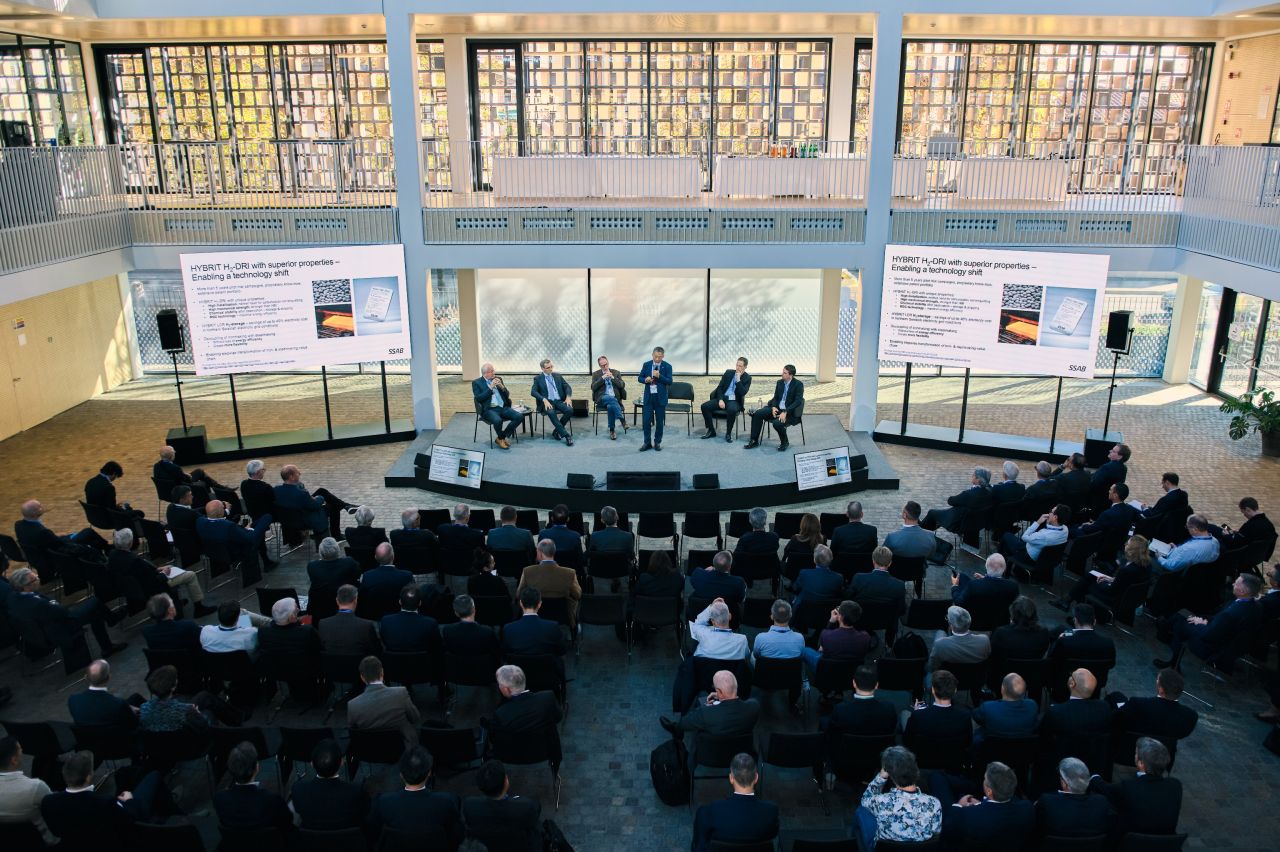
Ron Ashburn, executive director for the Association for Iron and Steel Technology (AIST) has expressed sympathy for European trade measures during its European Steel Forum and remarked that a re-industrialisation of the western world would take some de-globalisation.
“Even the best-run companies are under pressure if they are not helped by trade protection,” Ashburn said at the event in Udine, Italy, attended by Kallanish.
The USA have gone ahead with strong measures, “and other countries are following suit to defend their markets.”
This may also include re-nationalisation, as has been the case with British Steel.
This is a game of measures and countermeasures, which, Ashburn joked, “makes mainly the lawyers rich”. He compared the multitude of international issues with a Whack-a-Mole game: “You fight one problem, and another one pops up. You cannot win, you have to pull the plug.”
Panellist Antonio Marcegaglia, ceo and co-owner of Italy’s Marcegaglia group echoed similar sentiment.
But warned: “We should not create a too protective environment.” However, he added: “We cannot be the only open market. Trade measures need to be limited, but the most recent ones are fundamentally good… we need some protection, but we also need to be careful not to be isolated.”
Author: Christian Koehl Germany


French government supportive of Fos-sur-Mer venture: Marcegaglia
Marcegaglia group’s takeover of the former Ascometal plant in Fos-sur-Mer, and its investment plans for the site are being well supported by the French Government, according to ceo and co-owner Antonio Marcegaglia.
“From my French colleagues I learned that the project is considered iconic by the central government,” he said at the European Steel Forum of US Association of Iron and Steel Technology (AIST) in Udine, Italy, attended by Kallanish.
“We were very lucky,” he said describing the support given by decision makers, which he said is helpful when it comes to promising decarbonisation projects. The technological transition at three steel plants in France have been given the status of “national strategic projects,” Marcegaglia noted.
Particularly the case of Marcegaglia Fos-sur-Mer “demonstrates that this is possible in an old industry.” The EAF planned with Danieli will be the first newly built steel meltshop in 50 years, Kallanish learns.
He pointed out that the project has been making progress “reasonably fast by European terms,” but quipped that “the Chinese would be laughing at this, though.”
Buying the French plant for Marcegaglia meant a change of concept of his group. “Our business model for over 60 years was that of an independent processor,” he said. The step now taken means a backward integration to include an actual steel-melting phase in its business.
Looking back at the decision of bidding for the plant “was quite entrepreneurial for me and my sister,” he noted.
Author: Christian Koehl Germany

UK steel industry expects price increases in 2027; imports of fabricated goods may undermine trade regulation
The UK steel industry anticipates higher prices in 2027 despite largely tepid demand expectations, with key regulatory developments, such as the start of the UK’s Carbon Border Adjustment Mechanism and the recent safeguard quota changes, remaining under the spotlight at the annual joint International Steel Trade Association (ISTA) and National Steel Association (NSA) 2026 meeting.
With many market participants converging in Leeds for the annual joint meeting Oct. 22, the impact of the revised UK tariff rate quotas was a key topic, with concerns still existing over whether domestic UK production could fill the supply gaps left from a tighter import environment.
One speaker stated that the market remained supply-driven, as demand across most products remained largely weaker, albeit not in contraction. Like the dynamics affecting the European market, sources at the event noted that a recurring point of contention during negotiations was the allocation of risk, with buyers preferring to purchase outright on duty-inclusive terms, inclusive of potential CBAM charges.
However, due to uncertainty over these final CBAM charges — either due to verification concerns or limited transparency about inputs when purchasing from re-rollers — traders remained hesitant to close deals at an outright price or offer on inclusive terms, given the potential for margin-busting, higher-than-expected costs. Buyers and sellers at the event alluded to additional contract clauses being considered, either to share any higher-than-expected CBAM costs or to postpone any CBAM charges until the final cost can be ascertained, but these have been met with mixed reactions.
This uncertainty has also extended to the safeguards, with an increase in offers reported on a DAP basis, compared to the more traditional DDP terms used in the UK market, as sellers attempt to limit their risk exposure to any additional costs from material imported in excess of allocated quota volumes.
For hot-rolled coil imports into the UK, as of Oct. 26, the residual country quota was fully exhausted, with India at 94% of its 8,364 metric ton quota also allocated. South Korea’s quota sits at 20.3% allocated, of a total of 2,196 mt, while the largest quota, EU-origin HRC has allocated 65,700 mt of 93,750 mt total, data from the UK Department for Business and Trade showed.
Imports of fabricated goods may undermine regulation
According to numerous panel and audience members, the inflow of fabricated steel goods remained a key concern, with many arguing that it would undermine the current safeguard measures affecting upstream materials and that it could be used to circumvent CBAM from 2027. As in the EU, there are no quotas on downstream production, with limited protection provided by the EU’s safeguards for material exported from the UK for processing before being reimported (or vice versa).
One source with close ties to ports in the UK noted a large increase in these fabricated goods entering the country in 2026 and said they expected this trend to continue until the government provides sufficient protection.
Logistical issues
Logistical issues, ranging from sustained higher fuel costs impacting inland and waterborne freight charges to a shift in import patterns causing significant port backlogs, were also a key topic of discussion during the event, with expectations shifting toward significant steel inflows surrounding the quarterly refresh date for the safeguard quotas.
As a result, sources expect cyclical delays, with some already being recognized by port authorities following the recent quota refresh. Some material has struggled to clear customs in time for the 1st of the quota period, leaving importers potentially liable for out-of-duty costs. Likewise, it was also highlighted during presentations at the event that significant backlogs were forming across all imported products due to the influx of material timed around quotas refreshes due to insufficient berths and the resulting ship queues, increasing the risk of demurrage charges. In addition to the extra manpower required to move the material through the warehousing system or make it ready for inland freight, some market participants at the event shared broader concerns that these trends were likely to continue for the long term.
Author: Charles Thompson, Riley Waters
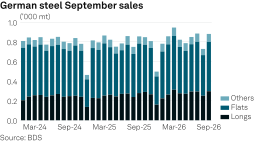
German steel distribution sales rebound in Sep as stocks drop from Aug
German steel sales rose to 879,820 units in September, 2.9% higher year over year and 20.9% up month over month, data from Bundesverband Deutscher Stahlhandel, the German steel association of steel stockholders, showed Oct. 27.
The month-over-month increase was recorded across all three product categories. Sales of steel longs rose 18.4% from August to 296,173 units, while flats longs increased 21.5% to 503,098 units. Sales of other steel products climbed 27.1% to 80,549 units, according to the BDS data.
Compared with September 2025, steel longs sales increased 7.1%, while sales of other steel products rose 9.6%. Flats longs sales were broadly stable year over year, edging down 0.3%, the data showed.
The September recovery followed a weaker August, when total sales fell to 727,529 units. September sales were also 5.8% above the 2025 monthly average of 789,369 units.
Total steel stocks declined to 1,868,313 units in September, down 2.8% from 1,921,832 units in August, according to BDS. Stocks of steel longs fell 2.1% month over month to 618,961 units, while flats longs stocks decreased 3.2% to 1,211,698 units. Stocks of other steel products were relatively stable, easing 0.8% to 37,654 units.
Despite the monthly decline, total stocks remained 1.4% above September 2025 levels. Flats longs inventories increased 3.6% year over year, and stocks of other steel products rose 23.5%. These gains more than offset a 3.8% decline in steel longs stocks.
For the third quarter as a whole, average total sales were 830,846 units, up 1.3% from the 819,973-unit average in the third quarter of 2025, according to the BDS data. The Q3 2026 average was also 1.5% above the second-quarter 2026 average of 818,333 units.
Average total stocks during Q3 2026 stood at 1,903,146 units, up 2.1% year over year and 1% from the second quarter. The quarterly increase was driven by higher average stocks of flats longs and other steel products, while average steel longs stocks declined.
Author: Annalisa Villa

ArcelorMittal trial shows carbon capture could cut steel emissions
ArcelorMittal and partners Mitsubishi Heavy Industries Ltd., BHP and Mitsubishi Development Pty Ltd. have completed the first phase of a carbon capture trial at the steelmaker’s integrated Ghent plant in Belgium, supporting further assessment of commercial-scale deployment, the partners said in a joint statement Oct. 28
The trial is relevant for the wider steel market because blast furnace-based production accounts for around 70% of global steel output and is expected to remain significant for decades. In Ghent, the company has two blast furnaces, with a capacity of around 5 million metric tons per year of crude steel.
According to the statement, the trial demonstrated CO₂ capture, at pilot scale, at rates exceeding 90%, and provided operational and engineering data to support the assessment of the potential for future full-scale application of the carbon capture technology at the Ghent blast furnace.
Engineering assessments based on the results indicate that full-scale application to the blast furnace’s pre-combustion off-gas could lower the Ghent facility’s overall CO₂ intensity by up to 24%, the companies said. If the technology is applied across multiple emission points in the steelmaking plant, the approach could support progress toward near-zero emissions intensity, they added.
“The results of this trial are very promising and demonstrate the abatement potential of the blast furnace and integrated steelmaking route,” according to BHP Vice President Marketing Sustainability Ben Ellis. “Through this partnership, we have tested a pathway to meaningful emissions reductions in the near term, and a potential lever for near-zero emissions blast furnace steelmaking longer term.”
In phase one, the trial separated CO₂ only, with the remaining carbon monoxide potentially continuing to be used for power and heat generation at the site, although its subsequent combustion releases additional CO₂, the companies said.
The partners will now move to phase two, applying the capture process to post-combustion gases from Ghent’s hot strip mill reheating furnace. That furnace uses a variable blend of coke oven gas, blast furnace gas, basic oxygen furnace gas and natural gas, creating a more dynamic flue-gas composition than the phase-one stream.
Platts, part of S&P Global Energy, assessed Northwest European hot-rolled coil carbon-accounted at €810/mt ex-works Ruhr Oct. 27, up €5/mt day over day.
Author: Annalisa Villa