


Voestalpine prepares tube segment cutbacks
Voestalpine will cut back on 150 jobs in its tubulars segment at the plant in Kindberg, Austria as a reduction measure caused mainly by the US import restrictions, company executives have said during its earnings conference call.
According to ceo Herbert Eibensteiner, the sales of seamless tubes have suffered from the US import duties, where the unit sells 15% of its production. Diversion to energy customers in the Middle East is not an option with war in Iran, Eibensteiner said. “We are aware of our social responsibility, and we are working on a redundancy plan with the works council until the end of November,” he added.
Not only are company’s exports from Europe to the US suffering, but also its operations in the US.
“There is a shortage of steel in the USA, so steel prices are skyrocketing, which affects our processing operations there,” cfo Gerald Mayer told Kallanish.
He noted that duties similar to the US were considered by Canada, but eventually dropped, “although the circumstances are the same as with the USA,” Mayer added.
At home in Austria, voestalpine is struggling with the Danube’s continued low water levels and continues to transfer transport to rail. Of 17 million tonnes/year of materials shipped to and from the plant in Linz, 10% come and go via the river. “That share used to be twice as much, so we have already achieved good progress in this regard,” Mayer noted.
Executives on the call also noted that its greentec project to transition to hydrogen-based direct reduced iron production is proceeding within the projected time frame and costs.
This comes as German producer thyssenkrupp Steel revealed the ramp-up for its own DRI plant will occur later than originally planned.

EU coil price targets cannot be passed down
Considerable price hikes for coil products from the northwestern European market leader have not caused a big stir among buyers yet. They maintain a reserved attitude, prefer to wait rather than buy, and point at the unwillingness of their customers to accept these hikes.
New prices heard in the market last week were confirmed this week by the mill to Kallanish at €820/tonne ($914/t) for hot-rolled coil, delivered, €900/t for hot-dip galvanized, and €940 for cold-rolled coil.
One trader finds it extremely hard to predict the actual demand of the next months that would justify such increases. “Stockholders want low inventories at year-end, and the question is, will there be a refill rally at the beginning of next year? And nobody can seriously tell,” he says.
Similar doubts are expressed by Scandinavian and German buyers, especially when it comes to handing the rises down. “We cannot push it through to our customers,” the Scandinavia states flatly.
On Dutch manager estimates that a premium of €30/t can be achieved until year-end, if taking a recent level of €760/t for HRC. But those regional sources find that this level has been passed now and see the price at €770/t and above.
Its possible that the announcement will suppress activity even more for a while, and lock buyers in their wait-and-see mode.
“The spot price for January/February delivery is only about to take shape,” one German service centre manager says. “I am certainly not shouting out loud that I want to buy,” he adds. “So, I am waiting for them to come knocking, but they have not come yet.”
UNESID present ten proposals to strengthen industry competitiveness
The Spanish steelmakers association UNESID has presented ten policy proposals aimed at strengthening the competitiveness of Spain’s steel industry, addressing high energy costs, unfair trade practices and the challenges associated with industrial decarbonization.
The proposals have been submitted to Spain’s main political parties ahead of the general elections scheduled for November 29, with the association calling on the next government to prioritize industrial competitiveness in its economic, energy and climate policies. Global steel overcapacity, high energy prices, competition from third countries and increasing regulatory requirements continue to threaten the sector’s competitiveness, according to UNESID.
Calls for electricity costs of €40/MWh for energy-intensive industries
Ensuring competitive energy costs for steel producers is among the association’s main priorities. Spain’s steel industry consumes approximately 10 TWh of electricity and 10 TWh of natural gas annually. To address high electricity costs, the association called for structural measures to bring final electricity costs for energy-intensive industries to approximately €40/MWh. The proposed measures include permanently reducing network charges and levies to the maximum extent permitted, reviewing electricity tariff periods and system adjustment costs, and maximizing compensation for indirect carbon emissions costs.
Specific support mechanisms for gas-intensive industrial consumers and emergency measures to address energy crises were also requested. In addition, the association emphasized the need to guarantee timely access to electricity grids, warning that insufficient grid capacity could delay industrial electrification and decarbonization investments.
EU ETS reform and stronger CBAM protection sought
Revisions to the EU Emissions Trading System (ETS) were also proposed to ensure that industrial decarbonization remains technologically and economically viable. In this regard, UNESID urged the EU to maintain sufficient free emissions allowances while carbon leakage risks persist, remove conditions that penalize industrial installations and prioritize reinvestment of ETS revenues in industrial transformation. Regarding the Carbon Border Adjustment Mechanism (CBAM), the association called for its scope to be extended as soon as possible to downstream steel products and for an effective mechanism to protect European steel exports.
It also proposed reviewing the timetable for phasing out free emissions allowances based on CBAM’s demonstrated effectiveness in preventing carbon leakage. Stimulating demand for low-carbon steel through public procurement, public support mechanisms and regulatory and fiscal incentives for private-sector consumption was also highlighted as a priority.
Global steel overcapacity prompts for stronger EU trade defense measures
Global steel overcapacity exceeds 640 million mt, creating pressure on European producers through subsidized imports and market distortions, according to UNESID. To address these challenges, the association called on the Spanish government to support the effective implementation of the EU’s new steel regulation and prevent future revisions from weakening its ability to address global overcapacity. The proposals also include extending the regulation’s scope in 2027 to products manufactured predominantly from steel, strengthening EU trade defense instruments and increasing resources for customs enforcement and market surveillance.
To strengthen demand for domestically produced steel, the association proposed introducing an effective European preference in public procurement, publicly funded investments and strategic industrial value chains. A target of at least 50 percent European-origin steel was recommended, with origin verified under the “melted and poured” principle.
UNESID also recommended applying technology-neutral low-emission criteria that recognize different steelmaking production routes. Any extension of the European-origin designation to third countries should be limited to reliable trading partners meeting equivalent European standards on labor, environmental protection, climate policy and fair competition, according to the association.
Spanish steel industry processes 9.3 million mt of scrap annually
Securing competitive access to steel scrap and other strategic raw materials was highlighted as essential to supporting low-emission steel production. According to UNESID, Spain’s steel industry processes approximately 9.3 million mt of scrap into new steel annually, recovers nearly 80 percent of its waste and byproducts, and recirculates more than 90 percent of the water used in production. The association also called for European policies supporting scrap availability, industrial recycling and the removal of unnecessary regulatory barriers to circular economy practices.
Other proposals include faster industrial permitting procedures, greater financial support for decarbonization investments and operating costs, and stronger innovation programs accessible to small and medium-sized steel companies. The remaining priorities include improving industrial employment conditions, workforce training and regulatory stability, as well as strengthening coordination between Spanish authorities responsible for customs controls and enforcement of EU trade and environmental regulations.
Author: SteelOrbis Editorial Team

Vattenfall uses SSAB Zero steel in German solar park, cutting carbon emissions by 67%
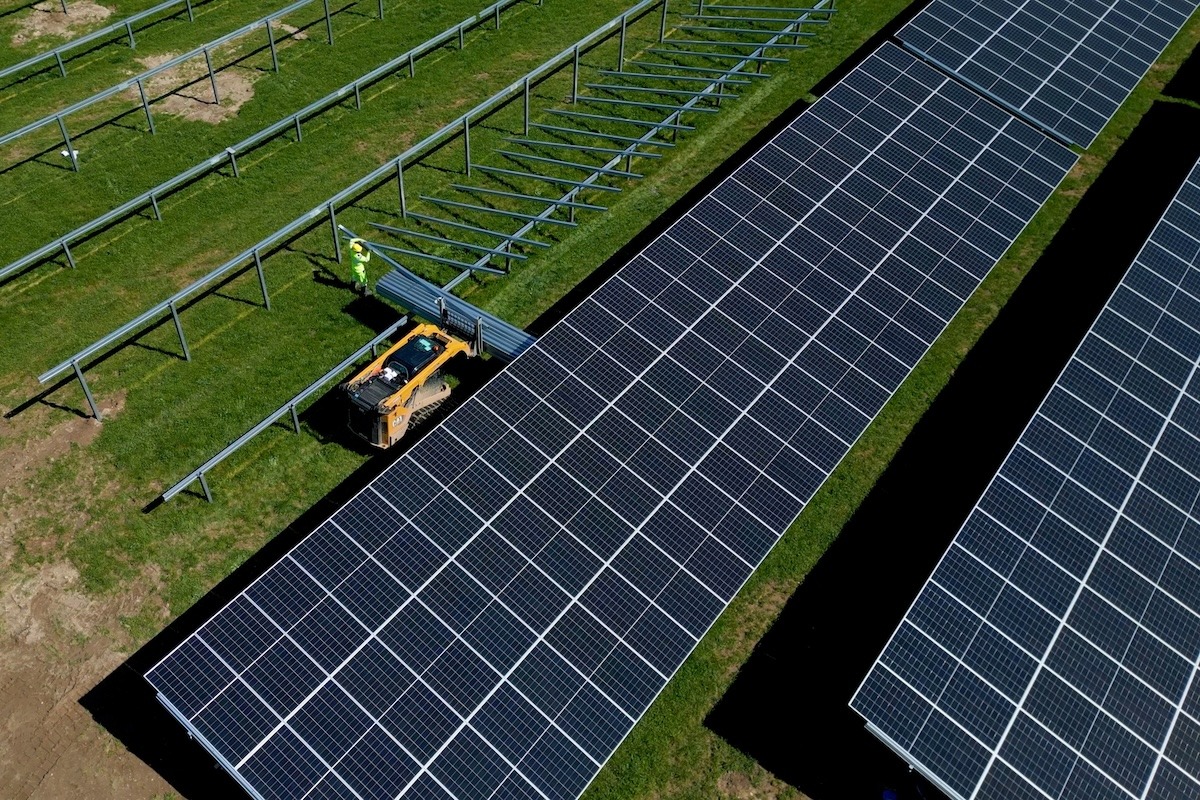
Swedish energy company Vattenfall has announced that it has used low-emission steel supplied by Swedish steelmaker SSAB for the solar panel mounting structures at its Juliusburg/Krukow solar park in Germany, reducing carbon emissions associated with the structures and their supply chain by 67 percent compared to conventional steel.
The 80 MW solar park in Germany’s Schleswig-Holstein state, was commissioned in the summer of 2026. Vattenfall has selected SSAB Zero steel for the solar panel substructures in the Krukow section of the project.
SSAB Zero steel offers 67% reduction in carbon emissions
According to Vattenfall, the mounting structures are manufactured using recycled steel produced by SSAB with fossil-free electricity. The company stated that technical evaluations showed SSAB Zero steel provides the same strength and quality as conventional steel, while the financial impact of using the material was considered reasonable in relation to the sustainability benefits.
Vattenfall noted that using lower-emission materials in solar park construction is part of its efforts to reduce emissions associated with renewable energy projects, including those generated during the construction phase and throughout the supply chain.
Solar park expected to generate up to 80 GWh of electricity annually
The Juliusburg/Krukow solar park has a nominal capacity of 80 MWp. According to Vattenfall, the facility can generate up to 80 GWh of fossil-free electricity annually.
Meanwhile, Vattenfall stated that it is also using low-emission steel in other renewable energy projects, including the Clashindarroch II onshore wind farm in the UK and the Nordlicht offshore wind cluster in the German North Sea.
SSAB stated that the use of SSAB Zero steel in the solar park demonstrates how lower-emission materials can be incorporated into renewable energy infrastructure while maintaining the performance and quality of conventional steel.
Author: SteelOrbis Editorial Team

Steel prices in Europe to increase in Q4, outlook stays positive: ArcelorMittal
Prices of flat and long steel products in Europe are expected to keep rising in the fourth quarter of 2026, adjusting to higher energy costs, global steel producer ArcelorMittal said in its report for the third quarter of 2026.
The company added that this would also affect the annual contracts for flat steel products, which represent more than 25% of Europe’s flat steel production volumes. The negotiations for the long-term contracts are still running, but Fastmarkets’ hot-rolled coil (HRC) indices have already shown an upward trend.
Producers in Northern Europe were heard seeking increases of €100-150 ($112-168) per tonne for long-term agreements for the first half of 2027 from levels agreed for the second half of 2026, but were unlikely to secure more than half of the requested increase, sources told Fastmarkets on October 30.
The average quarterly price of HRC in Northern Europe in the first quarter of 2026 was €671.70 per tonne, increasing to €695.13 per tonne in the second quarter and €723.87 per tonne in the third quarter of the year, Fastmarkets’ daily steel hot-rolled coil index domestic, exw Northern Europe showed.
A similar trend could be observed in Southern Europe. The average quarterly price of HRC in Italy was €659.86 per tonne in the first quarter, increasing to €685.56 per tonne in the second quarter and €713.57 per tonne in the third quarter, Fastmarkets’ daily steel hot-rolled coil index domestic, exw Italy showed.
EU trade measures to support the positive trend
ArcelorMittal also expects the growth of flat steel shipments in Europe to accelerate during Q4 of 2026, reaching a double-digit year-on-year increase. The steel producer added that the medium- and long-term perspective remained positive, with the implemented EU trade measures contributing to the optimistic expectations.
On June 30, the European Commission announced tighter steel import quotas, which came into effect on July 1. “Enhanced EU trade measures are beginning to rebalance European steel market fundamentals, reducing import penetration and supporting higher domestic capacity utilization,” ArcelorMittal said in its report.
The steel producer added that after the implementation of the new tariff rate quota (TRQ), the company has brought all its European blast furnaces back into operation.
“The additional policy measures to expand protection downstream could further strengthen European industrial competitiveness and, with it, domestic steel demand, building on the positive impact already seen from enhanced steel trade measures,” the steel producer added.
Q3 results of the European division
Despite the positive expectations, the European division of the company reported a 4% decrease in crude steel production to almost 7.25 million tonnes in Q3 of 2026 compared to the previous quarter of the year, when it was 7.55 million tonnes. Crude steel production in Q3 of this year was also slightly lower than in the corresponding quarter of 2025, when it was 7.25 million tonnes.
Crude steel production of ArcelorMittal Europe was 21.63 million tonnes in the first nine months of 2026, compared to 22.77 million tonnes in the same period a year earlier.
Flat steel shipments in Europe increased by 1.1% to 5.19 million tonnes in Q3 of 2026 compared to the previous quarter, ArcelorMittal said. According to the company, this was related to normal seasonal trends and reflected the early impacts of the new TRQ mechanism. ArcelorMittal Europe’s flat steel shipments in Q3 of 2026 were also higher than those reported in the same period in 2025, when they were 5.07 million tonnes.
For the first nine months of 2026, flat steel shipments amounted to 15.65 million tonnes, still slightly lower than in the same period in 2025, when they were 15.73 million tonnes, ArcelorMittal’s recent report showed.
Long steel shipments in Europe amounted to 1.72 million tonnes in Q3 of 2026, compared to 2 million tonnes in the previous quarter. The long steel shipments in Q3 of 2025 were 1.93 million tonnes.
For the first nine months of 2026, the long steel shipments in Europe amounted to 5.51 million tonnes compared to 6.12 million tonnes in the same period last year. ArcelorMittal said that the decline was linked to seasonal factors. In addition, the impact of lower imports was offset by inventory destocking.
The European division of ArcelorMittal reported earnings before interest, taxes, depreciation and amortization (EBITDA) amounting to $548 million in Q3 of 2026, compared with $697 million in the previous quarter of the year.
This reflects the impact of lower long product shipments and a temporary mismatch between rapidly rising input costs and realized selling prices, according to ArcelorMittal.
EBITDA in Q3 of 2026 was higher compared to the same quarter of 2025, when it reached $513 million.
For the first nine months of 2026, EBITDA of ArcelorMittal’s European division reached $1.7 billion compared to $1.5 billion in the same period of 2025.
Decarbonization in progress
ArcelorMittal underlined in its Q3 report that the energy transition remained an attractive opportunity for the company, with electric-arc furnace (EAF) investments playing a key role in the decarbonization of its steelmaking footprint.
The company added that its EAF project in Gijón (with planned capacity of 1.1 million tonnes per year) and the Sestao expansion were on track for commissioning in Q4 of 2026, with ramp-up through 2027.
The EAF at Dunkirk has moved into execution, the company added. At Dunkirk, ArcelorMittal is preparing to build a 2 million tonne per year EAF alongside a ladle metallurgy furnace (LMF), as part of its move toward lower-carbon steelmaking.
“Together, these projects are expected to add approximately 3.9 million tonnes per year of EAF capacity by 2029, supporting both decarbonization and long-term value creation,” ArcelorMittal said.


Hydrogen still makes sense for Europe ironmaking: Kallanish Green Steel Strategies
The use of hydrogen for ironmaking still makes economic sense in some specific locations in Europe, panellists said at the Kallanish Green Steel Strategies event held in Brussels this week.
Anne Cécile Marie, commercial director, GravitHy, highlighted the initial “gold rush” to utilise hydrogen across various industries and applications in Europe.
“We’re starting to realise that hydrogen makes economic sense in very focussed and specific applications, and at GravitHy, we are convinced that iron making and iron producing is clearly one of them,” she told delegates.
“That being said, you need to look at the proper success conditions to develop and locate the project. And of course, the electricity price is the key driver to that. But we still believe that in specific locations and specific conditions, when you’re able to secure competitively electricity supply, hydrogen actually still makes sense in Europe.”
She added that she believes the merchant metallics supply model her firm has adopted provides flexibility for steelmakers for the raw materials sourcing they will need for decarbonising. This combined with competitive electricity prices enables the success of hydrogen projects for iron making.
“We are in a favourable situation in France where we have access to base load nuclear electricity from the grid and we are also in a position where electro-intensive industries are able to negotiate long-term electricity supply contracts with the national provider. I’m aware that this favourable configuration is not what we find elsewhere in Europe,” she noted.
She highlighted how France benefits from very low electricity prices and that even prior to the Middle East crisis, GravitHy was not considering using natural gas. This is because any operating expenses savings would be lost in carbon footprint increases and the loss of ETS support.
“We’ve made the choice to start with H2 and to keep on the H2 track,” she added.
On energy costs, Michiel Nivard, engagement manager, McKinsey, said that consumers have moved from sourcing the lowest cost energy to managing supply security as a result of the war.
“Reducing the electricity price as a country, region is really hard,” he noted.
However, Nivard highlighted the use of hydropower in Scandinavia and nuclear in France. He proposed the diversification of supply, as well as long term PPAs, long-term offtake contracts and on-site generation.
“Less demand is the first thing you can do to reduce your energy bill, which is not saying produce less, but produce more efficiently,” he concluded.
Author: Carrie Bone UK


Bekaert to acquire Dextra for €140 million to expand construction reinforcement portfolio
Belgium-based steel cord and wire manufacturer Bekaert has announced that it has signed an agreement to acquire Thailand-based construction reinforcement solutions provider Dextra for an enterprise value of €140 million, aiming to expand its sustainable construction portfolio and strengthen its presence in international infrastructure markets. The transaction is expected to be completed in the first half of 2027, subject to regulatory approvals and customary closing conditions.
According to Bekaert, the acquisition will expand its existing reinforcement product portfolio with Dextra’s rebar couplers, glass fiber reinforced polymer (GFRP) solutions and engineering services. Dextra supplies reinforcement solutions for major infrastructure projects, including airports, tunnels, power stations and ports.
Stronger presence targeted in international infrastructure markets
The acquisition is expected to strengthen Bekaert’s presence in Europe, the Middle East, Africa and Asia, while providing opportunities to expand Dextra’s products into the North American market.
According to Bekaert, the combined businesses will offer a wider range of reinforcement products and engineering services for infrastructure projects, with a focus on improving construction efficiency and reducing environmental impacts.

Service centres unable to pass on costs: Assofermet
High stocks and fierce competition are making it hard for Italian coil service centres to pass any part of their higher costs on to customers, according to a market note from Italian steel trade association Assofermet.
“This results in a further squeeze on margins, made worse by rising energy and ancillary costs,” the association says.
Downstream consumption showed no significant change in October. Manufacturing is still suffering from weak orders, with no concrete signs of a recovery in demand strong enough to support service centre activity. No major change in new orders is expected in November. Selling prices are generally expected to rise slightly, as service centres try to recover at least part of the gap with rising coil prices. However, weak demand will largely determine how far these increases go and whether they hold, Kallanish notes.
On the coil supply side, European mills have raised prices for fourth-quarter deliveries, helped by trade protections, and appear determined to build on this trend for the first quarter of 2027. This widens the gap between producers’ demands and the downstream market’s ability to absorb further increases.
Concerns over the future of the former Ilva remains high after the supreme court rejected the appeals against the Milan Court of Appeal order suspending production at Taranto’s hot end.
“The Italian consortium led by Federacciai would appear to be inclined to withdraw,” Assofermet says. A separate sale of the company’s assets looks increasingly likely, the association adds.
Meanwhile, Italian steelmaker Arvedi and Jindal Steel International have submitted their own binding offers to acquire the former Ilva plants, the special commissioners have announced (see separate article).
For service centres, the permanent closure of Italy’s only integrated steel producer is fuelling fears over coils availability and supply balance, at a time when import restrictions are already increasing.
The market is sending mixed signals for distributors. Hot rolled coil prices are consolidating in Europe, supported by lower availability and falling imports.
However, demand from end-users such as the automotive, construction and household appliance sectors is still not strong enough to drive a lasting cycle of price increases. In October, distributors’ sales prices held up and was slightly above the same month of 2025, while volumes fell. Overall, volumes fell by more than a quarter, while average prices rose in almost every segment.
“Reduced availability is supporting coils, but without a recovery in industrial demand the increase is struggling to consolidate. For distributors, the priority remains the selective management of stocks in a context where value per tonne has improved, but volumes are not yet showing convincing signs of a turnaround,” Assofermet concludes.

Arvedi, Jindal submit offers for former Ilva assets
Italian steelmaker Arvedi and Jindal Steel International have submitted binding offers to acquire the former Ilva plants, the special commissioners of Acciaierie d’Italia (ADI) and Ilva, both in special administration, say.
The commissioners received the two offers before the deadline for binding bids, set at midnight on 8 November. “The proposals, both relating to the purchase of all the active business units, come from the Arvedi group and from Jindal Steel International,” the commissioners say in a note obtained by Kallanish. “The special commissioners will now examine the proposals to assess their completeness and compliance with the requirements set out in the tender.”
The consortium of Italian steelmakers led by local steel association Federacciai did not submit an offer by the deadline. Its partners had submitted a letter of interest. Sources close to the dossier had already doubted it would turn into a binding bid, and Italian steel trade association Assofermet said in its latest market note that the group “would appear to be inclined to withdraw” (see separate article).
The offers come after Italy’s Supreme Court rejected the appeals against the Milan Court of Appeal order suspending production at Taranto’s hot end. The hot end is now permanently shut. Blast furnace no. 2, the last one still operating, stopped producing pig iron in early October and was kept in preheating mode.
ADI’s special commissioners have asked the government to extend temporary layoffs to 8,622 workers from 4,450, almost the company’s entire workforce, until February (see Kallanish passim).

US Midterm Elections: potential effects on steel
Key Takeaways
- Democrats take control of both chambers in January, but the vote arithmetic on tariff repeal leaves one central steel policy lever in a different place than the campaign rhetoric did.
- Industry sources say it is possible interest rates come down before the end of 2027, while the Federal Reserve’s own projections tell a different story, and the gap ties back to energy and AI spending.
- Two December 2027 deadlines, one inside the Section 232 schedule and one inside the federal energy tax code, fall within the next 14 months and touch Plate, Galvanized and equipment demand.
Introduction
Voters changed Congress on November 3. They did not change the duty on a ton of imported steel.
Democrats are projected to control both the House and the Senate when the 120th Congress convenes on January 3, 2027, ending unified Republican control two years into President Donald Trump’s second term. Early tallies gave Democrats a House majority of at least 225 seats and a Senate majority of 54 seats, with some races still being counted. Those majorities fall well short of the 290 House votes and 67 Senate votes needed to override a presidential veto.
For steel manufacturers, service centers and distributors, the next 14 months, running through December 31, 2027, now sit inside a divided government. Democratic leaders have said they intend to push for repeal of the administration’s tariffs once the new Congress is seated. The President said after the election that his administration will keep its tariff policy in place, and he told an interviewer he intends to use his veto to block legislation and force negotiations.
The election also landed in the middle of an economic environment shaped by forces Congress does not directly control. An energy shock tied to the war with Iran pushed headline consumer inflation to 3.7% in September. The Federal Reserve, now led by Chair Kevin Warsh, raised its benchmark rate in September for the first time since July 2023. Oil fell below $100 a barrel in the days after the vote for the first time in a month. Data center construction, the strongest end market cited by many steel buyers this year, became a campaign issue. Democrats campaigned on restoring clean energy tax credits that were cut in 2025.
Each of these threads connects to steel through a different channel. Tariffs set the landed cost of imports and the pricing room for domestic mills. Interest rates set the cost of carrying inventory and receivables and the financing math on customer projects. Energy policy shapes demand for wind towers, solar racking, grid equipment and vehicles. Data center policy touches one of the largest sources of new nonresidential steel consumption in the country.
The distinction that runs through every one of these areas is the difference between enacted policy and stated intent. A bill introduced in January is not a customs notice. A campaign pledge on tax credits is not a change to the tax code. A Fed projection is not a rate decision. The calendar through December 2027 contains specific, verifiable dates on all of these fronts, and those dates mark when policy changes take legal effect.
Divided Government: What Changes on January 3
Democratic control of both chambers gives the incoming majority the ability to set the legislative agenda, organize committees, hold hearings and issue subpoenas, and shape the confirmation process for executive branch and judicial nominees. In the Senate, that includes nominees to federal agencies and to the Federal Reserve Board of Governors.
Control of Congress is not control of the executive branch. Legislation that reaches the President’s desk can be vetoed, and the projected seat counts leave Democrats far from the two-thirds threshold required in each chamber to override. In the Senate, most legislation also requires 60 votes to overcome a filibuster.
The positions of each side are on the record. Democratic leaders have said they plan to push for repeal of the tariffs and to revoke trade authorities delegated to the President. Several House Republicans voted with Democrats earlier in 2026 on a resolution to overturn tariffs on Canada, which some analysts have cited as a sign that bipartisan votes on narrower trade measures are possible. The President said his administration will continue its tariff policy despite the election results, and said removing the tariffs would please foreign governments and halt construction immediately. He also said Democrats would send him legislation he would veto, and that the two sides would then work together on deals.
The new majority’s clearest power concerns future legislation. Democrats can block tax and spending changes they oppose, and they can attach conditions to must-pass bills. They cannot repeal existing law by declining to act, and they cannot change tariff schedules without either the President’s signature or a veto-proof margin.
Why it matters: For the next 14 months, steel tariff treatment depends on executive action, court rulings and any negotiated legislation that the President signs. Purchasing, quoting and contract terms tied to duty rates rest on the customs schedule in force on the date of entry, while hearings, bills and statements shift market expectations ahead of any legal change.
Section 232 Remains the Central Steel Question
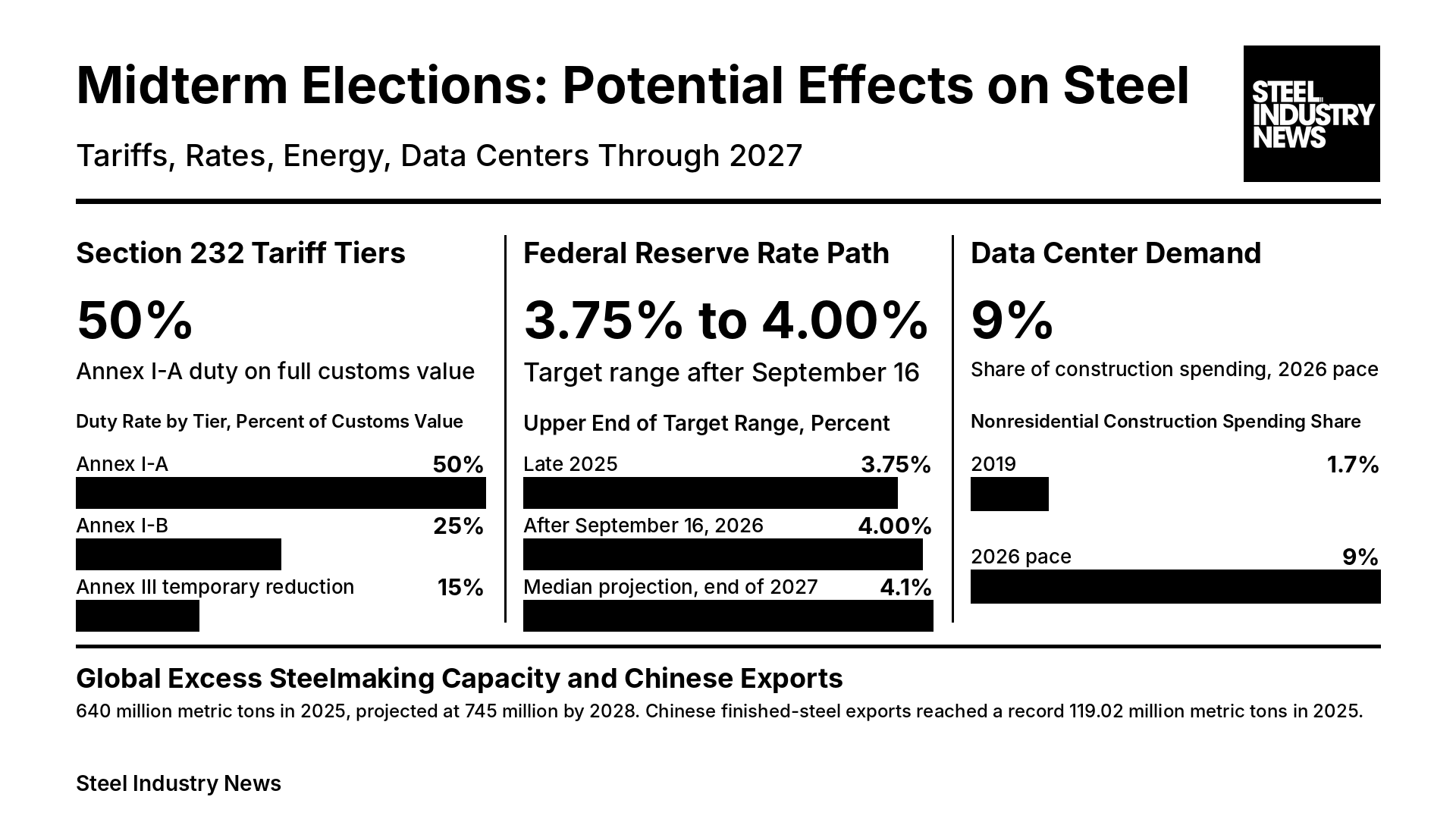
The Section 232 steel and aluminum tariff rate rose from 25% to 50% in June 2025. On April 2, 2026, a presidential proclamation restructured the program, effective April 6. Duties now apply to the full customs value of covered products, including derivatives, rather than only to the value of the metal content. The proclamation set tiered rates by product list, removed some derivatives from coverage entirely, created a weight-based exemption for certain articles with less than 15% metal content, and specified that steel, aluminum and copper duties do not stack.
|
Section 232 tier (effective April 6, 2026) |
Rate on full customs value |
Coverage |
|---|---|---|
|
Annex I-A |
50% |
Steel, aluminum and copper articles and listed derivatives |
|
Annex I-B |
25% |
Listed steel and aluminum derivatives and certain copper articles |
|
Annex III, temporary reduction |
15% (10% if made with U.S. metal) |
Certain industrial equipment and electrical grid equipment, through December 31, 2027 |
|
U.S.-metal derivatives |
10% |
Derivatives made entirely of metal melted and poured or smelted and cast in the United States |
|
UK origin |
25% or 15% |
UK-origin articles normally at 50% or 25%, respectively |
|
Metal content under 15% by weight |
Exempt from Section 232 |
Certain articles outside Chapters 72 through 76 |
The Annex III reduction for industrial and grid equipment expires on January 1, 2028. After that date, those products move to the 25% Annex I-B rate, or 10% if made with U.S. metal, unless the schedule is changed before then. The expiration falls one day after the 14-month window closes.
Different tariff programs rest on different statutes. The Supreme Court ruled on February 20, 2026, that the administration could not use the International Emergency Economic Powers Act to impose tariffs. That ruling did not affect Section 232 or Section 301 duties. The administration has since applied tariffs of up to 12.5% on goods from 60 trading partners under other authorities, alongside the sector-specific duties on steel and automobiles.
Trade negotiations are also moving on a separate track from Congress. In the weeks before the election, the United States and Canada were negotiating over Section 232 duties on steel and automobiles, with a narrower agreement under discussion. The White House exempted a number of Canadian goods from the 50% tariff before the vote. Canadian Prime Minister Mark Carney said after the election that he had not spoken with Democrats about legislation to remove tariffs on Canada, and that his government would continue working with the administration toward a deal.
Why it matters: Domestic mill pricing, import landed costs and derivative product exposure all trace back to the April 2026 tier structure. A change through a country agreement, a product-list revision or legislation would affect specific annexes and origins rather than the program as a whole. The Annex III expiration date sits on the calendar for any buyer of imported industrial or grid equipment with deliveries scheduled near the end of 2027.
Mills and Distributors Carry Different Exposure
Domestic mills and distributors read the same tariff headline from opposite sides of the transaction. Import protection supports domestic pricing power, while distributors that buy imports pay higher landed costs and carry more working capital for the same tonnage.
Recent company results show how protection has flowed through to producers. Nippon Steel said its U.S. Steel subsidiary earned underlying business profit of $421 million in the quarter ended September 30. The company raised its fiscal year guidance for U.S. Steel, including its Slovak operation, to at least $1.46 billion, up from $1.14 billion in August and $634 million in May (derived). Nippon Steel attributed the improvement in part to U.S. market prices supported by Section 232 tariffs, and said U.S. Hot Rolled Coil prices have continued to rise since the end of 2025. Its chief financial officer said strong prices reflected both tariffs and the strength of the U.S. economy, said about half of the year-over-year improvement came from market conditions and half from operating gains, and declined to comment on the effect of the midterm election.
|
U.S. Steel underlying business profit guidance (Nippon Steel fiscal 2026) |
USD (derived) |
Change from prior (derived) |
|---|---|---|
|
May 2026 |
$634 million |
– |
|
August 2026 |
$1.14 billion |
+$507 million (+80%) |
|
November 2026 |
$1.46 billion or more |
+$317 million (+28%) |
Distributor economics run through a different equation. Gross profit depends on the spread between inventory cost and selling price, plus processing revenue and inventory turnover. Rising prices lift returns on lower-cost stock already on the floor. Falling prices compress margins when older, higher-cost inventory competes against cheaper replacement material. A shift in tariff expectations can move buying behavior before any duty changes: customers who anticipate lower prices shorten their buying horizons, while customers who anticipate higher duties pull orders forward.
The same mechanism works in reverse for mills. Protection supports price, but mill earnings still depend on order volume, operating rates, product mix, raw material and energy costs, and customer acceptance of price increases. Nippon Steel’s own breakdown of U.S. Steel results split the gain between market conditions and operating improvements.
Why it matters: A tariff change affects mills, import location sensitive service centers and fabricators differently, and in the case of distributors the effect shows up first in inventory valuation and order timing rather than in reported revenue. Price direction alone does not describe the condition of either side of the supply chain.
Interest Rates, Inflation and the Federal Reserve
Interest rates were not on the ballot, but they connect directly to steel through inventory financing, customer project economics and construction demand. Floating-rate credit lines used to carry inventory and receivables move with short-term benchmark rates, and higher borrowing costs raise the hurdle for the construction and equipment projects that consume steel.
The rate environment heading into the new Congress runs opposite to the easing cycle of late 2025. The Fed cut rates three times in the second half of 2025, ending the year at a target range of 3.50% to 3.75%. It held that range through July 2026. On September 16, 2026, the Federal Open Market Committee voted 12 to 0 to raise the range to 3.75% to 4.00%, the first increase since July 2023. Minutes from that meeting showed officials pointed to energy prices, AI-related spending and inflation running above the 2% target for more than five years. On October 28, the committee held the range steady by a 10 to 2 vote, with both dissenters, Governor Lisa Cook and Cleveland Fed President Beth Hammack, preferring another quarter-point increase.
The Fed’s September projections put the median federal funds rate at 4.1% for the end of 2026 and 4.1% for the end of 2027. Those projections contain no rate cuts across the full window covered here. The next decision, with updated projections, is scheduled for December 9, 2026.
Inflation in 2026 has been driven largely by energy. Headline consumer prices rose 3.7% from a year earlier in September, up from 3.4% in August, while core inflation, which excludes food and energy, rose 2.6%. Headline inflation peaked at 4.2% earlier in the year. The October consumer price report is scheduled for release on November 10.
Two of the policy questions raised by the election feed directly into those inflation readings. Lower energy prices would reduce the headline figure; oil fell below $100 a barrel after the vote, though analysts noted the results do not resolve the geopolitical conditions behind the price spike. Any reduction in tariffs would lower costs for imported goods. Both would show up in the data the Fed uses. Industry sources say it is possible rates will come down before the end of 2027 if energy-driven inflation eases and the price effects of tariffs fade. The Fed’s September projections do not show a cut in that period, and the decision rests with the committee, which sets policy independently of Congress. Congress does hold one lever: the Senate confirms nominees to the Fed Board, and that confirmation process passes to a Democratic majority in January.
Why it matters: Inventory carrying costs, customer financing and project feasibility all track the federal funds rate. The Fed’s published path through 2027 currently shows no cuts, while industry sources say a decline in rates is possible if inflation eases. The inflation reports and December projections are the scheduled data points that test that path. Congressional action on tariffs and energy affects rates only indirectly, through the inflation readings the Fed weighs.
Energy Policy: Clean Energy Credits, Electric Vehicles and Steel Demand
Energy costs were among the central issues of the campaign, and energy policy reaches steel through several product channels. Wind towers and foundations consume Plate. Utility-scale solar uses Galvanized racking and structural supports. Grid expansion requires transformers, poles and substation structures. Automotive production, including electric vehicle and battery plants, is one of the largest consumers of flat-rolled steel.
The 2025 budget law changed the federal incentives behind much of that demand. Under the law, wind and solar projects that began construction by July 4, 2026 keep eligibility for the production and investment tax credits. Projects that began construction after that date must be placed in service by December 31, 2027, to qualify. That cutoff falls on the final day of the window covered here. Geothermal, hydropower, nuclear and energy storage projects are not subject to the same accelerated deadline.
Federal tax credits for new, used and commercial electric vehicles ended for vehicles acquired after September 30, 2025. The credit for charging equipment ended for property placed in service after June 30, 2026.
Democrats have proposed reversing those changes. More than 160 House Democrats back the Energy Bills Relief Act, introduced by Representatives Sean Casten and Mike Levin, which would restore the clean energy tax credits from the Inflation Reduction Act, including the electric vehicle credit of up to $7,500 for new vehicles. Senate Democratic Leader Chuck Schumer has said restoring the clean energy tax credits would be among the first actions of a Democratic majority, while not explicitly addressing electric vehicle credits. Restoring the wind and solar credits ranks among the top Democratic energy priorities after the election, while restoring the electric vehicle credit has drawn less support from party leaders. Areas cited as having support in both parties include geothermal, nuclear, battery production, domestic mineral processing and a Senate permitting bill unveiled in late September.
Any restoration of the credits requires legislation the President signs. The administration has opposed broader clean energy policies, and tax legislation faces the same veto threshold as tariff legislation.
Why it matters: The December 31, 2027 placed-in-service deadline sets the timing for wind and solar projects that missed the July 2026 construction start, which bears on Plate, Galvanized and fabricated structure demand tied to those projects through the end of 2027. Electric vehicle and battery plant demand depends on credit treatment that, as of now, remains repealed. Any change to either requires enacted legislation rather than stated priorities.
Data Centers: Demand Driver Under Political Scrutiny
Data center construction has been the strongest end market cited by steel buyers and mills in 2026. The projects draw on a wide range of products: Beams and Plate for structures, Cold-Formed Steel framing, Pipe and Tube for cooling systems, conduit and strut supports, racks and enclosures, and the transmission and substation steel needed to bring power to each site. Private data center construction ran at a record seasonally adjusted annual rate of $96.5 billion in September 2026, according to Census Bureau data. Data centers are on pace to account for about 9% of private nonresidential building construction spending in 2026, compared with about 1.7% in 2019. As of the second quarter of 2026, 3,173 operational data centers in the United States represented about 56.6 gigawatts of net IT power, with another 1,140 facilities planned.
That growth turned into a campaign issue through electricity bills. Candidates in both parties addressed how to supply power to large new loads without shifting grid costs onto residential customers, and local ballot measures in several communities put data center development directly before voters. In September, the House voted 417 to 3 to pass a bill requiring states to consider having large electricity users such as data centers pay the full additional cost of serving them. Some Senate Democrats said the bill did not go far enough. A group of House Democrats introduced separate legislation to end certain federal tax incentives available to data centers. The Senate Democratic energy plan released in March included reforming how data centers pay for energy infrastructure.
The President has supported data center development. Proposals for a national moratorium have circulated among some progressive Democrats, while others in the party have emphasized affordability and cost allocation rather than limits on construction.
The Fed’s September minutes added another link between data centers and steel. Officials cited AI-related spending as one of the inflation pressures behind the rate increase, connecting the same buildout that supports steel demand to the borrowing costs that affect every other steel-consuming sector.
Why it matters: Cost allocation rules for electricity, federal tax treatment and local siting decisions all bear on the pace and location of data center construction, which feeds directly into Beam, Plate, framing, Pipe and grid steel orders. The bipartisan House vote shows ratepayer protection has support in both parties, while tax incentive changes and moratorium proposals face the same legislative and veto constraints as other measures.
Federal Spending and Project Timing
Divided government changes the dynamics of federal spending. Appropriations, supplemental funding and any reauthorization of infrastructure programs now require agreement between a Democratic Congress and a Republican President. Key provisions of the 2021 Bipartisan Infrastructure Law and the Energy Act of 2020 have expired or are scheduled to lapse in 2027, creating an opening for reauthorization negotiations during the window covered here.
For steel suppliers, the gap between announced spending and executable demand is measured in procurement steps. A project may have political support and still require appropriated funds, engineering, permits, contract awards and contractor mobilization before mill orders are placed. An already designed and funded project and a newly announced program sit at different points on that timeline.
Manufacturing investment follows a similar sequence. Construction, equipment procurement, commissioning and production ramp-up occur at different stages, and each stage purchases different steel products. Beams and Plate are needed during construction; machinery components are ordered later; recurring production demand begins only after a facility starts operating. A single announcement can represent several distinct purchasing windows spread across years.
Public work also carries payment timing exposure. Delayed approvals or funding disputes can shift shipment schedules and receivable collection even without a project cancellation.
Why it matters: Steel demand from federal programs within the next 14 months depends on projects that are already funded and moving through procurement. Reauthorization talks and new spending proposals affect the pipeline for later years. Confirmed engineering packages, contract awards, equipment orders and site activity are the milestones that convert spending into tonnage.
Global Supply and the Paths Through December 2027
The election does not separate the domestic market from global steel conditions. The OECD projects global excess steelmaking capacity reaching 745 million metric tons by 2028, up from 640 million metric tons in 2025. Chinese customs data show finished-steel exports reached a record 119.02 million metric tons in 2025, up 7.5% from 2024. Exports totaled 85.64 million metric tons from January through September 2026, and full-year 2026 exports are forecast at 110 million to 115 million metric tons, which is 3.4% to 7.6% below the 2025 total (derived). The United States, Canada, Mexico, Brazil and India are among the economies that have raised tariffs on many basic steel products, and the OECD has reported growing circumvention of trade measures through transshipment.
A change in U.S. market access shifts trade incentives beyond any single bilateral relationship. Import availability and offer prices respond to restrictions in other markets, overseas demand and the efforts of producers abroad to find new customers. Domestic protection limits that exposure at the border, but overseas prices still enter customer negotiations and the economics of imported downstream goods.
The stated positions of the administration and the incoming majority mark out the range of outcomes now under discussion. One path keeps the Section 232 structure substantially intact while Congress challenges it through legislation, hearings and oversight. A second involves limited adjustments, such as a country agreement with Canada or product-specific revisions, without dismantling the broader framework. A third involves escalation, with additional trade measures or spending confrontations adding uncertainty for customers. Each path carries different effects on mill pricing, import economics, distributor inventory values and customer order timing.
Why it matters: Global excess capacity, foreign trade restrictions and circumvention all bear on the import offers that reach U.S. buyers, whatever happens in Washington. The three paths above differ in which annexes, origins and products are affected, and each is tied to specific actions, such as a signed agreement, a revised annex or an enacted bill, that can be tracked as they occur.
Conclusion
The midterms produced a clear political result and a less settled commercial one. Democrats take control of both chambers on January 3, 2027, with majorities short of the margins needed to override a veto. The President has said he will keep his tariff policy and use his veto to force negotiations. Democratic leaders have said they will push to repeal tariffs and restore clean energy tax credits.
For steel, the policies in force remain the reference point. The Section 232 structure set in April 2026 applies 50% and 25% duties on full customs value, with a temporary 15% rate on certain industrial and grid equipment that expires at the end of 2027. Wind and solar projects that missed the July 2026 construction start must be in service by December 31, 2027, to claim federal credits. Electric vehicle credits remain repealed. The Fed raised rates in September, held in October, and published projections showing a 4.1% median rate at the end of both 2026 and 2027, though industry sources say it is possible rates will come down before the end of 2027 if inflation eases. Data center construction continues to anchor nonresidential steel demand.
The calendar through December 2027 is specific: the October inflation report on November 10, the Fed decision on December 9, the seating of the new Congress on January 3, ongoing U.S.-Canada talks on Section 232, and the paired year-end 2027 deadlines in the tariff schedule and the energy tax code. Each date can be checked against what has changed in law, customs treatment and order books.