


Frankstahl subsidiary Steelcoin lists steel-backed token on Bullish
Steelcoin X (SCX), a token redeemable for physical hot-rolled coil, has been listed on digital asset platform Bullish Exchange, Steelcoin announced on September 22.
Steelcoin is a wholly-owned subsidiary of Austrian steel distributor Frankstahl.
SCX can now be traded against the euro around the clock through Bullish Exchange’s central order book and automated market maker. Bullish is providing the trading venue and liquidity.
Each SCX token corresponds to one tonne of HRC and is issued on the Ethereum blockchain. Holders can redeem the tokens for physical steel under the conditions set out in the project’s white paper. The minimum redemption quantity is one complete coil, typically weighing 20-30 tonnes and therefore requiring 20-30 SCX.
Unlike steel-related futures and exchange-traded products that are settled in cash, SCX is intended to be settled through the delivery of steel.
The token is issued by Vienna-based SC Steelcoin GmbH. The company describes SCX as a utility token compliant with the EU Markets in Crypto-Assets Regulation (MiCAR) and says its crypto-asset white paper has been notified to Austria’s Financial Market Authority.
Bullish Exchange president Chris Tyrer said the listing reflected growing institutional interest in tokenised commodities. Marcel Javor, founder of Steelcoin and owner of Frankstahl, said the initiative was intended to bring steel trading onto an institutional digital order book.
Bullish Europe is regulated under MiCAR as a crypto-asset service provider. The exchange is part of Bullish, which is listed on the New York Stock Exchange and also owns digital asset information provider CoinDesk.

Italy’s steel export value up 2.8% in H1 amid diverging flats and longs trends
In the first half of 2026, Italy exported a total of approximately 4.66 million mt of flat and long steel products, up 0.5 percent compared to the 4.64 million mt recorded in the same period of 2025. In terms of value, these exports amounted to approximately €3.84 billion in the January-June 2026 period, up 2.8 percent compared to €3.73 billion in the same period of 2025.
More specifically, exports of flat steel products amounted to 2.03 million mt in this period, down 11.9 percent compared to 2.30 million mt last year. The value of flat steel product exports decreased by 5.5 percent to approximately €1.88 billion, compared to €1.99 billion in the same period of 2025. Meanwhile, the average value per metric ton increased by 7.2 percent, rising from approximately €867/mt to €929/mt.
The long steel segment followed the opposite trend, with exports increasing by 12.7 percent to 2.63 million mt in the first six months of the year. The value of these exports reached approximately €1.95 billion, up 12.5 percent from €1.74 billion in 2025. Meanwhile, the average value remained largely stable, edging down from approximately €743/mt in the first half of 2025 to €742/mt in the period under review.
SteelOrbis’ analysis is based on Istat data on Italian exports to the global market and cover HS categories 7208-7212 for flat steel products and HS categories 7213-7217 for long steel products.


Germany’s crude steel output up 6.3% in Jan-Aug 2026
In August this year, Germany’s crude steel output increased by 1.7 percent year on year to 2.59 million mt, according to data released by the German Steel Federation (WV Stahl). In the January-August period of 2026, crude steel production in Germany rose by 6.3 percent year on year to 23.90 million mt.
In the given month, Germany’s pig iron output amounted to 1.65 million mt, down by 5.5 percent year on year, while production in the January-August period increased by 5.7 percent to 14.94 million mt.
Meanwhile, the country’s hot rolled steel output moved up by 4.1 percent year on year to 2.36 million mt in August and by 4.2 percent to 21 million mt in the first eight months of the year.
EU scrap restrictions to non-OECD nations could wreak havoc on ferrous trade flows: sources
Restrictions on the export of scrap metal from the European Union to certain countries outside of the Organisation for Economic Co-operation and Development (OECD) from next year are expected to realign supply chains for secondary ferrous materials, sources told Fastmarkets on Tuesday September 22.
A draft published by the European Commission on Friday September 18 showed a proposed list of countries outside of the OECD which would be allowed to continue importing EU-origin scrap metal classified as “waste” from May 21, 2027 under the revamped Waste Shipment Regulation (WSR).
Twenty-four nations outside of the OECD submitted applications to continue receiving non-hazardous EU waste in compliance with the revamped WSR back in February 2025. The revamped WSR came into force within the EU in May 2026, with the export restrictions to non-OECD nations delayed for a further year.
Although applications from some European countries outside of the EU were approved for imports of metal scrap including Ukraine, Moldova and North Macedonia, the vast majority of applicant countries were rejected, the list shows.
Applicants had to demonstrate that imported waste would be managed in an “environmentally sound manner,” the Commission stated without elaborating. The proposed list is open for feedback until October 16, with adoption still planned for the fourth quarter of 2026.
Market panic
The draft has raised panic in key ferrous scrap importer markets over recent days, sources said, because if there were no major amendments, it could lead to European steel scrap being locked out of several major buyer markets like India, Pakistan and Egypt.
One way for recyclers to avoid their scrap metal being restricted by the WSR rules is to ensure that their material is not classified as a waste product by obtaining end of waste (EOW) status from an EU-accredited auditor if their material is of high purity, Fastmarkets understands.
But it is not known how many EU recyclers have obtained EOW status and for how much of their scrap metal output.
“Export restrictions on recycled metals are the wrong way to go. Introducing them via waste law does not make it any better,” Murat Bayram, president of the Germany-based Circular Metal Association (CMA), said on Tuesday. “Those who close international markets do not create additional demand or more competitiveness in Europe.”
“If European metal producers do not buy the available quantities, sales markets will disappear, material values will come under pressure and surpluses will grow,” he added.
Sebastian Will, deputy chairman of German metals recycling trade association BVSE, called for “open markets and real demand instead of new export barriers.”
Realignment in trade
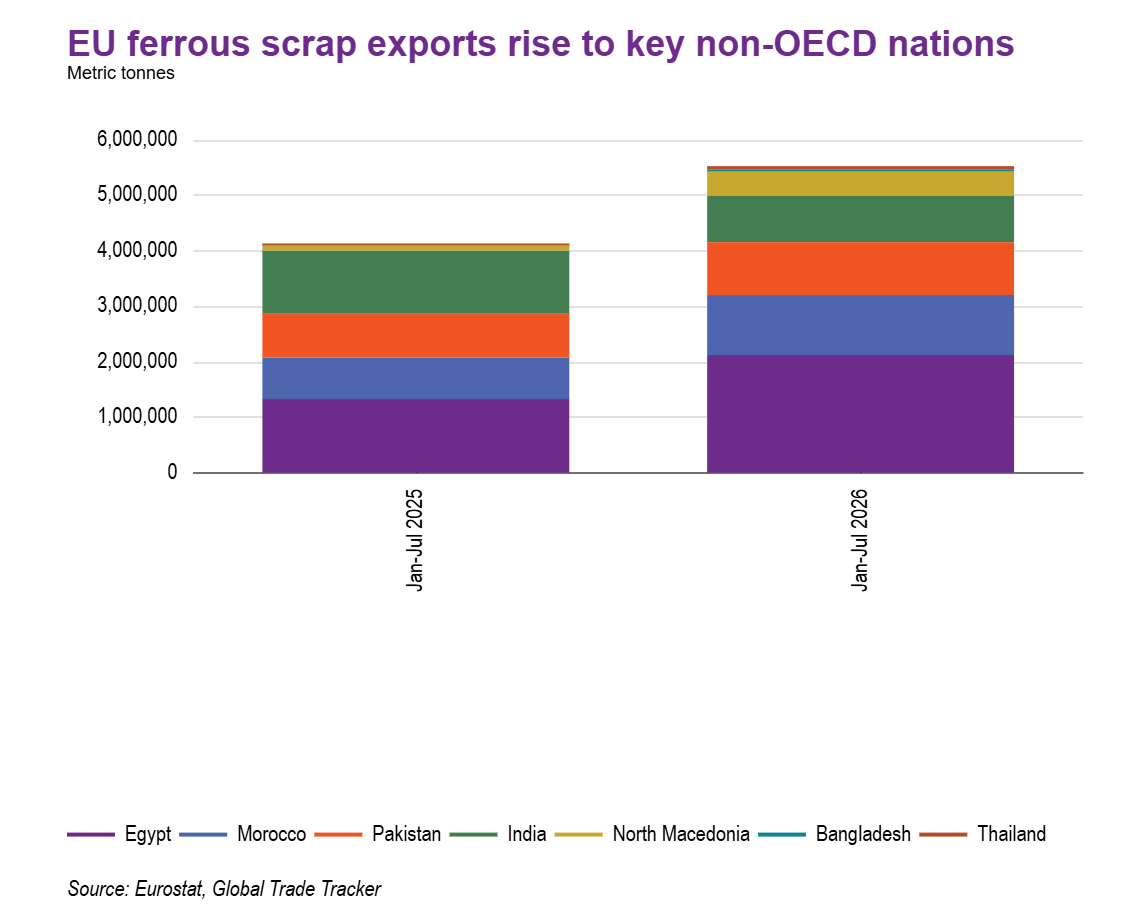
The EU is the world’s largest ferrous scrap exporting bloc, exporting 13.76 million tonnes under harmonized system (HS) code in January-June 2026, according to Eurostat data, up by 10.3% year-on-year.
Its largest single buyer, Turkey, is not affected by the proposed restrictions because it is a member of the OECD, but there is potential trouble for importers in Egypt, Pakistan and Morocco – which make up positions two to five on the list.
“I think it could cause quite a significant realignment rather than simply removing tonnage from the international market,” a major exporter source said this week. “Turkey is OECD so EU exporters can continue selling there, and I would expect more European scrap to be pushed towards Turkey and the EU domestic market.”
“The bigger impact could be in India, Pakistan and Bangladesh – those markets would have to replace EU supply from origins such as the UK, US, Japan, Australia and other Asian or Middle Eastern exporters,” he said. “That should increase competition for available scrap from those origins and potentially support higher CFR premiums in South Asia.”
“Egypt and Morocco will be most affected in terms of European steel scrap,” a second major scrap exporter source said.
There is still time for an appeal, so “there is not too much panic in the market yet, but for exporters, [this could be] very bad,” he said.
Egypt imported 2.12 million tonnes of steel scrap from the EU in the first six months of 2026, up by 59.7% year-on-year, according to the Eurostat data, while Morocco imported 1.08 million tonnes in the same period of time, up by 44.9%.
Both countries are raising ferrous scrap use due to rising local melting capacities for production of materials like rebar, and Egypt’s continued import safeguards of steel billet, according to market sources.
Knock-on effect in South Asia
Should key consumer markets in Asia such as India and Pakistan not receive approval to import EU waste materials under the final determination, demand for scrap in alternative East Asian export markets is expected to rise further, sources said.
This will have “an indirect but powerful impact” because importers from India and Pakistan relying on EU scrap will shift their focus to nations that export larger volumes to Bangladesh, such as Singapore, Malaysia and Australia, a Bangladeshi source said on Friday. “This will ultimately impact prices in South Asia.”
Asian ferrous scrap traders in East Asia said that although there is still time given this is a draft decision, demand from South Asian importers which currently buy from the EU may be redirected to Japan, Australia or New Zealand.
“If not from them, then where would they get their scrap from?” a Singapore-based trader said, highlighting that Bangladesh is especially vulnerable given its scrap import dependency.
The source, however, also cautioned that there might not be sufficient scrap to go around, adding that a good portion of scrap exported by Australia and Japan is already headed to Bangladesh.
Pakistan was the largest South Asian buyer of European steel scrap in the first half of 2026, with 952,110 tonnes – up by 18.5% year-on-year – while India purchased 832,375 tonnes – down 26.2%, according to the Eurostat data.
Fastmarkets’ calculation of the steel scrap shredded, index, import, cfr Port Qasim, Pakistan was $418.68 per tonne on Friday September 18, up from $365.19 per tonne on September 23, 2025.
Bangladesh imported just 40,154 tonnes from the EU over the same period, but imported major volumes from Asian and Oceania origins this year.
This includes 906,910 tonnes of imports from Japan, 499,707 tonnes from Australia and 462,887 tonnes from Singapore, according to Bangladeshi customs data.
UK position
One major exporter country in Europe not directly affected by the WSR rules is the United Kingdom, given the UK left the EU following a referendum in 2016.
Sources said they did not expect the UK to replicate the EU’s WSR rules at this time, which would allow UK-based scrap exporters unfettered access to non-OECD export markets.
“From a UK perspective it could actually create quite a sizeable opportunity,” the first exporter source said. “If UK material remains freely exportable while equivalent EU material is restricted, UK container exporters potentially become more strategically important to India, Pakistan and Bangladesh.”
“Given the volumes involved, I could certainly see buyers becoming much more focused on locking in UK supply,” he said, adding that he hasn’t “seen anything at this stage suggesting the UK will automatically follow the EU” given its waste shipment regime is now separate after the UK left the EU.
The second exporter source agreed, noting that he doesn’t think the UK will adopt similar WSR rules, and regards this as a benefit of the UK leaving the EU.
The UK is a pivotal exporter of ferrous scrap, and – like EU exporters – sells large volumes into key non-OECD markets including Egypt, Morocco and Pakistan.
UK exports of steel scrap were 4.92 million tonnes in January-July 2026, up by 7.5%, according to UK customs data.


European Commission proposes India, Pakistan scrap export ban
The European Commission has proposed major scrap importers India, Pakistan and Bangladesh be prohibited from procuring ferrous scrap from the EU starting 21 May 2027, Kallanish notes.
The Commission included the countries on its draft list of non-OECD countries that could be authorised to import non-hazardous waste from the EU once the Waste Shipment Regulation provision comes into effect next year. However, ferrous scrap was among the materials proposed by the commission not to be included. This stipulation also applies for Egypt and Saudi Arabia, among others.
Authorities have opened an online consultation on the draft list until 16 October.
The Waste Shipment Regulation, adopted in 2024, bans waste exports to non-OECD countries from next May; however, countries can request exemptions, but must demonstrate their capacity to manage waste sustainably.
The first list of countries authorised to receive waste from the EU will be established by the end of 2026. This list will be updated regularly and at least every two years, with the possibility for countries which are not on the list to reapply.
In a staff working document, the European Commission provides its assessment for each country. For ferrous waste, India’s application insufficiently demonstrated that pollution controls apply to treatment operations, the document notes. There is “no comprehensive” regulatory coverage of air emissions reduction for heavy metals, dust, dioxins and furans and PCBs, nor detailed requirements for wastewater treatment stages based on best available techniques.
“The regulatory framework lacks key provisions covering energy efficiency, including requirements for a stable shredder feed, energy efficiency plans, and energy balance records,” the Commission adds.
For Bangladesh ferrous scrap, “the management of residual waste and the incomplete implementation of pollution control measures during treatment raise concern. While Bangladesh has some basic controls in place, the framework does not fully cover key landfill safeguards, site verification and record-keeping requirements, or a comprehensive application of best available techniques. The application also lacks sufficient evidence on technical measures related to emissions control, energy efficiency, material recovery, wastewater management, and the handling and pretreatment of scrap.”
Although Pakistan met a number of requirements, it did not provide key requirements essential for metallurgical treatment: maintaining a stable shredder feed, increasing recovery of secondary materials, ensuring efficient energy use in secondary copper production, or preventing diffuse emissions during scrap pretreatment, the document states.
Egypt did not provide data on the proportion of metal waste that is recycled and referred to a lack of data, although it did indicate it is taking measures to increase the rate of recycled metal waste.
Saudi Arabia’s application did not demonstrate a ban on waste dilution or mixing for treatment residues and a ban on landfilling separately collected waste intended for reuse or recycling, the Commission says. The use of annual compliance testing and of independent laboratories were also not demonstrated. It also did not provide requirements for maintaining a stable shredder feed, implementing energy efficiency plans or energy balance records, controlling scrap quality to minimise pollutants, or preventing and reducing diffuse dust emissions.
Author: Adam Smith Austria


EU imposes GOES provisional safeguard, includes laminations, cores
The European Commission has imposed provisional safeguard measures on imports of grain-oriented electrical steel (GOES) products until 26 February 2027. The measure, welcomed by steelmakers’ association Eurofer, comprises tariff-rate quotas coupled with price thresholds, Kallanish notes.
Following an investigation launched in March, the Commission concluded that provisional measures were urgently needed to protect a strategic EU industry that is under threat from high import pressure – fuelled by global overcapacities and the closure of traditional export markets. Also included are cores that are already incorporated in transformers. The measures thereby also provide protection to transformer manufacturers downstream.
The analysis of import trends of the product concerned shows a 120% increase in import volumes in absolute terms during the period considered – 2021 to 2025 – a 141 % increase compared to EU production and a 66 % increase compared to EU consumption.
The price thresholds range from €2,800-5,000/tonne ($3,214-5,740) while the quotas for GOES range from 30,694 tonnes for China to 4,790t for South Korea, and for laminations and cores from 14,162t for Turkey to 2,694t for “other countries”.
“Europe cannot expand and strengthen its electricity grids without maintaining a European supply of Grain-Oriented Electrical Steel. This safeguard strikes the right balance: preserving a viable European GOES production base while keeping the market open to the imports needed by transformer manufacturers,” says Eurofer director general Axel Eggert.
The cost of the measure to EU electrification should be limited. Estimates indicate the measure would add only around 0.002 cents per kilowatt-hour to overall grid costs. GOES accounts for a small share of transformer costs, while transformers account for only a limited share of total grid investment, the association notes.
“By covering not only GOES coils but also laminations, cores and transformer cores incorporated in imported transformers, the measure prevents import pressure from simply shifting downstream. This ensures that EU transformer makers are not placed at a disadvantage against importers using artificially low-priced GOES outside the EU, while preserving access to the imports needed to compete in European and export markets,” it concludes.

EU mills/distributors interdependent, energy determines investment
EU mills and distributors are increasingly relying on each other amid limited export competitiveness and tighter import measures, while energy prices trump all other considerations for steelmaking transition investments in the bloc.
So concluded a panel of steelmakers’ representatives at last week’s EUROMETAL Regional Meeting Central Europe in Warsaw, attended by Kallanish.
Given the energy and carbon costs put on EU mills that foreign competitors are not burdened with, “we can forget about exports really, and being competitive exporting outside Europe,” exclaimed Jiri Mravec, head of innovation & transformation at Trinecke Zelezarny (TZ). “So without European customers, we don’t survive the next month … We are in this fight side by side and together. I mean, steelmakers and the whole downstream value chain, And in crisis, you find your friends.”
European customers will meanwhile shift towards domestic mill procurement due to the complexity of navigating the new trade barriers. This shift has been gradual so far because of the high stocks accumulated in prior quarters, said Tomasz Plaskura, chief marketing officer East Europe – ArcelorMittal Europe Flat Products.
“In terms of competitiveness, of course, it’s our primary objective to stay competitive in Europe in the entire value chain,” he noted, adding he agreed with the need to extend import measures downstream.
The Emissions Trading System (ETS) has so far meanwhile just been a stick rather than a carrot for mills. In terms of allowances, TZ is overallocated for its blast furnace alone, but when taking into account its captive power plant that utilises BF off-gases, it is short off allowances and burdened by the cost. “We are already having discussions on how do we put this in [our steel] prices in terms of some CO2 surcharge or something,” Mravec noted.
“If we just increase the price by €160, we are out of the market very quickly. So it forces us to decarbonise, but they force us to decarbonise in the times when we are poor … We don’t have the Ebitda margin to go to banks,” he added.
“If you plug in €200 per megawatt hour of electricity in the Excel, it will give you no ROI for any electrification business case, and no one’s willing to pay for the green steel extra premium, that I can confirm,” he continued. CBAM “has to be working really well” for mills to achieve the steel prices required to make the investment feasible.
Fellow Czech mill Nova Hut, currently a re-roller, faces the “unique situation” of needing to purchase ETS allowances for its reheating furnaces and also navigating CBAM to import the required semi-finished steel feedstock, said Nova Hut chief executive Radek Strouhal.
“It’s not very easy with the CBAM because we are approaching the suppliers asking about certification … During February, we received cross benchmark figures, so we were offering material in the last quarter, last previous year, and not knowing what will be the price, just estimating where the benchmark can be,” he continued.
The firm’s plan to install an EAF “is the only future we can have”, he added. However, it will need “predictable” electricity prices to operate. With EU gas prices shooting up in September, it would be difficult to imagine having to pay €200/MWh for electricity from the grid, he added. Nuclear power “is the only way”.
Competitive energy prices are “the only driver to keep those [steelmaking electrification] investments in Europe” as they form the business case, more so than subsidies, Plaskura said.
Mravec said TZ’s EAF subsidy application is “hitting the wall with financing”. The firm’s strategy is to operate an EAF alongside a BF to have flexibility. “I am 100% certain there will not be a successful hydrogen DRI in Central Europe. This is relevant for particular geographic regions where you can get so cheap renewable electricity that you produce so cheap hydrogen to be able to be cost competitive,” he concluded.


Author: Adam Smith

Euro area construction output stable in July 2026 from June
According to first estimates released by Eurostat, the Statistical Office of the European Union, in July this year the seasonally-adjusted production of the construction sector in the European Union member states (EU-27) decreased by 0.3 percent compared to June this year and fell by 1.8 percent compared to the same month of 2025. In June, production in the construction sector had moved down by 1.3 percent month on month.
In the euro area, the seasonally-adjusted production of the construction sector in July remained stable month on month and moved down by two percent year on year. In June, production had decreased by 1.5 percent month on month.
Building construction in the EU-27 in July moved down by 0.4 percent month on month and down by 5.6 percent year on year, while civil engineering output in the region decreased by 0.9 percent month on month and decreased by 0.4 percent year on year. In the euro area, building construction remained stable month on month and was down by 6.4 percent year on year, while civil engineering output in the region rose by 0.6 percent both month on month and year on year.
As compared to June, construction output in July increased by 2.8 percent in Belgium, by 2.1 percent in the Czech Republic, and by 1.9 percent in Slovakia, while it decreased by 4.7 percent in Hungary, by 3.8 percent in both Poland and Sweden, and by 2.2 percent in Austria.
As compared to July 2025, construction output in July this year increased by 12.8 percent in Finland, by 11.6 percent in Slovenia and by 4.8 percent in Bulgaria, while it decreased by 12.2 percent in Hungary, by 9.7 percent in Spain and by five percent in France.

European HRC prices climb despite weak demand; import risks and supply concerns support market
Domestic prices for steel hot-rolled coil (HRC) edged up in both Northern Europe and Italy on Monday September 21, while sources reported steady but gradual price increases linked to weak demand and limited import activity.
In Northern Europe, sources said prices were gradually increasing but demand remained weak as there was no major restocking in the market.
A supplier source in the region indicated workable HRC levels for October delivery at €740-750 ($850-861) per tonne ex-works, adding that it was aiming to achieve €760 per tonne ex-works, depending on how demand develops.
“Mills are carefully observing the situation,” the supplier said on Monday.
The same source said HRC import activity into the region was very quiet due to the high risks related to safeguard quotas and Carbon Border Adjustment Mechanism (CBAM), so buyers were staying a bit away for the moment.
The supplier also said that it was seeing prices mostly stable in the upcoming period, with an ambition to reach levels around €800 per tonne ex-works in the domestic market by the end of the year.
Meanwhile, a distributor source in Germany reported offers for material within the range of €750-760 per tonne delivered on Monday, which nets back to €730-740 per tonne ex-works, adding that the market was very quiet and demand remained weak.
The same source said that levels around €720 per tonne ex-works, which were previously quoted by sources in the market on Friday September 18, were no longer achievable.
On the other hand, a buyer source said on September 21: “Whilst there may be odd deals at lower levels, we would agree that around €750 [per tonne ex-works] is a fair estimate, trending to €775 [per tonne ex-works].”
As a result, Fastmarkets’ daily steel hot-rolled coil index domestic, exw Northern Europe was calculated at €745 per tonne on September 21, up by €7.50 per tonne from €737.50 per tonne on September 18.
The index was also up by €7.50 per tonne week on week and by €22.92 per tonne month on month.
In Italy, the picture of achievable prices in the market remained slightly blurred, with buyers and suppliers reporting different levels.
Latest offers were reported at €750 per tonne delivered, equivalent to around €735 per tonne ex-works after deducting €15 per tonne in delivery costs, a trade source said on Friday September 18.
The same source added that there was limited room for negotiation, indicating workable levels for hundreds of tonnes at €750 per tonne delivered and for larger volumes at €740-745 per tonne delivered (€725-730 per tonne ex-works) on the same day.
Meanwhile, a distributor source said on Monday that the minimum levels it was hearing were within the range of €730-740 per tonne ex-works, declining to offer lower prices.
“Honestly, I think that in this moment buyers are not realistic. Price is going up week after week and some numbers they declare are not anymore available, according to my opinion,” the same source said.
A second trade source quoted achievable levels in the range of €730-735 per tonne ex-works on Monday, in line with the latest deals heard in the market on September 17. The source added that prices at €725 per tonne ex-works sounded “optimistic” under current market conditions.
Thus, Fastmarkets’ daily steel hot-rolled coil index domestic, exw Italy was calculated at €733.75 per tonne on September 21, up by €3 per tonne from €730.75 per tonne on September 18.
The index was down by €2.50 per tonne week on week but up by €21.25 per tonne month on month.
One of the main factors affecting HRC availability in Italy remained the uncertain future of the former Ilva steelworks in Taranto, which has been ordered to suspend hot-end operations by October 28.
However, market participants were uncertain how the situation would develop. Italy’s Court of Cassation, the highest court of last resort in the country, is scheduled to hear appeals against the shutdown order on October 20, only days before the deadline for the closure to take effect, a trade source told Fastmarkets.
As a result, many participants remained in a wait-and-see mode regarding the producer’s future and its potential impact on domestic steel supply.
At the same time, a company source at Metinvest’s Ferriera Valsider mill in Italy told Fastmarkets that it was not taking new orders yet. “We are producing but the potential space for new orders, if any, would be for December production earliest,” the same source said.
Polish domestic rebar prices rise amid higher energy costs
Polish domestic rebar prices rose in the week to Friday September 18 as producers continued to push for higher levels in response to increasing production costs.
“There is a really big cost pressure for mills. Energy prices are very high. Compared to a month ago, prices are doubled,” a distributor source told Fastmarkets.
Rising oil and energy prices continued to support higher offers, while some mills adjusted their working hours depending on energy costs.
Deals for domestic rebar were heard at 2,770-2,800 zloty ($729-737) per tonne, with offers also heard within that range. Workable levels were heard at 2,740-2,800 zloty per tonne.
Fastmarkets’ weekly price assessment for steel reinforcing bar (rebar), domestic, CPT Poland, rose to 2,740-2,800 zloty per tonne on Friday, up from 2,650-2,680 zloty per tonne the previous week.
In the wire rod segment, indications were heard at 2,900-3,100 zloty per tonne delivered.
Fastmarkets’ weekly price assessment for steel wire rod (drawing quality), domestic, delivered Poland, remained unchanged at 2,900-3,100 zloty per tonne on Friday.