


Argus White paper: Explaining the European steel safeguard
The European Union will implement its definitive steel safeguard in early-February designed to prevent redirection of imports.
Longs imports will take the biggest hit from the new quota, while flats, and particularly hot-rolled coil, could be largely unaffected.
While cold-rolled coil and hot-dip galvanised imports from established sources could slip, there is scope for growth in supply from new suppliers.
Since early-December Argus has been publishing market leading and market moving coverage of the safeguard, its likely structure and impact on the market.
The content, contained below, will be updated as the story continues to unfold.

Knauf Interfer SSC spins off processing activities
Knauf Interfer has spun off its Nürtingen steel service centre into a newly-founded company named Meform,Kallanish learns from the distribution group.
Nürtingen, which exclusively handles hot strip, has hitherto operated a rolling-profiling facility which shapes slit material into finished fabricated forms. This activity will now be carried out by Meform, which will figure under two units, Meform Components GmbH and Meform Profiles GmbH. As part of an asset deal, the new company will continue hiring all employees for the activities.
Matthias Zaiser, the managing owner of the new units, plans to invest into new technologies to develop Meform further. For Knauf Interfer, the transfer signals a further concentration on its core activities in steel and aluminium with an emphasis on markets characterised by the requirement of light construction, says Matthias Kessel-Knauf, ceo of the group.

S. Korean steelmakers to get higher quotas for EU exports
South Korean steelmakers will get higher quotas on top of their exports to the European Union starting from February 2, the Ministry of Foreign Affairs said late last week.
The additional quotas come after the EU told the World Trade Organization it will impose a 25% duty on steel imports above a certain threshold, effective February 2, the ministry said. Once the quota has been reached, the 25% duty would apply, the European Commission had said.
The higher quotas are expected to rise 105% from February 2 to June 30, 2019; to 110% from July 1, 2019 to June 30, 2020; and to 116% from July 1, 2020 until June 30, 2021, the ministry said.
Domestic steelmakers, such as Posco Daewoo, are expected to get the additional quotas over 2019-2021 on 11 items which include cold-rolled and galvanized products.
In 2017, South Korea exported about 3.13 million mt of steel products to the EU, valued at $2.9 billion, the ministry said.
— Clement Choo

EU carmakers oppose proposed EC steel safeguards

The European Commission’s proposal of definitive safeguard measures on steel imports was met with “regret” Friday by the European Automobile Manufacturers’ Association (ACEA), which said the proposal would not consider the needs of the automotive sector.
“ACEA questions the need for such trade protectionist measures. In the automotive sector, access to EU steel production is extremely tight and imports remain necessary to fill supply-chain gaps,” the association said in a press release Friday.
The EC, however, said that steel prices remain under downward pressure and said imports of steel products into the EU increased significantly in recent years and are likely to increase further — compounded by trade diversion resulting from US trade measures.
“Imports of steel into the EU have increased over the last year because European manufacturing output has grown substantially since the economic crisis,” ACEA Secretary General Erik Jonnaert said. “Motor vehicle manufacturing has increased by 5 million units per year since 2014, and some increase in steel imports has been necessary to meet this higher demand.” He added that a no-deal Brexit and the threat of US duties on European cars on top of the new measures would negatively impact the competitiveness of EU carmakers.
Anti-dumping measures against corrosion-resistant steel — one of the most sought-after products by carmakers — have only been in place for Chinese product grades that primarily go into production for other industries.
In a notification document to the World Trade Organization, obtained by S&P Global Platts Wednesday, the EC outlined its planned definitive safeguard measures, which include country-specific quotas on the biggest steel-supplying countries to the EU, with all other countries under a quarterly residual quota.
The safeguard measures are intended to be in place for three years, including the period of provisional safeguards that started in July 2018, and would expire on July 16, 2021. Once a quota is filled, a 25% tariff would apply.
When a country with “significant supplying interest” has exhausted its specific tariff-rate quota, it would be allowed to have access to the quarterly global tariff-rate quota for the specific steel product, which would apply to all other countries, but only in the last quarter of the year. An exemption for hot-rolled coil would apply, which would be under a quarterly global quota.
— Laura Varriale
Sülzle acquires rebar processing facility
Germany’s Sülzle Stahlpartner has acquired the rebar processing unit of Carl Pfeiffer GmbH in Stockach near Lake Constance, the buyer informs Kallanish.
Carl Pfeiffer is a specialised wholesaler for trade and industry which wants to focus on its core activities in the future. In the course of this process, it has decided to divest its rebar cutting and bending activity. Among other things, Pfeiffer is currently investing in a new warehouse logistics system. Sülzle has long cooperated with Pfeiffer, and plans to continue to do so in the future.
“With the new site in Stockach, we are noticeably expanding our supply area, and can serve customers and construction projects in the Lake Constance region much faster,” say Sülzle’s managing directors, Heinrich and Andreas Sülzle.”
Next to Ruhl, which is also headquartered in southern Germany, Sülzle is one of Germany’s largest distributors of rebar, with 15 of its own sites and two partner firms in Munich and Aichach.
Turkey rebar: EU quota to be filled rapidly
Market participants expect the proposed EU definitive safeguard Turkish rebar quota to be exhausted in a matter of days upon its introduction in early February, they said today after the European Commission (EC) made its plan public.
One Turkish mill has a total of 65,000t of rebar either to be shipped to Europe, en-route or waiting at port, which the producer had earmarked to clear customs once the new quotas come into effect. Another steelmaker was heard to have sold around 70,000t for February arrival.
Some 18,000-30,000t have arrived or are due to arrive in Romania in January and is expected to be cleared by customs in February, according to a market participant. Another continental European source said they expect the 117,231t allocated to Turkey for the period between 2 February and 1 July to be gone within a day.
The question remains when the residual global quota of 217,775t will be made available in the February-July period to exporters with allocated volumes. The EC declined to comment.
But some market participants anticipate a situation similar to what happened in the US post-Section 232 tariffs being implemented, with EU domestic rebar prices set to increase, while buyers continue importing and pay the duty.
The Argus daily rebar assessment fell by $2.50/t to $447.50/t today, as more mills were confirmed to be offering at $450-455/t fob, although market participants agreed $445/t fob would be possible for larger tonnages for some mills. A sale to Germany was heard to have been concluded recently, although details could not be obtained.
Turkish wire rod offers heard were $480-490/t fob.
In the domestic market demand picked up slightly yesterday, with one north Turkey-based mill selling just under 7,000t. Traders were planning to make more purchases today.
The seller offered rebar at 2,466 lira/t ($451/t) ex-works today excluding value-added tax (VAT) — unchanged since mid-December — but lowered its billet offer by TL60/t to TL2310/t on the same basis, although it did not sell much material.
An Iskenderun producer offered at TL2,880/t ex-works including VAT, and a trader said it purchased at TL2,860/t from two mills in the region.
A Marmara mill said it sold around 10,000t of rebar in the local market in the past two weeks at $445-450/t ex-works equivalent excluding VAT to reduce its inventory levels, and is now offering at $450/t ex-works.
EU quotas suggest 5% annual increase until mid-2021
The European Commission has prepared a draft document on the final decision over permanent safeguard measures on imports of a number of steel products into Europe. This indicates that tax-free quotas will rise by 5% annually until mid-2021. Despite this clause, traders are expressing their concerns as the system imposes further limits compared to the temporary measures currently in place, Kallanish understands.
As an example, as anticipated the quotas for HRC will be calculated globally rather than country-based. The draft from the EC indicates that a first quota of some 3.3 million tonnes will be allocated in the February-June 2019 period. After that a quota of 8.6mt will be set for July 2019-June 2020 and one of 9mt for July 2020 – June 2021.
A similar increase over the period is calculated for all other products. The quotas for these however will be allocated to a specific country of origin for the largest importers and a general ‘residual group’ of other countries including all smaller sources.
The division into country of origin could well create new challenges for importers in Europe. A Swiss-based trader, for example, notes that for Chinese metallic coated sheets the EC is setting a 500,000t quota for the July 2019 – June 2020 period. During full-year 2018 over 1mt of such products were imported into Europe from China.
The products mostly under pressure since the temporary quotas were applied have been longs. Over 90% of the quotas set for the period ending February 2019 had already been used in mid December 2018 (see Kallanish passim). The EC is setting an overall 2.1mt quota for the period July 2019- June 2020 for wire rod specifically, while for rebar it will be 1.5mt (both divided into specific countries of origin).
All quotas will be allocated quarterly and unused quotas will be allowed to be transferred to the following quarter. Specific source countries having exhausted their quotas meanwhile will be able to use the unused tonnages included in the ‘residual quota’ group only in the last quarter of the period, Kallanish understands.
Questions arise over proposed EC safeguard measures
European steel market players on Thursday were still analyzing the possible impact of the European Commission’s proposed definitive safeguard measures on steel imports into the European Union.
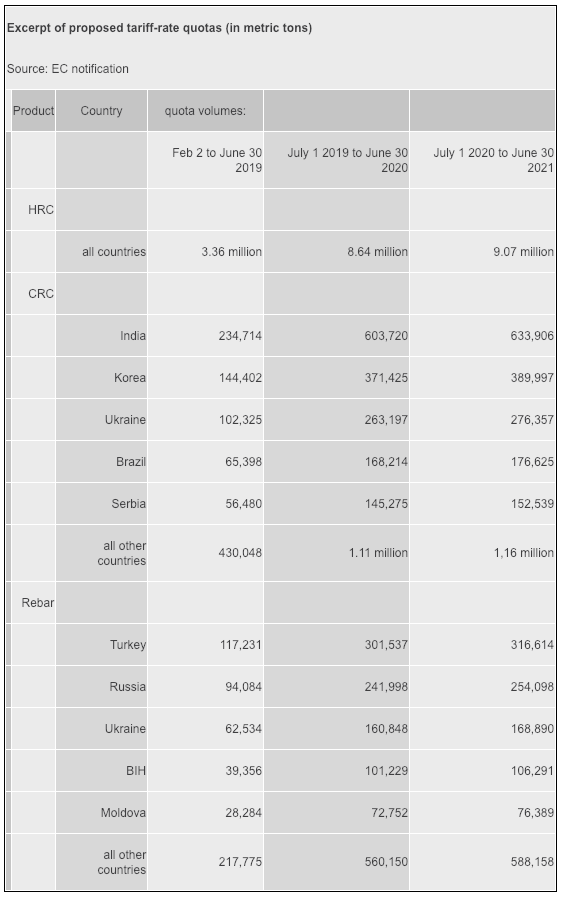
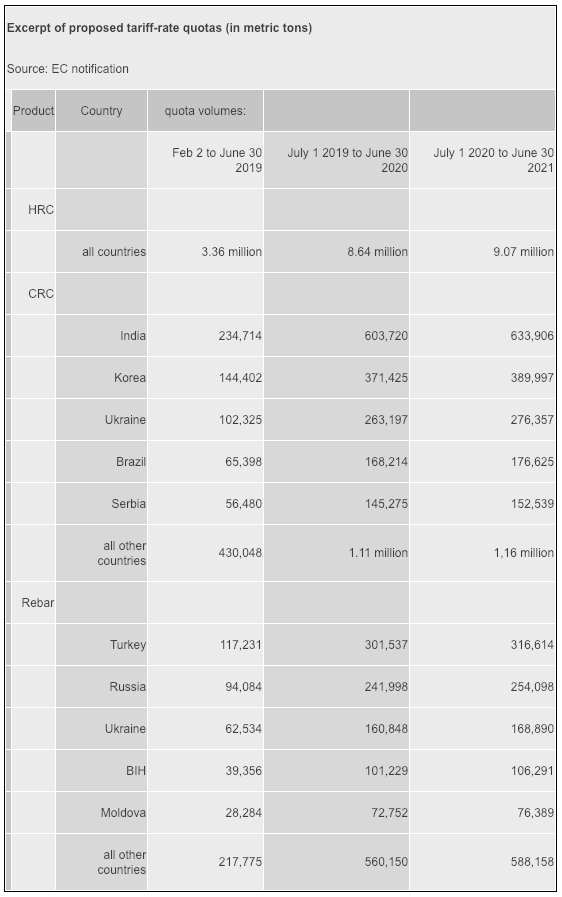
In a notification document to the WTO, obtained by S&P Global Platts, the EC outlined its planned definitive safeguard measures, which include country-specific quotas on the biggest steel-supplying countries to the EU. However, the EC plans to make an exemption for hot-rolled coil imports which would receive a global tariff-rate quota.
The definitive safeguard measures will be enforced no later than February 4, the EC said.
A mill source said it would be “odd” that HRC received a global quota and that Turkey has not been singled out as it was a major source of material for European buyers in 2018.
According to the EC, a country-specific approach would not be appropriate for HRC as 60% of imports are already covered by anti-dumping measures.
Provisional import quotas, which have been in place since July last year, show that HRC quotas have not yet been filled. Around 37% — 1.56 million mt — can still be imported until February 1 out of an initial quota of 4.27 million mt as of the last update on December 28.
“HRC imports weren’t the big problem, there weren’t massive amounts. CRC and HDG were critical,” said the mill source. He added that singling out India for CRC (see table) would be questionable as India has not been a “distorting” supplier in recent years. However, around 604,000 mt (46% of the initial quota of 1.318 million mt) was still available for import and HDG had a balance of 469,000 mt (22% of the initial quota amount of 2.115 million mt) as of late December.
Most market sources consulted told Platts they are still working out what the proposed safeguards would mean.
“It seems there will be some confusion and I think that traders will hold back until it becomes clearer,” UK-based trader said.
He added that he saw large re-rollers being at an advantage with a global tariff-rate quota for HRC because they will be able to bring in large volumes of cheaper HRC and then process it within the EU to value-add the volumes.
Long products saw the most robust import activity in the past few months, with Turkey a major source for importers. It would receive a country-specific quota under the proposal (see table).
The rebar quota balance came to 9,215 mt as of December 31, only 1.35% of the initial allocated amount of 714,964 mt set in July 2018. At 4,384 mt, the wire rod balance is only 0.4% of the 1.6 million mt allocated.
The safeguard measures are intended to be in place for three years — including the period of provisional safeguards that started in July 2018 — expiring July 16, 2021. Once a quota is filled a 25% tariff would apply.
The level of the tariff-rate quota should be increased by 5% in each year the measures are in force. The EC considers that the quantitative level of the tariff-rate quota should be based on the average imports in the period 2015-2017 plus 5%.
When a country with “significant supplying interest” has exhausted its specific tariff-rate quota, it would be allowed to have access to the quarterly global tariff-rate quota for the specific steel product which would apply to all other countries, but only in the last quarter.
Laura Varriale, Len Griffin, Erica Sesay
Trader Metalcorp relocates to Luxembourg
Steel trader Metalcorp Group has recently moved its headquarters from Amsterdam to Luxembourg. This is in order to simplify its corporate structure and reduce administrative costs, it says in a statement monitored byKallanish.
The company is active in diverse sectors, in trading as well as production. Apart from its procurement, logistics and trade services of steel and non-ferrous metals, it claims to be one of Europe’s leading independent producers of secondary aluminium ingots.
Its steel trading activities achieved revenues of €127 million ($145m) in the first half of 2018, making up around 38% of the company’s total revenue, Kallanish learns from a spokesman. Metalcorp also owns Greek steel pipe and hollow sections producer Nikolaidis Bros in Thessaloniki.
The company mentioned in 2018 that it was bidding for another steel producing, or processing company which it did not name. An acquisition did not happen, its spokesman says, but notes that the company continues to “… test options for takeovers.”
German steel stocks drop for first time since August
Steel inventories at German stockholders dropped in November month on month for the first time since August, according to data from German stockholder association BDS.
Stocks of flat steel amounted to 1.42 million mt, a 13% drop from October to November. In a year-on-year comparison, stocks were up 9.4%. In October 2018, stocks reached the highest level since June 2014. German sources said that buying was subdued during autumn as prices remained volatile during that period, with many sitting on their hands until a price direction became clearer.
Stock volumes of long steel only saw a marginal month-on-month decrease, by 1.28%, to 836,426 mt. Compared to November 2017, stocks grew 3.14%.
Stocks were expected to fall in Germany towards the end of the year amid the seasonal destocking period, although sources said that warehouse volumes remained on the high side for that time of year.
Sales volumes for both long and flat steel saw a decrease in November, indicating that demand from end-users tailed off. From October to November, flat steel sales dropped 6.59% to 558,249 mt, while long steel sales dipped 4.94% to 302,154 mt.
In year-on-year comparison, sales went down 3.2% for flat steel and 4.27% for long steel.
— Laura Varriale