


La Unión de Almacenistas eligió ayer a su nuevo Presidente
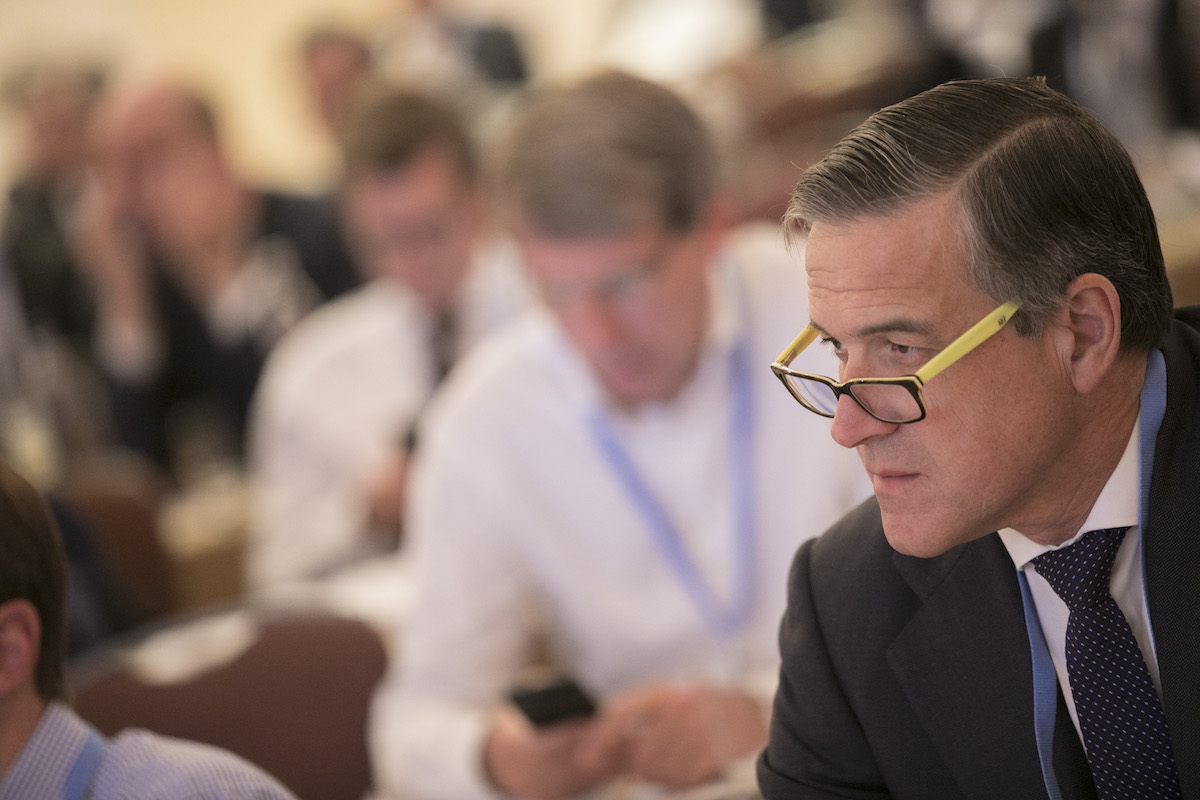
Ayer día 12 de Junio se celebró la Asamblea General de la Unión de Almacenistas de Hierros de España en Madrid en la que se ratificó por unanimidad la elección de los nuevos Presidente y Vicepresidente, D. Roberto González (Tirso CSA) y D. Fernando Moraga (Grupo Hierros Alfonso).
D. Roberto González, ha sido Vicepresidente de la asociación durante el último año, y forma parte de la Junta Directiva desde el año 2013. El nuevo Presidente agradeció a D. Juan Carlos Núñez (Hierros y Aceros García Cía) su gran labor al frente de la asociación, manifestó su propósito de dar continuidad a los proyectos iniciados durante su mandato, y explicó algunos de los objetivos de la presidencia para los próximos cuatro años: extender “aguas abajo” la digitalización, proporcionar formación al sector, trabajar en la potenciación del uso del acero, aumentar el número de asociados y empoderar a la Unión de Almacenistas, son algunos de ellos.


Polish construction growth boosts Konsorcjum Stali’s first-quarter sales
Konsorcjum Stali (KS) increased sales 16.4% on-year in the first quarter to 178,000 tonnes, boosted by a 26.1% rise in Poland’s building and construction sector output, Kallanish learns from the Polish distributor and fabricator.
First-quarter revenue rose 28% to PLN 461.06 million ($127.1m) and net profit grew 5% to PLN 11.45m.
Despite the 2-3% annual growth forecast for Polish steel consumption in the coming years, and 1.9% EU consumption growth in 2018, the threat remains of a global trade war stemming from US 232 tariffs, KS observes.
In 2017 KS increased sales 5% on-year to 639,000t (see Kallanish passim). This was driven by a 7% rise in traded product sales to 398,000t. Rebar sales rose 15% to 168,000t, but sheet deliveries fell -6.8% to 69,000t. Z and G sections sales were flat at 60,000t. Sales of KS-produced or processed products, meanwhile, rose 3.4% to 241,000t.
At an industry meeting in Poland last month KS chief executive Janusz Smolka said Polish construction projects should go ahead despite the increasing number of construction firm bankruptcies.

Stocks at EU steel distributors drop as shipments rise
Steel shipments from European service centers and stockholders rose year on year in April, while stocks gradually fell to normal levels, the European Federation of Steel, Tubes and Metals Distribution & Trade (EUROMETAL) said Wednesday.
Shipments at flat steel service centers in April rose 7.3% year on year.
While EUROMETAL does not specify volumes, the association releases an index for stock levels with the average of 2015 equivalent to 100. On this basis, stock levels at European flat steel distribution centers dropped to 110 in April from 121 in the same month last year, indicating lower volumes from last year, though nevertheless slightly elevated.
“After quite some overstocking in late 2017, mainly in coated products, stocks of EU SSC are now closely back to normal,” EUROMETAL said.
Shipments at multi-product distributors in April rose 8.5% year on year. The stock volume index stood at 101 in April, down slightly from 102 in the same month last year.
The data coincides with the latest stock volumes at German steel distributors. As reported, inventories of flat steel products at German stockholders and distributors in April fell to their lowest level so far this year, down 6.3% year on year at 1.45 million mt, according to figures from German stockholders association, BDS. Long product stocks in Germany also declined, but not as heavily as flat steel, falling 4.5% year on year to 879,715 mt.
Laura Varriale, PLATTS
April signals on-year revival in EU distribution activity
Activity at European flats steel service centres (SSC) and multi-product distributors rose significantly in April compared with the same month of 2017, Kallanish learns from EUROMETAL.
Shipments by SSC moved up 7.3% y-o-y in April alone. Overall shipments during the first four months of the year remained stable compared with the same period of 2017, the European distributors’ association notes.
SSC also showed slight re-stocking activity during the period as stocks returned to 72 days’ worth of sales. In April last year these were calculated at 82 days’ worth of sales.
Meanwhile shipments from multi-products distributors also jumped 8.5% y-o-y in April. Overall aggregated shipments in the first four months of 2018 have been 0.7% higher than last year. Stocks in April meanwhile reached 80 days’ worth of sales, compared with 87 days’ worth of sales in April 2017.
Revista INFOACERO – Mayo 2018
En el siguiente enlace pueden acceder a la edición de mayo de nuestra revista Infoacero: Infoacero mayo 2018
A continuación destacamos algunos de sus contenidos:
- Opinión – D. Fernando Moraga – Presidente de la Unión de Almacenistas de Aragón y Soria y Miembro de la Junta Directiva de la UAHE.
- Evolución del Índice de Precios de Productos Siderúrgicos – UAHE.
- Asamblea General UAHE – Programa de Conferencias, Madrid 12 de junio 2018
- Previsiones 2018-2019 para el Sector del Acero en Europa: Resumen del Informe de Eurofer actualizado al mes de mayo 2018.
- Próximos Eventos: Jornada EUROMETAL sobre Líneas de Corte Países Sur de Europa, 25 – 27 de junio 2018 – Barcelona
EUROMETAL highlights Section 232 divergence from WTO principles
Europe’s steel distributor’s trade association EUROMETAL has joined virtually the rest of the continent is signalling the disruptive nature of the US Section 232 tariffs on global trade. EUROMETAL highlights the guiding principles of the Marrakesh Agreement made when establishing the World Trade Organization (WTO).
In a statement sent to Kallanish, the association adopts a rational and reasoned approach, suggesting that the precipitous US action and consequential retaliatory actions by other nations are both undesirable. “EUROMETAL is aware that global overcapacities in steel are of nature to disrupt steel trade flows, with spiralling moves towards protectionism, unfair trade practices and retaliating trade measures and, as a consequence, raising uncertainty and volatility in global steel markets.
In that line, US safeguard measures and corresponding retaliating measures are a serious blow against the optimisation of global steel supply chains with heavy negative consequences for all stakeholders of the steel supply chain,” its says.
These stakeholders include all main end-user groups as well as the global distribution sector, EUROMETAL says. The association reinforces this by listing the four basic tenets of the World Trade Organization as listed in the Marrakesh agreement. These are the “… official primary guiding principles of free and fair trade,” it says.

EUROMETAL: Distributors see global protectionism key risk for industry
The participants of EUROMETAL’s Central Europe Regional meeting of steel distributors on May 14-15 in Vienna addressed the problem of increasing value of steel by distributors and steel service centres (SSC), as well as the main challenges and opportunities the industry is facing now. The meeting was attended by more than 50 industry representatives from Central and Eastern Europe, including the producers and independent SSC and distributors.
Accessing the situation in the Central and Eastern European steel distribution during the meeting attended by Metal Expert participants agreed that the global protective measures currently pose a major threat to the European steel market. New EU safeguard measures, if applied, will reduce imports, thus aggravating the situation in the distribution sector in terms of supply balance, Metal Expert understands. All distributors and SSC are dependent on imports; they need imports in addition to the material they buy from the EU mills, otherwise they lose their competitive edge. “Independent distributors are back bone of the industry…We have solid function in the market…Yet, now there is a danger, not only in terms of AD cases…, now we have that safeguard investigation, which is a general attack on imports,” Ralf Reintjes, managing director of German trader Primex Steel and ISTA executive committee member, said. There has to be a healthy mixture between imported and EU-produced steel, which is hard to achieve in terms of ongoing AD cases, participants agree.
Some speakers believe that currently mills are better-positioned in the market than independent players, partly because of trade measures. “I don’t think independent SSC have such a bright future. We could see that during the AD procedures. There was a fight between integrated mills and independent SSC, and now it is really for the favour of integrated mills what we see in Europe at the moment,” Roland Fazekas, president of Hungarian stockholding company Carboferr, opined.
There was an opinion voiced during the discussion that independent steel distributors need a body to represent them in trade cases, like Eurofer for the mills. “We are simply to small…we need an independent body which can represent us in cases like safeguard investigation, AD cases, because such organizations have voice,” Ralf Reintjes added.
It is worth noticing that the EU launched a safeguard investigation into all steel imports, except for semis, from all origins, in a response to the US Section 232 case. This investigation is expected to have a major influence on flat steel products. Last year, steel imports volumes sent to the EU reached 29.4 million t, with flats constituting 69% of that volume, EUROMETAL director general Georges Kirps showed in his presentation. Even though the flats imports situation has stabilised since the imposition of safeguard measures in 2016-2017, overseas deliveries are not going down significantly. Lower shipments from the counties covered by AD measures have been offset by those from other regions. “Non-EU import flow changed by imports sources, owing to imposed AD measures,” Kirps said.
Sometimes, even the protective measures are not enough to fully stop imports, like in case with Russia that managed to increase HRC deliveries to Europe from 23,000 t in January-March 2017 to 420,000 in Q1 2018, despite the AD applied. “Certain Russian company, Severstal, has a low antidumping [rate] and runs SSC in Poland and Baltic region. So one of the explanations for that is increased deliveries mainly to Poland and Baltics for their own assets,” Kirps noted.
In a wake of increasing steel imports volumes to the EU in recent years competitiveness has become one of the key issues for the local steel market participants. For the EU distributors, the crucial differentiating factor from imports remains the range of services they can offer. From that point of view, the cooperation between mills and the SSC is essential for the steel market, especially, in the current situation, when there is no longer a clear split between the distributors’ market and the mills’ market. “Now mills just go directly to our customers, it’s complete chaos,” a European distributor told Metal Expert.
At the same time, distributors are more flexible than mills as they buy material from different sources and can deal with small tonnages which mills usually don’t do. “Mills will never be able to provide the same level of services as SSC,” Gabriel Holub, sales manager at U.S. Steel Kosice said during his presentation. The sustainable cooperation between mills and distributors can increase value of steel supply chain. “As the largest integrated mill in the Central Europe and without our own distribution network, the cooperation with SSC is a natural part of our business,” he said.
Despite the mentioned risks, many participants agreed that prospects for independent SSC are rather optimistic. Among the advantages of distributors is their consistent approach to the market. A relative value that they apply to the customer as an independent SSC is probably greater than the mills would give. “We are more flexible to satisfy specific customer demands,” Garry Furey, general manager of Czech service centre Mi-King said. Apart from a range of services the mills cannot provide, the distributors can also handle small tonnages which mills would not deal with. These competitive strengths are putting the distribution sector in a good position in the steel market, Metal Expert understands.
Speaking of the main opportunities for independent SSC, the meeting participants addressed digitalization as one of the key competitive advantages for a short-term perspective. Launching online platforms allows them to achieve greater customer acquisition, cut costs, improve warehouse management and logistics routing, to increase value of a supply chain. “Digitalization is a first step towards Industry 4.0….In digitalization we see a huge potential, may be not now, but for the future – definitely,” Dr. Jan Moravec, member of the board of Ferona, mentioned during his speech.
“We are trying to standardize our processes and digitalize whatever we can in our organizations. We gain a lot of time in terms of customer service by applying automatized processes,” one of the participants said during the panel discussion. Besides, the participants mentioned that for the future prospects it is important for a steel distributor to offer its customers a wider range of material – not only steels, but also a supplements, including plastics, aluminium etc. “If you have a full package of steel and supplement materials, for end-users, it’s also a value-added kind of service you can offer, which distinguishes your company from the others,” one of the distributors said.
EUROMETAL includes 18 national associations and represents interests of about 3,000 steel distributors and service centres. Among the upcoming regional events organized by EUROMETAL is SSC Meeting Southern Europe in Barcelona on June 28. The meeting will address the ways SSC can enhance the value chain of steel, key challenges and opportunities the independent SSC in Southern Europe are facing now.
Italian service centers under pressure as margins decline
Italian steel service centers (SSC) remain under pressure, with the first five months of 2018 seeing very little demand, particularly from end-users, according to sources.
2018’s shipment volumes are lower than 2017’s, sources say. In addition, margins are being squeezed. Mill prices have fallen consistently, by about Eur20-Eur25/mt, over the last two months, but SSCs have had to cut their prices by even more – around Eur40-Eur50/mt, a source at a large Italian service center said.
“Obviously this bigger SSC price reduction is penalizing the SSC margin, which is not sustainable any more, and needs to rise urgently, even if the demand isn’t helping and some uncertainty is still present in the market” he added.
Even with slow demand and shipments, SSC stock levels have decreased over the last three months and, as a consequence, SSCs are little by little entering the market, sources say, with the main purchases expected in the coming weeks.
Margins fell because SSCs are having to sell at least Eur30-35/mt below where they make any money, while mills have started to decrease their prices to entice buyers, but also due to pressure from imports.
“Domestic prices have moved down as end-users continue to resist any price rises from distributors, with SSCs not fully absorbing mill price increases in the first quarter,” another source said.
The price of hot-dip galvanized sheet from Italian mills fell the most, around Eur10/mt week on week, to Eur620/mt base substrate, ex-works, according to Platts-TSI data, as a result of an excess in supply.
Cold-rolled coil prices fell Eur5/mt to Eur615/mt base ex-works, according to Platts data, on pressure from Turkish imports, with some seen at Eur620/mt CIF Italian ports, based on a Eur/$ exchange rate of 1.18, traders said.
Domestic Italian hot-rolled coil prices were reported to be around Eur520-Eur530/mt base ex-works, down from Eur550-Eur560/mt four weeks ago. HRC prices dropped, but by a smaller amount than HDG as there is less supply. Buyers last week bid at Eur520/mt ex-works and some mills have dropped below even that mark.
Annalisa Villa, PLATTS

ASSOFERMET – Le nuove cariche sociali

Nella giornata di ieri a Milano, presso la sede del Consiglio Nazionale delle Ricerche (CNR), si sono svolte le Assemblee elettive ASSOFERMET per il Triennio 2018-2020.
Dopo ben 12 anni di mandato del Dott. ROBERTO LUNARDI, la Presidenza dell’Associazione ha visto il passaggio del testimone al Dott. RICCARDO BENSO,
Presidente di Albasider Spa, che lavorerà affiancato al riconfermato Vice Presidente, Dott. MICHELE CIOCCA. Mantenere e proseguire la collaborazione con i vertici di tutti e quattro i Settori di ASSOFERMET al fine di migliorare sempre di più i servizi alle Aziende, restando vicini alla base associativa, è senza dubbio uno degli obiettivi primari del nuovo Presidente.
Scelta di continuità per i Presidenti e Vice Presidenti di ASSOFERMET ACCIAI, ASSOFERMET ROTTAMI e ASSOFERMET METALLI che hanno visto la riconferma rispettivamente di TOMMASO SANDRINI e DAVIDE FERRARI (Acciai); PAOLO POZZATO e LAILA MATTA (Rottami); CINZIA VEZZOSI e ALBERTO SCURATI (Metalli).
Eletta per la prima volta una donna alla Presidenza di ASSOFERMET FERRAMENTA, SABRINA CANESE, che sarà affiancata dal Presidente uscente MICHELE TACCHINI.
Milano, 24 maggio 2018

EU growth continues but slower, tariffs needed: USSK
Despite its slowing pace, continued solid economic growth in the EU, even stronger in the Visegrad 4 countries, will stimulate steel demand beyond 2018. However, the EU needs trade measures to protect against steel redirected by US Section 232 tariffs. So said US Steel Kosice (USSK) sales manager Gabriel Holub at the Central Europe regional meeting of distributors’ association EUROMETAL.
Overall EU economic fundamentals are robust thanks to private consumption supported by a strong labour market, combined with moderate inflation and expected acceleration of disposable income, according to Holub. EU steel use should rise over 2% on-year in 2018.
Between now and 2022 V4 automotive sector output is expected to grow 20% due to shift in production at major OEMs and better capacity utilisation. “It is a very nice growth which should be translated into a steady growth of steel consumption and increase of related services,” Holub said at last week’s meeting attended by Kallanish.
EU white goods output, too, is seen strong. “There is also a visible very strong commitment from OEMs to research innovations, so with more new products coming to the market, in the future we can expect that this sector will be staying, from a demand perspective, healthy and strong,” he added.
EU steel imports rose in the first quarter, notably from India and Turkey, after falling in the second half of 2017. “The level of imports is expected to be balanced in the near future even if there is currently a period of higher uncertainty mainly linked to US Section 232 tariffs and risk of redirection of volumes to Europe from countries which cannot export to the traditional destinations,” Holub observed. Many European customers have turned to local suppliers in the current period of uncertainty, he added.
The “… balanced” import situation, coupled with increased raw materials prices, should result in continued healthy steel prices in 2018, the manager explained.
Holub warned, however, “… it is necessary to react in order to protect the European steel market from potential huge surge of imports from countries which are hit by measures elsewhere globally.”
He concluded by saying European mills and distributors should cooperate to better manage periods of uncertainty and changing end-user requirements.