


New EU trade investigation concerns Italian stainless distributors
Italian distributors and processors of stainless steel products say that they have concerns about the ongoing EU trade investigation on possible new safeguard measures, Kallanish learns from a note issued by local association Assofermet. The measures are intended to limit the imports of ferrous products and therefore could also impact the stainless sector.
The European Commission initiated an investigation in April over possible new safeguard measures for steel. This was in response to the imposition of Section 232 import tariffs in the US and the threat of a re-direction of volumes to the EU (see Kallanish passim).
Assofermet notes that, within the stainless steel sector, new barriers would be especially harmful for the distribution segment. It calculates that Italian distributors could lose up to 30% of their turnover as a result and that stainless prices could rise immediately.
The association adds that the EU stainless steel sector already suffers from a limited internal competition due to recent consolidations both in production and distribution. “European production is also incapable of completely satisfying local demand,” Assofermet notes.
As a result, the imposition of new barriers or a quota system for the stainless steel sector would impact the distribution market significantly. This would further increase the risk of delocalisation and put the fragile recovery seen lately in jeopardy, the note concludes.
EU distribution shipments fall in first quarter
Shipments from both steel service centres (SSC) and multi-products distributors moved downwards compared with last year in the first quarter of 2018, Kallanish learns from the latest data issued by European distributors’ association EUROMETAL.
Flat steel service centres saw shipments decrease by -1.9% year-on-year in Q1 2018. When expressed in days of shipments, stocks at EU SSC averaged in March 2018 at 64 days against 60 days in March 2017. For same months, the index of stock volumes moved from 116 in March 2017 to 110 in March 2018 (average 2015 index = 100), EUROMETAL confirms.
Shipments by EU Multi-Product & Proximity Steel stockholding distributors slipped by -1.5% y-o-yin total. Long products shipments fell significantly, while shipments of coil, plate and tube saw an improvement compared with last year, says EUROMETAL without giving figures. Nevertheless, the improvement in these was not strong enough to offset the fall in longs.
The stock volumes index at EU multi-product & proximity steel stockholding distributors was 103 in March 2018, compared to 101 in the year-before period. When expressed in days of shipments, stock volumes in March 2018 levelled at 75 days, compared with 68 days in March 2017.
In comparison the market grew by 2.5% y-o-y for SSC and by 0.6% for multi-products distributors in Q1 2017, Kallanish notes.

Remaining parts of Remag sold off to Steel Mont
All operative parts of insolvent German steel distributor Remag have been sold now as the remaining parts – the distribution units in Nuremberg and Soest – have been taken over by Anaj Trade, a sister company of Indian trading house Steel Mont.
Florian Dausend, managing partner at Cornelius Treuhand, the company managing the sale of Remag, told S&P Global Platts that Steel Mont’s takeover was completed in April, but only included the flat steel part of the business. Steel Mont also has offices in Duesseldorf.
As previously reported, German distributor and rebar fabricator Suelzle acquired Remag’s Hagmeyer steel service centers in Geislingen and bending and processing works in Goeppingen, as well as its rebar distributor BTM Muenchen and the company’s Stahl Ehrenfriedersdorf site for flat and long products earlier this year.
Dausend said the diverse portfolio of the company made it difficult to sell it as a whole.
“We were flexible during the investor process and offered the group as a whole as well as single entities. The M&A process was therefore open in regards to the outcome. In that sense there has not been a target that there would be a sale as a whole only. In the end, there has not been an offer made for that,” he said.
The search for financial investors was difficult, said Dausend, as steel companies such as Remag would be currently not attractive for them.
Remag traded 200,000 mt/year of steel products and was mainly active in the southern parts of Germany.
The company applied for insolvency in October last year following uncertainties with a trade credit insurer over the credit limits that made it difficult to pursue refinancing for 2018. Market sources told Platts that due to this issue, some deals could not be done.
Laura Varriale, PLATTS

German stockists looking to destock in May: survey
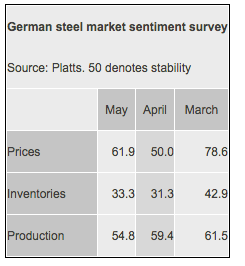
German buyers are looking to stay in waiting mode as the latest monthly S&P Global Platts steel sentiment survey showed the index for inventories continuing to drop this month.
Stockholders and traders indicated they would remain hesitant about booking orders in the coming weeks. The index for that particular sector was at 8.3, indicating the intention to destock. Stockholders in particular sit on high stocks.
As reported, March levels at German stockholders stood at 1.55 million mt for flats and 878,000 mt for long products, the highest levels since July 2014.
Traders on the other hand are currently waiting for clarity over the details of expected safeguard measures by the EU on steel imports following the US Section 232 tariff announcements, while activity in the northern European import market remains subdued.
End-users expect inventories to rise, indicating they would increase purchasing this month. Overall, Platts’ index for inventories gave a reading of 33.3, significantly below the 50.0 mark that notes stability.
The pricing outlook increased to 61.9, suggesting the expectation of increasing prices. Mills and end buyers were the most bullish, while the stockholding side showed a bearish outlook at 41.7. Sources said German producers would keep prices firm for the moment.
The outlook for May production was up slightly from last month’s survey, with an overall indication of 54.8. Mills and stockholding respondents were firm in their outlook, but end users indicated they would slightly decrease output in May.
Laura Varriale, PLATTS
Polish distributor sees improved outlook, but 232 threat
The outlook for Polish economic growth in 2018 has improved from forecasts made last year, with Gdp now set to rise over 4% this year. Steel consumption, meanwhile, should grow 2-3% and 1.9% in the EU as a whole. However, US 232 steel tariffs look set to change trading patterns, which could have a negative impact on the EU market. This is according to top-three Polish distributor Konsorcjum Stali (KS).
Stable consumption should help support current steel price trends; however, 232 tariffs are a new factor that could destabilise the situation, according to KS. “The US’ protectionist trade policy could result in repercussions from other countries and lead to a trade war,” the distributor says in a report seen by Kallanish. The tariffs are “… one of the biggest threats to economic stability in the coming years.”
In 2017 KS increased sales 5% on-year to 639,000 tonnes. This was driven by a 7% rise in traded product sales to 398,000t. Rebar sales rose 15% to 168,000t, but sheet deliveries fell -6.8% to 69,000t. Z and G sections sales were flat at 60,000t. Sales of KS-produced or processed products, meanwhile, rose 3.4% to 241,000t.
Sheet deliveries nevertheless generated 17.9% more revenue at PLN 183.4 million ($51.35m) due to the gradual ramp-up of the coil service centre in Krakow, which was opened in 2013, and the resulting increase in cold and hot-dip galvanized coil processing.
Exports accounted for 0.56% of KS revenue in 2017, down from 0.58% in 2016.
Celsa Huta Ostrowiec and CMC Poland accounted for 26.2% and 19.2% respectively of KS’ procurement in 2017.
KS says the anticipated investment into developing the Polish railways and energy sector, as well as further expansion of road infrastructure and residential construction will continue to generate significant steel demand. However, Brexit will result in a reduction of EU structural and investment funding available for poorer member countries. “This could have a negative impact on the scope of investments realised in Poland after 2020, and therefore also have a negative impact on steel demand in Poland,” KS observes.
KS reported a 26% increase in revenue in 2017 to PLN 1.53 billion, but net profit fell -3% to PLN 41.55m due to higher costs.
March German stockholder inventories highest since July 2014
March German stock levels reached their highest level since July 2014, according to latest data from German stockholders’ association, BDS.
Flat steel products volumes at German stockholders and distributors went up by 3.8% year on year to 1.55 million mt in March, while long products increased by 4.82% on year to 878,000 mt — levels last seen in July 2014 when volumes reached 1.56 million mt for flat and 935,021 mt for long products.
A more detailed look at stock level changes from February to March showed that stockholders saw a re-stocking period in March.
Flat product levels rose 6.02% month on month, long products grew 2.61%. The data suggests that stocks moved up following active buying in the beginning of the year, with average lead times of four-to-six weeks for longs and six-to-eight weeks for flats depending on the specific mill. Sources told Platts that buying interest from German stockists had been limited throughout March and April amid the increased stock levels.
At the same time, sales volumes increased 9.76% month on month to 296,229 mt for longs and 3.67%to 582,090 mt for flat products. Sources of flat steel products told Platts, however, that stockists had difficulty passing margins on to customers, as offers from producers remained high.
Sales volumes compared to a year ago saw a 11.51% year-on-year drop to 296,229 mt for long products, while flat products decreased by 6.72% year on year to 582,090 mt.
Laura Varriale, PLATTS
Sweden’s BE Group posts strong start to 2018
Swedish steel distributor BE Group says that it has had a strong start to 2018. In a first-quarter results statement monitored by Kallanish, the company says that it has delivered the highest underlying operating result since Q3 2008.
“With this quarter’s results, we show that we are heading in the right direction and that all the effort that the organisation has put in is beginning to pay off,” says president and ceo Anders Martinsson.
Demand in the next quarter is expected to remain strong in its main markets, primarily construction and engineering, the company says in a brief outlook. “The turbulence that occurred on a macro level with regard to trade barriers has so far resulted in continued price increases,” he continues.
The company’s internal improvement measures have also assisted the group’s performance, Martinsson says. Improved cash flow means that “… net debt is thereby 5% lower than the same time last year and we are continuing to strengthen the balance sheet,” the ceo adds.
Shipped tonnage increased by 5% in Sweden and Poland in Q1 2018 the company says without giving figures. Net sales to these countries increased by 20%, BE adds. Net sales also increased in Finland and the Baltics by 5% despite stiffening competition in thin sheets, which constitutes a significant part of the group’s business there.
Net sales increased year-on-year by 8% to SEK 1,226 million ($138m) versus SEK 1,138m in Q1 2017. The underlying operating result increased to SEK 48m from SEK 30m, same basis, due to higher sales and a higher underlying gross margin.
EU steel oversupply rebalancing in 2018
The balancing of supply and demand in the European Union steel sector is reducing the market disruption from a widening trade deficit in 2018, according to calculations by S&P Global Platts.
Despite domestic production rising and imports increasingly outpacing exports, the World Steel Association’s latest forecast, released in April, that EU demand will rise 2% in 2018 to 165.6 million mt, will see the oversupply decline should current production and trade levels persist.
EU crude steel production underperformed relative to the rest of the world in the first quarter, according to worldsteel. While global output rose 4%, EU output was just 0.9% higher year on year at 43.1 million mt.
Should the EU keep this pace, the 2018 total will be 170.2 million mt. This assumption would result in an imbalance in supply and demand of 4.6 million mt, or 2.8%; down from 3.9% in 2017. However, this improvement ignores the trade deficit that widened at the beginning of 2018.
According to statistics published by Eurofer, EU exports of flat and long steel products totaled 22.9 million mt in 2017, down 2.7% from 2016. Imports fell, but just 0.6% despite a raft of antidumping duties on flat steel.
Higher exports at the start of 2018 were not enough to counter the swell in imports, with the trade deficit totaling 1.48 million mt in the first two months of the year, up 10.2% year on year.
Assuming this margin of increase persists for the rest of the year, the flat and long steel trade deficit would increase to 3.47 million mt in 2018, up from 3.15 million mt in 2017.
Adding the deficit in trade to the supply demand imbalance leaves an excess supply of just over 8 million mt of steel, or 4.9%. This would be down from 5.9% (9.5 million mt) in 2017.
The picture may improve if the trade deficit is squeezed – as is widely expected following a spike in the January import volumes – while stockholders and service centers have been holding low inventories in the face of uncertain price direction.
Yet there are also potential headwinds, with US tariffs expected to redirect steel towards Europe, as well as a general slowing of the EU economy following a weaker-than-expected first quarter.
This issue eases if companies are optimistic on pricing and are willing to hold stock, but that has not been the case recently.
Peter Brennan, PLATTS

AÇOMEFER elegeu os novos órgãos sociais

A AÇOMEFER- Associação Portuguesa dos Grossistas de Aços, Metais e Ferramentas, elegeu no passado dia 18 de abril os seus Órgãos Sociais para o próximo triénio (2018-2020).
Deste modo, o Presidente da Direção, Senhor Dr. Manuel Fernandes Nobre, passará a ser o representante AÇOMEFER junto da EUROMETAL.
Mais se informa, que a composição dos Órgãos Sociais da AÇOMEFER para o triénio 2018/2020 é a seguinte:
ASSEMBLEIA GERAL
Presidente: Afonso Pedro de Oliveira Ribeiro (Antero & Cª., SA)
Secretários: José Esteves Larangeira (Larangeira, Almeida, Lda) e João Carlos Coelho (Nordesfer – Armazéns de Ferro, SA)
CONSELHO FISCAL
Presidente: Abel André Ribeiro da Silva (Martins Ferreira – Com. Prod. Siderúrgicos, SA)
Vogais: Paulo Rola (Ferlito – Ferros do Litoral, SA) e Paulo Alves (F. Marques da Silva, SA)
DIREÇÃO
Presidente: Manuel Fernandes Nobre (FAF – Produtos Siderúrgicos, SA)
Vice-Presidente: António dos Santos Vieira (J. Justino das Neves, SA)
Tesoureiro: Tomás dos Santos Ladeira Baptista (TS-Thomaz dos Santos, SA)
Diretores: Paula Correia dos Santos (J. Soares Correia – Armazéns de Ferro, SA) e Carolina Afonso Lúcio (Metalofarense – Produtos Siderúrgicos, SA)
AÇOMEFER – Associação Portuguesa dos Grossistas de Aços, Metais e Ferramentas
Rua Filipe Folque, 67 – 5º, 1050-112 Lisboa
Tel. +351 21 352 85 37

Revista INFOACERO – Abril 2018
En el enlace siguiente pueden acceder a la edición de abril de nuestra revista Infoacero: Infoacero Abril 2018
A continuación destacamos algunos de sus contenidos:
- Próxima Jornada UAHE- Asamblea General y Conferencias- Madrid, 12 de Junio.
- Evolución del Índice de Precios de Productos Siderúrgicos – UAHE.
- Próximos Eventos: Bienal Máquina Herramienta 2018 (1 de Junio, Bilbao) y Metalmadrid 2018 (26 y 27 de Septiembre, Madrid)
- Informe Worlsteel Association: Previsiones a corto plazo de la Demanda de Acero – Abril 2018
- Colaboración ASCEM: Jornada Técnica ASCEM- 10 de Mayo.