


DIGITALE TRANSFORMATION in der Stahldistribution?

8 Meinungen dazu veröffentlicht das Magazin “stahlmarkt” 12.2017 in seinem jährlichen Stimmungsbarometer.
Dass sich Geschäftsmodelle zusehends ändern, lässt sich auch für den Stahlhandel nicht abstreiten. Die Unternehmen sind herausgefordert und werden aktiv. Hier die Ergebnisse aus den Antworten von acht Kennern der Branche:
Die Zusammenarbeit muss effizient und transparent gestaltet werden. Die Optimierung der internen und externen Prozesse ist entscheidend. Eine Reduzierung des gebundenen Kapitals und die Vereinfachung der Einkaufsvorgänge sind z. B. Vorteile. Neue Vertriebs- und Beschaffungskanäle werden entstehen. Die Logistik wird von der Digitalisierung profitieren.
Die Meinung zu Online-Shops, Portalen und Online-Plattformen ist unterschiedlich. Einige Händler bauen ihre eigenen Online-Shops auf, andere würden eine übergeordnete Plattform präferieren.
Mehr dazu im Magazin »stahlmarkt« 12.2017, S. 8 ff.
E-Paper
Im Internet
Stahlbranche bevorzugt analoge Auftragsabwicklung

Die Stahlbranche liebt das Papier noch immer – das ist die zentrale Schlussfolgerung einer aktuellen Studie von Günther + Schramm. Trotz entsprechender Angebote durch die Händler ist die elektronische Auftragsabwicklung via EDI erst wenig verbreitet. Ein weiteres Ergebnis: Digitalisierung ist für die befragten Unternehmen aus der metallbe- und -verarbeitenden Industrie mehrheitlich ein Trend für die Zukunft. Hoch im Kurs stehen hingegen individuell zugeschnittene Servicekonzepte des Handels.
Analoge Bestellmethoden sind in der Stahlbranche nach wie vor weit verbreitet. Nur 23 Prozent der 77 befragten Unternehmen nutzen die papierlose Auftragsabwicklung. EDI-Nutzer sehen darin deutliche Vorteile, wie etwa den schnellen Datentransfer und den zügigen Bestellvorgang. 67 Prozent erzielen damit eine Entlastung des Personals und genauso viele reduzieren mittels EDI ihre Prozess- und Verwaltungskosten. „Bestellvorgänge via Onlineportal sind im Augenblick eher ein Thema für Trendsetter als für die breite Masse. Was wir aber an unserem eigenen Onlineangebotes sehen, ist, dass viele Kunden dort beispielsweise die Verfügbarkeit von Produkten prüfen oder Zolltarifnummern recherchieren“, sagt Jörg Mayer, Leiter Material- und Prozesslogistik bei Günther + Schramm.
Händler als strategische Partner
Angesichts der zunehmenden Komplexität der Materiallogistik versprechen sich die Studienteilnehmer von individuell zugeschnittenen Servicekonzepten (85 Prozent) oder durch Just-in-time-Belieferung (81 Prozent) deutlich größere Optimierungspotenziale. Ein komplettes Outsourcing ist trotz des steigenden Kostendrucks und des zunehmenden Bedarfs an Produktionsflächen nur für acht Prozent der metallverarbeitenden Betriebe eine Lösung.
Quelle und Fotos: Günther + Schramm GmbH / Bildtext: Geschäftsführer Bernd Seibold (Vorschaufoto) / Systemdienstleister im Stahlhandel sind gefragt (Beitragsgrafik)
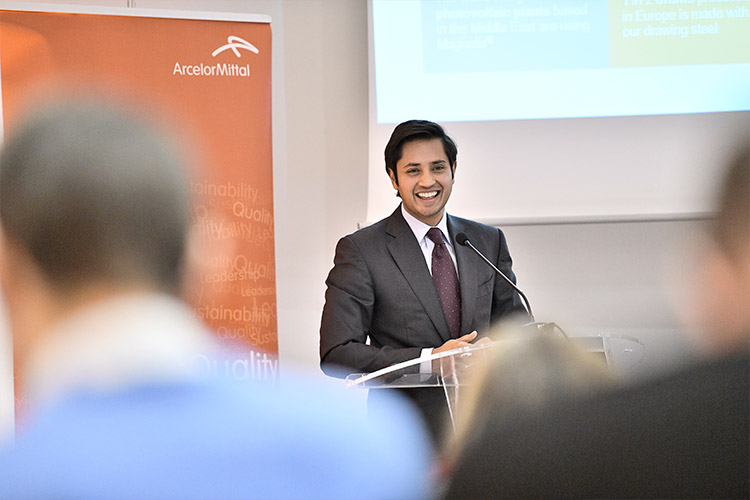
Digitalisation improves ArcelorMittal quality and service

ArcelorMittal Europe is investing significantly in digitalisation throughout its business, the steelmaker confirmed at its European media day in Paris attended by Kallanish. This will improve the company’s production quality and services, the ceo of ArcelorMittal Europe Flat Products business division north Wim Van Gerven said.
“Through digitalisation customers’ product needs can be met straight away, for example through the company’s ‘virtual mill’ which connects all flat products’ mills, systems, and order books, to removes all boundaries, whether geographical or technical. The company also intends to achieve the best product quality, through better prediction using advanced analytics made possible through big data and distributed computing. This means production issues can be detected before they happen, allowing the early detection of defects,” the executive added.
Cost efficiency in production and logistics will also be achieved. The company’s R&D sites in Avilés, Spain has developed a technology for line scheduling that has significantly improved productivity. Also the deployment of automated stockyards, linked to line scheduling and transport devices such as autonomous cranes means less stock is needed, and lead times are cut. This gives two major supply chain benefits.
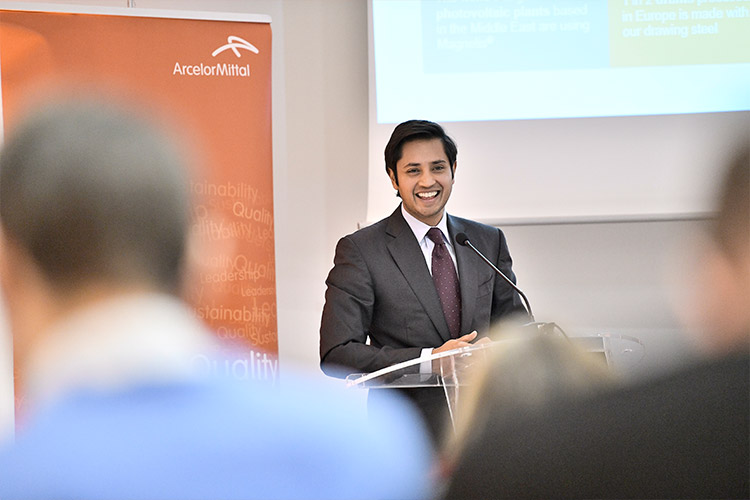
On its production lines supplying the automotive industry, ArcelorMittal uses digital twinning to create a digital fingerprint of a coil that’s scheduled for delivery. Quality defects are marked with a barcode on the coil and linked to a digital twin of the coil in the cloud. Customers can then automatically scan the bar codes when the coil arrives, access the quality data from the cloud and optimise their operations with the knowledge downloaded from the barcode. By knowing where the issues with the coil are in advance, this helps to eliminate waste and optimise productivity for both supplier and customer, the company says.
“2017 has been a milestone year for digitalisation within the company. While the company has had a digital focus for a number of years, benefiting customers in particular, ArcelorMittal is today making major investments, not only in terms of resources but also in time and in management attention, to remain at the forefront of digitalisation in the steel industry”, ArcelorMittal Europe ceo Aditya Mittal concluded.

Revista INFOACERO – Noviembre 2017
En el enlace siguiente pueden acceder a la edición de noviembre de nuestra revista Infoacero: Infoacero noviembre 2017
A continuación destacamos algunos de sus contenidos:
- Opinión – D. Gerardo García de las Heras- Miembro de Junta Directiva UAHE.
- Evolución del Índice de Precios de Productos Siderúrgicos – UAHE.
- Asesoría Legal UAHE– Nueva Ley de Contratos del Sector Público- D. Javier Edo.
- Resumen XIII Forum de Productos Siderúgicos- Barcelona, 26 de Octubre.
- Previsiones de Eurofer sobre el sector Siderúrgico en Europa: cuarto trimestre de 2017 y perspectivas para 2018. Producción, Consumo Real y Consumo Aparente de Acero.

German flat steel stocks reach lowest level since Jan ’16
Flat product stocks at German distributors reached their lowest level since January 2016 in October, according to fresh data from the German stockholders association BDS.
Flat steel inventories reduced 6.1% year on year to 1.35 million mt last month, the second consecutive decrease. Looking at historical data from the past two years, volumes this low were last seen in January 2016, when flat stocks stood at 1.32 million mt. Long products dropped by 3.7% on year to 795,697 mt, but were up 1.4% month on month.
The figures mirror comments from flat steel sources, who suggested stockholders were hesitant to make commitments to buy larger volumes over the past months. In October, most buyers were awaiting the Stuttgart sheet fair at the beginning of November to see where the market was headed. A German mill source told Platts buyers were slowly returning to place orders for Q1 following the fair, where mills indicated higher prices. A German service center source said the market was occupied with automotive contracts and that spot activity remained quiet on the previous months’ levels, while stockists were preparing for December. Sources said there was some remaining HRC that could still be delivered late December, but quantities were low.
While long stock levels had been below last year’s levels since April, flat products remained above last year’s levels until July, and have been lower than last year since then.
Sales volumes of long products were stable in October, amounting to 285,545 mt, but flat products saw a decrease of 0.4% to 520,284 mt.
Laura Varriale, SBB DAILY BRIEFING

Chinese HDG seen retaining EU presence despite duties

Chinese imports of hot-dip galvanized coil into the EU are expected to remain significant going forward despite the existing anti-dumping duties in place. This is thanks to the fact automotive grades have been excluded from the trade barriers, said sources gathered at the Assofermet event in Milan attended by Kallanish on Monday.
Georges Kirps, head of the European distributors association EUROMETAL, confirmed that Chinese HDG suppliers will continue to play an important, albeit reduced role in Europe.
Eurometal calculated that China supplied some 2.3 million tonnes of HDG into Europe in 2016. However, the association noted that the automotive sector was very effective in lobbying to exclude automotive grade HDG from the imposed duties.
Kallanish understands that despite the imposition of duties in August this year, China could still supply some 1 million tonnes/year of HDG into Europe going forward. In addition, other suppliers that process hot and cold rolled coil imported from China, such as Vietnam, are increasing their exports into Europe.
The European Commission could investigate some of the new importers in the market for circumventing the existing trade laws by selling material processed from Chinese HRC and CRC. However, Kirps observed that proving circumvention for the European Commission is a very complicated process.
Following the imposition of provisional antidumping duties in August, the EU is expected to announce definitive measures on Chinese HDG by February 2018.

Zukunftsperspektiven für Stahl und andere Werkstoffe
Mit innovativen Produkten, neuen Anwendungsfeldern und einer klaren Fokussierung auf die Zukunftsthemen der Branche präsentierte sich KNAUF INTERFER mit seinen stahlliefernden Geschäftsfeldern auf der Blechexpo 2017. Speziell die Themen Energiewende, Mobilität und Leichtbau stehen dabei in Form von Exponaten und großformatigen Visualisierungen im Mittelpunkt.
Material und Anwendung – dieser Zweiklang bestimmt den Stand der Knauf Interfer. Der dynamisch gestaltete Auftritt spiegelt die Zukunftsorientierung der Geschäftsfelder Stahl Service Center, Stahldistribution und Kaltwalzen wider. „Agilität und Flexibilität sind die Schlüssel zu den von Digitalisierung und Dynamik geprägten Märkten“, so Matthias Kessel-Knauf, Vorsitzender des Vorstands der Knauf Interfer SE, „diese Zusammenhänge wollen wir auch auf der Messe darstellen und diskutieren.“
 Knauf Interfer treibt im Zuge einer immer stärkeren Vernetzung von Kompetenzen, Experten und Werken die Digitalisierung im Geschäftsfeld Stahl Service Center voran. In der Stahldistribution investierte das Unternehmen 2017 in den Ausbau der Standorte Bremen und Frankfurt/Main, die sich dadurch zu hoch spezialisierte und eng miteinander verzahnte Spezialisten entwickelten. Im Geschäftsfeld Kaltwalzen wurden sämtliche Prozesse von Walzen bis zur Veredelung optimiert und noch stärker an den sich ändernden Anforderungen des Marktes ausgerichtet. „2017 markiert für uns den Auftakt einer kontinuierlichen Entwicklung, die wir auch künftig gemeinsam mit unseren Kunden und Partnern gestalten möchten“, so Matthias Kessel-Knauf.
Produktinnovationen
 Zu den Highlights der diesjährigen Messe zählten die in einem Karosseriemodell präsentierten Produkte und Konzepte aus Stahl und Aluminium für den Automobilbau. Neben Serienprodukten präsentierte Knauf Interfer auch innovative Ansätze für die Mobilität von morgen, die in enger Zusammenarbeit mit der Automobilindustrie zur Marktreife entwickelt wurden.
Oberflächenkompetenz demonstrierten die Stahl Service Center mit ihrem breiten Colorprogramm, das Geschäftsfeld Kaltwalzen mit ihren Shinox®-Produkten. Diese erhalten in einem abgestimmten Produktionsprozess bis einschließlich der Galvanisierung einzigartige Materialeigenschaften, porenfreie Oberflächen, enge Schichtdickentoleranzen und einen hervorragenden Korrosionsschutz. Reduzierte Whisker- und Flitterbildung, die verbesserte Auflagenhaftung und eine hohe Duktilität ermöglichen stabilere und effizientere Prozesse in der Verarbeitung. Matthias Kessel-Knauf: „Shinox® ist ein gutes Beispiel dafür, wie die Unternehmen der Knauf Interfer durch eine integrierte Kette von der Fertigung über die Oberflächenbehandlung bis zum weiterverarbeitbaren Produkt die Basis für hochwertige Endprodukte in bester, kontrollierter Qualität schafft.“
Quelle: Knauf Interfer
Fotos: marketSTEEL
Wuppermann verkauft fünf Gesellschaften
Die Wuppermann-Gruppe hat am 9. November 2017 den Verkaufsvertrag von fünf Gesellschaften unterzeichnet. Die drei reinen Blechbearbeitungswerke liegen im österreichischen Thalgau, im tschechischen Holýšov sowie in Herbolzheim. Zusätzlich hat das mittelständische Stahlunternehmen die Wuppermann Intralogistik GmbH mit Sitz in Herbolzheim und die Wuppermann Rohrtechnik GmbH in Burgbernheim veräußert, die neben der Blechbearbeitung auch Rohre produziert. Die Werke beschäftigen insgesamt über 600 Mitarbeiter.
Käufer ist die Lafayette Mittelstand Capital, eine eigentümergeführte Beteiligungsgesellschaft mit dem Fokus auf mittelständische Unternehmen in Deutschland, Österreich und der Schweiz. Das Closing soll zum Jahreswechsel stattfinden. Über die Verkaufsmodalitäten haben beide Parteien Stillschweigen vereinbart. Das neue Unternehmen, geführt durch Lafayette, wird zunächst den Firmennamen Wuppermann beibehalten.
 Fokussierung auf Kernbereiche
Wuppermann hatte seine Mitarbeiter Anfang 2017 über den geplanten VerkaufVeräußerung der fünf Gesellschaften informiert. „Wir vertrauen darauf, dass Lafayette dieses Geschäftsfeld, das nicht mehr zu den Kernkompetenzen von Wuppermann zählt und damit nicht die notwendige Aufmerksamkeit von uns erhalten kann, langfristig wettbewerbsfähig ausrichtet und so den Mitarbeitern auch in Zukunft einen sicheren Arbeitsplatz und den Kunden eine zuverlässige Partnerschaft und hochwertige Produkte bieten kann“, erklärt Dr. C. L. Theodor Wuppermann, Sprecher des Vorstands der Wuppermann AG. „Unsere Expertise liegt in der Verarbeitung von warmgewalzten Bandstahl. Mit dem Verkauf der Blechbearbeitungswerke können wir uns wieder mit vollem Einsatz auf unseren Kernbereich fokussieren.“
„Neben dem finanziellen Investment bringen wir uns bei Bedarf auch operativ in die Unternehmen mit ein. Wir sehen in der Blechbearbeitung von Wuppermann eine Unternehmensgruppe, die zu unserer Philosophie passt, ein produzierendes Unternehmen mit sehr guter Marktstellung, welches wir zu einem Champion seiner Branche weiterentwickeln wollen”, so eine Erklärung vom neuen Eigentümer Lafayette.
Quelle: Wuppermann AG Artikelfoto: Wuppermann verarbeitet Bandstahl. (Foto: Wuppermann)
Autor: von Alexander Kirschbaum
EU Parliament approves new anti-dumping methodology
The European Parliament Wednesday agreed changes to anti-dumping and anti-subsidy legislation that will aid proof of dumping against third-countries.
Existing regulation has been amended to ensure that when costs are artificially low, information from other representative markets, or from published reference prices, can be used in dumping investigations. Dumping can only be proved where export prices are below domestic levels, but many actors – including Eurofer – have argued that certain dumping cases were hindered by distortions to domestic prices and costs; China being a prime example.
“Costs are normally calculated on the basis of records kept by the exporter and producer under investigation. However, where there are direct or indirect significant distortions in the exporting country with the consequence that costs reflected in the records of the party concerned are artificially low, such costs may be adjusted or established on any reasonable basis,” according to the amended regulation.
Where investigated imports come from non-members of the World Trade Organization, “normal value should be determined on the basis of the price or constructed value in an appropriate representative country, or the price from such a third country to other countries, including the Union, or where those are not possible, on any other reasonable basis, including the price actually paid or payable in the Union for the like product,” the amended regulation said.
European steel producers’ association Eurofer said the amendment “arose from the EU’s move away from having a specific list of ‘non-market’ economies for which a ‘non-standard’ methodology automatically applied.”
“It is important to ensure that European businesses are shielded sufficiently from dumping from countries that significantly distort markets.
“Now that new methodology has been agreed by the EU, it must actually work in defending European jobs and industry against dumping from countries with significant distortions – as the US’ approach does,” it said.
Steel market sources have speculated the amendments to the methodology could make it easier to prove dumping. Speaking at a Eurometal event in Ghent, Belgium, earlier this year, Simone Jordan, chairwoman of ISTA, said Indian exporters could find themselves under pressure following the change. India’s domestic iron ore prices have typically been below levels into China, the world’s largest consumer, and ensuring sufficient supply for domestic Indian producers has been a political issue in recent years.
“Is India now on the EU’s radar? I thought they would be safe because they have Market Economy Status, but clearly that could be trickier now,” Jordan said at the event in Belgium.
India has ramped up shipments into Europe exponentially this year. Hot rolled coil shipment over January-September reached 936,000 mt – second behind Turkey’s 1.5 million mt – up from 161,000 mt in the same period of 2016.
Annalisa Villa and Colin Richardson, SBB DAILY BRIEFING

EUROMETAL to add Turkish companies to member base
European Steel association EUROMETAL announced it has expanded its member base to include Turkish steel stockholding companies and service centers.
“In order to benefit from the full range of support services EUROMETAL offers to its members, companies from Turkish steel distribution & SSC business have now decided to join Eurometal,” the association said Wednesday.
Three Turkish companies have joined the organization so far. As one of the biggest stockholding distribution companies in Turkey, SOYBAS sells 150,000 mt of flat, longs and tubular carbon steel products, operating its own steel service center (SSC) and structural steel tube production. Also accessing membership is Yametas, a Turkish SSC and steel tube producers for all strip mill products and Gokmetal, an SSC for flat products.
EUROMETAL’s decision was made amid increasing relevance of the Turkish market for European steel companies. The Turkish steel market has grown significantly in the last two decades, reaching a consumption of 34 million mt in 2016, compared with 41 million mt in Germany and 24 million mt in Italy as both production and steel distribution and servicing has developed strongly. European coil producers are large sellers into Turkey.
According to the association, membership is constituted not only by national associations, but also “by steel distribution, trade and SSC companies having cross border interests in European steel, tubes and metal markets.”
Pascal Dick, SBB DAILY BRIEFING