

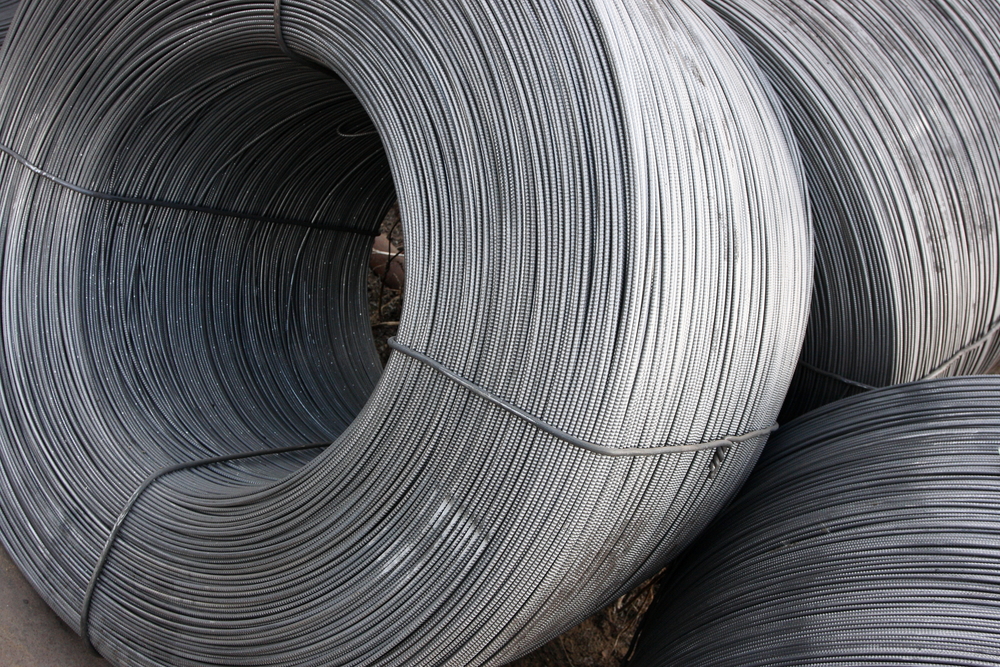
European quality wire rod suppliers target higher prices
ArcelorMittal is communicating to its customers this week its intention to raise offer prices for new quarterly and half-year quality wire rod contracts by €100/tonne ($109). These are currently being negotiated.
The increase was triggered by the need to restore margins as well as the expectation that apparent demand should improve in the first quarter of 2024. Quality wire rod is mainly produced at blast furnace-based mills, which are currently subject to higher-than-expected iron ore and coking coal prices.
The margin squeeze for this product has been severe enough in recent months to force ArcelorMittal to reduce output at its BF-based mills producing most of its quality wire rod.
Kallanish reported earlier this week that the BF-based ArcelorMittal Zenica long steel plant, in Bosnia, has paused production due to weak market conditions. Production should be restarted at the plant as soon as the market allows it. Similarly, production at ArcelorMittal’s Polish wire rod mill in Sosnowiec is temporary stopped.
“Other steelmakers in Europe are facing the same situation as ArcelorMittal and are making similar production cuts as well as price hikes,” a senior market source commented on Wednesday.
Emanuele Norsa Italy


European CRC, HDG prices supported by limited restocking; real demand remains subdued
Slow end-user demand was the principal factor dragging on European domestic cold-rolled coil and hot-dip galvanized coil prices, sources said.
However, restocking and a lower supply due to output cuts allowed European mills to get small gains in CRC and HDG trading in November.
European producers were also busy negotiating long-term contracts with end users for the first half of 2024, and were said to be looking for €750 ($820) per tonne for hot-rolled coil — feedstock for CRC production — and €850 per tonne for HDG coil, in line with flat steel contracts for the second half of 2023.
“Mills want to push the spot market higher, in line with automotive contracts,” a trading source said.
In Northern Europe, local producers were offering around €770-780 per tonne ex-works for CRC and €790-800 per tonne ex-works for HDG.
Deals, however, were reported at lower levels — at €750-755 per tonne ex-works for CRC and €770 per tonne ex-works for HDG.
Lead times for both products were minimum 8 weeks, sources said.
Fastmarkets’ weekly price assessment for steel cold-rolled coil domestic, exw Northern Europe was €750-755 per tonne on Wednesday, up by €5-10 per tonne from €740-750 per tonne seven days earlier.
And the corresponding weekly price assessment for steel hot-dipped galvanized coil domestic, exw Northern Europe was €770-780 per tonne on Wednesday, narrowing upward by €20 per tonne from €750-780 per tonne in the same comparison.
Meanwhile, competitive offers from overseas suppliers were putting additional pressure on European prices. The strengthening of the euro against the US dollar has also made import more attractive recently.
The currency strengthened to $1.094 per €1 on November 22, compared with $1.077 per €1 on November 15, according to currency exchange website Oanda.
A transaction for a limited tonnage of Japan-origin coil with end-January shipment was reported at around €695-699 per tonne CFR to Southern Europe during the assessment week.
Suppliers from South Korea reportedly withdrew from the market and were expected to come back with higher offers shortly. Price ideas were no lower than €710-730 per tonne CFR to Europe for February shipment.
Turkish suppliers, however, were able to offer December shipment, January delivery CRC at €710 per tonne CFR.
A Vietnamese supplier was offering $840-850 per tonne CFR for 0.5mm HDG with Z140 coating for late January shipment.
Published by: Julia Bolotova


Steel HRC restocking limited in Europe, but mills still mull new price rises
Fastmarkets calculated its daily steel hot-rolled coil index, domestic, exw Northern Europe, at €659.75 ($721.73) per tonne on November 22, up by €3.50 per tonne compared with €656.25 per tonne on Tuesday.
The index was up by €14.62 per tonne week on week and by €46.62 per tonne month on month.
Transactions were reported at €650-660 per tonne ex-works in the region, while buyers estimated the achievable price to be €650-670 per tonne ex-works.
But buyers were booking only small tonnages in the highly volatile market.
“We all understand that the recent price rises are entirely cost-driven, supported by reduced supplies,” a trader in the region said. “But without support from end-user demand, [price increases] might not be sustainable.”
The most recent booking was still below integrated mill offers in the region, which were heard at €680 per tonne ex-works and at €700 per tonne ex-works for January-delivery coil.
In general, lead times for HRC in Northern Europe varied between six and eight weeks, Fastmarkets understands.
Despite a slow pace of restocking and subdued demand from end-users, producers in Europe were planning to announce another round of price rises for first-quarter-delivery HRC, with offers expected to be “above €700 per tonne ex-works.”
“[Integrated mills in Europe] gave a price idea for February delivery of €730 per tonne ex-works,” a steel service center source told Fastmarkets.
In Southern Europe, Fastmarkets calculated its daily steel HRC index, domestic, exw Italy, at €639.38 per tonne on Wednesday, up by €4.38 per tonne from €635 per tonne on Tuesday.
The index was up by €6.88 per tonne week on week and by €41.71 per tonne month on month.
Italian mills were offering January-delivery HRC at prices no lower than €650 per tonne delivered in the local market, which would net back to about €635 per tonne ex-works, market sources said.
For February lead times, price ideas were closer to €680 per tonne delivered (around €665 per tonne ex-works).
Even though real consumption remained low in Italy, some sources said that there were signs of a revival in buying interest in the spot market.
“Even the most skeptical buyers see that the low prices are gone, [and] reduced domestic supplies and an uptrend in imports support the uptrend [in the domestic HRC market],” a source in Italy said.
In the secondary market, prices for HR sheet started to pick up in the week to November 22, to about €740-750 per tonne CPT, compared with €720-740 per tonne CPT a week earlier.
Overseas HRC suppliers to Europe were also seeking higher prices, with offers from Asia heard no lower than €620-630 per tonne CFR, for January shipment coil.
Offers from Indian mills were heard at €640-650 per tonne CFR to Italy, while HRC from Egypt was on offer in Italy at €620 per tonne CFR.
Published by: Julia Bolotova
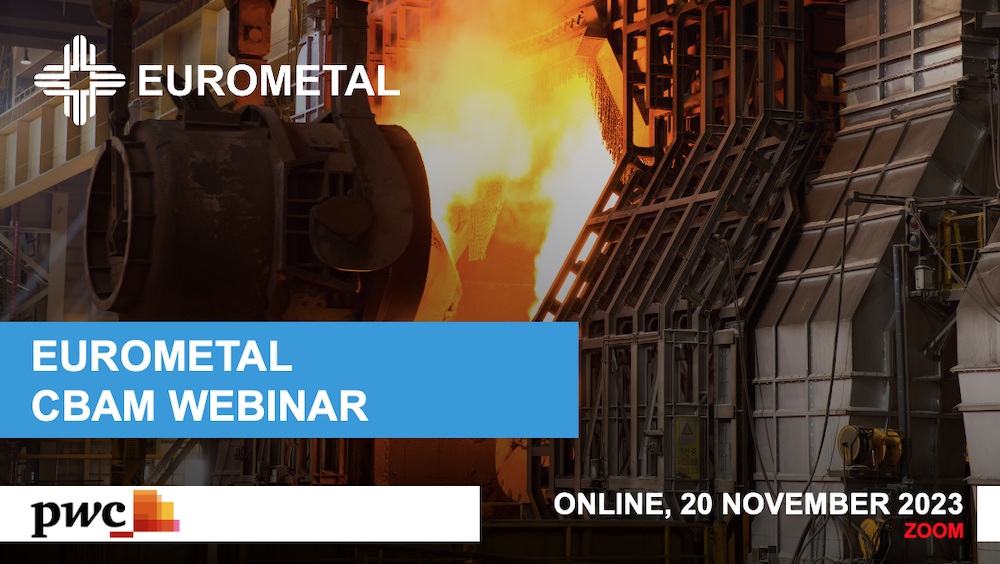
EUROMETAL organized a webinar on CBAM
Last Monday, EUROMETAL organized a webinar on CBAM and particularly its impact on the Steel industry.
This webinar organised in collaboration with PwC Poland aimed to clarify doubts about steel imports subject to the new Carbon Border Adjustment Mechanism (CBAM), with penalties (fines) for non-compliance.
This webinar counted on the expertise of Senior Associate Martyna Jermalonek and Manager Daniel Maryjosz from PwC Poland.
86 participants registered for this event online.

German crude steel production down as high energy prices weigh on EAFs steelmakers
In the first ten months of the year, production went down by 4.1% to 30.11 million mt compared with the corresponding period of the previous year.
“The situation is becoming increasingly difficult,” Stahl noted for the electricity-intensive electrical steel production.
Steel production via EAF Electric Arc Furnace route fell by 20.9% in October to 799,000 mt year on year, and by 12.9% year to date to 8.4 million mt compared with the same period in 2022. Crude steel production via Blast Furnace route decreased by 3.1% last month to 2.08 million mt year on year and by 0.2% to 21.70 million mt from January to October compared with the same period a year before. October pig iron production went down by 4.7% to 1.86 million mt compared with the same month a year before and by 0.4% to 19.95 million mt year to date.
In October hot rolled steel production went down by 2.2% to 2.52 million mt year on year and by 4.7% to 26.07 million mt year to date.
At the beginning of October hot rolled-coils prices stood at 625/mt base ex-works Ruhr and decreased to Eur600/mt base ex-works on Oct. 26. Platts assessed hot-rolled coil in Northwest Europe down Eur5/mt on the day at Eur660/mt ($722.172/mt) ex-works Ruhr Nov. 20. The price rose due to restoking and production cuts.
With around 40 million tons per year, Germany has the largest steel production in Europe. Sthal is the voice of steel producing companies in Germany, which have set the goal of producing their steel in a CO2-neutral manner by 2045, thus saving a third of total industrial greenhouse gas emissions.


Low real demand challenges European HRC price rise
Demand from major end users has remained low and market sources had a largely pessimistic outlook for steel consumption in the first quarter.
The price recovery in November has been supported by restocking, rising import offers and effects from production cuts across Europe. Distributors, however, have been acquiring smaller lots of coil as they have been cautious to increase stocks.
“Real consumption is still weak, with apparent demand higher supported by restocking,” an Italian service center said.
“Real demand remains low, and restocking is done for limited volumes as buyers are concerned and do not want to build stocks in such market,” a mill source said.
The planned restarts of some blast furnaces in the EU also made buyers question the sustainability of the price recovery.
Platts assessed domestic prices for hot-rolled coil in Northwest Europe stable on day at Eur660/mt ex-works Ruhr on Nov. 21.
Tradable values have been reported at Eur640-680/mt ex-works Northwest Europe, with majority of data heard at Eur650-670/mt ex-works Ruhr.
Several sources said that the steelmakers were intending to increase offers again soon to achieve prices above Eur700/mt ex-works Northwest Europe in the first quarter.
Platts assessed domestic prices for hot-rolled coil in South Europe stable on day at Eur645/mt ex-works Italy on Nov. 21.
Tradable values have been reported at Eur640-650/mt ex-works Italy and offers for limited lots of December delivery coil have been heard at Eur640/mt delivered Italy and for January delivery, at Eur670-680/mt delivered Italy.
ArcelorMittal supplies low-emission steel to Schneider Electric
Schneider Electric will use ArcelorMittal’s XCarb low-carbon-emission products for its automation systems, electrical cabinets and enclosures, Kallanish notes.
This steel is made in the Spain-based Sestao plant by the electric arc furnace method using recycled scrap and 100% renewable electricity.
“Our XCarb steel will be used by Schneider Electric to manufacture their new PanelSeT SFN floor-standing enclosures built to protect large electrical panels for industrial automation, power distribution and electronic applications,” ArcelorMittal explains.
The supply is part of the company’s efforts on sustainability and reducing CO2 emissions. Schneider Electric’s commitment is to be net-zero-ready across its operations, with a 25% carbon reduction target across its entire value chain by 2030.
The company estimates to increase by 50% the volume of low-carbon materials used in its products as part of the ongoing 2021-2025 sustainability impact programme.
Todor Kirkov Bulgaria
German power pricing benefits mills, hurts fabricators: WSM
The power pricing scheme as envisaged by the German government favours big groups, but puts small and medium-sized fabricators at a disadvantage. According to fabricators association WSM, its typical member company next year will have twice the power costs of a steel mill.
The government’s recent package to alleviate manufacturing industries from their electricity costs only supports big energy consumers, WSM states. “For WSM’s 5,000 plus member companies, it is a slap in the face,” says the federation’s managing director, Christian Vietmeyer. “Goliath is profiting, while David is left behind.”
According to calculations by WSM, the reduction of grid fees and taxes will see big groups pay a power price of €0.08.3 ($0.09.1) per kilowatt hour in 2024, whereas the cost for medium-sized steel fabricating companies will be €0.16.3/kwh, Kallanish notes.
This outcome is absurd in so far as “many companies of our industry make components that are relevant for the energy transition, used in wind power plants, electric vehicles and railways,” Vietmeyer points out. With twice the power costs for steel-working companies as opposed to steelmaking mills, “you cannot prepare progress”, he adds. “It is nothing short of ridiculous that policymakers are trying to paint their energy price package as a positive feat.”
The higher costs will keep discouraging companies from producing in Germany and may instead drive them abroad, if they have that option. Comparing international prices, WSM states that power for German domestic producers costs 2.5 times as much as in France, 2.4 times as much as in China, and 3.3 times as much as in the USA. “It is foreseeable that we will lose our competitiveness in the international comparison,” Vietmeyer concludes.
Christian Koehl Germany

Spanish steelmakers warn of tube, profile import misdeclaration
Spanish steelmakers’ association Unesid has informed the country’s Tax Agency that non-European origin pipe, tube and steel profiles are being imported without complying with the EU’s trade regulations. These products are used in the building of photovoltaic energy installations, Kallanish notes.
“Some importers declare these products as solar structures to avoid the EU regulations for steel imports, just because they have some perforations,” says Unesid general director Andrés Barceló. This misclassification causes serious damage to the market and local economy, he adds.
Spain is massively investing in sustainable energy projects to meet EU decarbonisation objectives. In 2022, almost 4.5 gigawatts of photovoltaics were installed with a total capacity reaching 19.8GW. The country’s target is to have 65GW capacity in 2030, which will require around 100,000 tonnes/year of pipe, tube and profiles.
“This strong investment could generate great added value locally since we have the industry with the capacity to provide this material competitively. Therefore, it is essential that these materials coming from outside the EU pay safeguard duties following the provisions of customs regulations,” Barceló concludes.
Spanish Tax Agency trade data show that between June and August, Chinese-origin imports of the products reached 21,899 tonnes. The total figure from third countries amounted to 25,686t.
Todor Kirkov Bulgaria

Thyssenkrupp demands policy-industry roundtable after German budget cutbacks
The recent court ruling against the German government’s budget towards climate protection measures will have repercussions on the steel industry’s ambitions, says thyssenkrupp Steel chief executive Bernhard Osburg.
Last week, the country’s highest court in Karlsruhe ruled that the government cannot use €60 billion ($66 billion) in credit facilities that were lined up to fund long-term energy transition projects. The decision especially hurts the climate and transition fund KTF. Policymakers must now find an alternative way to proceed with the transition of German industries towards emission-free manufacturing, Osburg demands. “If we fail to get a grip on this, Germany might as well forget about its climate targets,” tk Steel’s ceo is quoted as saying by national media.
Osburg made his statement on Monday, when the steelmaker lay the foundation for its encompassing transformation towards direct reduced iron-based steel production. This involves the construction of a modern hot strip mill and slab storage yard, and the conversion and new construction of two continuous casters and two new walking beam furnaces. The investment of €800 million aims to meet the changing needs of the market, meaning the demand for lower tolerances, higher strength and optimised surfaces, Kallanish hears from tk Steel.
On the sidelines of the ceremony, which was attended by North-Rhine Westphalia state’s economic affairs minister, Mona Neubaur, Osburg issued the call for a “transformation summit” at a political level. The issue is big and pressing enough to have led German Chancellor Olaf Scholz himself to call a meeting with representatives of the national and state governments, companies, and the unions, Osburg said.
Christian Koehl Germany