European Commission announces Q2 2026 CBAM certificate price
|
2026 CBAM certificate prices
|
Publication date
|
Price
|
|---|---|---|
|
Q1 2026
|
7 April 2026
|
EUR 75.36/t
|
|
Q2 2026
|
6 July 2026
|
EUR 75.28/t
|
|
Q3 2026
|
5 October 2026
|
To be announced
|
|
Q4 2026
|
4 January 2027
|
To be announced
|


ArcelorMittal Europe CEO Geert Van Poelvoorde to leave his role at the end of July

Energy price caps, “buy European” rules key to green steel future, German study says
Green steel production in Germany can be internationally competitive only if policymakers cap industrial electricity and hydrogen prices, support investment, introduce “buy European” procurement rules and shield domestic producers from unfair competition, according to a study by economists at the University of Mannheim.
The study, funded by the Hans Böckler Foundation, examined the conditions under which green steel production could become economically viable in Germany and Europe while maintaining the region’s industrial competitiveness.
The authors, Tom Krebs and Patrick Kaczmarczyk, concluded that Europe’s steel industry would require extensive public support and market protection measures to deliver the investment needed for the transition to low-carbon steelmaking.
The researchers argued that significant domestic steel production is crucial for Germany’s industrial resilience, noting that a global “steel shock” could cost the German economy up to €50 billion ($57.3 bln) annually in lost value creation, calculated in a preliminary study in 2025.
Existing measures, including anti-dumping duties on steel imports, have been fragmented and insufficient, according to the study, while the industry has continued to cut production, reduce employment and delay key investments.
As of July 1, however, new safeguard measures came into force, which, together with the Carbon Border Adjustment Mechanism (CBAM) that came into force on January 1, 2026 are expected to significantly trim steel imports into the block.
An Italian source said that he believes that, due to the CBAM, even current, modest quotas will not be completely fulfilled, which, in his opinion, will result in a 60% drop in hot-rolled coil imports and 80% in cold-rolled coil imports.
The study, however, recommends the following measures:
Industrial electricity price: A guaranteed electricity price of €60 ($69) per megawatt-hour (MWh), including grid fees and all levies, until 2035 for all energy-intensive companies. For companies covered by collective bargaining agreements, the researchers propose an additional €10/MWh reduction.
Industrial hydrogen price: A guaranteed purchase price of €140/MWh for green hydrogen until 2035 for all energy-intensive companies. An additional reduction of the hydrogen price by €20/MWh for companies with fixed-rate tariffs.
Targeted investment support: Direct grants or low-interest loans amounting to 50 percent of the investment sum for companies in the steel industry that invest in future-proof production facilities and provide a site and job guarantee. Payment of an additional investment premium for companies with collectively bargained wage agreements.
Public participation: if necessary, the state (federal and state governments) should participate in strategically important companies in the steel industry to reduce capital costs and secure the long-term transformation perspective.
Measures to stimulate demand: Government contracts should be preferentially awarded to domestic producers (Buy-European or Local Content rule), emissions-intensive imports will be subject to a CO2 price (CBAM), and imports from countries with low labor and environmental standards will be subject to protective tariffs.
The study estimates that Germany would need to produce 40 million tonnes of climate-friendly steel annually to help meet projected EU demand of 160-180 million tonnes per year by 2050.
This would be split equally between primary steel, produced via low-CO2 direct reduction, and secondary steel produced from recycled scrap in electric-arc furnaces.
Current investment plans fall short of that target, with only 8 million tons of primary steel capacity planned and about 15 million tonnes of secondary steel capacity available.
The researchers estimated production costs for primary steel made via direct-reduced iron technology at about €590 per tonne of crude steel under the proposed policy framework, compared with an average flat steel market price of roughly €640 per tonne over the past three years.
Climate-friendly secondary steel production would also be competitive under the proposed framework, with estimated costs of €464 per tonne, according to the study.
The researchers highlighted industrial electricity and hydrogen prices as the key factors of competitiveness, describing them as “the central instrument of a strategic industrial policy for the steel industry, while investment promotion represents a necessary complementary instrument.”
The study also argued that lower production costs alone would not be sufficient to ensure the success of climate-neutral steelmaking. Measures such as “buy European” procurement rules, protective tariffs and public participation in strategically important steelmakers would be needed to secure demand, support investment and maintain industrial capacity.
The study comes as several European steelmakers have delayed, postponed or canceled decarbonization projects amid challenging market conditions.
In June 2025, Europe’s largest steel producer, ArcelorMittal, scrapped plans to invest in an electric-arc furnace and direct-reduced iron facility in Germany and put final investment decisions on decarbonization projects across Europe on hold due to what it described as a challenging economic environment, Fastmarkets reported.
At the time, ArcelorMittal said that the European steel industry was facing unprecedented competitive pressure and warned that imports were already a major concern even before the additional costs associated with decarbonization.
As of now the demand for green steel remains modest in Europe.
According to a representative of the automotive industry, purchases of green steel represent a single-digit percentage in their structure of steel purchases. The company counts the total carbon footprint of the car and is balancing between procurements of green steel, green plastic, aluminum and batteries.
Currently producers capable of producing green flat steel are asking for a €170-200-per-tonne premium and up to €300-per-tonne in some cases.
However, a future green steel producer said this week that he does not see automakers paying these levels.
As a result, Fastmarkets’ weekly assessment of the green steel domestic, flat-rolled, differential to HRC index, exw Northern Europe remained stable week on week at €120-200 per tonne on July 2.
Fastmarkets defines green steel as material with combined Scope 1, 2 and 3 carbon emissions not exceeding 0.8 tonnes of CO2 per tonne of steel produced.

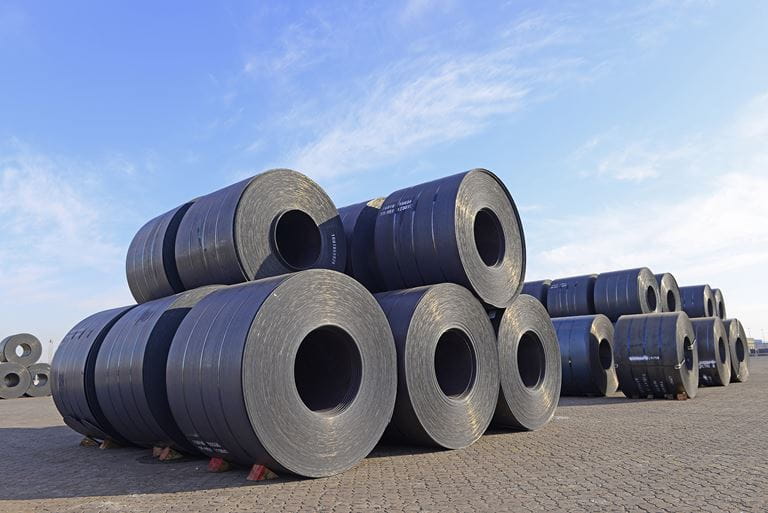
Northern European HRC prices rise on latest offers while Italian market digests new EU import quotas
Prices for steel hot-rolled coil in Northern Europe increased on Friday July 3, supported by higher mill offers, while Italian prices edged lower amid uncertainty following the introduction of new EU steel import quotas and subdued trading activity, sources told Fastmarkets on Friday.
In Northern Europe, a supplier reported an offer for September-delivery material at €720 ($823) per tonne ex-works on Friday, but the price was discarded because it fell outside Fastmarkets’ six-week maximum delivery window.
A buyer reported that a major supplier had raised its offer price by €20 per tonne to €690 per tonne ex-works, adding that “other mills speak of good order books, but don’t want to talk about prices.”
Market participants reported limited trading activity on Friday, with many still assessing the effect of the new EU steel import quota system that came into force on July 1.
“The shock is setting in, and some people have already been told to pay some duties. First, we are going to see some distressed cargoes have to be shipped elsewhere,” a trade source said on Friday.
The same source added that most quotas were likely already exhausted, although Fastmarkets could not independently confirm this through European Commission data.
Fastmarkets’ daily steel hot-rolled coil index domestic, exw Northern Europe was calculated at €695.00 ($793.28) per tonne on July 3, up by €4.06 per tonne from €690.94 per tonne on Thursday July 2.
The index was up by €12.50 per tonne week on week and by €5.00 per tonne month on month.
Market conditions in Italy differed from those in Northern Europe, with sources reporting that domestic mills had largely withdrawn offers while assessing the effect of the new quota regime.
Market participants linked this to Italy’s greater reliance on imported HRC compared with Northern Europe, making the market more directly exposed to the new regulation.
“Italian mills pulled their quotes [because] they need to announce new price levels,” a supplier told Fastmarkets on Friday, but was unable to provide a workable price indication because of this.
A buyer source provided an indication of achievable prices at €670 per tonne ex-works on Friday, while previous indications were mainly heard at €680 per tonne ex-works on July 2. The same source, however, said market conditions could change quickly as participants adapt to the new import regime.
Fastmarkets’ assessment of daily steel hot-rolled coil index domestic, exw Italy was €676.67 per tonne on July 3, down by €3.33 day on day from €680.00 per tonne.
The index was up by €8.54 per tonne week on week and up by €4.42 per tonne month on month.

Meridian Steel enters liquidation process
Meridian Steel (MSL), subsidiary of Duferco International Trading Holding (DITH), has started the process of winding up the business as its operations are no longer sustainable, Kallanish learns.
A statement by the board of directors says it is “with regret” that a thorough business review has concluded that the company’s operation is no longer sustainable. As a result, the board has taken the decision to commence the process of winding up the business.
It cites the reductions to UK steel quotas and increase in tariffs as being a “devastating setback”, with imports accounting for most of its feedstock.
“Moreover, the lack of protection for UK manufacturers utilising steel will inevitably put their business under pressure,” it adds.
It continues that its financial situation has been “further exacerbated by steadily increasing overheads, most crucially, utility costs which continue to rise, affecting both ourselves and our customers.”
“Despite significant investment and financial support from the shareholders over many years, these factors have negatively affected MSL’s performance and with no prospect of improvement, it is simply not viable for the company to continue operations,” it notes.
In the year to September 2025, the company reported a loss before tax of £718,000 ($958,630), rising from a loss of £212,000 the year previous, according to its most recent Companies House filing.
Sources tell Kallanish that workers have been informed, with a consultation process currently underway. The company’s website says it has 101 employees and two sites, which specialise in strip products, processing 150,000 tonnes/year of steel.
DITH bought the firm that became Meridian Steel in May 2019. Kallanish has contacted DITH for comment.
Author: Carrie Bone


Volkswagen threatens to close German plants
Volkswagen (VW) is mulling the closure of various production plants in Germany, Kallanish learns.
The German carmaker is under pressure to reduce its costs and is therefore testing closures of four plants – Hannover, Emden, Zwickau und Neckarsulm, according to media reports. This would mean that up to 10,000 jobs are under threat.
Volkswagen, alongside its various brands, is the largest German carmaker, and likely the largest single steel consumer of the country.
VW has so far not specified the number of jobs in Germany or confirmed the plant closures, but recently confirmed the agreements for wider job cuts of 50,000 roles across the group by 2030.
The state government of Lower Saxony holds 20% of the voting rights in the group, and together with the representatives of the work force holds a majority in the supervisory board. The state also holds a veto option in important decisions.
The participation of the state is similar in structure at steelmaker Salzgitter AG. Both the steelmaker and the carmaker have their main plants in Lower Saxony (Wolfsburg, Salzgitter), and their historical development has been closely tied to one another.
A statement by union IG Metall cites Lower Saxony’s Prime Minister Olaf Lies as saying: “We have taken notice of the plans as they were reported in the media. Concrete measures will have to be discussed and decided by the supervisory board.
He adds that: “The state Lower Saxony will not approve a development that banks on plant closures as a supposedly easy solution.”
Author: Christian Koehl

European longs market still weak, new EU CSQs discussed by market players
The main topic of discussion in the European long steel market this week has been the new country-specific quotas (CSQs) of the EU, which market participants had been eagerly awaiting.
No changes in offer prices for rebar or wire rod have been recorded within the EU this week, indicating overall stability as the summer season approaches.
However, it is worth noting that in the Italian market prices for wire mesh have reached €550/mt ex-works base (€780/mt ex-works), compared to a rebar price of around €440/mt ex-works base (€700/mt ex-works). “This is an extremely wide gap. Usually, wire mesh carries an extra cost of about €30/mt compared to rebar. This is an unusual scenario,” a trader commented.
Regarding quotas, the EU country-specific quotas for reinforcing bars (category 13) and non-alloy and other alloy steel wire rod (category 16) have been allocated as follows:
| Country | Category 13 – Rebar (mt) | Previous quota | Quota reduction (%) | Category 16 – Wire rod (mt) | Previous quota | Quota reduction (%) |
| Turkey | 239,676.09 | 381,744.44 | 37.22% | 244,589.00 | 476,042.88 | 48.62% |
| Egypt | 144,367.80 | – | – | 86,714.89 | – | – |
| Ukraine | 67,710.16 | 177,721.36 | 61.90% | 189,145.02 | 498,307.24 | 62.05% |
| Algeria | 63,761.42 | – | – | 0.00 | – | – |
| Moldova | 39,719.11 | 114,779.32 | 65.40% | 95,839.25 | 279,749.84 | 65.74% |
| China | 20,216.13 | – | – | 0.00 | – | – |
| United Kingdom | 0.00 | – | – | 175,399.53 | 741,096.52 | 76.33% |
| Switzerland | 0.00 | – | – | 162,195.34 | 547,777.12 | 70.39% |
| Vietnam | 0.00 | – | – | 97,086.65 | – | – |
| Malaysia | 0.00 | – | – | 86,683.40 | 491,019.88 | – |
*Blank fields indicate that those countries did not benefit from a CSQ for those specific categories, or that they drew from the global residual quota.
Market participants’ opinions on the matter differ. Some have expressed satisfaction, while others had hoped for stricter measures. However, all sources interviewed by SteelOrbis agree that the effects of these new measures will only materialize at the end of the summer holidays, as the market is currently at a standstill. In addition, there is a chance that – to offset the missing volumes in the European market – domestic producers will increase their capacity utilization rates. Some are already working on production line upgrades, but at the moment no official communications have been released.
“It is certainly an important message, but some products are under more pressure than others. The consequences will not be the same for all products,” a source commented. “I am satisfied with the measures on rebar and wire rod, but perhaps more could have been done regarding Turkey. The reductions are in line with expectations, and I hope they will help stabilize prices.”
Meanwhile, another representative of an Italian mill stated, “The volume reductions have been lower than expected, while on the other hand the risk related to exceeding the quotas is very high. It will be interesting to see how importers behave. […] I expect customs clearance requests will not be so high, also because with this regulation you have a second chance with the residual quota.”
According to reports, however, only considering Turkish material, there are already around 97,069 mt awaiting customs clearance for category 13 (against a quarterly quota of 59,919 mt) and about 93,635 mt for category 16 (against a quarterly quota of 61,147 mt).
In the meantime, export offers for rebar and wire rod from Turkey have been reported at €540-550/mt CFR and €550-560/mt CFR respectively, down by €5-10/mt week on week. As for Egypt, rebar and wire rod offers have been reported at €540-560/mt CFR and €560-570/mt CFR respectively, with only a slight change in the euro-dollar exchange rate from 1.13 to 1.14 compared to the previous week. For Egyptian prices, offers are down by €10-15/mt week on week.
Author: SteelOrbis Editorial Team


EUROMETAL President featured in European Commission’s Trade-Off Podcast on the future of EU steel
Alexander M. Julius, President of EUROMETAL, participated in the latest episode of the European Commission’s Trade-Off podcast, a series exploring the European Union’s commercial and trade policy.
Entitled “What’s the deal with steel?”, the episode examines the strategic importance of the steel sector for Europe’s economy and industrial future. The discussion highlights how steel remains indispensable for the green and digital transitions, supplying the essential materials needed for wind turbines, electric vehicles, infrastructure and advanced manufacturing.
The podcast also addresses the significant challenges currently facing the European steel industry, including persistently high energy costs, global overcapacity, and increasing pressure from subsidised imports. Against this backdrop, the panel discusses the European Union’s new steel trade measures and their expected impact on the market.
Joining Alexander Julius were Sarah Rerbal, Head of Trade Policy at thyssenkrupp Steel, and Pauline Weinzierl from the European Commission.
Reflecting on the discussion, Alexander Julius welcomed the open exchange of views on the advantages and shortcomings of the new framework, while underlining one of the key concerns expressed by market participants: “I very much liked our discussion on the pros and cons of the measures. One of the main concerns we discussed was the late publication of the country-specific tariff quota allocations. The delayed announcement created significant uncertainty for the steel-using industry at a critical stage of the implementation of the new EU steel trade regime.”
The episode provides valuable insight into the policy objectives behind the EU’s new steel trade regime while recognising the practical challenges faced by manufacturers, distributors, service centres and steel users during its implementation.
EUROMETAL invites members and stakeholders to listen to the podcast here:

Hydnum officially secures public funding for Puertollano plant
Hydnum Steel (HS) has officially secured €60 million ($68.3m) in funding for the building of the first “green” steel mill on the Iberian Peninsula, Kallanish learns from the prospective Spanish steelmaker.
The financing is part of Spain’s strategic PERTE programme, aimed at accelerating the industrial sector’s green transition, under the European Union’s Recovery, Transformation and Resilience Plan – Next Generation EU.
“The Spanish Ministry of Industry and Tourism has officially reaffirmed its support for Hydnum Steel and confirms that our project is the immediate solution Europe needs to lead the reindustrialisation of its steel industry,” the company states. “This final resolution strengthens the backing we first received in the initial call of the PERTE and enables us to move forward with our timeline to begin construction early next year.”
The green steel plant, located in Puertollano, in the Castilla-La Mancha region, is designed to use fossil-free energy throughout the manufacturing process and will gradually incorporate green hydrogen to substantially reduce CO2 emissions. HS aims to produce 1.5 million tonnes/year of flat steel, supplying key sectors such as automotive, construction and renewable energy.
The project has strong institutional support and international recognition. It has been declared a priority project by the Castilla-La Mancha regional government and is currently pursuing “project of singular interest” status, a legal designation that will expedite its development. Moreover, the World Economic Forum recently identified it as one of the five most important industrial decarbonisation initiatives globally.
The project is a partnership consisting of the Helvella investment company, Siemens, ABEI Energy and Russula Corp.
Author: Todor Kirkov

Revista InfoAcero Junio 2026
Pueden ver la edición de junio de nuestra revista INFOACERO aquí
Destacamos a continuación algunos de sus contenidos:
- Opinión – D. Roberto González- Presidente UAHE
- Índice UAHE: Evolución precios de aprovisionamiento septiembre 24 – abril 26
- Construcción: Resumen informe Euroconstruct junio 2026
- Información Asociativa: Asamblea General y Conferencias, Premio UAHE – Madrid, 25 junio
- Próximos Eventos: Decarbonized & Sustainable Industry (3-5 noviembre, Bilbao)// Advanced Manufacturing (4,5 noviembre, Madrid)