


Restrictive EU-UK trade ‘rules of origin’ for EV batteries could cost automotive sector billions, ACEA warns
Passenger car registration numbers in the EU market increased by 18.5% year on year in May 2023, making it the tenth consecutive month of growth, the European Automobile Manufacturers’ Association (ACEA) said on June 21.But in a separate statement on June 20, the association warned that a more restrictive 10% “rules of origin” tariff to be imposed on electric vehicle (EV) batteries, traded under the EU and UK Trade and Cooperation Agreement (TCA), could result in the sector paying out €4.3 billion ($4.7 billion) over three years.
The restrictions would require that all battery parts and critical battery materials be produced in the EU or UK to qualify for tariff-free trade. At the moment, batteries must simply be assembled in Europe to be eligible for tariff-free transactions.
The UK is the EU’s principal export market for EVs, accounting for almost 25% of exports, so the move would result in a reduction of EV production by around 480,000 units, the trade body said. The new rules were set to be introduced on January 1, 2024.
“Because we face increasing competitive pressures from abroad, the application of these rules would have severe consequences for electric vehicle manufacturing in Europe, at the very time when we should be massively ramping-up sales and production,” ACEA director general Sigrid de Vries said.
The organization said that the changes would be “detrimental” to the EU automotive industry, the largest end-use sector for flat steel products such as hot-rolled coil, so the ACEA was calling for a three-year postponement to their introduction.
De Vries said that, despite “massive investment” in the European battery supply chain, more time was needed to build up the required capacity. “In the meantime,” he added, “vehicle manufacturers must rely on battery cells or materials imported from Asia.”
Despite the investment, however, panelists at Fastmarkets’ Lithium Supply & Battery Raw Materials conference, held in Las Vegas in June, said that Europe would probably remain a net importer of battery raw materials due to the challenges of developing mining projects in the region.
In addition to the problems of sourcing battery raw materials domestically, China-made electric vehicles currently comprised one-third of the UK sector, despite 10% import duty.
Consequently, the ACEA said that the change to the EU-UK free trade agreement would also result in a loss of competitiveness in the global EV market.
EV support for a struggling sector
The potential for losses in both output and profit in the automotive steel-using sector was of particular concern in light of the challenges already faced by the industry.
These have included repeated disruptions to supply since 2022, as well as rises in energy costs following the Russian invasion of Ukraine last year, according to European steel association Eurofer’s Economic And Steel Market Output Report for 2023-24, published in May.
Eurofer added that low consumer confidence and squeezed incomes, as well as high inflation and an uncertain economic outlook, have weakened general demand in the sector.
War-related uncertainties have also affected demand, but Eurofer said that moderate growth in the automotive industry was expected in 2023 (+1.2%), “provided that war-related disruptions and uncertainty ease substantially as a result of an improved economic and industrial outlook.”
But the trade body forecast a drop in automotive output in 2024 by 1.8%.
The steady but weak automotive consumption has been dragging prices downward in the markets for flat steel products such as HRC in recent months, with prices on a downward trend since April.
Fastmarkets’ daily calculation of its steel hot-rolled coil index, domestic, exw Northern Europe, was €674.10 per tonne on Friday June 30, down by €73.53 per tonne from €747.63 per tonne a month earlier.
Meanwhile, demand for EVs was expected to go up because of the EU’s revised regulations on CO2 emissions performance, adopted in March this year, requiring all new cars and vans registered in the Union to be zero-carbon-emissions by 2035.
“Political commitment at EU level toward the full adoption of EVs by 2035 should prove supportive [of the market], despite the fact that general car demand appears to depend on fragile consumer confidence throughout 2023 and possibly 2024,” Eurofer said in its report.
In the UK, an equivalent plan to transition cars and vans to zero emissions by 2035 was approved by the government in November 2020, with sales of petrol and diesel vehicles to be phased out by 2030.
According to UK car industry trade body, The Society of Motor Manufacturers and Traders (SMMT), EVs have become the second-most-popular vehicle type in terms of sales, representing 15.4% of the UK car market in April 2023, up by 4% year on year from 10.8% in 2022.
Petrol-powered cars still dominate the market but have fallen year on year to a 42.8% market share from 45.8% in April 2022.
According to ACEA, however, the changes to the EU-UK free trade agreement could hamper automotive production output in Europe despite an expected boom in demand in its biggest export market.
Published by: Holly Chant


French construction industry continues to slow
Sentiment among French construction companies has again deteriorated significantly in June following a difficult May. The firms surveyed reported deteriorating opinion on their past and future activity.
More companies than in May consider the market unpredictable due to the current uncertainty, Kallanish learns from a l’Institut National de la Statistique et des Études Économiques (Insee) report.
In June, fewer building contractors than in May considered their order books to be higher than normal and reported 8.5 months of work. Production capacity was stable in June and the same number of construction firms as in May reported slowing output because of supply difficulties. About 27% of companies, slightly more than last month, reported being at the limit of their production capacity, meaning they could not produce more with their current means if they were to receive more orders.
“In June 2023, significantly fewer business managers than in the previous month have announced that they will increase their prices in the upcoming three months,” the report states.
The French rebar market is stagnant with producers resorting to production cuts to address the current overcapacity and an agonisingly sluggish private construction sector. Domestic rebar prices have lowered considerably over recent months to €580/tonne ($633) base ex-works on average, sources say.
Natalia Capra France

Quiet conditions prevail in European HRC market; prices flatten
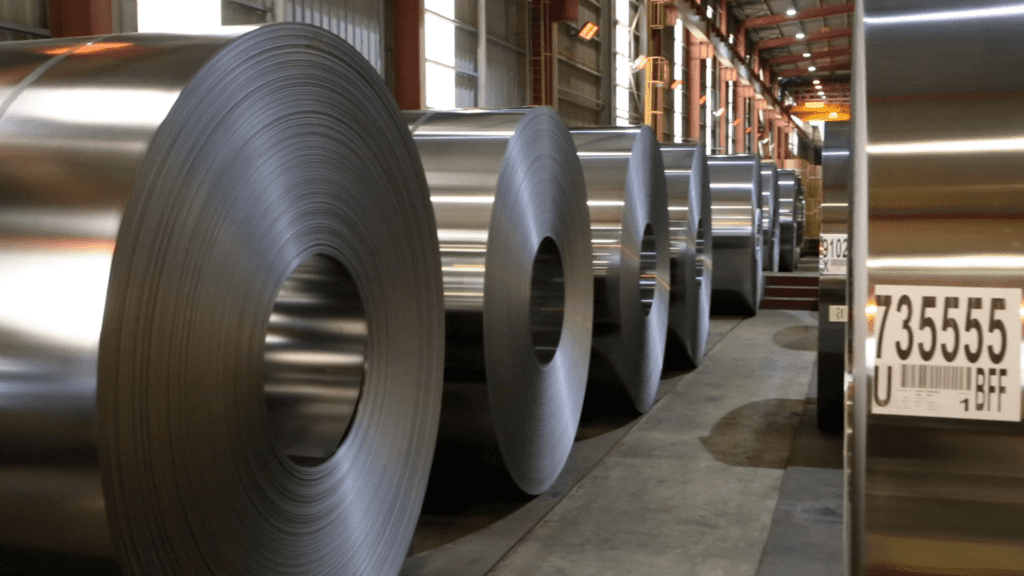
European hot-rolled coil prices have stabilized and potential supply disruptions are likely to prevent further drops, but a rebound is unlikely in the short term due to low demand, sources told Fastmarkets on Wednesday June 28.Trading remained quiet in Northern Europe on Wednesday, with buyers still holding back from restocking, citing slow downstream sales.
Most market sources agreed that the downtrend that affected the market in the past several weeks has come to an end. They now expect HRC prices to stabilize in the coming weeks.
“Mills are hungry for orders, but not very willing to lower offered prices anymore. Production disruptions in Germany and France will affect [HRC] prices indeed, but not immediately,” a trader said.
“I hope the [HRC] price will stabilize, but the [end-user] demand is so low that I absolutely do not believe in a rebound,” a distributor said.
On Monday, authorities ordered the suspension of steelmaking operations at ArcelorMittal’s Fos-sur-Mer site in southern France due to environmental and worker-safety considerations. ArcelorMittal did not specify the timeline for the closure, only pointing out that “the company has established and implemented an action plan with all parties to reduce personnel exposure.”
The final decision on the plan is expected later in the week to July 7, sources said.
On the same day, German steelmaker Salzgitter declared force majeure on steel deliveries because of disruptions resulting from heavy rain in Germany.
Producers in Northern Europe were able to offer September-delivery coil, sources said, with offers reported at €680-700 ($744-766) per tonne EXW on Wednesday. At the same time, buyers’ estimates of tradeable values were €660-680 per tonne EXW.
A deal for a sizeable tonnage of HRC from a mill in the Benelux area was reported at €620 per tonne EXW, but this could not be widely confirmed by the time of publication.
Fastmarkets’ daily steel hot-rolled coil index domestic, exw Northern Europe was calculated at €670.63 per tonne on Wednesday, down by just €1.37 per tonne from €672.00 per tonne on Tuesday.
The latest calculation of the Northern European index was down by €9.37 per tonne week on week and by €80.20 per tonne month on month.
Fastmarkets calculated its corresponding daily steel hot-rolled coil index domestic, exw Italy at €645.18 per tonne on Wednesday, down by just €0.81 per tonne from €645.99 per tonne on Tuesday.
The Italian index was down by €6.17 per tonne week on week and by €43.57 per tonne month on month.
Offers from integrated producers and re-rollers in the region were still being heard in the range of €650-680 per tonne EXW for August and September delivery.
One mill in the south of Italy was reportedly offering sizeable tonnages of commodity grades HRC at €620-630 per tonne CPT in Italy. But market sources said that such low offers had not impacted the price trend much.
“[Mills in the south] are absolutely irrelevant to real market levels. They are in a chronic delay for delivering orders,” a steel-service center source in Italy said.
Buyers’ estimations of tradeable values were still reported at around €640-650 per tonne EXW for small tonnages and around €620-630 per tonne EXW for sizeable volumes.
Buyers, however, were only booking small lots recently, postponing restocking.
HRC offers from Asian mills to Italy have been limited in the week to Wednesday.
Most sources reported a range of €610-620 per tonne CFR, mainly for August shipments from Vietnam and Taiwan.
Published by: Julia Bolotova

CRC, HDG prices flat across Europe, seen stabilizing in July
Trading in Europe for cold-rolled and hot-dipped galvanized coil remained “frozen” in the week to Wednesday June 28, but prices seem to have hit rock bottom and are likely to stabilize in the short term, sources told Fastmarkets.The spot market has remained quiet across Europe, with both mills and buyers continuing to hold back from trading.
Firm offers were also rare in the market because – until recently – mills were largely focused on long-term contracts negotiations with end users in automotive industry, rather than on spot sales.
But negotiations for long-term contracts with buyers in the automotive industry for the second half of 2023 are reportedly being finalized at levels similar to that for the first half of 2023, which was considered to be positive for the market.
Buyers, meanwhile, are largely maintaining medium to low levels of stocks and were reported to only be making hand-to-mouth bookings lately.
One integrated mill in the region was offering CRC at €780 ($854) per tonne EXW and HDG at €800 per tonne EXW, both for September delivery, sources told Fastmarkets.
An Italian mill offered August-delivery HDG to Germany at €800 per tonne CPT, which is unchanged from a week earlier.
But buyers’ price ideas for CRC in the region were reported at €750-760 per tonne EXW, and no higher than €780 per tonne for HDG, sources said.
Nevertheless, sources expected the mood in the market to change in the coming weeks, with mills possibly even attempting to raise prices.
“The recent disruptions in Germany and France might result in tighter flat steel supply in Europe – we need a bit more time to assess the impact,” a trading source in Germany said.
On Monday, authorities ordered the suspension of steelmaking operations at ArcelorMittal’s Fos-sur-Mer site in southern France, on environmental and worker-safety considerations. The final decision on the plan is expected later in the week to July 7, sources said.
On the same day, German steelmaker Salzgitter declared force majeure on steel deliveries because of disruptions resulting from heavy rains in Germany.
Fastmarkets’ weekly price assessment for steel cold-rolled coil domestic, exw Northern Europe was €760-780 per tonne on Wednesday, widening downward by €10 per tonne from €770-780 per tonne on June 21.
The corresponding weekly price assessment for steel hot-dipped galvanized coil domestic, exw Northern Europe was €780-800 per tonne on Wednesday, unchanged from June 21.
Meanwhile, there were few import offers to Europe heard over the past week, with some suppliers heard to have withdrawn their offers.
Notably, South Korean and Indian mills were reportedly out of the market during the assessment week.
In the second half of June, August-shipment CRC from Japan was reportedly sold to Italy at €680 per tonne CFR. But Japanese suppliers were not in the market this past week, sources said.
A mill from Vietnam was targeting $700-710 per tonne CFR for August-shipment CRC to Europe.
An offer of 0.5mm Z100 HDG from Vietnam was reported at €790-795 per tonne CFR Antwerp, but only for September-shipment coil, since August-shipment material was already sold out.
“Import prices seem to be stable, but as the difference between imports and domestics are relatively small just a few buyers have appetite to purchase. Besides that, if they want to buy it’s only for limited volumes, as risks are high,” a second trading source said.
Published by: Julia Bolotova

OKS Otto Knauf GmbH now belongs to the SCHÄFER WERKE Group
In future, OKS and EMW will be operating on the market together as sister companies.
SCHÄFER Werke GmbH & Co. KG, headquartered in Neunkirchen in Germany’s Siegerland region, has acquired OKS Otto Knauf GmbH in Iserlohn from Fidelium Partners. Both parties have agreed not to disclose the purchase price.
OKS Otto Knauf GmbH is an independently operating steel service company with over 100 employees. Founded in 1952, the business, with its rich tradition, gradually developed into a modern steel service centre.With its high-performance slitting lines, it processes several hundred tons of steel annually into the required forms and precise dimensions, achieving a turnover of approximately €95 million.
After its acquisition by Fidelium from the international operator STEMCOR in 2017, OKS was able to reposition itself successfully as an SME in Germany’s renowned “Mittelstand” and return to profitable growth. After the OKS takeover, Fidelium introduced an extensive series of successful optimisation measures. These included cost optimisation programmes and efficient use of operating capital, improvements in production and systems, as well as the successful implementation of product verification and business development measures.
The 100% family-owned SCHÄFER WERKE Group operates globally with diversified business areas: EMW Steel Service Centre, perforated sheets, container systems and IBCs, as well as IT and interior systems. The work of all these divisions is based on high-quality fine steel sheet and the processing of this material is one of the group’s traditional core competencies.
With this forward-looking investment, SCHÄFER is strengthening its EMW business unit – a steel service centre that operates independently of the plant. EMW will benefit from this acquisition and is pursuing its own long-term goals of continuous, healthy growth as well as the expansion of capacities. Above all, however, the takeover will expand the service portfolio: OKS has an extensive range of machinery, as well as a highly skilled and experienced workforce. Steels in thicknesses from 0.25 – 16 mm can be processed here and slit strips in stainless steel and aluminium are also produced, in addition to carbon steels. For EMW, the additional storage capacities are also very welcome. While the coil warehouse holds 60,000 tonnes, the finished material warehouse can store 15,000 tonnes of slit strip.
As one of Europe’s largest independent steel service centres, EMW supplies coils, slit strip, cut-to-size and circular blanks to the steel processing industry. At its two locations, in Neunkirchen (North Rhine-Westphalia) and Treuen (Saxony), EMW has more than 220,000 tonnes of thin steel sheet permanently in stock. This means almost all standard market grades are constantly available. A highly efficient organisation for transport logistics is also one of the company’s particular specialities.
Source: emw-stahlservice.de
Klöckner launches data tool for emissions tracking
Following the launch of its Nexigen PCF Algorithm for calculating individualised product carbon footprints (PCFs), Klöckner & Co is now introducing a tool for customers’ smart management of PCFs.
The newly-launched Nexigen Data Services technology solution facilitates insights into the CO2 emissions history of products which customers have purchased from the distribution group. In addition, the tool suggests greener alternatives to these products and illustrates the corresponding potential for emissions reduction, Kallanish understands.
Nexigen Data Services visualises the CO2 emissions of a steel product along the entire value chain by means of a CO2 passport. According to Klöckner, this passport cannot be manipulated, thanks to the use of blockchain technology.
To this end, the company has employed Polkadot – an open blockchain technology, which Klöckner claims is the most energy-efficient compared to other blockchains. The use of this technology allows for a high degree of data integrity and resiliency against outages as well as gapless transparency along the value chain, it says.
Christian Koehl Germany


EUROMETAL participated in the UAHE General Assembly


EUROMETAL participated yesterday in Madrid in the General Assembly of the Unión de Almacenistas de Hierros de España (UAHE).
The day’s agenda included two keynote presentations, the first given by Santander Asset Management with the title “2023 Market Vision and Investment Behavior”, and the second, on “Carbon Adjustment Mechanism at the Border”, given by EUROMETAL President.
Fernando Espada alerted Spanish steel distributors and stockists to the most recent carbon regulation adopted by the European Commission. CBAM will progressively replace the European Union Emissions Trading System (EU ETS) and for which we must start preparing ourselves from now on.
Some experts warn of possible reductions in imports and exports; the possible reduction of import quotas and shortages of some products and the possible disappearance of small and medium-sized importers, especially agents, who will have more difficulties in dealing with the new requirements.
The event was attended by 80 UAHE members among the 130 participants.
Photos: UAHE
EU HRC price stable; market seen evaluating impact of production cuts
European domestic prices for hot-rolled coil were unchanged on July 27, with market participants seen evaluating the impact of unplanned production cuts.
Platts assessed domestic prices for hot-rolled coil in Northwest Europe stable on the day at Eur670/mt ex-works Ruhr on June 27.
Market participants estimated tradable values at Eur660-700/mt ex-works Ruhr with a majority of achievable prices reported at Eur660-680/mt ex-works Ruhr.
On June 27, German steelmaker Salzgitter issued a notice of force majeure to its customers, saying that recent heavy rain and local flooding have damaged roads and rail tracks, affecting its ability to ship raw materials and dispatch steel goods.
Labour Inspectorate also ordered ArcelorMittal France to temporarily close its production at Fos-sur-Mer June 23 due to high levels of emissions threatening the health of workers. The company has started to prepare for the shutdown of the steel mill and site facilities, but it is scheduled to have a meeting with French authorities in early July to discuss an action plan.
“Fos-sur-Mer will most likely have to lower production, as it is the easiest and the fastest way to reduce emissions,” a service center source said. “This situation and the recent announcement of Salzgitter will be used by mills to increase offers. Most likely prices will remain stable or move up slightly, as demand is not great. But at least the negative sentiment about prices will disappear from the market.”
In addition, Hungarian-integrated steelworks Dunaferr has suspended rolling operations because of a lack of slabs with a restart tentatively scheduled by mid-July.
Majority of the European steelmakers expect to have longer summer maintenance to balance supply and demand, according to sources.
Although downward pressure from new import offers has disappeared due to a limited number of offers, uncompetitive prices and longer lead times, large volumes of cheap import coil are currently on the way or crossing borders of the EU, they added.
Offers of HRC from Asia were reported at Eur630/mt CIF European ports.
Platts assessed domestic prices for hot-rolled coil in South Europe at Eur645/mt ex-works Italy on June 27, stable on the day.
The assessment was based on deals heard at Eur640-650/mt ex-works Italy. The mills, however, were seen trying to increase offers to Eur670-690/mt ex-works Italy.
Platts is part of S&P Global Commodity Insights.
Author Maria Tanatar


EU extends sanctions on imports of products, goods containing Russian steel
Importers of iron and steel goods into the European Union will have to prove that the material they have used isn’t sourced from Russia, the EU said June 23, as part of the 11th package of sanctions against Moscow.
The bloc first banned the import of key iron and steel products from Russia in March 2022, S&P Global Commodity Insights reported. In a bid to further tighten restrictions, the latest sanctions now require importers to prove that the inputs used in their goods have not originated from Russia.
According to the European Steel Association, the EU imported 3.2 million mt of steel finished products from Russia in 2020 and an estimated 3.7 million mt in 2021, when Russia was the second-largest supplier after Turkey, as reported by S&P Global.
Turkey continues to buy large volumes of Russian steel, some of which is processed and re-exported to the EU market. The EU ban on the third country steel imports incorporating inputs originated in Russia, coming into effect Sept. 30, is likely to be a challenge for Turkish exporters who depend on the sales to the EU market.
Shift to non-EU markets?
However, market players in Turkey do not expect the low-priced imports of Russian steel to stop because of the EU sanctions.
Russia remained Turkey’s top HRC supplier in the first quarter of the year at 287,500 mt, up 90% on the year, Turkish Statistical Institute data showed.
It is possible that some Turkish mills would shift the steel exports incorporating Russian feedstock to non-EU markets, while supplying the EU buyers with products originating in Turkey or other non-sanctioned countries, including Southeast Asia or North Africa, according to a few Turkish sources.
However, complete elimination of the Russian input and replacing it with alternatives to maintain the same level of exports to the EU may not be possible due to the sheer size and competitiveness of Russian material for Turkish buyers compared with other origins. This may be particularly relevant for Turkish imports of billet and slab, where Russia’s share in the Turkish imports is much bigger than for the finished products.
In 2022, Turkey’s semi-finished steel imports from Russia reached a record high of 3.2 million mt, up 1 million mt on the year. The data for January-April 2023 showed a 7% on the year drop in the imported volumes but the import level from Russia was nevertheless high at 1.12 million mt and represented 50% of the total.
The EU ban on the imports of steel products rolled from Russian semis will become effective April 1, 2024 — when suppliers, mainly of rebar and wire rod, will face curbs on any steel products rolled from Russian billet. The same measure for slab will come into force on Oct. 1, 2024, and is likely to affect Turkish exports of HRC to the EU.
Ban on car exports to Russia
Also, with the 11th package, the EU extends the ban on exports to Russia of luxury cars to all new and second-hand cars, above engine size of 1,900 cm³, and all electric and hybrid vehicles.
In addition to luxury cars, the EU has banned supplies of new and used electric cars, hybrids and gasoline cars with an engine capacity of more than 1.9 liters, Russian auto industry analysts Autostat said.
However, the ban applies only to firms/corporates, so cars from Europe will continue to be imported through individuals, while the majority of hybrid cars and EVs come to Russia from China and Korea, noted Autostat.
That said, Autostat expects a shortage of cars of all brands in the domestic market throughout 2023, and sales of new cars will take more than one year to return to their pre-war levels.
Sales of passenger cars and light commercial vehicles in Russia over January-May 2023 declined 26% on the year to 228,500, while domestic production of cars over January-April stood at 113,000, 57% lower versus the corresponding period last year.
On the other hand, sales of new electric vehicles keep rising each month, and their market share is also growing, having reached 1.2% in May with a record high 880 cars sold last month, up from the previous 861 record in April and eight times more than in May 2022.
The Kaliningrad-based car manufacturer Avtotor has started the construction of a foundry and mechanical plant. The project is in line with Avtotor’s agreement with Russia’s Ministry of Industry and Trade aimed at developing domestic production of parts and components for the car industry, especially those that are no longer supplied because of European sanctions, as well as European and American auto companies’ self-sanctioning.
The Avtotor foundry and mechanical plant, with 5,000 mt/year non-ferrous and 10,000 mt/year ferrous maximal output, will produce aluminum, cast iron, copper, steel, titanium castings, as well as magnesium alloys.
Author Ekaterina Bouckley, Wojtek Laskowski

EC maintains steel safeguard measures until June 30, 2024
The European Commission has kept in place definitive safeguards on certain steel products until June 30, 2024, it said in its Official Journal on June 27.
The decision follows a review to determine whether the measures should be terminated a year early in June 2023.
The EC concluded that “an increase in the volume of imports should the measure be terminated as originally expected, could undermine significantly any meaningful economic recovery and the efforts being made by the Union steel industry in its process of adjustment to a higher level of imports.”
“All tariff-rate quotas of the steel safeguard will continue to be increased (liberalised) by 4% as of 1 July 2023,” the EC said in a statement on its website.
The EC said it did not consider that the current outlooks for the EU’s steel market could justify the early termination of the measure, and that despite a slowdown in EU consumption, notably in the second half of 2022, imports in 2022 were the third-highest in the last decade.
Therefore, despite a reduction in the level of tariff-rate quotas used in a situation of lower consumption, data shows that import pressure increased and remained, in terms of market share, close to the historic highs seen just before the adoption of the safeguard measure in early 2019.
Author Annalisa Villa