

Pressure on Turkish HRC pricing leads mills to plan maintenance breaks
Ongoing pressure on Turkish hot-rolled coil pricing due to slow demand has caused some producers, which have already reduced their usage capacity, to plan maintenance at their facilities in July, sources told S&P Global Commodity Insights June 23.
The market remained slow amid the approaching summer holidays, an executive of a major Turkish steel producer told S&P Global Commodity Insights, adding that his company would start “planned annual” maintenance works at its facility, but gave no further information about the start date and length.
Another Turkish HRC producer source said his company would also start a maintenance break soon, without mentioning the exact start date.
At least three HRC producers were planning to start maintenance works in July, a flat steel service center manager said, adding that some coated flat steel producers could also follow.
“A coated coil producer has already started maintenance work at one of its galvanizing lines,” he said.
Evaluating output
A coated coil producer manager said his company would be evaluating reducing its output in the coming weeks if the bearish sentiment in the market persisted. He was expecting Turkish HRC prices to soften below $700/mt EXW in the coming weeks.
The Platts Turkish weekly HRC assessment fell to $795/mt EXW June 17, according to S&P Global data, having fallen $400/mt since mid-March.
The fall was also in line with lower imported scrap prices, with the Platts Turkish imports of premium heavy melting scrap 1/2 (80:20) falling $15/mt day on day June 22 to $335/mt CFR, the lowest level since Nov. 20, 2020, according to S&P Global data.
Not mentioning prices
A pipe producer source said the market was so quiet that HRC producers had stopped mentioning any price in recent days.
“They are currently asking buyers’ bids, but demand remains low,” he noted.
Prices could continue to soften in the coming weeks amid uncertainties, a service center manager said.
Drawing attention to global recession concerns, the manager said there wasn’t any hope of a price recovery in the market because of low export demand.
“But if any protection measures for HRC imports will be announced in the coming weeks in line with expectations, this could provide some support to Turkish mills’ HRC pricing,” he said.
Industry sources told S&P Global June 16 that the Turkish Trade Ministry could announce the final decision on its antidumping investigation into HRC imports from the EU and South Korea in late June or early July.
— Cenk Can

UK government proposes to extend steel import safeguards, formal decision imminent
The UK government, based on a recommendation from the secretary of state for international trade, has proposed to extend for a further two years tariffs and quotas on 15 categories of steel products to sustain domestic steel production, it said June 23.
The decision, which is expected to be given formal approval in parliamentary business June 30, was welcomed by UK steel producers.
“Today’s decision to maintain the UK’s steel safeguard in full once again shows that the government is backing Britain’s steel industry,” said Gareth Stace, director general of producers’ association UK Steel.
“Huge credit must be given to the determination and purpose shown by the prime minister and the secretaries of state at [the Department for International Trade] and [the Department for Business, Energy and Industrial Strategy] in ensuring the right result was ultimately delivered. As the UK establishes itself as an independent trading nation, they have taken their duty seriously to stand up for jobs in British steelmaking and for the future of this strategic industry.”
The UK safeguards system that is due to expire on June 30 has been under review since late 2021. It mirrors the EU safeguards system, put in place in mid-2018 in response to the US’s imposition of Section 232 import tariffs of 25% on steel imports in March that year.
The UK trade secretary has proposed, on the basis of a Report of Findings from the Trade Remedies Authority (TRA), to extend the measure for a further two years (from 1 July 2022 until 30 June 2024) for the following five steel categories: 6 – Tin mill products; 7 – Non-alloy and other alloy quarto plates; 12 – Merchant bars and light sections; 16 – Non-alloy and other alloy wire rod and 17 – Angles, shapes, and sections of iron or non-alloy steel.
The trade secretary has concluded that, on the basis of the TRA’s Report of Findings there is clear evidence that: “if the measure were discontinued, there would be serious injury or the threat of serious injury to UK producers.” The trade secretary also concluded that the retention of the measure for these categories of steel is in the economic interest of the UK.
For category 12, severe supply problems have been identified, potentially involving associated increased costs to businesses using those products: the trade secretary therefore proposes increasing the tariff rate quota on Category 12a by 126,136 mt to ensure it better reflects trade flows.
According to the trade secretary’s document the steel safeguard measure will also continue to apply on the following 10 steel categories until June 30, 2024, on the basis of grounds raised by interested parties:
1 – Non-alloy and other alloy hot-rolled sheet and strip; 2 – Non-alloy and other alloy cold-rolled sheet; 4 – Metallic coated sheet; 5 – Organic coated sheet; 13 – Rebar; 19 – Railway material; 20 – Gas pipe; 21 – Hollow section; 25 – Large welded tube and 26 – Other welded tube.
The trade secretary did not propose to reapply the measure to the four categories for which the measure was discontinued in 2021 (categories 14, 15, 27 and 28).
Safeguards not long-term solution – UK Steel
“We are aware this extension was not straightforward. Establishing a trade remedies framework for the first time in 50 years was always going to be challenging and the nature of these measures virtually guarantees some opposition from one quarter or another. However, this is not sufficient reason to shy away from using the trade tools now at our disposal and the government has done the right thing today in staying the course and ensuring the UK’s steelmakers are not left to the mercy of a global steel market that suffers from overcapacity and state-induced distortions,” Stace said.
“It is vital we now work with partners like the EU and the US to address the underlying issues that are destabilizing global steel markets. Safeguards are not a long-term solution, and the goal here is a global market for steel where we all play by the same rules,” the UK Steel director said.
June monthly contracts in the UK domestic scrap market fell sharply for the second consecutive month across the grades, with a firmer containerized export market providing little respite volumes-wise for recyclers. UK mill appetite for ferrous scrap was to be relatively low.
S&P Global Commodity Insights’ Platts assessment of 3B shredded scrap was GBP 315/mt delivered to the mill on June 10, down GBP 32.50/mt on month. The OA Plate and Structural scrap assessment for June contracts was at GBP 317.50/mt delivered on June 10, down GBP 35/mt on month.
— Annalisa Villa

Import offers tumble in EU HRC market
Import offers fell sharply in the European HRC market June 23, reinforcing bearish sentiments for domestic prices.
S&P Global Commodity Insights assessed imported hot-rolled coil down Eur90/mt June 23 at Eur740/mt CIF Antwerp.
Trader sources reported a sharp drop in offer levels from Japan on the day, with one trader reporting an offer at Eur720/mt CIF Antwerp. Another trader had sight of offers higher at Eur780/mt CIF Antwerp, but agreed that buyers were bidding at the Eur720/mt level. The source considered tradable value for import material at Eur740/mt CIF Antwerp.
Despite competitive prices, spot buyers were reluctant to purchase import materials due to long lead times and uncertainty in the market. However, the automotive sector was reported as looking to book HRC overseas.
These lower import offers, as well as weak demand and oversupply, pushed source indications for the domestic market lower on the day, with tradable value heard in the Eur850-870/mt range, ex-works Ruhr.
Hot-rolled coil in Northwest Europe was assessed down Eur10/mt June 23 at Eur860/mt ex-works Ruhr, according to S&P Global.
A trader and mill source agreed on a tradable value at Eur850/mt ex-works Ruhr, with another trader seeing prices of Eur850-870/mt ex-works Ruhr as achievable on the day.
A deal was reported at Eur850/mt delivered Ruhr ex-Italy, with very little resistance reported from said mill to lower pricing.
In South Europe, prices also fell against lower demand, with no transactional activity reported. HRC was assessed down Eur10/mt at Eur780/mt ex-works Italy.
Multiple trader sources reported tradable value at Eur780/mt ex-works Italy, and one trader said mills continued to offer officially at Eur820-850/mt ex-works Italy, although mills indicated prices of Eur800/mt ex-works Italy would be workable.
“Price decline is a problem, but I think mills are still in black — volumes are the main [cause for ]concern,” a service center source said. “There are no sufficient production cuts and if a buyer put an actual volume on the table, the mills would not let it go, regardless of the price.”
— Benjamin Steven, Maria Tanatar
Tata stands firm on cutting ties with Russia
Tata Steel says the 75,000 tonnes of coking coal received from Russia in May was contracted weeks before its 20 April announcement that it was cutting business ties with Russia after its Ukraine invasion.
“We confirm that the said deal was made before the announcement,” Tata Steel informs Kallanish. “Please note that Tata Steel has stopped doing business with Russia, in line with the announcement made on April 20, 2022. Post the announcement, the company has not made any fresh purchase of PCI coal from Russia.”
Tata Steel’s April announcement made it the first major global steelmaker to cut ties with Russia for invading Ukraine (see Kallanish passim). The company does not have any active operations or employees in Russia. It stated that its steel plants in India, the UK and the Netherlands will source alternative supplies of raw materials to end their dependence on Russia.
Sayed Aameer India


CIS steel output continues to fall in May
CIS crude steel production decreased in May, according to the latest worldsteel data monitored by Kallanish.
Regional output amounted to an estimated 7.4 million tonnes, down by 19% year-on-year. During the first five months of 2022, crude steel production was 38.4mt, down 13.1% on January-May 2021.
Russian production in May is estimated to have been at 6.4mt, down by 1.4%. Cumulative steel output was 23.1mt, a decrease of 2.3% over the same period last year.
The second-largest producer in the region, Ukraine, saw May crude steel output drop to only 308,000 tonnes, down by 83%. The country’s year-to-date output totalled 4.2mt, down 52.8%.
This is the result of Ukrainian steelmaking coming to an almost complete standstill due to the Russian invasion of Ukraine on 24 February. In April, most Ukrainian steelmakers resumed production, but at low capacity utilisation and amid huge logistical problems, including for exports (see Kallanish passim).
The third-largest steel producer in the CIS over January-May was Kazakhstan with an estimated output of 1.83mt, up 0.5% compared with the same period last year.
Belarus, the fourth-largest producer, saw crude steel output in the five months reach 755,000t, down by 19.6% on-year.
Russia remained in fifth place in the ranking of top ten global steel producers in May, worldsteel data shows. However, Ukraine dropped to 18th place.
In March, the European Council agreed to adopt the EU’s fourth round of sanctions against Russia (see Kallanish passim), thereby banning imports from Russia of those steel products currently under safeguard measures. The ban is expected to impact some €3.3 billion ($3.52 billion) of steel exports from Russia.
The safeguard quotas assigned to Russia and Belarus have been redistributed among other nations. There is hope among EU steel buyers that, with Ukrainian steel capacity gradually coming back on line, imports from this country could pick up again. In May, the EU removed tariffs on Ukrainian steel for one year.
Svetoslav Abrossimov Bulgaria
UK extends lapsing safeguards, steelmakers express relief
The UK government has decided to extend safeguard quotas for a further two years to end-June 2024 on the five categories of steel products on which they are set to lapse next week, Kallanish notes.
The decision has been lauded by UK Steel, whose director general, Gareth Stace, says the move “will guard against anticipated surges in imports from trade diverted away from the US and EU markets that will remain shielded for years to come. Such surges would have risked jobs, investment, and our ability to transition to net-zero”.
‘We are aware this extension was not straightforward. Establishing a trade remedies framework for the first time in fifty years was always going to be challenging and the nature of these measures virtually guarantees some opposition from one quarter or another,” he continues. “However, this is not sufficient reason to shy away from using the trade tools now at our disposal.” The move ensures “steelmakers are not left to the mercy of a global steel market that suffers from overcapacity and state-induced distortions.”
“It is vital we now work with partners like the EU, and the US to address the underlying issues that are destabilising global steel markets. Safeguards are not a long-term solution, and the goal here is a global market for steel where we all play by the same rules,” Stace concludes.
In June 2021 the UK Trade Remedies Authority recommended to extend safeguard measures on ten products for a further three years, with nine slated to be revoked. The government then used emergency legislation to extend measures for one year on five of the categories that were proposed to be revoked. These were categories 6, 7, 12, 16 and 17 – tin mill products; quarto plate; merchant bar and light sections; wire rod; and angles, shapes and sections.
The government has now decided that if the measure were discontinued, there would be serious injury or the threat of serious injury to UK producers. Moreover, UK producers are adjusting to the surge in steel imports, as required under the WTO Safeguards Agreement, it says. However, due to supply problems with category 12, the government has increased the tariff rate quota on category 12a by 126,136 tonnes to ensure it better reflects trade flows.
Adam Smith Poland
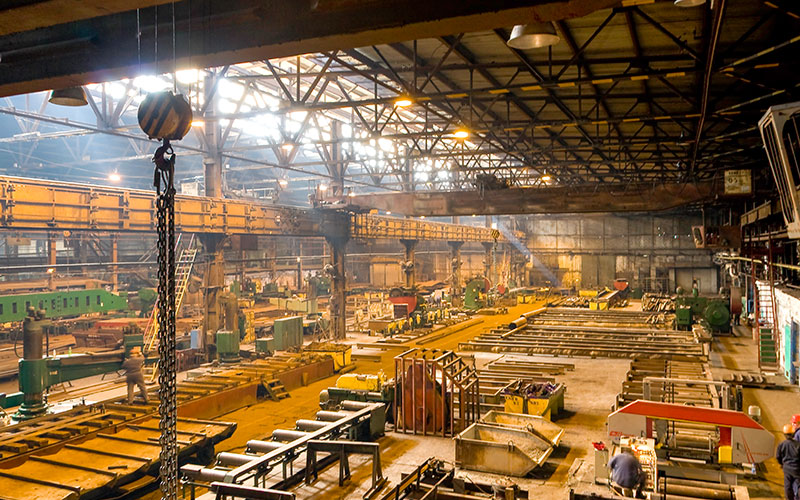
Acciaierie d’Italia idles lines amid demand deadlock
Italian steelmaker Acciaierie d’Italia, the joint venture between ArcelorMittal and state-owned Invitalia, has idled two galvanizing lines due to deteriorating demand for coil in Italy and Europe, sources tell Kallanish.
The company declined to comment. However, deadlock and falling prices are persisting in the Italian coil market. This is forecast to continue through the summer, sources speculate.
Acciaierie d’Italia may not be an isolated case. Other Italian and European producers are mulling longer-than-usual, six-week maintenance production stoppages over August and are already beginning to reduce output by idling re-rolling lines. In France, ArcelorMittal is understood to be preparing to idle one blast furnace – HF2 – at its Dunkirk mill, effectively reducing output for the coming months (see Kallanish 20 June).
At present, Acciaierie d’Italia’s Taranto steel plant is working using BFs 1, 2 and 4, Kallanish understands. The steelmaker said in May it will increase its steel output by 40% this year compared to 2021. In 2022 it intends to produce 5.7 million tonnes of steel. Sources however believe this is now in doubt because of the unexpected deadlock in the global flat steel market.
The producer posted approximately 4.4mt of output in 2020 and had a production target of 5mt last year. Output for 2021 is yet to be announced.
Natalia Capra France

EU CRC and HDG market quiet as automotive negotiations continue
Activity in the downstream coil market was muted June 22 as steelmakers engaged in negotiations for long-term automotive contracts.
In Northern Europe, cold-rolled coil was down Eur20/mt on the week while galvanized material fell Eur15/mt to be assessed at Eur1,000/mt ex-works Ruhr and Eur1,060/mt ex-works Ruhr, respectively.
With negotiations for H2 automotive contracts ongoing, some contracts were heard to have been settled and reportedly agreed as either stable or at a marginal rise of Eur20/mt.
Sources have mixed expectations for automotive recovery, with some OEMs heard to have resolved supply chain problems, particularly in relation to semiconductor shortages.
A producer located in the south of Italy has been actively offering galvanized material into the Northern market, and was heard at Eur940-950/mt ex-works Italy.
In the South, CRC was down Eur10/mt while HDG also down Eur25/mt to be assessed at Eur950/mt and Eur975/mt, respectively, both ex-works Italy.
Apparent demand remains poor and real consumption in the Italian market was reportedly sufficient, although not at levels to offset inflated stocks across supply chains.
South Korean import offers for CRC were reported at Eur830/mt CFR Italy by a trader source. A different trader source considered bids of Eur800/mt CFR as workable.
— Benjamin Steven, Maria Tanatar
EU HRC market mulls mill closures, import prices slide
Hot-rolled coil in Northern Europe was stable June 22, while prices in South Europe moved down on import pressures.
Against source expectations, import prices were also heard lower on the day, triggered by sharp drops in the Chinese market.
Platts assessed hot-rolled coil in Northern Europe at Eur870/mt ex-works Ruhr, according to S&P Global Commodity Insights.
Distribution sources agreed a tradable value range of Eur860-880/mt ex-works Ruhr, seen as achievable against offers reported at Eur870-880/mt ex-works Ruhr.
A large service-center source considered lower prices as achievable, reportedly targeting Eur850/mt ex-works Ruhr in ongoing negotiations.
In South Europe, prices fell Eur20/mt to Eur790/mt ex-works Italy, informed by indications of Eur780-800/mt ex-works Italy as a workable range. Offers were heard on the day at Eur800-820/mt ex-works Italy.
These estimations were reinforced by a deal heard from a Serbian mill, settled at Eur790/mt delivered to Italy.
Buy-side sources saw the pricing downtrend as continuing in the near term, with prices expected to fall to Eur750/mt ex-works Italy.
A deal for 30,000 of Indian boron-added HRC was reported at $765/mt CFR Italy, multiple sources reported that boron content has a limiting effect on the usability of the material, particularly for welding purposes.
“As far as I know, boron-added material is no problem for re-rolling,” said an influential trading source.
A producer from Japan was heard as offering hot-rolled coil at Eur750-760/mt CFR Italy, sourced through a European trader.
South Korean HRC has been offered at Eur780/mt CFR Italian ports, though import material is still regarded as unattractive to medium and smaller buyers due to long lead-times and uncertainties in the wider market.
Sources continue to report poor demand, with full inventories across supply-chains considered the primary factor.
Following ArcelorMittal’s announcement of two blast furnace closures in France and Germany, sources report that Central European mills are planning output cuts to minimize production levels – one steelmaker was heard as considering idling one of its three blast furnaces in the near-term.
— Benjamin Steven, Maria Tanatar

EU steel section prices continue to drop on low demand
European domestic steel sections prices continued to soften during the week ending June 22, as buyers held back from booking orders, expecting prices to drop further.
Platts assessed the European medium sections price (category 1, S235 JR) at Eur1,300/mt delivered June 22, down Eur50 on week, according to S&P Global Commodity Insights.
Activity was also low with many market players gathered this week at the Wire and Tube industry exhibition in Dusseldorf, Germany.
One Benelux-based distributor source put a tradable value for beams around Eur1,250/mt delivered, adding that purchasing activity was still on hold as the market was expecting prices to fall further.
Another distributor in the Benelux region noted that tradable value for category 1 medium sections was around Eur1,250/mt, delivered Benelux, but prices were higher in Germany at around Eur1,350-Eur1,360/mt, delivered. “Scrap is moving down, so customers are waiting [until] the last moment to place orders [for what they need],” he said.
In Northern Europe, Platts assessed domestic shredded scrap at Eur397.50/mt delivered June 10, down sharply from Eur500/mt in May, according to S&P Global. The assessment for Southern European shredded scrap was at Eur400/mt delivered to the mill for June June 10, down sharply from Eur510/mt delivered in May.
“Everyone is talking about very low prices, but there are no transactions in the market,” one European mill source said, adding that the market was hearing levels around Eur1,250-Eur1,260/mt delivered, but those were mostly from buyers. He also noted that the limited activity happening in the market was around Eur1,350-Eur1,360/mt delivered.
Another mill source indicated workable levels for category 1 medium sections around Eur1,250/mt, delivered, adding that tradable levels in Germany were higher, at around Eur1,300-Eur1,350/mt delivered.
Elsewhere, Northwest European domestic rebar prices also softened on the week ending June 22. Platts TSI assessed Northwest Europe Rebar down Eur80 to Eur1,085/mt ex-works June 22, according to S&P Global.
One seller and one distributor source put a workable level for domestic rebars at Eur1,100/mt, delivered. One mill source indicated workable levels around Eur1,050-Eur1,100/mt delivered, highlighting a lack of significant activity in the market.
— Rabia Arif, Staff