


Switzerland seeks EU exemption from new steel tariffs
Switzerland has stepped up its diplomatic efforts in Brussels to secure an exemption from the European Union’s planned new steel trade regulations.
Despite the European Parliament’s Trade Committee having formally rejected such a request in recent weeks, Swiss authorities revived their bid for an exemption by holding an urgent meeting with EU representatives on Thursday.
Switzerland’s State Secretariat for Economic Affairs (SECO) announced that an extraordinary meeting of the Joint Committee of the EU–Switzerland Free Trade Agreement was convened at Bern’s request. During the meeting, the Swiss side stressed the need to preserve established regional supply chains that are critical to European industry and called for special treatment in steel trade.
Switzerland’s renewed push comes at a time of rising tensions in EU trade policy. On Tuesday, the European Parliament’s International Trade Committee (INTA) approved a new steel trade framework to replace the current safeguard measures set to expire in June 2026, with 36 votes in favour, two against and five abstentions. The committee explicitly rejected a proposal to exempt Switzerland from out-of-quota tariffs.
Under the newly adopted framework, duty-free steel imports into the EU will be capped at 18.3 million tonnes per year, representing a 47% reduction compared with 2024 quota levels. Tariffs on out-of-quota imports will be increased from 25% to 50%. Exemptions will be limited to members of the European Economic Area—Norway, Iceland and Liechtenstein.
However, the committee’s strict stance toward Switzerland appears at odds with messages the EU has conveyed to other trading partners. EU Trade Commissioner Maroš Šefčovič said earlier this week, following the EU–India free trade agreement, that India would enjoy a “privileged position” in negotiations on access to the EU steel market. India is reportedly seeking a duty-free quota of around 1.6 million tonnes per year.
Despite Switzerland’s intensified diplomatic efforts, experts believe it will be difficult for the EU to reverse course on its new steel policy in the short term. The new measures are expected to establish a tighter trade regime aimed at protecting the European steel industry, while triggering new rounds of negotiations with third countries.


Trasteel becomes a member of EUROMETAL
Trasteel Group is a diversified industrial and trading platform headquartered in Lugano, Switzerland, with operations across more than 60 countries. The company combines global steel and metals trading with a network of industrial assets, processing facilities, and engineering subsidiaries across Europe and Asia.
Trasteel will generate $1.7B revenue in 2025 ($1.5B in 2024), split evenly between trading and industrial activities. The trading division focuses on steel, raw materials, consumables, metallics, non-ferrous metals, derivatives and energy, with a strategy built on geographic, time, and the technical arbitrage opportunities.
The industrial division includes Europe’s fourth-largest rerolling mill (370k tons capacity), tube plants with 400k tons of annual production, automotive blanking facilities, and rebar service centers in Poland and Romania. Engineering subsidiaries in Italy and Turkey extend the Group’s capabilities into machinery manufacturing, maintenance, and mechanical services.
More information: trasteel.com

Panatere inaugurates world’s first solar furnaces to produce recycled steel in Switzerland
Switzerland-based raw material processor and recycler Panatere has inaugurated the world’s first two solar furnaces dedicated to steel recycling in La Chaux-de-Fonds, canton Neuchâtel, according to media reports. The project marks a major technological milestone in the push toward decarbonized and circular steel production.
“There is a real interest in recycling our valuable resources. We want to keep the metal waste from the factories and recycle it locally,” Raphaël Broye, CEO of Panatere, said, describing the project as a demonstration of “true circular sustainability”.
Every year, Switzerland imports around 140,000 mt of stainless steel, including 15,800 mt for the watchmaking industry and 6,500 mt for the medical sector. Panatere’s solar recycling initiative aims to reduce this import dependence by processing local scrap.
By using 500 concave mirrors and a heliostat to concentrate sunlight, the furnace can reach temperatures of up to 2,000 °C, melting metals in just 1.5 hours with zero carbon emissions.
Panatere’s initial goal is to recover five percent of the metals produced domestically, which are currently exported as waste.
By 2028, the La Chaux-de-Fonds solar center aims to produce 1,000 mt of solar steel per year, supplying local industries such as watchmaking and medical manufacturing. The project is also expected to create new local jobs and stimulate regional economic activity.
The solar steel project has received broad institutional backing, including support from the Federal Office for the Environment, the cantons of Neuchâtel, Jura, and Bern, SIG (Services Industriels de Genève), the Swiss Climate Foundation and Energy Lab.
The first solar-produced steel bar will be exhibited at the International Watch Museum in La Chaux-de-Fonds.


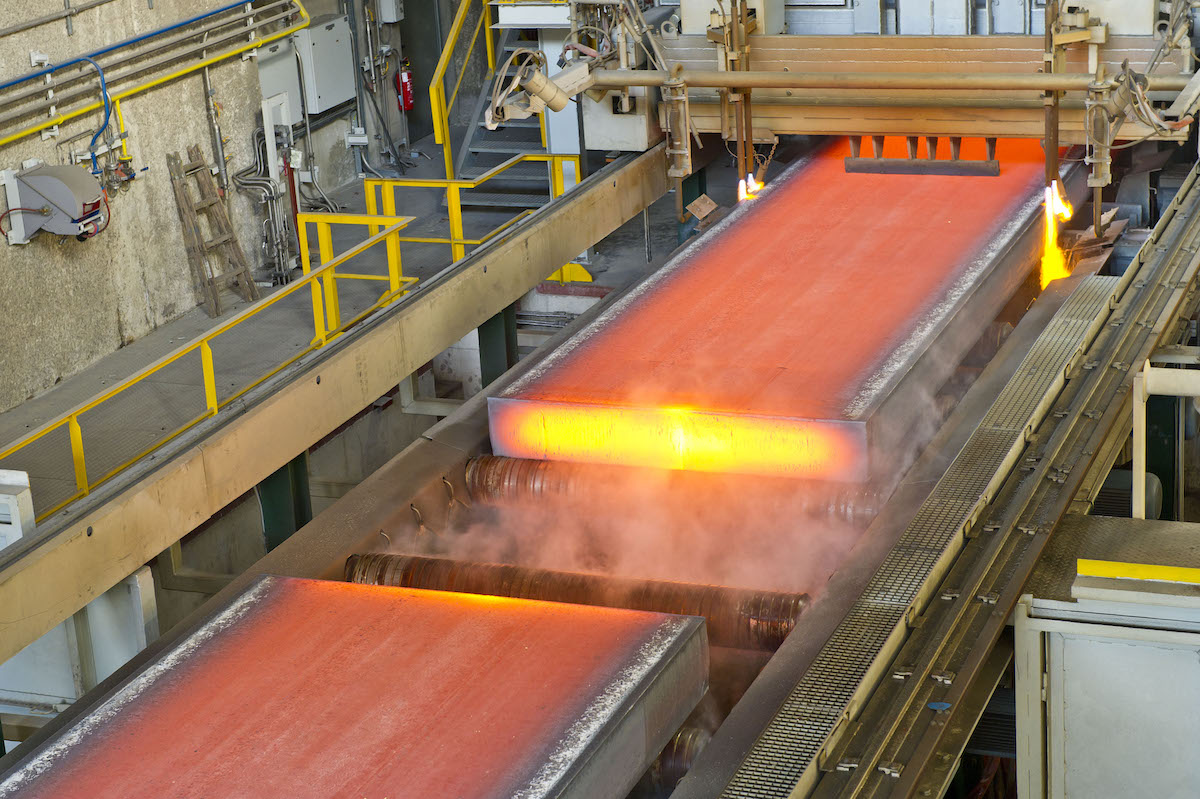
Swiss government offers subsidies to steelmakers
Steel and aluminium companies in Switzerland are eligible for state aid from the start of this year retroactively until the end of 2028, Kallanish notes.
The companies will benefit from a rebate on electricity grid usage charges. Fees will be reduced by 50% in the first year, 37.5% in the second, 25% in the third and 12.5% in the fourth. The costs for the government amount to some CHF37 million ($42m), according to Swiss public information portal swissinfo.ch.
High electricity costs and grid fees in recent years have been the main cause of concern of the country’s to steelmakers, Swiss Steel and Stahl Gerlafingen, to keep up in international competition. Production cutbacks and job cuts have been an issue at both companies.
National union Syna claims that the government’s offer has been made possible by worker protests over jobs since last autumn. Only in February, workers in one rally urged Swiss Steel to seize the government’s offer. This is not as understood as it appears at first.
The companies must comply with a number of requirements. They will have to submit a plan for the sustained preservation of production sites and jobs, and pledge investments. Swissinfo also notes that, in particular, they are prohibited from paying variable remuneration to members of management and the supervisory board.
Despite the dire state of Switzerland’s steelmakers, the government’s offer has not created major media waves, and might not be welcomed with open arms by the supposed beneficiary companies. Upon request from Kallanish, Swiss Steel confined itself to a brief statement saying: ”We have taken note of the decree, and will carefully examine if we will apply for it.”
Christian Koehl Germany


Eusider Trading joined as Member of EUROMETAL
EUROMETAL is delighted to welcome Eusider Trading as a new member company.
Eusider Trading SA, established in Switzerland in 2019, specializes in the global trading of flat and long steel products, as well as raw materials, with a particular focus on Metallics. The company procures high-quality materials worldwide, supplying key markets across Europe, MENA, and Latin America.
A strong emphasis is placed on coils, especially coated materials sourced from top-tier suppliers, which are regularly distributed to major steel service centers and stockists worldwide.
Thanks to the leadership of their CEO, Marco Micciché, and the active role of experienced steel professionals coming from previous engagements in primary international steel trade companies, Eusider Trading has expanded its reach and solidified its presence in global markets over the past five years.
Discover more: eusidertrading.com