

Key Takeaways
- Democrats take control of both chambers in January, but the vote arithmetic on tariff repeal leaves one central steel policy lever in a different place than the campaign rhetoric did.
- Industry sources say it is possible interest rates come down before the end of 2027, while the Federal Reserve’s own projections tell a different story, and the gap ties back to energy and AI spending.
- Two December 2027 deadlines, one inside the Section 232 schedule and one inside the federal energy tax code, fall within the next 14 months and touch Plate, Galvanized and equipment demand.
Introduction
Voters changed Congress on November 3. They did not change the duty on a ton of imported steel.
Democrats are projected to control both the House and the Senate when the 120th Congress convenes on January 3, 2027, ending unified Republican control two years into President Donald Trump’s second term. Early tallies gave Democrats a House majority of at least 225 seats and a Senate majority of 54 seats, with some races still being counted. Those majorities fall well short of the 290 House votes and 67 Senate votes needed to override a presidential veto.
For steel manufacturers, service centers and distributors, the next 14 months, running through December 31, 2027, now sit inside a divided government. Democratic leaders have said they intend to push for repeal of the administration’s tariffs once the new Congress is seated. The President said after the election that his administration will keep its tariff policy in place, and he told an interviewer he intends to use his veto to block legislation and force negotiations.
The election also landed in the middle of an economic environment shaped by forces Congress does not directly control. An energy shock tied to the war with Iran pushed headline consumer inflation to 3.7% in September. The Federal Reserve, now led by Chair Kevin Warsh, raised its benchmark rate in September for the first time since July 2023. Oil fell below $100 a barrel in the days after the vote for the first time in a month. Data center construction, the strongest end market cited by many steel buyers this year, became a campaign issue. Democrats campaigned on restoring clean energy tax credits that were cut in 2025.
Each of these threads connects to steel through a different channel. Tariffs set the landed cost of imports and the pricing room for domestic mills. Interest rates set the cost of carrying inventory and receivables and the financing math on customer projects. Energy policy shapes demand for wind towers, solar racking, grid equipment and vehicles. Data center policy touches one of the largest sources of new nonresidential steel consumption in the country.
The distinction that runs through every one of these areas is the difference between enacted policy and stated intent. A bill introduced in January is not a customs notice. A campaign pledge on tax credits is not a change to the tax code. A Fed projection is not a rate decision. The calendar through December 2027 contains specific, verifiable dates on all of these fronts, and those dates mark when policy changes take legal effect.
Divided Government: What Changes on January 3
Democratic control of both chambers gives the incoming majority the ability to set the legislative agenda, organize committees, hold hearings and issue subpoenas, and shape the confirmation process for executive branch and judicial nominees. In the Senate, that includes nominees to federal agencies and to the Federal Reserve Board of Governors.
Control of Congress is not control of the executive branch. Legislation that reaches the President’s desk can be vetoed, and the projected seat counts leave Democrats far from the two-thirds threshold required in each chamber to override. In the Senate, most legislation also requires 60 votes to overcome a filibuster.
The positions of each side are on the record. Democratic leaders have said they plan to push for repeal of the tariffs and to revoke trade authorities delegated to the President. Several House Republicans voted with Democrats earlier in 2026 on a resolution to overturn tariffs on Canada, which some analysts have cited as a sign that bipartisan votes on narrower trade measures are possible. The President said his administration will continue its tariff policy despite the election results, and said removing the tariffs would please foreign governments and halt construction immediately. He also said Democrats would send him legislation he would veto, and that the two sides would then work together on deals.
The new majority’s clearest power concerns future legislation. Democrats can block tax and spending changes they oppose, and they can attach conditions to must-pass bills. They cannot repeal existing law by declining to act, and they cannot change tariff schedules without either the President’s signature or a veto-proof margin.
Why it matters: For the next 14 months, steel tariff treatment depends on executive action, court rulings and any negotiated legislation that the President signs. Purchasing, quoting and contract terms tied to duty rates rest on the customs schedule in force on the date of entry, while hearings, bills and statements shift market expectations ahead of any legal change.
Section 232 Remains the Central Steel Question
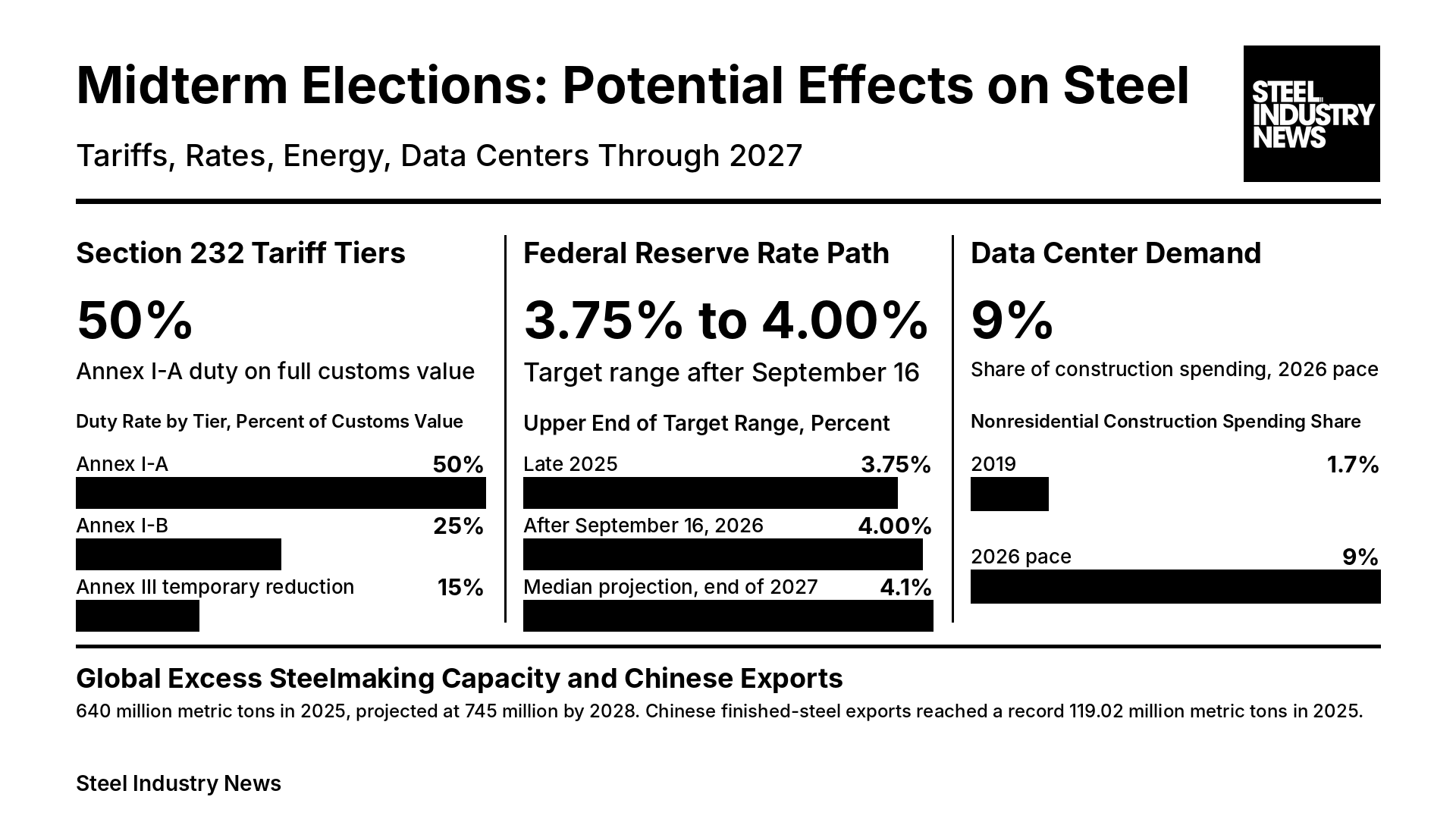
The Section 232 steel and aluminum tariff rate rose from 25% to 50% in June 2025. On April 2, 2026, a presidential proclamation restructured the program, effective April 6. Duties now apply to the full customs value of covered products, including derivatives, rather than only to the value of the metal content. The proclamation set tiered rates by product list, removed some derivatives from coverage entirely, created a weight-based exemption for certain articles with less than 15% metal content, and specified that steel, aluminum and copper duties do not stack.
|
Section 232 tier (effective April 6, 2026) |
Rate on full customs value |
Coverage |
|---|---|---|
|
Annex I-A |
50% |
Steel, aluminum and copper articles and listed derivatives |
|
Annex I-B |
25% |
Listed steel and aluminum derivatives and certain copper articles |
|
Annex III, temporary reduction |
15% (10% if made with U.S. metal) |
Certain industrial equipment and electrical grid equipment, through December 31, 2027 |
|
U.S.-metal derivatives |
10% |
Derivatives made entirely of metal melted and poured or smelted and cast in the United States |
|
UK origin |
25% or 15% |
UK-origin articles normally at 50% or 25%, respectively |
|
Metal content under 15% by weight |
Exempt from Section 232 |
Certain articles outside Chapters 72 through 76 |
The Annex III reduction for industrial and grid equipment expires on January 1, 2028. After that date, those products move to the 25% Annex I-B rate, or 10% if made with U.S. metal, unless the schedule is changed before then. The expiration falls one day after the 14-month window closes.
Different tariff programs rest on different statutes. The Supreme Court ruled on February 20, 2026, that the administration could not use the International Emergency Economic Powers Act to impose tariffs. That ruling did not affect Section 232 or Section 301 duties. The administration has since applied tariffs of up to 12.5% on goods from 60 trading partners under other authorities, alongside the sector-specific duties on steel and automobiles.
Trade negotiations are also moving on a separate track from Congress. In the weeks before the election, the United States and Canada were negotiating over Section 232 duties on steel and automobiles, with a narrower agreement under discussion. The White House exempted a number of Canadian goods from the 50% tariff before the vote. Canadian Prime Minister Mark Carney said after the election that he had not spoken with Democrats about legislation to remove tariffs on Canada, and that his government would continue working with the administration toward a deal.
Why it matters: Domestic mill pricing, import landed costs and derivative product exposure all trace back to the April 2026 tier structure. A change through a country agreement, a product-list revision or legislation would affect specific annexes and origins rather than the program as a whole. The Annex III expiration date sits on the calendar for any buyer of imported industrial or grid equipment with deliveries scheduled near the end of 2027.
Mills and Distributors Carry Different Exposure
Domestic mills and distributors read the same tariff headline from opposite sides of the transaction. Import protection supports domestic pricing power, while distributors that buy imports pay higher landed costs and carry more working capital for the same tonnage.
Recent company results show how protection has flowed through to producers. Nippon Steel said its U.S. Steel subsidiary earned underlying business profit of $421 million in the quarter ended September 30. The company raised its fiscal year guidance for U.S. Steel, including its Slovak operation, to at least $1.46 billion, up from $1.14 billion in August and $634 million in May (derived). Nippon Steel attributed the improvement in part to U.S. market prices supported by Section 232 tariffs, and said U.S. Hot Rolled Coil prices have continued to rise since the end of 2025. Its chief financial officer said strong prices reflected both tariffs and the strength of the U.S. economy, said about half of the year-over-year improvement came from market conditions and half from operating gains, and declined to comment on the effect of the midterm election.
|
U.S. Steel underlying business profit guidance (Nippon Steel fiscal 2026) |
USD (derived) |
Change from prior (derived) |
|---|---|---|
|
May 2026 |
$634 million |
– |
|
August 2026 |
$1.14 billion |
+$507 million (+80%) |
|
November 2026 |
$1.46 billion or more |
+$317 million (+28%) |
Distributor economics run through a different equation. Gross profit depends on the spread between inventory cost and selling price, plus processing revenue and inventory turnover. Rising prices lift returns on lower-cost stock already on the floor. Falling prices compress margins when older, higher-cost inventory competes against cheaper replacement material. A shift in tariff expectations can move buying behavior before any duty changes: customers who anticipate lower prices shorten their buying horizons, while customers who anticipate higher duties pull orders forward.
The same mechanism works in reverse for mills. Protection supports price, but mill earnings still depend on order volume, operating rates, product mix, raw material and energy costs, and customer acceptance of price increases. Nippon Steel’s own breakdown of U.S. Steel results split the gain between market conditions and operating improvements.
Why it matters: A tariff change affects mills, import location sensitive service centers and fabricators differently, and in the case of distributors the effect shows up first in inventory valuation and order timing rather than in reported revenue. Price direction alone does not describe the condition of either side of the supply chain.
Interest Rates, Inflation and the Federal Reserve
Interest rates were not on the ballot, but they connect directly to steel through inventory financing, customer project economics and construction demand. Floating-rate credit lines used to carry inventory and receivables move with short-term benchmark rates, and higher borrowing costs raise the hurdle for the construction and equipment projects that consume steel.
The rate environment heading into the new Congress runs opposite to the easing cycle of late 2025. The Fed cut rates three times in the second half of 2025, ending the year at a target range of 3.50% to 3.75%. It held that range through July 2026. On September 16, 2026, the Federal Open Market Committee voted 12 to 0 to raise the range to 3.75% to 4.00%, the first increase since July 2023. Minutes from that meeting showed officials pointed to energy prices, AI-related spending and inflation running above the 2% target for more than five years. On October 28, the committee held the range steady by a 10 to 2 vote, with both dissenters, Governor Lisa Cook and Cleveland Fed President Beth Hammack, preferring another quarter-point increase.
The Fed’s September projections put the median federal funds rate at 4.1% for the end of 2026 and 4.1% for the end of 2027. Those projections contain no rate cuts across the full window covered here. The next decision, with updated projections, is scheduled for December 9, 2026.
Inflation in 2026 has been driven largely by energy. Headline consumer prices rose 3.7% from a year earlier in September, up from 3.4% in August, while core inflation, which excludes food and energy, rose 2.6%. Headline inflation peaked at 4.2% earlier in the year. The October consumer price report is scheduled for release on November 10.
Two of the policy questions raised by the election feed directly into those inflation readings. Lower energy prices would reduce the headline figure; oil fell below $100 a barrel after the vote, though analysts noted the results do not resolve the geopolitical conditions behind the price spike. Any reduction in tariffs would lower costs for imported goods. Both would show up in the data the Fed uses. Industry sources say it is possible rates will come down before the end of 2027 if energy-driven inflation eases and the price effects of tariffs fade. The Fed’s September projections do not show a cut in that period, and the decision rests with the committee, which sets policy independently of Congress. Congress does hold one lever: the Senate confirms nominees to the Fed Board, and that confirmation process passes to a Democratic majority in January.
Why it matters: Inventory carrying costs, customer financing and project feasibility all track the federal funds rate. The Fed’s published path through 2027 currently shows no cuts, while industry sources say a decline in rates is possible if inflation eases. The inflation reports and December projections are the scheduled data points that test that path. Congressional action on tariffs and energy affects rates only indirectly, through the inflation readings the Fed weighs.
Energy Policy: Clean Energy Credits, Electric Vehicles and Steel Demand
Energy costs were among the central issues of the campaign, and energy policy reaches steel through several product channels. Wind towers and foundations consume Plate. Utility-scale solar uses Galvanized racking and structural supports. Grid expansion requires transformers, poles and substation structures. Automotive production, including electric vehicle and battery plants, is one of the largest consumers of flat-rolled steel.
The 2025 budget law changed the federal incentives behind much of that demand. Under the law, wind and solar projects that began construction by July 4, 2026 keep eligibility for the production and investment tax credits. Projects that began construction after that date must be placed in service by December 31, 2027, to qualify. That cutoff falls on the final day of the window covered here. Geothermal, hydropower, nuclear and energy storage projects are not subject to the same accelerated deadline.
Federal tax credits for new, used and commercial electric vehicles ended for vehicles acquired after September 30, 2025. The credit for charging equipment ended for property placed in service after June 30, 2026.
Democrats have proposed reversing those changes. More than 160 House Democrats back the Energy Bills Relief Act, introduced by Representatives Sean Casten and Mike Levin, which would restore the clean energy tax credits from the Inflation Reduction Act, including the electric vehicle credit of up to $7,500 for new vehicles. Senate Democratic Leader Chuck Schumer has said restoring the clean energy tax credits would be among the first actions of a Democratic majority, while not explicitly addressing electric vehicle credits. Restoring the wind and solar credits ranks among the top Democratic energy priorities after the election, while restoring the electric vehicle credit has drawn less support from party leaders. Areas cited as having support in both parties include geothermal, nuclear, battery production, domestic mineral processing and a Senate permitting bill unveiled in late September.
Any restoration of the credits requires legislation the President signs. The administration has opposed broader clean energy policies, and tax legislation faces the same veto threshold as tariff legislation.
Why it matters: The December 31, 2027 placed-in-service deadline sets the timing for wind and solar projects that missed the July 2026 construction start, which bears on Plate, Galvanized and fabricated structure demand tied to those projects through the end of 2027. Electric vehicle and battery plant demand depends on credit treatment that, as of now, remains repealed. Any change to either requires enacted legislation rather than stated priorities.
Data Centers: Demand Driver Under Political Scrutiny
Data center construction has been the strongest end market cited by steel buyers and mills in 2026. The projects draw on a wide range of products: Beams and Plate for structures, Cold-Formed Steel framing, Pipe and Tube for cooling systems, conduit and strut supports, racks and enclosures, and the transmission and substation steel needed to bring power to each site. Private data center construction ran at a record seasonally adjusted annual rate of $96.5 billion in September 2026, according to Census Bureau data. Data centers are on pace to account for about 9% of private nonresidential building construction spending in 2026, compared with about 1.7% in 2019. As of the second quarter of 2026, 3,173 operational data centers in the United States represented about 56.6 gigawatts of net IT power, with another 1,140 facilities planned.
That growth turned into a campaign issue through electricity bills. Candidates in both parties addressed how to supply power to large new loads without shifting grid costs onto residential customers, and local ballot measures in several communities put data center development directly before voters. In September, the House voted 417 to 3 to pass a bill requiring states to consider having large electricity users such as data centers pay the full additional cost of serving them. Some Senate Democrats said the bill did not go far enough. A group of House Democrats introduced separate legislation to end certain federal tax incentives available to data centers. The Senate Democratic energy plan released in March included reforming how data centers pay for energy infrastructure.
The President has supported data center development. Proposals for a national moratorium have circulated among some progressive Democrats, while others in the party have emphasized affordability and cost allocation rather than limits on construction.
The Fed’s September minutes added another link between data centers and steel. Officials cited AI-related spending as one of the inflation pressures behind the rate increase, connecting the same buildout that supports steel demand to the borrowing costs that affect every other steel-consuming sector.
Why it matters: Cost allocation rules for electricity, federal tax treatment and local siting decisions all bear on the pace and location of data center construction, which feeds directly into Beam, Plate, framing, Pipe and grid steel orders. The bipartisan House vote shows ratepayer protection has support in both parties, while tax incentive changes and moratorium proposals face the same legislative and veto constraints as other measures.
Federal Spending and Project Timing
Divided government changes the dynamics of federal spending. Appropriations, supplemental funding and any reauthorization of infrastructure programs now require agreement between a Democratic Congress and a Republican President. Key provisions of the 2021 Bipartisan Infrastructure Law and the Energy Act of 2020 have expired or are scheduled to lapse in 2027, creating an opening for reauthorization negotiations during the window covered here.
For steel suppliers, the gap between announced spending and executable demand is measured in procurement steps. A project may have political support and still require appropriated funds, engineering, permits, contract awards and contractor mobilization before mill orders are placed. An already designed and funded project and a newly announced program sit at different points on that timeline.
Manufacturing investment follows a similar sequence. Construction, equipment procurement, commissioning and production ramp-up occur at different stages, and each stage purchases different steel products. Beams and Plate are needed during construction; machinery components are ordered later; recurring production demand begins only after a facility starts operating. A single announcement can represent several distinct purchasing windows spread across years.
Public work also carries payment timing exposure. Delayed approvals or funding disputes can shift shipment schedules and receivable collection even without a project cancellation.
Why it matters: Steel demand from federal programs within the next 14 months depends on projects that are already funded and moving through procurement. Reauthorization talks and new spending proposals affect the pipeline for later years. Confirmed engineering packages, contract awards, equipment orders and site activity are the milestones that convert spending into tonnage.
Global Supply and the Paths Through December 2027
The election does not separate the domestic market from global steel conditions. The OECD projects global excess steelmaking capacity reaching 745 million metric tons by 2028, up from 640 million metric tons in 2025. Chinese customs data show finished-steel exports reached a record 119.02 million metric tons in 2025, up 7.5% from 2024. Exports totaled 85.64 million metric tons from January through September 2026, and full-year 2026 exports are forecast at 110 million to 115 million metric tons, which is 3.4% to 7.6% below the 2025 total (derived). The United States, Canada, Mexico, Brazil and India are among the economies that have raised tariffs on many basic steel products, and the OECD has reported growing circumvention of trade measures through transshipment.
A change in U.S. market access shifts trade incentives beyond any single bilateral relationship. Import availability and offer prices respond to restrictions in other markets, overseas demand and the efforts of producers abroad to find new customers. Domestic protection limits that exposure at the border, but overseas prices still enter customer negotiations and the economics of imported downstream goods.
The stated positions of the administration and the incoming majority mark out the range of outcomes now under discussion. One path keeps the Section 232 structure substantially intact while Congress challenges it through legislation, hearings and oversight. A second involves limited adjustments, such as a country agreement with Canada or product-specific revisions, without dismantling the broader framework. A third involves escalation, with additional trade measures or spending confrontations adding uncertainty for customers. Each path carries different effects on mill pricing, import economics, distributor inventory values and customer order timing.
Why it matters: Global excess capacity, foreign trade restrictions and circumvention all bear on the import offers that reach U.S. buyers, whatever happens in Washington. The three paths above differ in which annexes, origins and products are affected, and each is tied to specific actions, such as a signed agreement, a revised annex or an enacted bill, that can be tracked as they occur.
Conclusion
The midterms produced a clear political result and a less settled commercial one. Democrats take control of both chambers on January 3, 2027, with majorities short of the margins needed to override a veto. The President has said he will keep his tariff policy and use his veto to force negotiations. Democratic leaders have said they will push to repeal tariffs and restore clean energy tax credits.
For steel, the policies in force remain the reference point. The Section 232 structure set in April 2026 applies 50% and 25% duties on full customs value, with a temporary 15% rate on certain industrial and grid equipment that expires at the end of 2027. Wind and solar projects that missed the July 2026 construction start must be in service by December 31, 2027, to claim federal credits. Electric vehicle credits remain repealed. The Fed raised rates in September, held in October, and published projections showing a 4.1% median rate at the end of both 2026 and 2027, though industry sources say it is possible rates will come down before the end of 2027 if inflation eases. Data center construction continues to anchor nonresidential steel demand.
The calendar through December 2027 is specific: the October inflation report on November 10, the Fed decision on December 9, the seating of the new Congress on January 3, ongoing U.S.-Canada talks on Section 232, and the paired year-end 2027 deadlines in the tariff schedule and the energy tax code. Each date can be checked against what has changed in law, customs treatment and order books.