


Blastr adds Ecolab for water treatment, management
Blastr Green Steel has secured a new strategic investor in its latest round of financing, aiming to collaborate on best-in-class water systems at its projected plant in Inkoo, Finland.
In addition to investing in the project, new partner Ecolab has commenced the design of, and intends to subsequently build and operate the water management system at the plant, Blastr tells Kallanish.
According to Blastr, Ecolab is a global leader in water, hygiene and infection prevention solutions and services, operating in more than 170 countries. Its Nalco Water business provides sustainable water solutions to steel companies and other customers to reduce water usage, maximise production process water reuse and wastewater recycling, and minimise treated effluent discharged.
The parties will work together to minimise seawater intake, seawater discharge, and heat load to the sea, with potential reductions estimated at up to 85-90%. Further advances will be explored through innovative stormwater integration and the use of municipality wastewater, Blastr notes.
The company adds it will shortly launch its Series A investment round through its recently announced financial advisor, Evercore.
“Strategic collaborations, such as this most recent one with Ecolab, further enhance Blastr’s financial case as we build momentum in our funding,” says Blastr chief financial officer David Morant.
Christian Koehl Germany


Steel HRC prices in Europe rise gradually despite lack of demand
Local prices for steel hot-rolled coil in Europe increased on Thursday August 28 despite muted trading and a general lack of support from the demand side.
In Northern Europe, both deals and estimates of workable prices for material scheduled for delivery in October were heard at higher levels than on August 27, within the range of €580-590 ($677-689) per tonne ex-works versus €570-580 per tonne ex-works.
The remaining volumes of material scheduled for shipment in September were, however, still traded within the range of €560-580 per tonne ex-works, according to a seller source.
Several seller sources said that new formal targets were €600-610 per tonne delivered, but such prices faced “lots of pushback from customers.”
Fastmarkets’ calculation of the daily steel hot-rolled coil index, domestic, exw Northern Europe, was €579.38 ($676.24) per tonne on Thursday, up by €6.88 per tonne from €572.50 per tonne the previous day.
The Northern European index was up by €5.63 per tonne week on week and up by €20.38 month on month.
The Italian market was still comparatively quieter because participants have not yet fully returned to business after their summer break.
Some small deals were heard done within the range of €540-550 per tonne ex-works, while target offers from integrated mills and re-rollers in Italy for October-delivery coil were heard at €570-580 per tonne ex-works.
Fastmarkets’ daily steel hot-rolled coil index, domestic, exw Italy, was €541.67 per tonne on August 28, up from €540.00 per tonne on August 27.
The Italian index was up by €0.84 per tonne week on week and by €15.42 per tonne month on month.

European green steel premiums hold steady as demand stays weak; Nordic buyers lead uptake
Premiums for green flat steel were holding stable across Europe, trending below official offers amid weak demand, sources told Fastmarkets on Thursday August 28.
Buying interest for green steel remained niche and regionalized across Europe, sources said.
“Customers are focused on broader problems, such as low steel demand, US tariffs and regulatory changes impacting import flows into Europe [new safeguards and Carbon Border Adjustment Mechanism],” one major distributor said.
Nordic countries remained leaders in green steel purchases, with one supplier pointing out that they were selling “up to 90%” of their green steel products to Nordics.
Another supplier said that they were selling small tonnages of green steel quite regularly to the Nordic countries as well.
“Buyers in the Nordic countries are generally more willing to purchase green steel. They know they can pass the additional cost on to the end customer, as many public projects in this region now require the use of green steel,” a mill source said.
Fastmarkets’ methodology defines European green flat steel as “steel produced with Scope 1, 2 or 3 emissions at a maximum of 0.8 tonnes of CO2 per tonne of steel.”
Premiums for such steel were set at minimum price of €200 ($233) per tonne among European mills.
Buyers estimated achievable prices much lower, at €100-130 per tonne, adding that mills were willing to grant discounts for volumes above 2,000 tonnes.
Suppliers estimated achievable prices higher, at €150-170 per tonne.
As a result, Fastmarkets’ assessment of the green steel domestic, flat-rolled, differential to HRC index, exw Northern Europe was €120-170 per tonne on Thursday, unchanged week on week.
Fastmarkets’ assessment of the flat steel reduced carbon emissions differential, exw Northern Europe was also unchanged week on week at €40-60 per tonne on Thursday.
For steel produced in blast furnaces with reduced carbon emissions of 1.4-1.8 tonnes of CO2 per tonne of steel, offers for premiums were indicated at €60-70 per tonne during the assessment week.
Buyers’ estimates of tradable prices were around €20-50 per tonne, with most of the estimations coming in the range of €40-50 per tonne.
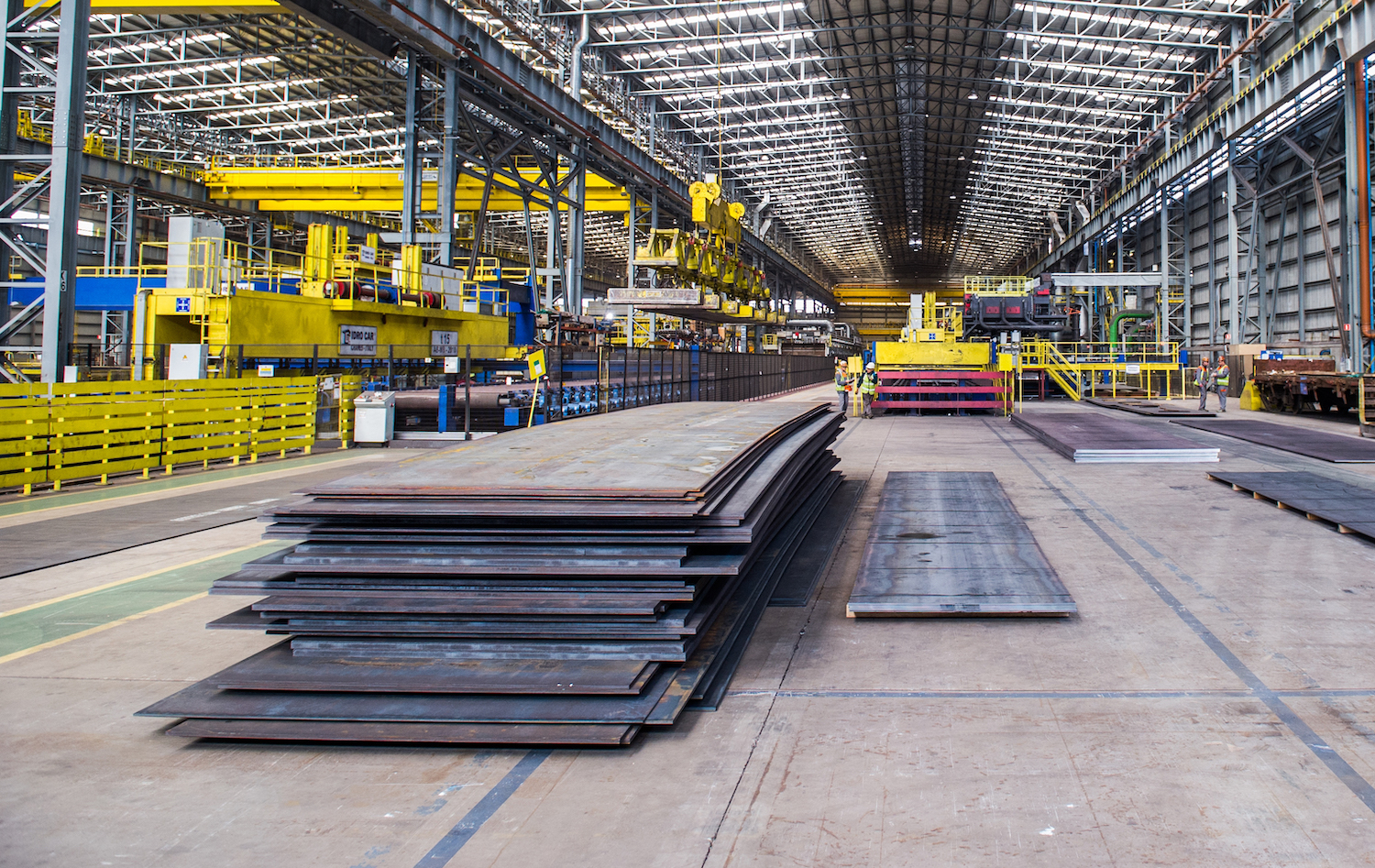
European steel heavy plate prices flat amid limited end of summer trade
Steel heavy plate prices in Europe remained stable in the week to Thursday August 28, following several weeks of muted trade during the summer holiday period and fresh Italian export deals.
Italy
Italy’s domestic heavy plate market was stable during the pricing period, with a few export deals to Northern Europe heard at €610 per tonne exw.
But sources said trading remained limited, with low domestic demand reflecting the holiday slowdown.
Fastmarkets’ weekly price assessment for steel domestic plate 8-40mm, exw Southern Europe was €590-620 ($689-724) per tonne on Thursday, unchanged since August 7.
“There is no real market restart yet, but next week there will be more discussions [post-summer] and probably more price clarity,” a producer source said.
Northern Europe
In Northern Europe, heavy plate prices were also stable amid the end of the summer lull, with many industry participants returning to the market during the pricing period.
Fastmarkets’ weekly price assessment for steel domestic plate 8-40mm, exw Northern Europe was €630-670 per tonne on Thursday, stable from a week earlier.

German Stockholding: July steel sales rise 0.8% on year, stocks dip 3.7%
German steel sales rose 9.6% month over month and 0.8% year over year to 857,680 mt in July, while stocks dropped from levels seen in the previous year, according to data published by the German steel stockholders’ association BDS Aug. 27.
Steel longs sales in July rose 1.1% month over month and 1.2% year over year to 257,652 mt, while sales of flat products decreased 0.6% year over year but rose 12.1% month over month to 499,325 mt.
All other steel sales in July rose 26.5% month over month and 7.9& year over year to 86,703 mt.
Germany’s total steel stocks in July decreased by 3.7% year over year but increased by 1.7% month over month to 1.89 million mt. Stocks of long steel products rose 5.5% year over year and 0.2% month over month to 661,490 mt. Stocks of flat products dropped 8.2% year over year but rose 2.5% month over month to 1.19 million mt. Other steel stocks declined 0.7% year over year and rose 4% month over month to 39,989 mt.
Platts, part of S&P Global Commodity Insights, assessed domestic HRC in Northern Europe at Eur575/mt ex-works Ruhr Aug. 26, stable day over day. In July, prices moved down from Eur565/mt ex-works on July 1 to Eur535/mt on July 21, and then started to rise, closing at Eur560/mt at the end of July.
German crude steel production continued to decline in July, with output falling by 13.7% year over year to 2.7 million mt, according to data from the German steel federation WV Sthal published Aug. 20.



ACEA: EU car registrations slip in Jan-July, but hybrid-electric units gain market share
New EU car registrations in the first seven months of the year fell 0.7% year over year to 6.54 million units, but rose 7.4% to 914,680 units in July, according to the data from the European Automobile Manufacturers’ Association (ACEA).
From January to July, battery-electric cars captured 15.6% of the EU market share with around 1 million mt units — up by 24.2% year on year but “still far from where it needs to be at this point in the transition,” ACEA said.
Hybrid-electric models continued to grow, retaining their place as the most popular power type among buyers, attaining a 34.7% share of the market in the seven-month period. Meanwhile, the combined market share of petrol and diesel cars fell to 37.7%, down from 47.9% over the same period in 2024.
Hybrid electric car registrations rose 16.7% year over year to 2.26 million mt units from January to July and 14.3% to 313,221 units in July. This compared with a 20% fall for petrol cars to 1.83 million mt units in the seven-month period and a 12% drop to 248,592 units last month.
The EU is working this week to remove duties on US cars shipped into Europe, currently at 10%, and other levies on US industrial goods, as agreed in the trade deal signed by the US and European Commission in order to reduce US duty on EU exports from 27.5% to 15%.
Steelmakers, the main commodity producers associated with automaking, have been hit by US tariffs of 50%. Eurofer, the European steel federation, has said that even a 15% tariff on cars will mean an additional burden for EU steel companies.
In 2024, when the tariff on cars was only 2.5%, around 760,000 EU vehicles were exported to the US, which could be estimated at around 1 million mt of EU steel, a significant part of which may disappear as a result of the new 15% tariff on vehicles, Eurofer said.
Platts, part of S&P Global Commodity Insights, assessed domestic hot-rolled steel coil in Northern Europe at Eur575/mt ($672/mt) ex-works Ruhr Aug. 27, stable day over day. Prices fell from Eur565/mt ex-works on July 1 to Eur535/mt July 21, and then started to rise, closing at Eur560/mt at the end of last month.

Metals industry calls on EU for clearer guidance on CBAM implementation
Major players in the global metals trade pressed the European Commission for greater clarity around the EU’s Carbon Border Adjustment Mechanism following a public consultation that drew over 350 company responses, highlighting concerns about the lack of emissions intensity details as the bloc prepares to fully operationalize its landmark carbon import policy.
The consultation feedback highlights industry concerns about the technical details and transparency involved in calculating the intensity and benchmark values of embedded emissions as companies prepare for CBAM’s transition from its current reporting-only phase to its definitive phase starting from Jan. 1, 2026.
Global commodity trader Trafigura emphasized the urgent need for regulatory clarity in the aluminum sector, specifically calling for the European Commission to publish “default values” and “free allocation benchmarks” to help importers estimate costs.
“In setting default and benchmark values, we would urge consideration as to the geographical concentration of certain value chains, given it is not always feasible, or economically viable, to procure certain upstream, midstream, or downstream products from within the EU, or from a broad range of countries,” it said in its submission to the European Commission.
Trafigura highlighted the mounting complexity of calculating carbon emissions for downstream aluminum products, noting that determining embedded carbon content becomes increasingly challenging as products become more intricate.
Downstream scope extension
The move reflects Brussels’ broader efforts to combat carbon leakage and prevent EU companies from relocating manufacturing and processing operations to countries with weaker climate regulations outside the bloc.
The European Commission launched the eight-week consultation in July, seeking industry feedback on expanding CBAM’s scope to cover additional downstream products along the value chain.
Germany’s Thyssenkrupp Steel Europe AG pushed for expanding CBAM’s scope to include strategically important downstream products, arguing that current trade metrics fail to reflect the risk of production relocation to non-EU countries.
Drawing parallels with the US approach, which extended steel tariffs to over 400 downstream products, Thyssenkrupp insists that CBAM must apply across value chains.
The steel producer urged the European Commission to prioritize products in the automotive and energy sectors, such as steel laminations for electric vehicles and power transformers, which are vital for the EU’s economic prosperity and industrial resilience.
Low-carbon steel developer Stegra expressed strong support for CBAM while calling for the timely implementation of the proposed improvements, including indirect emissions coverage and enhanced anti-circumvention safeguards.
The company stressed that these measures could be gradually implemented during 2026 and 2027 without significant difficulty, warning that timeline deviations would undermine both CBAM and the effectiveness of the EU Emissions Trading System.
The organization stresses that the phase-out of free allocations under the EU ETS is critical for the decarbonization of the region’s industry.
The EU’s CBAM works alongside the bloc’s ETS by imposing carbon pricing on imports, designed to prevent carbon leakage as Brussels phases out free emissions allowances for domestic producers. Under the mechanism, importers must purchase CBAM certificates equivalent to the carbon content of goods from six covered sectors: aluminum, cement, electricity, fertilizer, iron and steel, and hydrogen.
Platts assessed EU Allowances for nearest December delivery at Eur72.26/mt CO2 equivalent ($84.36/mt CO2e) on Aug. 27. CBAM’s carbon levy mirrors the EU Emission Allowance price.

Poland’s Boryszew Group advances sale of Rurexpol
Poland-based Boryszew Group has announced the signing of a letter of intent for the sale of pipe producer Rurexpol, the group company that was liquidated earlier this year and ceased operations. The transaction is valued at PLN 71.5 million ($19.5 million). The agreement is expected to be finalized by October 15, following a comprehensive due diligence review by the potential buyer.
According to the statement, the sale covers real estate, movable property such as machinery and equipment, certificates, concessions, licenses, and permits, intellectual property rights, spare parts inventories and technical and technological documentation related to production lines.
If the sale is concluded, it will permanently eliminate the possibility of Rurexpol returning to the Częstochowa Steelworks, where it once operated as the pipe production division.


Italian crude output declines in June
Italian crude steel production decreased in June following a hike in May but increased in the first half of 2025, industry association Federacciai says in a note obtained by Kallanish.
June production decreased by 3.2% on-year to just over 1.7 million tonnes. However, output in the first six months of the year increased by 2.9% on-year to 11.1mt.
“The breakdown of hot steel production shows a decline common to both [flats and longs] product families [in June],” Federacciai states.
Flat steel production decreased by 6.6% to 720,000t in June but increased by 7.7% to 4.8mt in January-June. Long’s output, meanwhile, decreased 2.3% to 1mt in June and rose by 0.4% to 6.4mt in H1.
Before the production rebound this year, Italian output declined over recent years, falling by 5% on-year in 2024 to 19.9mt, by 2.5% on-year in 2023 to 21mt, and by 11.5% y-o-y in 2022 to 21.6mt.
Natalia Capra France

German construction orders recover in first half
Germany’s construction companies lifted their order intake in the first half year of 2025 by 7.2% over H1 2024, Kallanish learns from their association, Bauindustrie.
The association notes, however, that orders have increased from a low level, following a negative trend for four years. Residential construction, for example, achieved a year-on-year increase of 9.7%, but is still a considerable 31% below the level of 2021.
The last month of the reporting period, June, saw a lesser y-o-y increase, by 2.9%, and a drop versus May. This coincides with the sentiment poll of economic institute ifo (see separate story), which reports a deteriorating mood in the summer month of August, but nevertheless reports hope for the autumn months.
Bauinmdustrie notes the second quarter was more troubled than the first. It coincided with the decline in German GDP in Q2. The association sees the biggest hurdle to road infrastructure investments being government inaction.
It calls road construction the “problem child” of the industry, which it says has “virtually collapsed”. This segment saw a 5.7% decline in orders y-o-y in H1, which even worsened in June, with a drop of 13.2%. “If we do not see a revival in the second half, 2025 will be a lost year for road construction,” says managing director Tim-Oliver Müller.
Christian Koehl Germany