

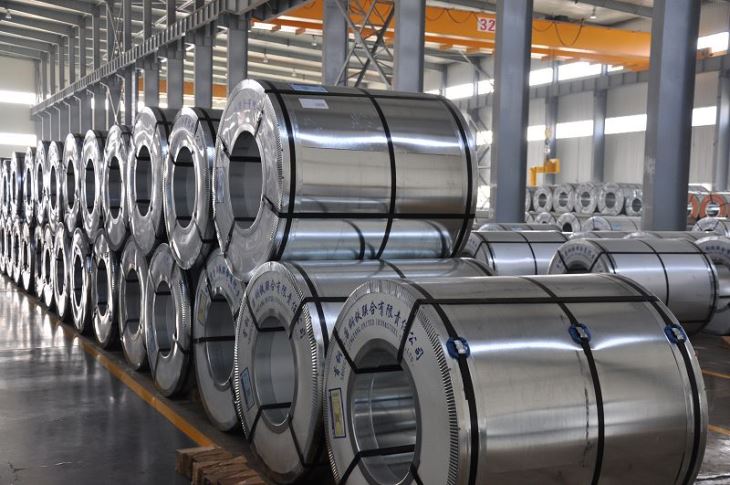
New safeguard caps could support EU coil prices
Tighter EU steel safeguard measures could help stabilise European domestic prices, especially for cold rolled and hot-dip galvanized coil, sources tell Kallanish.
A spokesman from a European coil mill points to the new “other country” quota caps for CRC and HDG. The quarterly CRC quota of over 330,000 tonnes will now be capped at 13% per origin, while for coated coil the cap is 20% or 25%, depending on whether passivated or oiled. “This will affect imports from major exporters like Vietnam and Thailand,” the spokesman notes.
One trader concurs, saying the new quota system “snipes” the most disruptive trade flows, for hot rolled coil from Japan, galv from Vietnam, and CRC from Turkey.
The mill source says he is sure this will positively influence the price premiums of domestic CRC and HDG. He sees the current premium for HDG at a maximum of €100 ($108) over HRC, and that of CRC at a maximum of €90. Assuming a current HRC price of €640/t ex-works, CRC, in his view, currently reaches a maximum of €730/t, and HDG to €740/t.
One Dutch buyer sees even higher offers, but other sources see most transaction prices at €20/t below those maximum levels.
A German source tells of a recent offer from India for over 550 tonnes of HRC at €545/t cif Bremen, with no extra duties involved.
Christian Koehl Germany

UK Steel calls for TRQ review, changes
Industry association UK Steel has submitted an application for a safeguard tariff rate quota (TRQ) review, claiming a change in circumstances, Kallanish learns.
UK Steel says it is submitting the application on behalf of its members, and there are several factors to justify a TRQ review, which can be requested if there is a change in circumstances.
The first being the reintroduction of US tariffs, including on the UK, which will have direct and indirect impacts on the domestic market, with a significant proportion of trade likely to be diverted to other export markets. This will still be the case even if the UK was able to secure an exemption for its own direct exports to the US. The likelihood of trade diversion is further amplified by the EU amendments to its own safeguards.
Amid the tariffs, there is weak demand in the UK and globally, with domestic demand remaining below pre-pandemic levels. Meanwhile, UK safeguard quotas have been liberalised year after year, first by 5% after their introduction and then by 3% yearly since, UK Steel points out.
“We now have quotas that are 22% larger than what the 2015-2017 import levels would have resulted in and these are due to be liberalised by a further 3% in July 2025,” it notes, adding the current safeguards do not offer adequate protection.
It also adds that certain UK safeguard product categories that have larger residual quotas are additionally exposed to diverted trade. These are categories 4, 7 and 13. These are also categories where the residual quota is dominated by a single importing country crowding out other suppliers.
The association proposes the TRQs should be reduced or at a minimum not be further liberalised in July, with UK Steel saying this is happening by default relative to demand. If liberalisation is necessary, this should be done by a nominal amount, for example 0.1%, like the EU has done, so that safeguards are not undermined. It adds the reversal of the redistribution of Russian and Belarussian quota volumes should also be considered.
Carry-over quotas from each quarter should no longer be available in the next quarter, while individual country caps of 15% should be introduced under residual quotas for categories 4, 7 and 13, it says. This is necessary to prevent the crowding out of other origins.
The application highlights there are no WTO definitions of “developed” and “developing” countries, and therefore these exceptions should be revoked for countries that are not “developing” in a steel context. UK Steel submits that China, India, Turkey, Brazil and Vietnam should not be considered developing countries for the purposes of steel safeguards.
Carrie Bone UK

EU expands safeguard quota caps to 16 products
The European Commission has expanded the product range covered by residual tariff-rate quota (TRQ) caps to 16 categories, up from just two previously – hot rolled coil and wire rod, Kallanish notes.
The Commission has reduced the cap on HRC from 15% to 13%, while the wire rod cap remains at 15%.
These limits, which restrict the maximum volume a single country can supply to the EU under the residual TRQ, aim to help existing suppliers maintain historical trade flows, while ensuring supply stability from countries at risk of being crowded out, according to the Commission.
The updated rules will take effect on 1 April.
EU “other country” residual safeguard quotas
| Product category | Other country TRQ 1.4-30.6 (tonnes) | Cap % | Cap (tonnes) | Specific “other country” from 1.7 to 30.6 |
| 1A – HRC | 856,770 | 13 | 111,380 | Egypt, Vietnam, Japan, Taiwan, Australia, Switzerland, United States, Libya, Canada |
| 2 – CRC | 334,370 | 13 | 43,468 | Türkiye, Vietnam, Taiwan, Japan |
| 16 – Wire Rod | 100,499 | 15 | 15,075 | Malaysia, Algeria, Egypt, Bosnia and Herzegovina, Korea, Japan, Indonesia, Serbia |
| 17 – Angles, shapes, sections | 67,480 | 15 | 10,122 | Türkiye, United Kingdom |
| 4B – Metallic coated | 104,779 | 20 | 20,956 | Türkiye, Vietnam, Japan (also China, Korea, India, United Kingdom if they exhaust their specific quota) |
| 6 – Tin mill products | 37,107 | 20 | 7,421 | India, Türkiye |
| 7 – Quarto plates | 550,190 | 20 | 110,038 | India, Indonesia, Korea |
| 13 – Rebars | 137,841 | 20 | 27,568 | Algeria, Egypt |
| 4A – Metallic coated | 472,050 | 25 | 118,012 | Türkiye, Vietnam, Taiwan |
| 5 – Organic coated | 42,861 | 25 | 10,715 | Vietnam |
| 14 – Stainless bars, light sections | 5,150 | 25 | 1,287 | China, Taiwan |
| 3B – Electrical sheets (other than GOES) | 8,628 | 30 | 2,588 | India, Japan |
| 20 – Gas pipes | 11,107 | 30 | 3,332 | UAE, Korea |
| 21 – Hollow sections | 18,533 | 30 | 5,560 | China, Serbia |
| 25B – Large welded tubes | 6,495 | 30 | 1,948 | Algeria |
| 26 – Other welded pipes | 20,051 | 30 | 6,015 | India,Serbia, Korea |
Elina Virchenko Turkey

Electrolux sets recycled steel use target
Swedish home appliance manufacturer Electrolux says it aims to raise the share of recycled steel and plastic by weight used in its product manufacturing to 35% by 2030. This adds steel to the target for the first time and almost doubles the weight of recycled materials versus the previous target.
Steel and plastic are Electrolux’s two most highly used materials by weight. Adding steel to the target increases the material in scope to more than 40% of all material purchased by the group – around three times what was in the scope of the previous target, the firm notes.
In 2024, carbon steel accounted for 37% of Electrolux’s raw materials purchases, with stainless steel comprising 12%. It consumed 633,000 tonnes of steel overall in 2024, up 8% on-year, according to its 2024 annual report monitored by Kallanish.
The firm has signed an initial agreement with a European steel supplier for a more sustainable steel option, with the first delivery scheduled by the end of 2026. This steel will be produced with electricity from fossil-free sources and green hydrogen instead of coal, it says without revealing the name of the supplier. Stegra previously named Electrolux as one of its early customers.

Italian rebar makers seek increases in slow market
Following a decline of nearly €30/tonne ($32.5/t) since February, Italian rebar transactions have now stabilised on a weekly basis. Demand has dropped notably amid weather disruption.
Two buyers in the Rome area indicate that adverse weather conditions are causing delays at several construction sites, which is in turn impacting their rebar purchases.
Last week, steelmakers announced price increases, but contracts have not yet reflected the hikes, Kallanish hears.
The current asking price among mills is set at €340/t base ex-works. Domestic rebar contracts are at €300-310/t ex-works. According to one agent, a number of buyers are still receiving material at around €300/t and are unwilling to pay the increases. Effective values are at €560-570/t ex-works on average, which includes an average of €260/t for size extras.
Domestic mesh contracts are also witnessing stability at €390-400/t depending on volumes. This does not account for transport costs or size extras, which are estimated at around €300/t, according to sources.
Germany’s crude steel production falls 13.5% Y-o-Y in February
German crude steel production fell 13.5% year over year to 2.7 million mt in February, according to data published March 24 by German steel federation WV Stahl.
Of the total, 1.84 million mt was produced from blast furnaces, down 14.4% year over year, while production from electric arc furnaces dropped 11.5% to 864,000 mt.
Meanwhile, Germany’s February pig iron production slipped 15.9% year over year to 1.71 million mt.
Output of hot-rolled steel products in February also fell 16.9% year over year to 2.37 million mt.
Platts, part of S&P Global Commodity Insights, assessed domestic HRC prices in Northern Europe at Eur635/mt ex-works Ruhr March 21, up 8% since the start of 2025.
Steel and Metals Action Plan
The association also reacted separately to the European Commission’s Steel and Metals Action Plan, with WV Stahl Director General Kerstin Maria Rippel saying in a statement the plan “sent a clear signal in favor of maintaining the competitiveness of the EU steel industry.”
She said the rapid response by the European Commission showed Brussels had recognized the seriousness of the situation.
“The proposals on external trade are a step in the right direction, and in view of the increasing import pressure and the consequences of the confrontational US trade policy, the tightening of the EU’s protective measures from April 1, 2025 is only logical,” Rippel said.
She called for further measures to be taken without delay, including strengthening the EU safeguard measures that expired in 2026, an effective successor instrument, and the long overdue adjustments to the Carbon Border Adjustment Mechanism.
Rippel said three measures were essential for the CBAM, including an effective export solution, the extension of the instrument to products in downstream value chains, and the prevention of circumvention.
“This is the only way to protect the energy-intensive steel industry from carbon leakage. These measures are essential to maintain a strong and competitive steel industry in Europe,” she said.
Rippel said the action plan also pointed in the right direction in other areas, such as energy prices and the development of lead markets for low-emission basic materials, but these need to be further specified.
“Energy costs, which are still too high, remain a major challenge for our businesses. Although the Action Plan provides some relief, it still lacks a concrete concept for a competitive industrial electricity price,” she said.
She called for the planned development of lead markets for climate-friendly steel to be specified, saying the Low Emission Steel Standard could and should play a key role in securing Europe’s leadership in setting standards for low-emission steel.
“We now have a road map for achieving competitive carbon neutrality in the European steel industry. It is now crucial that it is implemented quickly and consistently in Brussels, Berlin and the federal states. Otherwise, we will lose touch to other regions in the world that are ahead of us,” Rippel said.


High-grade iron ore, DRI/HBI should be on EU critical raw materials list: GravitHy CEO
High-grade iron ore, ultra-low CO2 direct-reduced iron and its processed form, hot-briquetted iron, should be part of the EU’s Critical Raw Materials Act, José Noldin, CEO of hydrogen-based DRI project developer GravitHy, said March 25.
“If a certain raw material is included in the CRMA then you have access to funding, which creates a stronger value chain,” Noldin said at the bi-annual members meeting of the International Iron Metallics Association in San Sebastian, Spain.
The European Commission “seems open to it,” he added.
Noldin told Platts on the sidelines of the event that GravitHy is actively pushing for this on European level but that there is no timeline yet on when and if the EC would make a decision.
The EC did not respond to a request for comment when asked by Platts on March 25.
Hurdles on path to decarbonization
According to Noldin, Europe would finally “walk the talk” in implementing steel decarbonization, but he said more funding and legislation are needed to achieve this successfully.
Historical barriers for the adoption of hydrogen-based DRI/HBI production remain and the industry should move away from integrated steelmaking, “decoupling the value chain of iron and steel,” Noldin said.
Instead of bringing hydrogen to steel production, bringing HBI production to where the energy is would be a more realistic approach amid the lack of sufficient infrastructure for hydrogen in Europe, he added.
GravitHy is building an HBI plant at Fos-sur-Mer, France. It will process pellets, supplied by Brazil’s Rio Tinto, into HBI used by electric arc furnaces to produce low-emission steel. The plant will be operational from 2028 and produce 2 million mt/y of HBI, Noldin said.
Platts assessed HBI imports at $350/mt CFR Mediterranean March 24, up $5/mt on the day. Platts is part of S&P Global Commodity Insights.
The EC released its list of 47 critical raw material projects across 13 EU member states classified as strategic projects under the EU on March 25, but none of them were ferrous metals-based projects.
The European CRMA entered into force in May 2024. It aims to ensure the secure and sustainable supply of critical raw materials for Europe’s industry and significantly lower the EU’s dependency on imports from third countries.

Mills’ growing end-user sales hurt distribution: EUROMETAL conference
Steel distribution in Spain and Portugal is undergoing a significant transformation, Kallanish heard from speakers at last week’s EUROMETAL Steel Net Forum Iberia in Vilamoura, Portugal.
While the 2025 outlook is positive, thanks to increasing orders, the industry continues to struggle with low profit margins and the growing challenge of steel producers acting as direct suppliers to customers.
“The distribution sector is evolving through automation, digitalisation, and optimised stock management, but margins remain unsatisfactory,” said José Velasco, president of the Cosimet Group. The high level of competition in the Iberian Peninsula, compared to France or Germany, is a major factor behind this trend.
According to Velasco, the industry is facing an increasingly aggressive challenge from steel producers engaging in direct sales. He highlighted the shift in supply chain dynamics, especially in rebar and pipes.
“Producers have their role and should not be involved in direct distribution to the end customers. In the supply of rebar and pipes, this intervention is quite noticeable. We are moving to the other side of the steel chain. In Spain, mills are now selling directly to small customers, often at similar prices to distributors. But we manage warehouses, and transform the material, creating value that is practically not reflected in the final pricing. We have minimal margins,” he observed.
This trend of disintermediation is a shift that Spain and Portugal may feel more intensely than other European countries. “Mills shouldn’t ignore us. I’ll give you an example of the automotive sector, where buyers must go through dealers rather than purchasing directly from manufacturers,” Velasco continued.
Distributors offer personalised service, stock availability and credit lines, executives argued, adding that the sector’s future must be based on generating value, with mills distinguishing between end customers and distributors.
“Steel producers want large, simple orders and our goal is to receive small, complex orders, which factories can’t handle, and pass them on to our customers,” explained Roberto Gonzalez, chief executive of Tirso CSA steel distribution company and president of the Spanish steel stockists association, Unión de Almacenistas de Hierros de España (UAEH).
“Many customers now buy directly from mills under the same conditions as distributors. This undercuts our sector, creating downward pressure on prices and harming the entire supply chain. I don’t think it’s right for manufacturers to undercut our customers. I think it’s backward; I dare say, a lack of vision,” he noted.

Carolina Vieira, an executive at Portuguese company J. Justino das Neves, likened the situation to a ship in danger of sinking unless all players row in the same direction.
“Right now, distributors are keeping the ship afloat, but if steel mills don’t support us, we’ll all go under. Producers must recognise our role in adding value, or we’ll all sink together,” she warned. “I take care of myself, and god takes care of others – this isn’t working. We can’t be a chain, a sector, like this.”
Similarly, Juan Carlos Núñez, ceo of Hierros y Aceros García y Compañía, emphasised the rising costs and need for better market organisation.
“The market is becoming increasingly demanding, with higher costs, a growing population, and in an environment of enormous uncertainty and volatility in geopolitical terms. So who wouldn’t want to sell at higher prices? To assume that cutting, drawing, and transport fees won’t be reflected in costs is utopian. We need to clarify where we add value and why it matters,” Núñez explained.

Steel Net Forum Iberia participants stressed that a well-organised market benefits all stakeholders and that the distribution sector is there to offer more solutions to customers. Many suggested replicating the North American competition model, where mills focus on production, not direct distribution, while sellers maintain their role as intermediaries, providing added value and services.
Alternatively, some industry voices urged for price differentiation policies, pushing mills to offer greater discounts to distributors who assume commercial risks and provide extensive value-added services.

ASSOFERMET raises concerns over new EU Steel and Aluminium Plan
In response to the European Commission’s Steel and Metals Action Plan published on 19 March, ASSOFERMET warns that the proposed measures risk undermining the circularity and sustainability of the European recycling industry.
While the plan aims to secure the availability of ferrous scrap within the EU by proposing potential export restrictions, ASSOFERMET argues that this approach ignores the current surplus of scrap and the lack of internal demand, despite already strict provisions under the Waste Shipment Regulation (April 2024).
According to ASSOFERMET, around 20% of recycled steel remains unused within the EU and is exported, not due to “scrap leakage” but because of insufficient domestic absorption capacity. Exporting this surplus is a key pillar of the EU’s circular economy, and restricting it could lead to severe consequences for the recycling sector, including job losses, market disruption, and environmental setbacks.
The association further criticizes the plan’s focus on production support without any measures to stimulate steel and aluminium demand. It calls for economic incentives, energy cost reductions, and binding targets for recycled content in industrial and public procurement as tools to boost competitiveness and sustainability.
ASSOFERMET urges the Commission to revise and complete the Plan in collaboration with all stakeholders to ensure it supports both recycling and industrial growth, in line with the EU’s environmental and circular economy goals.
PRESS RELEASE Assofermet 24.03.2025


Ezz Steel to challenge Europe’s anti-dumping duties on flat steel imports
Other countries affected by the anti-dumping duties would include Japan and Vietnam.
In June 2024, the European Commission initiated an anti-dumping investigation into hot-rolled flat steel imports from Egypt, Vietnam, Japan and India following a complaint by regional steel association Eurofer.
On Monday March 17, the Commission released a preliminary decision that imports of hot-rolled flat steel product imports from Egypt, Vietnam and Japan would become subject to provisional duties of 6.9-33%.
India was exempted from the measure after the investigation found that no dumping or unfair exports to Europe had taken place during the period under investigation, which was from April 1, 2023, to March 31, 2024.
The products that will be affected, according to the announcement, included certain flat-rolled products of iron, non-alloy steel, and other alloy steel with the provisional tariffs coming into effect starting April 7, Fastmarkets heard.
Proposed duties
The Commission’s finding meant that Egypt would become subject to a 15.6% tariff, while Vietnamese producer Formosa Ha Tinh would become subject to a 12.1% tariff and Japan-origin material would be subject to rates of 6.9-33% depending on the producer.
Ezz Steel is a major exporter of hot-rolled flat steel products into Europe and intended to launch an appeal regarding the provisional duties, with a delegation from Egypt’s Ministry of Investment expected to meet EU representatives to discuss the proposal, Fastmarkets has heard.
Steel producers in the various countries affected by the provisional duties will have a three-week window, until April 4, in which to submit objections.
Effect on Ezz Steel
Ezz Steel is by far the largest Egyptian exporter of HRC to Europe, and will be severely affected should the tariffs come into effect, making it unfeasible to continue to do business, Fastmarkets heard.
“It is one of [the company’s] main markets,” one market participant said. “It will be severely affected and will have lots of reasons to challenge this outcome. The market is very big for [the company], with exports to Europe making up 60-70% of its total exports.”
“Losing this market would be disastrous for [Ezz Steel] so announcing that it will challenge the outcome will help to put pressure on the European Commission and also help to reassure its customers in Europe,” the source added.
Outlook
If the proposed duties were to be imposed, flat-steel product trade flows from Vietnam, Japan and Egypt to Europe would be significantly limited, Fastmarkets heard.
The final decision on any permanent anti-dumping measures will be announced on October 7, Fastmarkets heard.
Ezz Steel did not respond to requests for comment at the time of publication.
Published by: India-Inés Levy
