


EPCG completes tk Steel stake acquisition
Germany’s thyssenkrupp says it has completed the sale of 20% of its thyssenkrupp Steel Europe division to Czech energy company EP Corporate Group (EPCG), Kallanish notes.
The transaction had previously been approved by both the supervisory board of thyssenkrupp AG and all relevant authorities. The closing “is an important step towards the independence of the steel business and a resilient, cost-efficient and climate-friendly steel production,” says thyssenkrupp chief executive Miguel López.
From the side of the buyer company, EPCG board member Jiří Nováček says that “as EPCG, we will contribute our transformation expertise to the benefit of thyssenkrupp Steel.”
The parties are already discussing the acquisition of a further 30% stake in thyssenkrupp’s steel business by EPCG. The aim is to form an equal 50/50 joint venture.
Christian Koehl Germany


German mechanical engineering orders fall 12%
Orders for German mechanical engineering and plant-building companies declined in the first half of 2024 by 12% on-year in real terms, according to industry association VDMA.
Domestic orders fell especially harshly, by 18%. Foreign orders fell by 9%, with euro countries falling more sharply (-14%), and non-euro countries by 7%. In June alone, the trend continued, with orders down 9% year-on-year. Domestic orders fell 8%, while orders from abroad dropped 10%, with euro countries down 12% and non-euro countries down 8%.
VDMA traditionally states its comparison in “real terms”. While nominal terms compare the straight sales figures, VDMA deducts the price inflation for a more comparable basis. “This year, the difference from prices was not that much at +2%, while last year it was +9%,” VDMA chief economist Ralph Wiechers informs Kallanish.
He explains that the calculations try to consider increases in intake materials and services, and to what extent they can be handed down. He also points out that the trend is currently opposite in China, which is seeing deflation and a decline in prices because of high inventories. He also mentions lower steel prices due to subsidisation in China.
“The order situation is disappointing overall,” Wiechers writes in VDMA’s statement on the figures. “A turnaround is not yet in sight, and what’s more, the economic stabilisation that was still emerging at the beginning of the year has recently suffered a setback,” he continues. In this context, he demands a supply-oriented policy for more investment and innovation, “to ensure that the first signs of a foreign-driven cyclical recovery are not thwarted”.
Christian Koehl Germany

Polish steel rebar prices inch downward on low demand, oversupply
Fastmarkets’ weekly price assessment for steel reinforcing bar (rebar), domestic, cpt Poland, was 2,680-2,730 zloty ($674-686) per tonne on Friday, widening downward by 20 zloty per tonne from 2,700-2,730 zloty per tonne the previous week.
Polish mills were heard to be hoping to achieve 2,750 zloty per tonne CPT, but lower offers at 2,700 zloty per tonne CPT were available in the market this week, sources told Fastmarkets.
Market participants estimated the tradeable market price at 2,680-2,730 zloty per tonne CPT.
According to some sources, even lower prices at 2,600-2,650 zloty per tonne could be achieved for large volumes exceeding 1,000 tonnes. But these were not included in this week’s assessment because they were not in line with Fastmarkets’ methodology.
“Demand [in Poland] is currently… moderate, but there is oversupply in the market, and that is why the prices are going down,” a distributor source told Fastmarkets.
According to a second distributor source, only the cut-and-bend sector in Poland was performing well at the moment, but demand in general remained low.
A producer source agreed that demand for rebar in the Polish market remained comparatively low, with the summer holiday period also having an effect.
“No significant changes are expected in August,” the producer source added.
In terms of any future developments in Polish rebar prices, the first distributor source said that, in summer, even significant price decreases would not revive the market.
“I am afraid that in September, when mills come back to the market, and demand is still not so good, there could be more price decreases,” the first distributor source said.
The same source added that more significant funding from the EU for infrastructure projects, which could eventually support the local demand for rebar, would come no earlier than next year.
In terms of imports, offers of rebar from Germany were heard at €625-635 ($675-686) per tonne CPT.
Ukrainian material was offered to Poland at €570-580 per tonne DAP border, sources told Fastmarkets.
Kametstal to offer new rebar grade to Polish market
Kametstal, a subsidiary of Ukrainian steel producer Metinvest, has received international compliance certificate No. 020-UWB-3057/W, which will allow it to supply B500B rebar in diameters of 8-32mm to the Polish market, the company has announced. The certificate will be valid until 2028.
This means that Kametstal will be able to expand its product portfolio in Poland.
According to Fastmarkets’ sources, the first volumes of this material have already been traded in the Polish market.


US Steel Kosice to idle one blast furnace in August
“In August, we have a planned shutdown of one of the blast furnaces due to maintenance work,” the spokesperson told Fastmarkets.
USSK has three blast furnaces with a combined capacity of around 4.5 million tonnes per year of pig iron. All three are operational, the spokesperson said.
The company produces hot-rolled, cold-rolled and hot-dipped galvanized coil.
BF No2 at Kosice steelworks was idled for a planned maintenance in March and resumed operations in June, Fastmarkets reported.
The spokesperson did not specify which BF will be shut down this time and for how long.
“The subsequent production configuration depends on the development of market conditions. In any case, we will meet the requirements of our customers to the maximum extent,” the spokesperson said.
European flat steel market down in 2024
Economic environment in the European flat steel market, where USSK is active, has been deteriorating in the past months, with steel prices under pressure.
In February, Fastmarkets’ steel hot-rolled coil index domestic, exw Northern Europe averaged €738.28 ($797.42) per tonne ex-works.
In March, the monthly average slipped to €691.99 per tonne ex-works, and prices continued to decline in April to an average €638.32 per tonne ex-works.
Since May, HRC prices in Europe have been largely stable, despite steelmakers’ attempts to push for higher offers.
The monthly average in July was €629.12 per tonne ex-works, and the latest calculation of Fastmarkets’ daily Northern European HRC index was €620.74 per tonne on Thursday.
Industry sources have been describing the European flat steel market as “heavily oversupplied,” and suggested that more steel output cuts might follow in the fourth quarter of 2024.
“If real steel demand doesn’t pick up [in September], we might see tumbling prices in end-2024,” a steel distributor in Norther Europe said.
“European mills have already been faced with a similar situation last year and reacted with massive steel output cuts in end-2023, maybe we will see similar scenario this year,” he added.
Thyssenkrupp Steel Europe completes deal for EP Corporate Group to become minority shareholder
Prague-headquartered energy company EP Corporate Group (EPCG) completed its acquisition of a 20% stake in the steel business of German industrial conglomerate Thyssenkrupp, which the two companies agreed in April.
Thyssenkrupp CEO Miguel Lopez said in a July 31 statement the deal with EPCG is “an important step towards the independence of the steel business and a resilient, cost-efficient and climate-friendly steel production.”
The parties did not disclose financial details of the transaction, but are already discussing the acquisition of a further 30% stake in Thyssenkrupp Steel Europe by EPCG with a view of forming a 50/50 joint venture.
Controlled by Czech billionaire Daniel Kretinsky, EPCG is a private industrial group focused on energy, infrastructure, logistics, media and e-commerce among other sectors with its European assets including gas pipelines and gas storage facilities, power plants and electricity networks. It has been seeking investment opportunities in industries that are exposed to higher energy costs and to potentially contribute to their decarbonization.
Thyssenkrupp is building its first direct iron reduction plant in Duisburg, where it plans to start using hydrogen in 2028-29, with Eur2 billion ($2.16 billion) funding from the German government covering two-thirds of the project’s cos. Thyssenkrupp Steel Europe would not be obliged to offtake energy from EPCG, which would instead act as a backup or fallback option.

The EU HRC market remains stable even as mills operate at break-even margins
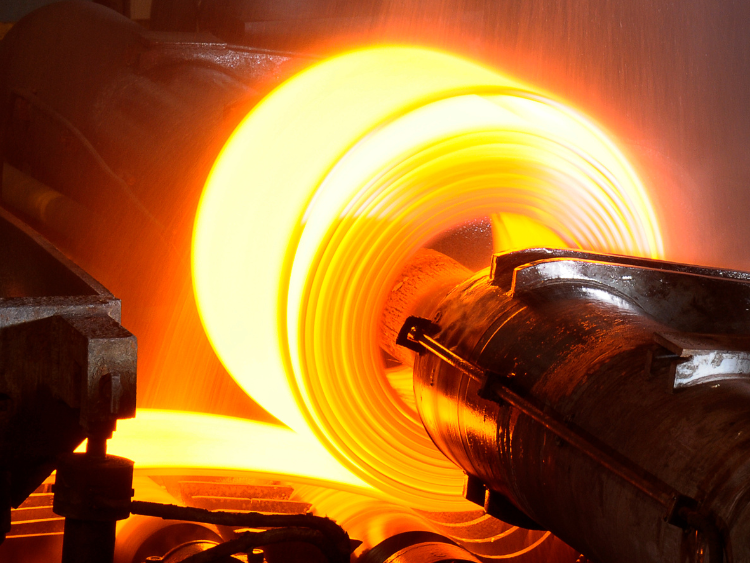
Domestic European hot-rolled coil prices remained largely unchanged Aug. 1 as weak market fundamentals persisted, with market sources remaining uncertain about the future price outlook.
Some sources noted that prices cannot go down any further, as mills are operating at break-even or tight margins, depending on the type of furnace used.
“I don’t think prices can go below [Eur600[/mt,” a service center source said.
According to market sources, the strain and volatility experienced in the HRC sector is not a surprise, particularly as sluggish demand in the European automotive industry and competitive Chinese automotive exports weigh on the market.
Sources said European mills may see some more stability and certainty in specialized coils, such as hot-dipped galvanized, where product quality remains higher than alternatives available in Asia.
Furthermore, the future of the automotive industry will depend on the level of support and legislation implemented from the European Commission, which could take the form of tax cuts or subsidies, sources said.
“You need incentives,” a service center source said.
Platts assessed Northwest European HRC at Eur620/mt ex-works Ruhr Aug. 1, stable with July 31.
Tradable values were reported at Eur620-640/mt EXW Ruhr.
Meanwhile, Platts assessed domestic HRC prices in Southern Europe at Eur620/mt EXW Italy Aug. 1, stable with July 31.
Germany’s Klöckner increases metal product shipments 8% on year in H1 2024
Steel and metal product shipments by Germany’s Klöckner & Co. increased 8.1% year on year to 2.3 million mt in the first half of 2024, the company said Aug. 1.
Acquisitions in H2 2023, particularly of New Jersey-based Amerinox Processing, helped boost its shipments in the US and Mexico, the steel and metals processor and distributor said in second-quarter earnings.
Second-quarter metals shipments rose to 1.2 million mt, up 11.5% from the first quarter and up 3.7% year on year.
However, sales slipped 2.6% year on year to Eur3.5 billion ($3.78 billion) in the first half of 2024 due to lower prices. This contributed to EBITDA falling 37% to Eur83 million. The company expects its full year EBITDA to be Eur120 million, down from Eur180 million in 2023, saying earnings in the prior-year comparative periods benefited from a more favorable market environment.
Demand has been weaker than expected in 2024, especially in Europe, the company said. Klöckner expects the Amerinox acquisition to drive a slight increase in shipments for full-year 2024 but sees sales falling year on year due to lower steel prices.
“Despite a challenging environment, we achieved a solid result and made further progress in implementing our strategy,” CEO Guido Kerkhoff said in a statement. “With the acquisition of Amerinox Processing in North America, we further expanded our range of higher value-added products and services.”
Amerinox processes stainless steel, aluminum and special carbon steel. Klöckner said it aims to use Amerinox’s favorable location at the major port of Camden to build competitive, global supply chains. In March 2024, the company disposed of parts of its European distribution business.

German marketplace Vanilla Steel receives funding from EU
Vanilla Steel has been awarded with a seven-figure subsidy from the Pro FIT programme of the Investitionsbank Berlin for an AI project, Kallanish learns from the online trading company.
The subsidy is supported by co-financing from the European Union, and aimed at the development of the company’s “Smart Forecaster” project.
According to Vanilla Steel, the Smart Forecaster project leverages artificial intelligence to predict future prices and demand for both prime and excess steel. The tool is set to revolutionise decision-making processes within the steel industry by offering precise demand forecasts and pricing trends for a wide array of steel types, Vanilla Steel claims.
Vanilla Steel, which was founded in 2021 but still refers to itself as a start-up, aggregates spot steel supply from over 500 suppliers and spot steel demand from more than 3,000 buyers across Europe. The Berlin-based company says its platform facilitates efficient and transparent trading, and believes that the Smart Forecaster project will be a significant leap towards streamlining and modernising the steel trading process.
Christian Koehl Germany
Klöckner continues America acquisitions, eyes defence in Europe
Following acquisitions in North America, Klöckner & Co increased shipments in the second quarter by 11.5% on-year to 1.2 million tonnes. In the first half year of 2024, shipments by the German-based distribution group increased 8.1% on-year to 2.3mt.
The increase is primarily attributable to the acquisitions in Mexico and the US completed in H2 2023, Klöckner chief executive Guido Kerkhoff said during a conference call monitored by Kallanish.
At €3.5 billion ($3.7 billion), sales dropped 2.6% in H1 due to lower prices. Operating income (Ebitda) before material special effects was €83 million, versus €130m a year earlier.
Klöckner underlines that business with service centres (SSCs), especially in high-value added products, is less dependent on the steel price development because of contractual relationships with the customers. SSCs accounted for nearly half of the company’s operating profit in H1.
Kerkhoff emphasised the efforts related to expanding the range of value-added offers, with processing steps taking place in different locations, and the logistical challenges this involves. He noted that many of the firm’s customers in the USA have been partners for more than ten years, and keep asking for more of these services.
In North America, the group will continue to target “opportunistic, highly selective, performance-and-growth-oriented mergers and acquisitions”. In its European markets – mainly Germany, Austria and Switzerland – it aims to actively position itself to benefit from growing demand in the defence sector.
Klöckner expects a slight decline in demand for most of its customer segments. Segments seen remaining stable on both continents are household appliances and energy, mostly renewables.
Christian Koehl Germany

Italian rebar prices weaken
Italian rebar prices have decreased in contracts by €10-15/tonne ($10.7-16.1), due to low consumption downstream, Kallanish notes. Values have fallen below the threshold of €600/t ex-works.
Activity is now quiet as the August break has started. Sources indicate some restocking happened in July.
Transaction values in the domestic market fall within the range of €300-320/t base ex-works, or €560-580/t ex-works effective. This includes an average of €260/t for additional size extras.
Domestic mesh is also hovering at around €400-430/t base ex-works. When considering their purchases, buyers should take into account costs for transport and an extra €300/t for size extras.
Meanwhile, mills’ price increase attempts for other long products do not seem to have been successful, while scrap prices in Italy recorded an average decrease of €25/t in July (see Kallanish passim).
Natalia Capra France