

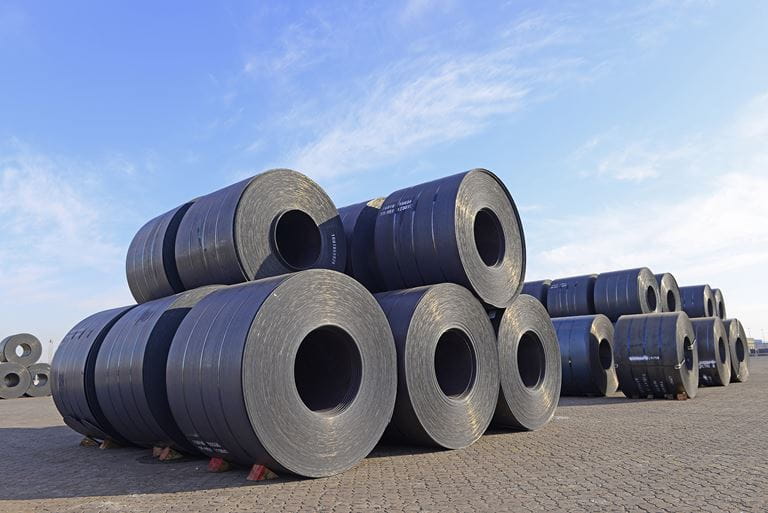
European HRC prices largely stable amid bearish sentiment
Persistently weak demand, combined with an oversupplied market, was putting downward pressure on HRC prices, Fastmarkets understands.
According to Fastmarkets’ sources, trading should remain quiet in the summer period, and any improvement can be expected in the third quarter, when the effects of the new EU import safeguard measures for steel are anticipated to be felt.
Fastmarkets calculated its daily steel hot-rolled coil index domestic, exw Northern Europe at €629.38 ($674.72) per tonne on Wednesday, down by €0.62 per tonne from €630.00 per tonne on Tuesday.
The index was down by €1.50 per tonne week on week and by €7.99 per tonne month on month.
Mills in Northern Europe were heard offering HRC at €640-650 per tonne ex-works but, according to Fastmarkets’ sources, producers were likely to agree to sell around €630 per tonne ex-works.
Market participants estimated tradeable prices at €620-630 per tonne ex-works.
“Demand is bad. Nobody is restocking,” a producer told Fastmarkets, adding that summer holidays are approaching and a rebound in HRC prices can be expected in the third quarter.
The source said that in this period, some positive effects of the new EU safeguard measures could be felt in the market.
A buyer told Fastmarkets that demand from end consumers of flat steel products was favorable, but the market remained quiet because producers were in a difficult situation — they were hungry for orders while negotiations for the long-term contracts with the automotive industry were still running.
The buyer source said that most distributors were also in wait-and-see mode.
Regarding imports, HRC from Asia was not so attractive due to similar prices to those in the domestic market and amid uncertainties related to the safeguard measures.
“Prices in Asia are not interesting. Thus, the possibility that imports could increase supply in the European market is limited,” the buyer source said.
“The big competition is between the steel service centers which have too high stocks,” the source said, adding that some production cuts might be necessary to balance the market.
Import offers of Asian HRC to Northern Europe were heard at €600 per tonne CFR.
Fastmarkets calculated its corresponding daily steel hot-rolled coil index domestic, exw Italy at €625.00 per tonne on Wednesday, stable day on day.
The Italian index was down by €3.13 per tonne week on week and by €5.00 per tonne month on month.
Suppliers in Italy were heard offering HRC at €640-650 per tonne delivered, which nets back to €630-640 per tonne ex-works.
But market participants put the workable price for domestic material at €620-630 per tonne ex-works.
Import offers of Asian HRC were limited in the Italian market, with buyers estimating the tradeable price at €600-610 per tonne CFR.
Published by: Darina Kahramanova


Blastr raises funds for greenfield project
Blastr Green Steel has successfully executed a financing round with strategic partners, Kallanish hears from the Scandinavian start-up venture.
The equity financing round involved Cargill Metals, Germany-based steel trader Interfer Group, Finland’s state-owned venture capital investment company Tesi, and Blastr founder Vanir Green Industries.
The proceeds will be used to progress development planning for the steel plant in Inkoo, Finland, and a facility in northern Europe designed to produce 6 million tonnes/year of high-quality low-carbon DR pellet feedstock. The funding will also support organisational ramp-up aligned with commercial and supply chain activities, Blastr says.
“This successful early financing round represents a significant step towards realising Blastr’s multi-billion euro investment programme for production of pellets, sponge iron and steel at global scale,” says Blastr chief executive Mark Bula.
As part of the next development phase, Blastr is establishing framework agreements covering the entire steel value chain. This concerns the supply of steelmaking technology, and working with Cargill Metals to finalise the supply of raw materials and feedstock for pellet production. The agreements will form the basis for construction financing discussions with strategic and financial partners, with the ambition of making a final investment decision by early 2026, Blastr says.
Christian Koehl Germany


EU quota cap eyes supply diversity
The EU has confirmed it will impose from 1 July a 15% cap for the residual hot rolled coil and wire rod tariff-rate quotas (TRQ) to ensure diversity of supply.
This was announced by the European Commission together with the extension of safeguard measures to 2026.
In the case of hot-rolled flat steel, representing 31% of total safeguard imports in 2023, the product is crucial for EU downstream production including cold-rolled flats and metallic coated steel, the European Commission (EC) says.
However, the rapid exhaustion of its residual TRQ starting from October 2023 led to heightened import pressure, particularly from new entrants like Vietnam and Egypt. This influx, accounting for over 45% of imports in this category by end-2023, squeezed out historically present suppliers.
Therefore, the EC implemented an adjustment by capping individual country exports under the residual TRQ at 15% of the quarterly volume. This aims to stabilise the market, mitigate import pressures, and ensure fair access for both EU users and exporting countries, without compromising product availability or industry performance, the Commission says.
Wire rod imports into the EU also faced significant disruption in its residual TRQ due to a sudden shift in import patterns. Until mid-2023, various countries like Algeria, Bosnia, Korea, and Japan were utilising the TRQ fairly evenly, maintaining stable trade flows.
However, starting from Q3 2023, Malaysia and Egypt emerged as major exporters to the EU under this TRQ, despite having negligible prior presence. Their combined share of imports surged to 76%, drastically reducing opportunities for smaller, traditional supplying countries like Bosnia and Japan, which saw their TRQ utilisation drop to minimal levels.
The EC has therefore sought to prevent the excessive dominance of new entrants and safeguard access for smaller exporting countries that were previously reliable suppliers. The cap allows affected countries like Malaysia and Egypt to continue exporting volumes higher than historical levels, while ensuring sufficient diversity of supply sources for EU users, the Commission explains.
Elina Virchenko UAE

UK extends safeguard, Ukraine suspension to 2026
The UK has decided to extend the steel safeguard measure across all 15 categories and maintain the suspension for Ukraine for an additional two years, until 30 June 2026. This decision follows the Trade Remedies Authority’s extension review.
The UK’s decision follows the EU’s formal publication of a steel safeguard extension decision on 25 June.
According to World Trade Organization rules, the trade remedy tool can only be applied until June 2026, Kallanish notes. The UK implemented steel safeguards for 19 product categories in 2021, inheriting them from its time in the EU, and maintained measures for 15 of them thereafter.
UK Steel has emphasised the significance of the safeguard extension for the UK’s steel sector. While the extension provides temporary relief, ongoing trade challenges are anticipated beyond 2026, says UK Steel director general Gareth Stace.
“While today’s extension of the steel safeguards has bought us some time, we are acutely aware that the trade challenges we face will persist beyond 2026. Global excess capacity is fast approaching unsustainable levels, fuelled by state subsidies and mostly from high-emission blast furnaces. Addressing excess capacity is not just a trade objective but should be part and parcel of any carbon leakage strategy too,” Stace adds.
Elina Virchenko UAE

Green steel definition narrows, pellet alternatives sought
The market’s perception of what constitutes “green” steel is moving away from carbon offsetting and mass balancing to actual low-carbon-intensity production, although a uniform global green steel standard is unlikely. There is meanwhile likely to be a wave of investment into fines-based iron reduction processes. So concluded a panel at Wednesday’s Fastmarkets International Iron Ore & Green Steel Summit 2024.
GMK Center chief executive Stanislav Zinchenko suggested European green steel supply of over 25 million tonnes/year in 2030 may exceed demand of 20m t/y, since this demand is seemingly coming only from the automotive and clean energy sectors. Therefore, there will be no supply shortage and no big green steel premium.
There is a host of carbon-offset steel brands in the market, but “green steel, for me, is not about certificates, it’s about production with less carbon intensity,” Zinchenko told delegates at the event in Vienna attended by Kallanish. Truly green steel will have a carbon intensity of below 250kg of CO2/tonne of steel and be produced using at least 80% green hydrogen, while low-emission steel can be hydrogen based and 260-400kg/t or natural gas based and 410-600kg/t intensity, he added.
However, “we will not have globally one green steel standard or one global monitoring system. It will never happen,” Zinchenko affirmed.
In terms of technology, the blast furnace “will redefine itself” using carbon capture and low-emission iron ore pellet, said Metso direct reduced iron director Parizat Pandey. Most of the investment is happening in thermochemical reduction processes, like the shaft-based direct reduction plant, while electric smelting is another area that will feature. The pathway chosen will depend on mill location.
With so many metallics production investments being committed to, there will be a high-grade iron ore pellet shortfall. “History shows beneficiation is not easy to do,” Pandey continued, so fines-based DRI processes are likely to see significant investment.
Asked about the potential for biochar as an alternative reductant to hydrogen amid restrictive hydrogen costs, Pandey asked: “Where is the capacity for this [biochar production]?” He added: “If we are serious about decarbonisation … there is no other way of reducing iron ore without using hydrogen to knock off the oxygen.”
CCUS deployment meanwhile will be challenged by the vast costs involved and land required, he said.
Europe should consider building out nuclear power capacity to mitigate hydrogen costs and renewable energy interruptions, Zinchenko asserted. Other regions are investing in this area. “If Europe refuses this, it also refuses energy security,” he noted. However, Pandey countered by saying nuclear permitting procedures are protracted and decommissioning at the end of the plant’s life cycle poses environmental challenges.
Adam Smith Poland

EC officially confirms new safeguard measures from July 1
The Commission first suggested extending the safeguards and adjustments to HRC and wire rod quotas in May 2024.
The new safeguards and adjustments will come into force on July 1 and will remain in place until June 30, 2026, according to the amended regulation, published in the Official Journal of the European Union on June 25.
The new safeguard adjustments envisage that the annual liberalization rate will change to 4% from 1%. In addition, a 15% cap per country over the TRQ volume initially available in each quarter will be introduced for HRC and wire rod.
For instance, HRC imports in 2023 from Taiwan to the EU amounted to 1.25 million tonnes; from Vietnam 1.16 million tonnes; and 1.09 million tonnes came from Japan, according to GTT stats.
The total allowance for “other countries” safeguards category that covers these countries was 3.7 million tonnes in 2023, according to the EU customs data.
When the suggested 15% cap is applied, each country would not be able to supply more than 555,555 tonnes of HRC per year to the European trading bloc.
Sources told Fastmarkets that Asian HRC suppliers had not been particularly active recently and that they were probably awaiting the start of July to have more clarity on quota allocations.
Fastmarkets’ weekly price assessment for steel hot-rolled coil import, cfr main port Southern Europe, remained steady at €600-610 ($641-652) per tonne on Wednesday, unchanged since June 19.
The changes are expected to limit imports of HRC to the EU and immediately after the announcement of the 15% cap on residual HRC quotas, European steelmakers even made attempts to increase domestic prices, Fastmarkets understands.
Those attempts were largely unsuccessful, however, due to the lack of demand from key steel-using sectors, leaving domestic prices for HRC in Europe broadly flat for more than a month.
Fastmarkets calculated its daily steel hot-rolled coil index domestic, exw Northern Europe at €629.38 per tonne on June 26, down by €0.62 per tonne from €630.00 per tonne on the day before.
The index was down by €1.50 per tonne week on week and by €7.99 per tonne month on month.
Eurofer welcomes extension of safeguards
The European Steel Association, Eurofer, welcomed the adoption of the new safeguard adjustments, but it warned that the period for which the measures would be applied would be insufficient to solve the problem of an oversupplied global market.
“We welcome the extension of the EU steel safeguards [because] the import penetration situation today is even worse than [it was] six years ago when the process was initiated. This problematic evolution has been fueled by worsening global excess capacity, which now stands at four times the size of EU steel demand,” Eurofer director general Axel Eggert said.
According to Eurofer data, the global steel market saw excess capacity increasing by nearly 50 million tonnes, from 514 million tonnes in 2019 up to close to 560 million tonnes in 2023.
“According to the Organization for Economic Development (OECD), approximately 158 million tonnes of new capacity is potentially coming on stream until 2026, while steel demand is currently growing by only around 36 million tonnes per year,” Eurofer said.
Eggert said that Europe had become a favorite export market for carbon-intensive excess capacity, despite the trade bloc striving to be a world leader in the decarbonization drive.
“This is a structural problem that poses an existential threat to all EU clean-tech value chains at a crucial time for our transition,” he said. “The safeguards will cease in just two years from now. We need to find a new, long-term solution to address this situation,”
Eurofer said the surge in EU imports has been driven by exporting countries where steel capacities have expanded most significantly, notably in Southeast Asia, parts of the Middle East and in North Africa – regions, where increasing capacity far exceeds local demand for steel.
“These expansions are fueled in part by investments from China and partly through local investments, often with explicit export objectives,” Eurofer said, adding that European institutions should act to tackle excess global capacity as a matter of urgency.

Spain’s automobile production, exports remain strong in May
Spain’s car industry saw its performance improve sequentially in May, Kallanish notes.
According to national automotive association Asociación Nacional de Fabricantes de Automóviles y Camiones (Anfac), output in May was 249,515 units, compared to 208,906 vehicles in April. However, this was 0.2% less versus the same month in 2023. Of the total, 78.1% were gasoline and diesel-powered automobiles. Five-month production amounted to 1.11 million units, a growth of 2.9% compared to January-May last year.
“It is positive that we are maintaining an increasing production rate, although growth is contained. The important thing is to close the year at above 2.5 million vehicles produced in Spain,” says Anfac general director José López-Tafall.
He however notes there has been a decline in EV business due to model changes and production readjustments. “It is a priority for manufacturers to sell more plug-in models, both in Spain and abroad. Without demand from this sector, it is difficult to have a large production volume. We are observing in other EU countries how the reduction of purchase subsidies, such as in Germany, generates a drop in sales of these vehicles.”
Spanish vehicle exports rose, supported by increasing demand in markets outside Europe and stable supplies to the EU. Shipments in May were at 221,354 units, compared to 181,996 units in the previous month and 0.3% higher than in May 2023.
European markets had a 93.5% share in Spanish deliveries in May, up 1.1 percentage points on-month and up 3.9pp on-year. Five-month exports improved 1.1% over the same period in 2023 to 983,338 vehicles, Anfac data show.
Todor Kirkov Bulgaria
Decarbonisation needs wholesale change, project realisation questionable: panel
CBAM and ETS are important to support low-emission steelmaking in Europe, but access to low-cost green energy and commitment from customers will be key. Technology makers are meanwhile ready for the expected boom in orders, but there are doubts over whether all the announced low-emission steelmaking projects will actually take place. So concluded a panel at Tuesday’s Fastmarkets International Iron Ore & Green Steel Summit 2024 in Vienna.
Echoing words from Midrex board member Stephen Montague earlier in the conference, “location, location, location” is key to DRI investments, pointed out H2 Green Steel commercial director global growth and business unit hydrogen Michael Lövgren. Besides having green hydrogen and therefore green energy, offtakers need to be on board with paying premiums for higher-cost produced steel.
“The whole value chain has to entirely change,” GravitHY chief growth officer Alice Vieillefosse stressed at the event attended by Kallanish. Commitment and investments are required from both policymakers and the private sector, with electricity grids in need of revamping.
It is one thing to have raw materials access, but the French government is keen to have local competency in the production of the intermediate product – in this case, direct reduced iron/hot-briquetted iron. That is why it is supporting GravitHY, she added.
Bernhard Hiebl, head of technology beneficiation, agglomeration and direct reduction at Primetals, said his firm has the capacity to cater for the plethora of expected low-emission steelmaking projects. “The question is, how many of these projects will actually happen in the coming years? … In principle, we are ready. We are seeing that many announced projects do not start overnight.”
The solution to having to contend with lower-grade iron ore supply, meanwhile, will be to use an electric smelter. “This will be the first step to substituting blast furnace operation,” Hiebl observed. All eyes will be on the first smelter at thyssenkrupp’s Duisburg plant when it comes into operation in 2-3 years, he added.
“From the market itself, there is not much interest right now [in smelters]; everyone is talking about pellets, but at the same time we know the pellets are not there,” he added. Another option being explored by Primetals is to feed sinter into DRI plants.
HBI production will be competitive in certain locations in Europe, provided it has government support and a sufficient electrical grid, Hiebl noted.
The HBI business case works in Boden, said Lövgren, and H2GS is also looking at Portugal as a viable location for HBI production. “To create sustainable value chains, one key ingredient will be to decouple the iron from the steelmaking in the value chain,” he added.
Adam Smith Poland
EU extends safeguards until 2026, Eurofer welcomes move
The EU has extended steel safeguard measures for another two years, aiming to stabilise the market amid high import penetration levels, it says in a 25 June note in its official journal.
It has also implemented, effective 1 July, the 15% cap per origin in the “other country” hot rolled coil tariff-rate quota, which it proposed last month (see Kallanish passim).
The European Commission (EC) found the EU’s steel industry is facing significant pressure from high and increasing imports from major steel-exporting countries. This pressure has been worsened by the influx of steel from new origins, exacerbating existing import pressures. The EC also confirmed persistent overcapacity and expects further capacity increases amid slow EU demand growth, Kallanish notes.
As the EU market remains attractive due to its size and prices, and given global overcapacity, numerous trade barriers, and market outlooks, the EC concluded that if safeguards lapse, imports would likely increase. This would further pressure the fragile EU steel industry and cause serious injury. Therefore, safeguard measures are necessary to remain in place to prevent or remedy such injury, it notes.
Imports from non-traditional suppliers, like Algeria, Egypt, Indonesia, Malaysia, and Vietnam, surged during 2022-2023 despite the safeguard measure. This caused significant market disturbances and sometimes undermined the effectiveness of the safeguard, the EC says.
Eurofer has welcomed the decision but emphasised the need for a long-term solution to address global excess capacity, which is four times the size of EU steel demand.
“Europe has become a favourite export market for carbon-intensive excess capacity, while we strive for decarbonisation leadership. This is a structural problem that poses an existential threat to all EU clean tech value chains at a crucial time for our transition. Safeguards will cease in just two years from now. We need to find a new, long-term solution to address this situation,” says Eurofer director general Axel Eggert.
The Commission highlights that since 2021, steel import penetration in the EU has exceeded pre-safeguard levels, adversely impacting the industry. Despite the safeguard, global excess capacity increased by nearly 50 million tonnes from 2019 to 2023, with an additional 158mt expected by 2026. This surge is driven by regions like Southeast Asia, the Middle East, and North Africa, where capacity expansions far outstrip local demand, partly due to Chinese investments.
“As a new EU cycle is about to begin, we call on all European institutions to tackle excess capacity as a matter of urgency in the upcoming months. We stand ready to support them in this endeavour,” Eggert notes.
Elina Virchenko UAE
Wibe Group partners with Sweden’s SSAB to use fossil-free steel in cable management systems
Under the agreement announced June 25, Wibe Group has committed to using the fossil-free steel in its cable management systems, such as cable ladders and cable trays.
Starting from 2026, Wibe Group will begin receiving small batches of steel produced without carbon emissions and aims to scale up annually as SSAB’s fossil-free production capacity grows.
Wibe Group would be able to reduce its carbon footprint by 90% by using the fossil-free material, it said.
SSAB collaborates with iron ore producer LKAB and energy company Vattenfall as part of the HYBRIT initiative to develop a value chain for fossil-free iron and steel production, which virtually eliminates CO2 emissions in steelmaking by replacing coking coal with fossil-free power and hydrogen.
SSAB began delivering shipments of fossil-free steel in 2021 and launched its second emissions-free product SSAB Zero using recycled scrap in 2023.
The steelmaker aims to scale up production of its carbon emission-free offering in 2026.
When commenting on the agreement, Wibe Group CEO Patrick Arcidiacono said it was “an important and major step” in the company’s sustainability journey.
“This initiative from SSAB does not only align with our vision but also with our owner Storskogen’s goal to reach net zero by 2045,” Arcidiacono said.
SSAB VP of Sustainable Business Thomas Hornfeldt said the steelmaker was “happy to welcome Wibe Group as a fossil-free partner.” He added that SSAB wanted to “cut emissions and create a fossil-free value chain with customers and partners.”
Platts, part of S&P Global Commodity Insights, assessed the daily European HRC carbon-accounted steel premium at $134.10/mt June 24, up from $109.58/mt at the start of 2024.
