

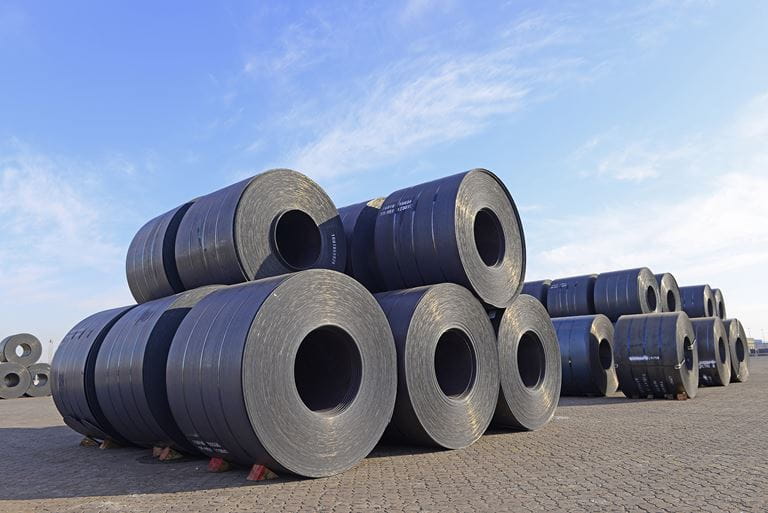
European HRC trading subdued as buyers retreat for summer break
European hot-rolled coil trading activity remained subdued on August 4, with seasonal holidays keeping many market participants away from their desks and limiting spot purchasing.
Mills in Northern Europe were targeting €715-750 per tonne ex-works, depending on specification, but buyers are not currently interested, sources said, describing demand as weak amid a lack of activity.
“The market is exceptionally quiet at the moment. Most market participants are on holiday and while mills are targeting around €730 per tonne ex-works, there is no urgency among buyers to book material. I cannot remember such a slow summer period,” one buyer in Germany said.
A second buyer source said that there was virtually no buying or selling taking place, that demand remains poor and that most market participants are focused on clearing existing imports and dealing with EU Carbon Border Adjustment Mechanism (CBAM) and safeguard-related requirements, rather than purchasing new cargoes.
“The market is effectively waiting for September,” the second buyer source added.
Market participants still in the market provided indications of tradable level at around €710-740 per tonne ex-works, depending on specification, with most hovering around €710-720 per tonne ex-works.
Fastmarkets’ daily steel hot-rolled coil index domestic, exw Northern Europe was calculated at €716.25 ($825.14) per tonne on August 4, down by €1.25 per tonne from €717.50 per tonne on August 3.
In Italy, meanwhile, the most recent HRC offers came in at €710-715 per tonne ex-works with the tradable level estimated at €700-710 per tonne ex-works.
Fastmarkets’ daily steel hot-rolled coil index domestic, exw Italy was unchanged at €710.63 per tonne on August 4.
Current activity was said to be slow, although sentiment for September was becoming more positive, sources said.
“Stocks at European ports have fallen significantly, while tighter safeguard quotas and reduced import availability are expected to support the market,” a local buyer said.

Salzgitter divests Klöckner DESMA under portfolio strategy
German steelmaker Salzgitter AG has announced the sale of its subsidiary Klöckner DESMA Elastomertechnik GmbH to German-French industrial group NAME & MAWI Partners S.A.S. (NMP) as part of its active portfolio management strategy.
The transaction, carried out under Salzgitter’s “best owner” principle, is expected to be completed in the fall of 2026, while the parties have agreed not to disclose the purchase price.
Sale supports Salzgitter AG 2030 strategy
Salzgitter stated that the divestment is part of the implementation of its “Salzgitter AG 2030” group strategy and is intended to create sustainable long-term development opportunities for its portfolio companies.
Commenting on the transaction, Gunnar Groebler, CEO of Salzgitter AG, said the sale follows a careful strategic review and reflects the company’s consistent portfolio management approach. He added that Salzgitter believes Klöckner DESMA Elastomertechnik will have favorable conditions for further development under its new owner, benefiting both the company and its employees through a clear long-term perspective.
NMP targets global expansion through acquisition
Narith Meksavanh, CEO of NMP Group, stated that the acquisition supports the company’s strategy of expanding its production capacity and international sales network to meet growing customer demand. He noted that combining DESMA’s manufacturing capabilities with NMP’s global sales network would strengthen the group’s position, particularly in the US, Indian and Chinese markets. NMP specializes in splitting, sciving and cutting technologies for soft materials and manufactures machinery primarily for the leather, rubber, footwear and packaging industries.
Klöckner DESMA manufactures injection molding machines for rubber and silicone products. In addition to injection molding machines, the company supplies complete production solutions including mold systems, cold runner systems and customized automation equipment for customers in the automotive, power distribution, power generation, raw materials, infrastructure, medical technology and household appliance industries.
Author: SteelOrbis Editorial Team


Producer prices in French industry down 0.6 percent in June 2026 from May
In June this year, producer prices in French industry were down by 0.6 percent month on month and up by 2.6 percent year on year, according to the statistics released by France’s National Institute of Statistics and Economic Studies (INSEE). Producer prices for manufactured products in France decreased by 0.6 percent in June compared to May and increased by 3.2 percent year on year.
In the given month, prices for exported manufactured products went down by 0.1 and prices of exported transport equipment increased by 0.1 percent, both month on month. On year-on-year basis, in June prices of exported manufactured products went up by 3.6 percent, while prices of exported transport equipment saw a 0.8 percent increase.
Meanwhile, import prices for manufactured products in France in June fell by 1.2 percent month on month and up by 4.4 percent year on year.
Author: SteelOrbis Editorial Team

Derichebourg completes acquisition of Germany-based Scholz following EC approval
In a press release issued on Friday, July 31, 2026, France-based Derichebourg announced that it has completed the acquisition of 100 percent of Scholz Recycling Group, as previously set out in the agreement dated May 5, 2026, and approved last week by the European Commission under Regulation (EC) No. 139/2004 on July 23, 2026. With this move, Derichebourg will strengthen its strategic position in the scrap and metals recycling industry.
Founded in 1872, Scholz Group built a significant presence in the recycling segment, generating a turnover of €1.6 billion and selling more than 3 million mt of ferrous and non-ferrous metals, paper and plastics in 2025. Scholz currently employs more than 3,500 people across Europe, with sites in Germany, Czechia, Poland, Slovenia, Austria and Romania.
Derichebourg stated that the acquisition will enable it to expand its operations into areas where it is not yet present, as well as “support decarbonisation of the steel industry in Europe to meet growing demand from European steelmakers, who will be replacing their traditional blast furnaces with electric arc furnaces – which consume large quantities of high-quality scrap steel – over the coming years”, the company statement says.
Abderaman El Aoufir, Derichebourg SA’s CEO, stated, “The completion of this acquisition [which had a transaction enterprise value of €480 million] marks a pivotal step in our international expansion strategy. We have been able to respond swiftly to a complex market opportunity thanks to the strength of our balance sheet and our industrial vision. The teams at Scholz have shown exceptional resilience, and we will now join forces to build, by leveraging our complementary strengths, a leading European player in recycling that supports the green transition. I would like to welcome them to the Derichebourg Group.”
Author: SteelOrbis Editorial Team

Weak demand keeps European HRC prices stable despite mills’ higher price ambitions
Domestic prices for steel hot-rolled coil (HRC) remained unchanged on Friday July 31 in both Northern Europe and Italy, while mills were reported to have full order books for the third quarter, expected to come back to the market with higher levels in September, sources told Fastmarkets on Friday.
In Northern Europe, market participants reported no significant trading during the day.
Mills were fully booked through the end of September and were offering October delivery, sources said, adding that August was expected to be a difficult month because most German states were on summer holidays.
Workable prices were indicated at €710-715 ($816-821) per tonne ex-works, while initial offers were reported at €730 per tonne ex-works, but sources said that level was too high.
A buyer said the market was still conditioned by weak demand. “[There are] no big volumes we can order in the moment,” they added.
A second buyer said producers were trying to withdraw volumes from the market now and would initiate increases as much as €20-25 in early September but added that “no one is ready to accept this [higher] level for September because market and demand are very weak.”
Fastmarkets’ daily steel hot-rolled coil index domestic, exw Northern Europe was calculated at €711.25 per tonne on July 31, unchanged day on day from July 30.
The index was up by €1.25 per tonne week on week and up by €28.12 per tonne month on month.
In Italy, sources said mills were largely absent from the market due to the traditional Ferragosto holiday in August, while demand remained weak.
A buyer said they had purchased HRC at €690 per tonne ex-works around 10 days earlier, but the transaction was excluded from the July 31 index because it fell outside the assessment’s pricing window.
The same source said mills reported full order books for September but added that they were skeptical of this because “if you ask for production, you can have it delivered in three weeks.”
As a result of the limited fresh input on Friday, Fastmarkets’ daily steel hot-rolled coil index domestic, exw Italy was also unchanged at €706.25 per tonne day on day.
The index was up by €1.87 per tonne week on week, with a big move by €38.75 per tonne month on month.

Polish rebar prices narrow down on improving buyer appetites
Polish domestic long steel prices edged lower in the week to Friday July 31, although market participants said the reductions were encouraging customers to restock.
“We are hearing that stocks were empty and with these new price levels customers have ordered quite a lot,” one distributor source told Fastmarkets.
Despite the improved buying activity, overall demand remained weak, however, particularly for rebar, according to sources.
Offers for Polish rebar came in at 2,660-2,680 ($706- 714) zloty per tonne CPT, with deals heard at those levels, although the overall tradable level was put at 2,650-2,680 zloty per tonne CPT.
Fastmarkets’ weekly price assessment for steel reinforcing bar (rebar), domestic, cpt Poland, narrowed down to 2,650-2,680 zloty per tonne on Friday, from 2,650-2,700 zloty per tonne on July 24
In terms of wire rod, offers were heard at 2,990-3,100 zloty per tonne delivered, sources said, while the tradable level was put at 3,000-3,100 zloty per tonne delivered.
Fastmarkets’ weekly price assessment for steel wire rod (drawing quality), domestic, delivered Poland, widened down to 2,990-3,100 zloty per tonne on Friday, from 3,000-3,100 zloty per tonne a week earlier.

EU reviews expanding steel regulation product coverage
The European Commission has launched a public consultation on whether four additional steel product categories should be brought under the EU Steel Regulation, Kallanish learns.
The review covers cast iron tubes, pipes and hollow profiles; non-alloy and other alloy wire; stainless wire; and non-alloy forged bars.
The Commission is seeking feedback from producers, users, traders, importers, industry associations and other stakeholders on whether the products should be added to the regulation.
Following the consultation, the Commission will assess the responses before completing its product scope review by 31 December 2026.
The EU Steel Regulation entered into force on 1 July 2026, replacing the bloc’s previous steel safeguard regime.
The framework includes duty-free tariff rate quotas totalling 18.3 million tonnes, a 50% duty on out-of-quota imports, and a melt-and-pour requirement aimed at preventing circumvention.

French prices stable in uneventful market
French long product prices are mostly stable, with some softening of around €10/tonne ($11.3/t) reflecting current uncertainty and limited downstream demand, Kallanish hears.
In flat products, black hot rolled sheet and tube prices are rising by €40/t on-month to €770-800/t delivered, in line with higher coil prices across Europe.
On long products, downstream sentiment is not negative, though consumption remains reduced. Several distributors report matching first-half volumes from the previous year, with some achieving slightly higher volumes at acceptable margins. Price increases for September appear unlikely, however, given reduced order intake from the construction sector, which in France is going through a harsh crisis.
Domestic merchant bar is at €310-320/t delivered, excluding size extras of around €410/t. Section prices are holding stable for now, with first-category sections at €800/t delivered.
Rebar prices have edged down from last month’s peak to around €680/t delivered as a midpoint, with activity slow due to subdued construction. Section prices are being raised by €25/t, which has not yet translated into contracts. First category sections remain at €800/t delivered.
The market is now at a standstill as the entire sector heads into the August shutdown. Most mills will carry out maintenance during August, with activity set to resume in September.

European heavy plate round-up: European heavy plate trades sideways as holidays begin
European heavy plate prices held largely stable in the week to 31 July as the market started its summer slowdown.
Spot demand was said to be weak across the European market, but mill orderbooks remain tight due to lesser import accessibility following the entry into force of the EU’s intensified tariff-rate quota (TRQ) regime at the start of July.
In Northwest Europe, price indications for s235jr commodity grade were reported on a wide range centering around EUR820/t ex-works Germany, while in Italy heavy plate was available at EUR690-700/t ex-works, though some indications, especially for project-based demand, were reported higher at EUR710-750/t ex-works. Overall, market participants anticipate increased prices once trading returns substantively after the summer, with a quiet few weeks in the interim.
German sources report very limited volumes available for fresh September production, both due to purchasing ahead of expected offer price increases post-holidays, as well as a 250,000 t booking for a US-based project, resulting in strong purchases from German mills for delivery later this year. As a result, only one German mill was said to have general spot volumes remaining – potentially for the rest of 2026 – with allocations otherwise restricted to special or affiliated customers.
Input slab costs for re-rollers – particularly dominant in Italy – were reported in a range of $560-580/t CIF, clustering toward the lower end of said range. Larger buyers expected to secure deals at a slight discount of around $550/t CIF, and have reported renewed aggression from foreign producers in the semi-finished steel segment now that the EU’s duty-free volumes have been tightened for their traditional finished steel exports.
| Weekly European heavy plate, slab and green steel | |||||
| Unit | Term | 31-Jul-26 | Change | ||
| Weekly heavy plate | |||||
| Northwest Europe ex-works heavy plate | EUR/t | EX-WORKS | 820.00 | 0.00 | |
| Germany delivered heavy plate (Northwest Europe) | EUR/t | DEL | 810.00 | 0.00 | |
| Italy ex-works heavy plate | EUR/t | EX-WORKS | 695.00 | -5.00 | |
| Weekly steel slab | |||||
| Italy CFR slab | $/t | CFR | 555.00 | 0.00 | |
| Weekly green steel | |||||
| Green heavy plate premium (scopes 1-3 CO2 under 1t) | EUR/t | 25.00 | 0.00 | ||
Author: Benjamin Steven and Maria Tanatar

EC launches first extension consultation on steel TRQs
The European Commission has launched a targeted consultation requesting feedback on the product scope of the EU’s new steel tariff-rate quotas (TRQs), as part of the measure’s embedded review mechanisms.
The consultation is open until 30 September, and seeks responses from steel producers and consumers, importers, traders, and consultants, as well as various associations and authorities across the steel value chain.
Under the new steel regulation – which entered into force 1 July, intensifying the EU’s steel tariff-rate quota system – the Commission is compelled to assess the “necessity” of adding additional steel products via legislative amendment to its protective coverage before end-of-year, more specifically:
- Tubes, pipes, and hollow profiles of cast iron (7303 00 10, 7303 00 90)
- Non alloy and other alloy wire (7229 20 00, 7229 90 20, 7229 90 50, 7229 90 90);
- Stainless wire (7223 00 11, 7223 00 19, 7223 00 91, 7223 00 99);
- Non alloy and other alloy forged bars (7214 10 00, 7228 10 50, 7228 40 10, 7228 40 90)
The questionnaire asks respondents whether they perceive any effects from global overcapacity on the EU market across the listed product categories, and to submit relevant evidence, as well as reciprocity-based questions on similar market access policies in third countries. Dedicated questions for steel producers seek responses on circumvention routes; while sections for downstream users investigate potential domestic supply and cost inflation risks, and the substitutability of said product categories in downstream processing.
Further review mechanisms within the regulation would then assess extension to imports of downstream steel-containing goods, by 30 June 2027.
McCloskey’s market sources have described the entry into force of the EU’s new steel TRQs as a “new era” for European steel trade, due to the complexity of the new measure, significant cuts to duty-free import volumes across trading partners, and the doubling of out-of-quota duty rates to 50%.
A primary concern that remains for market participants, however, is that protective efforts for upstream goods risks downstream steel consuming industries being forced to replace their domestic steel sourcing and processing operations with the substitutive import of comparatively unshielded finished manufactured goods, to sustain their competitiveness on the global market.
While this consultation will be welcomed by many in the steel value chain, others will likely see the proposed extension as much too slow, such as European steel trade and distribution association EUROMETAL, which has repeatedly called for more immediate and wide-ranging protections for steel-containing goods to prevent – or at least mitigate – an irreversible loss of domestic steel-consuming industrial capacity and demand.
Author: Benjamin Steven