

US, EU regulators initiate fresh Nippon/USS probes
The proposed acquisition of US Steel by Japan’s Nippon Steel is facing new antitrust reviews on two continents, Kallanish understands.
The US Department of Justice has opened an in-depth review of the proposed merger, Politico reports. The news arrives this week during a visit to the White House by Japanese prime minister Fumio Kishida.
Upon his arrival in Washington, Kishida expressed confidence that the controversial merger is undergoing fair scrutiny.
“We understand that discussions are underway between the parties,” the Japanese leader commented during a press conference on Wednesday. “We hope that these discussions will unfold in directions that would be positive for both sides. Japan believes that appropriate procedures based on law [are] being implemented by the US government.”
At the joint press conference, US president Joe Biden, who has stated his preference that US Steel remain American-owned (see Kallanish passim), repeated his support for the Pittsburgh, Pennsylvania-based company’s employees.
“I stand by my commitment to American workers. I’m a man of my word. I’m going to keep it,” Biden remarked.
One day earlier, Nippon Steel appealed to the EUs European Commission (EC) for clearance on its acquisition of US Steel, which since 2000 has owned steelmaking operations in Slovakia. The commission has set a provisional deadline of 17 May to decide whether the arrangement would be incompatible with any EU regulations. That investigative process is categorised as an “ongoing simplified procedure,” according to the EC’s public notice.
Antitrust regulators are the latest to scrutinise the potential deal. An earlier, rejected takeover bid from Cleveland-Cliffs drew concern from downstream steel consumers who complained that such a merger would be anti-competitive (see Kallanish 2 November). In addition to ongoing criticism from US politicians on both sides of the aisle, organised labour is actively fighting the sale to Nippon (see Kallanish passim). The United Steelworkers union has been outspoken in its disapproval of the deal, contending that the combination would violate its labour agreements with US Steel.
Kristen DiLandro USA

German federation voices concern over worldsteel outlook
Germany’s steel demand will not gain noteworthy momentum before 2025 and will lag the economic recovery of other regions, says national steel federation WV Stahl in a statement seen by Kallanish.
The statement arrives in reaction to the latest short range outlook by the World Steel Association (worldsteel) that was published earlier this week. It forecast a minor recovery this year, mainly owed to the restocking cycle. But even the stronger rebound of demand seen for 2025 will still not surpass the low level in the first year of the Covid pandemic, WV Stahl fears.
“The weak recovery of the EU and especially Germany is in opposition to the USA, where steel consumption is expected to rise by 20% between 2020 and 2025,” says Martin Theuringer of WV Stahl.
The association’s managing director, Kerstin Maria Rippel, concurs that “Germany is not following the global rebound. This is bad news that reaches out beyond the steel sector, given that steel demand is an indicator for the overall manufacturing industry.” She suggests that this could be a political problem. “In Germany as well as in the larger EU we need to respond to the strategies that make other regions strong.”
Some facets of the problem were voiced this week at “The Future of the EU Industry” meeting set up by Eurofer in Brussels. Kurt Vandenberghe of the European Commission’s DG Clima pointed out that Europe needs a “level playing field” that balances the regional ambitions for cleaner industries with the laws of international trade flows. Vandenberghe concedes that in producing steel more sustainably, China and the US have caught up.
“Five years ago, we (Europe) were the first; now, China and the USA are about to overtake us,” he observes.
Christian Koehl Germany
Northern European wire rod prices hold steady
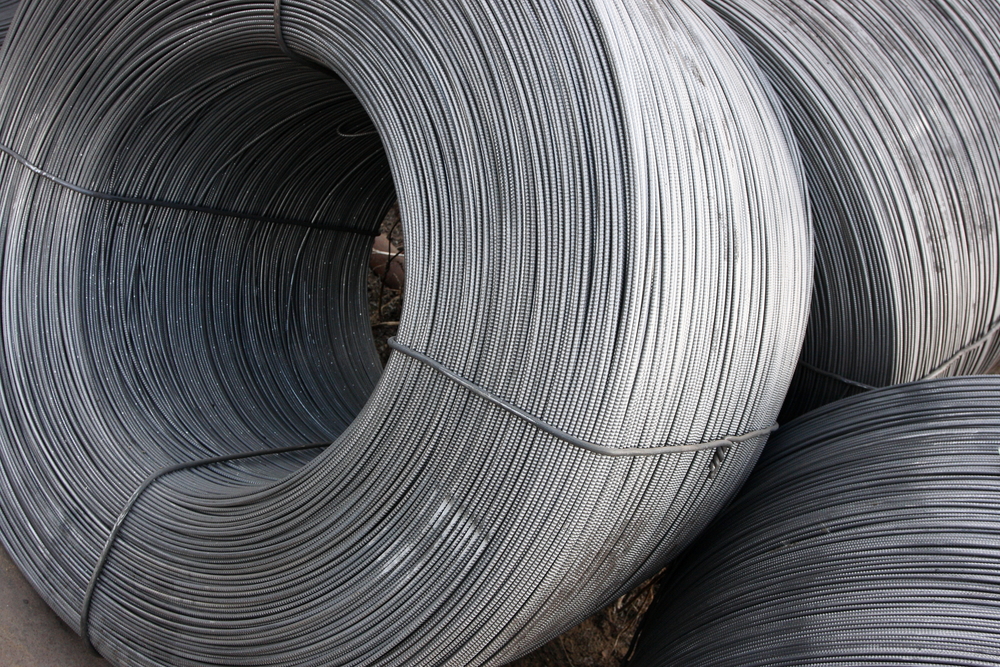
Northern European wire rod prices are stable this week amid low demand, sources say. However, some participants continue to expect more activity in the market this month.
“There was not much activity this week,” one buyer from the Netherlands tells Kallanish.
Domestic transaction prices for drawing-quality wire rod are at €650/tonne ($698/t) ex-works and mesh-grade wire rod is at €630/t.
Producers are asking for €650/t ex-works, on average, for mesh-quality rod.
“Most customers are again in the wait-and-see attitude, but this has to change soon,” another participant in the market notes.
If scrap prices start to increase, that could lift rod prices and demand, he adds.
German old thick scrap sort 3 is at €345/t, while new scrap sort 2/8 is €340/t. E40 shredded scrap is at €350/t. In Austria, scrap prices for new scrap sort 2/8 are €335/t, with old thick scrap sort 3 at €350/t.
Import quotes from outside the EU are having little impact on the European wire rod market. Offers are being heard from outside the bloc at €610-615/t cfr Rotterdam, which is considered uncompetitive by European buyers.
Earlier, ArcelorMittal said it is communicating to European customers its intention to implement a premium for all new orders of high-grade wire rod that require the use of DRI in the production process. According to participants, this will work only if the customer is ready to pay more for a higher wire rod grade.
Italian wire rod prices may increase as producers are considering pushing up their values due to the high production costs and low imports (see Kallanish passim). Domestic values for drawing-quality material are now at €640/t ex-works on average. Domestic mills are considering pushing up their asking prices to €670/t ex-works, sources say.
Svetoslav Abrossimov Bulgaria
Italy offers new procedure to avoid exhaustion of EU steel import quotas
The EU safeguard measures offer country-specific and global quotas for certain steel products and were first introduced in 2018. Quota allowances are given for each quarter, with any material imported in addition to the quota allowance subject to a 25% import duty.
But on March 28, Italy’s customs agency Agenzia delle dogane e dei Monopoli (ADM) published a notice, suggesting that steel buyers can pull back from import operations to avoid exceeding the safeguard quota.
The move follows “numerous requests” of trade associations, Fastmarkets understands.
“Custom clearing steel at the end of the quarter, when quotas for some products and origins gradually get filled, has always been a bit like gambling – with a risk of having to pay the 25% duty,” a trader source in Italy told Fastmarkets.
“The new procedure can help us to use quotas more efficiently,” the source added.
Buyers will now have more flexibility and will be offered several options for clearing imported steel cargoes through customs.
Buyers of imported steel will now be able to withdraw from clearing purchased goods through customs when the quotas are close to exhaustion, according to the ADM document.
Or they might only clear part of a cargo with customs and transfer any excess volumes to the next quarter by keeping the goods in the port.
If material is subsequently required urgently, buyers will be able to proceed with customs clearance and the possibility of facing import duties.
“This [new procedure] is not a new regulation, it is, rather, an interpretation of safeguards use and just [provides another] an option for the buyers,” a second trader in Italy said.
Market participants told Fastmarkets the new mechanism will be particularly useful toward the end of any quota period, when allowances are close to being filled and when clearing import bookings gets increasingly risky – in terms of having to then pay the 25% import duty if the quota is exceeded.
“The new procedure is not very useful at the beginning of the reporting period, but at the end [of the quarter], when few volumes are left, it will help buyers to clear steel imports risk-free,” a buyer in Italy said.
“So, when the quota becomes critical – ie, more than 80-90% used – instead of waiting for the new period, buyers can partially customs clear their cargoes and use quotas more efficiently,” he added.
Another buyer told Fastmarkets: “Buyers can hold goods at ports without customs clearance and no one will know how much goods are sitting at customs.”
The new procedure came into effect on April 1.
So far, the new procedure only applies in Italy, but some market participants said the mechanism could eventually be extended across the EU.
Italy is one of the largest steel importers in the world. In 2023, it imported around 6.5 million tonnes of steel from outside EU, according to European steel association Eurofer.
Vlada Novokreshchenova in Dnipro has contributed to this report


Blastr appoints Mark Bula as CEO
Blastr Green Steel (Blastr) has appointed Mark Bula as its new chief executive officer to lead the development of the greenfield venture, which plans a steelworks in Inkoo, Finland.
Mark Bula will be based in Finland, taking over for Hans Fredrik Wittusen, who has led Blastr through an important project maturation and pre-feasibility stage.
With 35-years of experience in the global steel industry, “Mark has delivered commercial development that has unlocked significant financing for start-up projects. He also developed go-to-market strategies in the Nordics, Europe, the Middle East, and the US,” says Lars-Eric Aaro, chairman and co-founder at Blastr.
Bula will drive Blastr’s strategic development, capital-raising, and project execution, leveraging extensive C-suite and start-up experience, Kallanish hears from Blastr. This includes being first in demonstrating European demand and an attainable price premium for decarbonised steel, the company notes.
Mark Bula previously was one of the people behind the other Nordic green-steel-greenfield venture, H2 Green Steel in Sweden, and used to be with US company Big River Steel as chief commercial officer.
He will assume the position in May and will, together with Hans Fredrik, ensure a seamless transition and continuity and momentum in achieving the Company’s strategic objectives, Blastr says.
Christian Koehl Germany

Worldsteel: China’s steel demand to fall in 2025
The World Steel Association (WSA) estimates China’s steel demand to be flattish in 2024 and to slip 1% in 2025 in its April Short Range Outlook, mainly weighed down by lower real estate investment. This is a relatively conservative estimate compared with Chinese institutions, Kallanish understands.
For 2024, WSA expects growth in infrastructure and manufacturing to compensate for the demand loss from property. But they admit they underestimated China’s steel demand weakness in Q4 2023, so that they needed to revise down their demand forecast for 2023 compared to last October by around 5%. The apparent steel use estimate for China in 2023 turns out to be a 3.3% drop on-year, much more in line with the Kallanish calculation of -3.5% than the original WSA forecast of 2% growth.
China has policies to boost demand by building affordable housing, renovating urban villages and constructing emergency public facilities, the so called “The Three Major Projects.” But local government financial burdens may slow down projects. The central government ordered 12 indebted local government to delay or stop some state-owned infrastructure projects this January.
For manufacturing, China saw robust car production this March and surging shipbuilding for the first two months this year. But more trade defence measures are being signalled globally, including from the EU and the United States. The European Commission started customs registration of electric vehicles from China last month as a step in their anti-subsidy investigation since last October. Five national labour unions meanwhile filed a petition for the US Trade Representative to investigate China’s shipbuilding sector last month. In addition, steelmakers in Vietnam have filed anti-dumping petitions last month against China’s hot rolled coils.
The China Iron & Steel Association (CISA) and the China Metallurgical Planning and Research Institute (MPI) estimates that 2024 demand will drop 1% and 1.7% on-year respectively (see Kallanish passim).

EU steel demand to recover in 2025: worldsteel
The 27 countries of the European Union plus the United Kingdom will have to wait until 2025 for a proper steel demand recovery. The World Steel Association sees EU steel demand increasing only mildly this year in “a technical rebound” before a more significant 5.3% rise in 2025. In 2024 steel demand is seen only 1.5 million tonnes higher than 2020, the year of the pandemic.
Europe is the region currently facing the biggest challenges, Kallanish gleans from worldsteel’s Short Range Outlook (SRO) steel demand forecast for 2024 and 2025. Steel-consuming sectors remain impacted by an unstable geopolitical landscape as well as uncertainty driven by high inflation, monetary tightening and partial withdrawal of fiscal support, while energy and commodity prices remain high.
“The persistence of these downside factors resulted in a major drop in the region’s steel demand in 2023 to the lowest level since the year 2000 and to substantial downward revisions of the forecast for this year,” worldsteel says.
European demand stood at 136.8mt in 2023 and should reach 140.7mt this year with a modest 2.9% surge. Demand is however predicted to rise y-o-y by 5.3% to 148.1mt in 2025.
Germany will remain among the world’s top ten steel-consuming regions together with China, India, United States, South Korea, Japan, Russia, Turkey, Mexico and Brazil. In 2023 Germany consumed 28mt of steel and it is forecast to absorb 28.9mt in 2024 reflecting a 3.2% hike. In 2025 the nation is expected to use 31.8mt with a notable 10% y-o-y hike.
The crisis in residential construction activity is expected to continue this year in most major markets with a recovery forecast for 2025. The sector suffers high construction costs and labour shortages which might reduce growth in public infrastructure and manufacturing investments in the short-term. Global manufacturing activity should start improving in 2024 although it remains affected by weak demand, high costs and tight financing. In contrast, the automotive industry which showed a strong recovery in 2023 should show weak growth in 2024.
The green transition will remain a strong driver behind public infrastructure investments. “A recent Economics Committee study estimated that global steel demand for new wind energy installations will triple by 2030 to around 30mt when compared with the early 2020s,” the report says. It adds that while the share of steel demand for wind energy installations will remain relatively low in total global demand, it may give quite a noticeable support to overall steel demand in certain regions such as Europe.
While globally geopolitical and inflationary tensions persist, a faster end to inflation and further monetary policy easing could support steel demand, particularly from the construction sector as well as strengthening investment in decarbonisation and public infrastructure against climate change risks.
Natalia Capra France

Demand, Chinese exports pressure global longs market: Irepas
While weak demand persists worldwide, “China’s aggressive exports” are putting pressure on the global long steel market. The market is perceived as unstable and challenging, with uncertainty looming, particularly beyond July, according to the according to the International Rebar Exporters and Producers Association (Irepas) in its April Short Range Outlook.
The global market anticipates positive signals from financial authorities overall, as customers in the US, EU, and Canada are postponing projects as they await easing interest rates, Kallanish notes.
China ramped up its exports in the first two months of 2024, surpassing its own record exports seen in 2015. Chinese steel producers are believed to be profitable, benefiting from reduced iron ore and coke prices, as well as lower energy costs within China, according to Irepas. Notably, China’s long steel exports continued to trail behind the country’s exports of flats.
Turkey’s Ministry of Commerce has imposed restrictions on exports of 54 product groups to Israel, including steel reinforcing bars and wire rods. Israel stands as one of the primary markets for Turkish exports within these product categories.
Following Turkey’s local elections at the end of March, there is anticipation of an economic slowdown in the country. The Turkish government aims to stabilize the value of the Turkish lira, which could be a disadvantage for Turkish steel mills in terms of their competitiveness.
In Europe, demand remains subdued, especially in Germany, where prices for reinforcing bars and wire rods are exceptionally low. The market saw a brief improvement at the end of 2023 but is not expected to recover until the second half of the year. Cut and bend prices are currently below replacement costs, and it may take several months for spreads to normalize.
Meanwhile, US steel output decreased by 600,000 tonnes in January-March compared to the same period in 2023.
Elina Virchenko UAE

Weak sales of finished product impact scrap: Assofermet
The outlook for finished steel product sales remains negative, says Italian steel trade association Assofermet. “Without a recovery in steel production and an improvement in the finished product sales – a picture that would lead to an increase in scrap demand– it is difficult to imagine possible increases in prices in the short term,” the association says in its market note monitored by Kallanish.
March domestic scrap prices declined between €15-20/tonne ($16-21/t). Demand from local mills remained consistently low due to production stoppages, which generated a significant slowdown in scrap deliveries. Despite the reduced deliveries, mills’ scrap yard stocks remain medium-high, Assofermet observes.
On the collection side, merchants noted a drastic drop in scrap availability on the market owing to the slowdown of manufacturing activity. This has sparked concern and may cause shortages if scrap demand recovers.
Meanwhile, the positive sentiment in the April pig iron market is forecast to drive some more scrap demand in Italy.
In March the Italian and European markets were generally weak with mills not showing particular interest in pig iron procurement. Russian producers refused last month to decrease their offers to Italy and the difference between pig iron and scrap prices remains significant. Internationally, Assofermet registered good pig iron demand and price levels. Offers from Brazil and Ukraine have resurfaced in addition to Russian offers.
US pig iron imports increased last month, allowing Brazilian suppliers to maintain a price level about $40/t higher than the European market.
Natalia Capra France
Worldsteel predicts modest steel demand rebound in 2024-25
Demand for steel worldwide will rebound by 1.7% in 2024 and will grow a further 1.2% next year, worldsteel predicts in a new short-range outlook examined by Kallanish.
Noting that those consumption growth rates are still relatively weak, worldsteel observes that the global economy seems headed for a soft landing and steel will be in heavy demand from public infrastructure and decarbonisation programs.
“After two years of negative growth and severe market volatility since the Covid crisis in 2020, we see early signs of global steel demand settling in a growth trajectory in 2024 and 2025,” comments Martin Theuringer, chairman of the worldsteel economics committee.
Steel demand in 2024 is projected to be 1.79 million tonnes, according to worldsteel’s outlook. For 2025, the volume should reach 1.81mt.
The apparent end of the monetary tightening cycle will provide relief from the downturn in housing activity and global manufacturing, Theuringer emphasises.
“We expect to see continued strength in investments in public infrastructure and manufacturing facilities,” the outlook document mentions. “However, we also observe that high construction costs and labour shortages emerge as major constraints for many major economies, and this might constrain further growth in public infrastructure and manufacturing facility investments in the short-term.”
Worldsteel predicts that steel consumption in China will remain flat this year compared with 2023. India is experiencing strong steel demand growth. A rebound is occurring in the MENA and ASEAN regions.
“The developed world is also expected to show a strengthening recovery with 1.3% in 2024 and 2.7% in 2025, as we expect to see steel demand finally showing a meaningful pick up in the EU in 2025 and continued resilience in the US, Japan and Korea,” the outlook specifies.
Further, “risks have moderated since our last update in October 2023 and are balanced,” worldsteel observes.
“On the upside, we believe that a faster than expected disinflation accompanied by further monetary policy easing could provide a significant boost to steel using sectors, particularly housing construction,” the authors comment. “We also believe that an acceleration in global decarbonisation efforts or in efforts to strengthen public infrastructure against rising climate change risks are significant positive risks that can support global steel demand going forward.”
Escalating geopolitical tensions, persistent inflation, and rising public borrowing in major economies, however, “are significant risks that certainly have the potential to slow down the ongoing economic recovery or even derail it.”