

Acciaierie d’Italia reports 2.5mt of orders
Acciaierie d’Italia (ADI), the joint venture between ArcelorMittal and state company Invitalia, has sold 2.5 million tonnes of steel, and has 1 million tonnes of steel in stock, including raw materials and finished products. In 2023, ADI produced about 3 million tonnes of crude steel, Acciaierie d’Italia’s ceo Lucia Morselli said in a televised speech at the Senate seen by Kallanish.
Morselli did not specify the period in which the 2.5mt of sales was secured or the period in which the sales are to be delivered, but did say that this number was “as orders.”
The true debt of Acciaierie d’Italia is about €700 million ($749m), Morselli states. In total ADI has €3.1 billion debt. “This debt is mostly intercompany, towards the holding company, of about €1 billion. Then there is about €1 billion that we should pay in case we decide to buy the equipment,” Morselli adds. The equipment of the Taranto steelworks belongs to the Ilva special administration. In May this year, the lease ADI is paying to use the equipment will expire, Kallanish notes. Morselli adds that roughly half of the €700m is outstanding debt.
The company is not in a dramatic situation and continues to produce and pay salaries, he says. But the absence of credit lines and liquidity, the Covid economic crisis, and the increase in energy costs have had a strong impact on productivity. Gas costs rose from €250m to €1.4 billion last year, which meant the shareholders had to help pay the energy bills, Morselli notes. This month a tribunal in Milan rejected ArcelorMittal’s appeal to block its state-owned joint venture partner in ADI, Ivitalia, from requesting the commencement of a special administration for the steelmaker. ArcelorMittal submitted an appeal which revealed that ADI had accumulated debt of €3.1 billion as of 30 November 2023. Trade unions have warned several times that the hot-end area is being idled and have lamented the lack of safety at the Taranto steelworks. ADI is rumoured to be idling blast furnace No. 2 at Taranto and is producing using only BF No. 4 (see Kallanish passim).
Natalia Capra France

Liberty restarts Galati steelmaking
Liberty Steel is confirming the restart of crude steelmaking at its plant in Galati, Romania, following the relaunch of operations at the blast furnace number 5, Kallanish learns from the company.
The output at the furnace will be ramped up during the next weeks. The furnace was temporary idled in autumn last year and brought steelmaking to a halt at Liberty’s European unit after other blast furnaces stoppages in Czech Republic and Hungary implemented in 2023.
Following the restart in Galati, Liberty is planning to resume rolling operations at its lines in Romania, Czech Republic and Hungary. The company explains that there is good demand at the moment for heavy plates and hot rolled coils.
“Despite the difficult European market conditions, Liberty Galati has managed to overcome a range of challenges over the last few months and has restarted its primary production – which will benefit its business as well as the rest of the Liberty’s other major European sites,” says Theuns Victor, ceo of Liberty’s European upstream businesses. “We do expect the improved market conditions this year to give Europe a much-needed boost and to provide some momentum to our operations.”
Emanuele Norsa Italy
Indian steel mills face greatest CBAM risk: Goldman Sachs
Investment bank Goldman Sachs Group says in a report that Indian steel producers are the most at risk from Europe’s carbon plan, the Carbon Border Adjustment Mechanism (CBAM), Kallanish notes.
This is due to two main factors: steel producers from India registering high sales to the European market, and Indian steel mills having an elevated emissions intensity. This puts them at more risk for carbon tax-related import charges.
In January, India was the largest HRC exporter to Italy, with shipments reaching 192,152 tonnes, according to data from Cybex.
According to the Goldman report by analysts led by Emma Jones, Indian steel mills could face an additional $102-190/tonne of carbon import tax charges on flows of Indian steel to the bloc over the next decade. This additional charge would account for 15-28% of current hot rolled coil prices, and assumes a carbon price of $70/t.
The CBAM carbon plan aims to levy charges on imported goods entering the European Union (EU), for certain energy-intensive sectors such as steel, to encourage cleaner pollution standards at its trading partners. The carbon tax will come into effect on 1 January 2026. The move has been met with strong criticism from overseas producers, including Russia and China.
The analysts say: “Indian steel producers operate at a carbon intensity level well above the EU and global level, potentially exposing them to elevated charges,” as they rely mainly on coal-based processes.
The report notes that, among the producers, Tata Steel and JSW Steel have the most direct exposure to the EU.
Indian mills have also been outspoken about the potential impact of this tax, likening it to a trade barrier. The Indian government is currently in discussions with the EU, in order to reach an agreement for concessions.
Suhita Poddar India

Celsa’s new owners evaluate foreign subsidiaries’ financial situation
The new owners of Spanish-headquartered Celsa have now taken full control of the company and are in the process of evaluating the financial situation of Celsa’s global units before presenting a new industrial plan.
Celsa has steelmaking operations in France, Norway, Poland and the UK, outside of Spain. According to local trade unions UGT, Celsa’s new management confirmed last week it is now evaluating the financial performance of the foreign units. Press sources in Spain report it might be considering selling some of the foreign units, if needed, to strengthen the group’s financial position.
Spanish trade unions add in a statement seen by Kallanish that Celsa confirmed that a new industrial plan is not yet available, but will be presented after the group-wide financial evaluation.
In addition to evaluating its global presence, Celsa is also actively looking for a Spanish industrial partner to support its industrial transformation. The trade unions were told the process of finding a new partner should last five to six months. Spanish press reported Megasa, Sidenor and Gonvarri as potential partners being considered by Celsa.
At the beginning of this year, Jordi Cazorla Pujalte started his role as Celsa Group chief executive. He replaced long-time boss Francesc Rubiralta who left the steelmaker after the group of investment funds, representing the main creditors of the company, took control of Celsa.
Emanuele Norsa Italy , Todor Kirkov Bulgaria

Thyssenkrupp to start DRI plant construction early
Thyssenkrupp Steel has received approval to start construction early of the first direct reduction plant at its Duisburg site, the steelmaker tells Kallanish.
Tk Steel submitted the application for approval at the Düsseldorf district government as the responsible authority in October 2023. The approval notice for the early start of construction is an important milestone in the approval process in accordance with the Federal Immission Control Act, the company notes. “We have thus cleared another important hurdle in the realisation of the first direct reduction plant,” says Arnd Köfler, tk Steel’s chief technology officer.
Over the next few months, a veritable factory town will be built on the site, with up to 2,000 people working there. The main part of the plant will be around 140 metres high and flanked by around 60 buildings.
By awarding the contract to build a DR plant with two melters to SMS group in spring 2023, tk Steel placed the largest single order in its history, it notes. Last summer, it received a grant from the federal and state governments totalling around €2 billion ($2.2billion) for its tkH2Steel project. Tk Steel’s own investment amounts to just under €1 billion.
Christian Koehl Germany
Carbon Capture viability in steelmaking decarbonisation seen fading
It is becoming increasingly clearer that carbon capture utilisation and storage (CCUS) will not play a meaningful role in steel decarbonisation, says the Institute for Energy Economics and Financial Analysis (IEEFA).
This follows the announcement last week by Rio Tinto, BHP and BlueScope Steel that they are working together on making Pilbara iron ore suitable for direct reduced iron.
DRI-EAF steelmaking, the preferred decarbonisation route globally, requires a higher grade of iron ore than the great majority of production in the Pilbara. A shift away from coal-consuming blast furnaces to DRI is therefore a major long-term challenge to Australia’s biggest export, IEEFA points out.
A promising way of enabling the use of lower-quality iron ore in DRI making is via an electric smelting furnace (ESF) – combining a DRI shaft furnace with a melting step to allow the removal of impurities, it adds.
Three of the Big Four iron ore miners, Vale, Rio Tinto and Fortescue, are investing in DR-grade ore supply. The outlier is BHP, which is not targeting high-grade ore and is instead leaning more heavily on unproven carbon capture solutions that would allow the continued use of its metallurgical coal.
Virtually all steel companies that plan to build low-carbon steelmaking capacity at commercial scale have opted for hydrogen-based or hydrogen-ready DRI plants, not CCUS.
“At this relatively early stage of the steel technology transition, it’s already time for steelmakers and iron ore miners like BHP to drop the idea that CCUS will play a major role in decarbonising the steel industry,” the IEEFA’s Simon Nicholas says in a note seen by Kallanish. Funding the new DRI collaboration would be a better way to “future proof” Australia’s biggest export and its steel industry, he adds.
This coincides with comments made by Fortescue Metals chairman Andrew Forrest during a Paris conference on Tuesday, at which he called CCUS “a complete falsehood”.
He is quoted by Reuters as saying: “We’re going to keep burning fossil fuels and somehow magically get rid of the carbon down into the ground where there is no proof that it will stay there, but heaps of proof that it fails. I say for policy makers everywhere do not be the next idiot waiting for the old lie to be trotted out and say I believe in carbon sequestration. It has only failed for 75 years.”
Adam Smith Poland

Italian sections prices decline slightly on stagnating market
The Italian merchant bar market continues to be stagnant. Mill sources and distributors report low consumption and strong competition from other European countries. Consumption is generally slow in Europe, two EU mills sources confirm, and prices are on a downward trend, Kallanish hears.
Buyers continue to purchase only back-to-back. Domestic merchant bar values are hovering at €320-330/tonne ($345-356) base delivered, reflecting an average €20/t on-month fall. Including size extras, prices are at €740-750/t, sources suggest. Domestic material is suffering from competition of imported European merchant bar offered and sold at below €300/t base delivered.
Demand for Italian sections continues to be weak and has been poor since the beginning of the year. Sections are also suffering from competition from cheaper imported material, with some distributors looking for volumes and implementing heavy discounts, sources tell Kallanish.
In the fourth quarter last year, beams sales volumes increased in Italy and some apparent demand resurfaced. Some purchases to replenish stocks are forecast towards the end of the month. So far in February, the first category of beams is flat on-month, hovering at €800-820/t, sources suggest.
Natalia Capra France
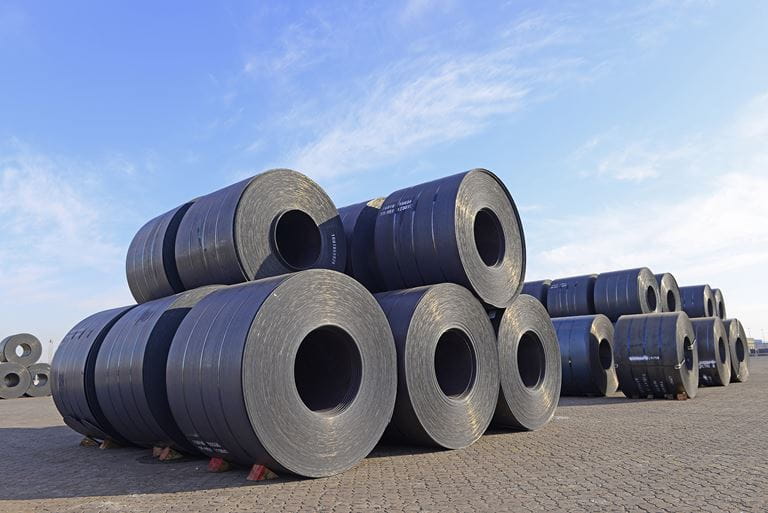
European HRC market activity slow as buyers avoid restocking
Activity in the European hot-rolled coil market remained muted on Feb. 12 as buyers have been holding back from building stocks.
“Everyone has enough material in stocks and the price-trend outlook is not positive, so there is no sense of urgency to make deals,” a trader said.
Buyers have also expressed concerns that the increase of domestic production following the restart of some of the furnaces that had been idled across Europe would not allow the prices to sustain at current level. In addition, real demand has remained slow, sources said.
“The price trend would depend on who can wait longer – mills or buyers,” another trader said.
Platts assessed domestic prices for hot-rolled coil in Northwest Europe at Eur745/mt ex-works Ruhr on Feb. 12, unchanged on day.
Tradable values were reported at Eur730-760/mt ex-works Ruhr, with the majority of tradable value indications heard around Eur740-750/mt ex-works Ruhr.
Platts assessed domestic prices for hot-rolled coil in South Europe down by Eur5/mt on day to Eur740/mt ex-works Italy on Feb. 12.
Tradable values have been reported at Eur740-750/mt ex-works Italy and one source estimated achievable prices at Eur710/mt ex-works Italy.
Author Maria Tanatar, maria.tanatar@


European HRC prices decrease slightly amid bearish sentiment
Mills in Northern Europe offered discounts for larger volumes to fill their order books, while buyers continued to postpone restocking in the hope that prices would decrease further, according to sources.
One offer was heard at €780 ($841) per tonne delivered, which nets back to about €765 per tonne ex-works.
“But [there were] no buyers [at this price] [and it] will go down easily this week or the next,” a buyer source told Fastmarkets.
A second buyer source pointed out that mills have been trying to keep prices higher by cutting production, “but in February, some blast furnaces are supposed to come on stream again.”
This could put some additional pressure on prices, the second buyer source said.
Sources estimated tradable market levels at €740-750 per tonne ex-works.
Some deals for small quantities were heard in the range of €740-760 per tonne ex-works.
Fastmarkets calculated its daily steel HRC index, domestic, exw Northern Europe at €747.50 per tonne on Monday, down by €3 per tonne from €750.50 per tonne on Friday.
The index was down by €12.50 per tonne week on week but up by €15.62 per tonne month on month.
Fastmarkets calculated its corresponding daily steel HRC index, domestic, exw Italy at €747.50 per tonne on Monday, down by €1.25 per tonne from €748.75 on Friday.
The index was down by €5 per tonne week on week but up by €25.83 per tonne month on month.
In Italy, some offers were heard in the range of €745-770 per tonne ex-works. But buying remained comparatively weak, with no major deals heard in the market.
“This usually happens when prices go down,” a third buyer source told Fastmarkets, citing low demand and sufficient stocks as other factors influencing trading activity.
Market participants estimated the tradable market levels in a wide range of €725-760 per tonne ex-works.
Levels close to the lower end at €725-735 per tonne ex-works could be reached for the material with April delivery, the third buyer source said.
Offers of imported HRC from Vietnam to Italy were heard at €630 per tonne CFR.
Imported material from Japan was offered to Italy at $700 per tonne CFR, although this level was not tradable, according to a fourth buyer source.
Asian material was offered to Italy at €670 per tonne CFR, the fourth buyer source added.
Offers from Egypt to Italy were heard at €640-650 per tonne CFR and from Turkey at €680-690 per tonne CFR.
Published by: Julia Bolotova, Darina Kahramanova


LKAB selects Energiron for hydrogen DRI plant
LKAB has selected Energiron to develop a new 100% hydrogen-based direct reduced iron plant in Gällivare, northern Sweden.
Energiron, a joint venture between Danieli and Tenova, will develop the new plant, designed to have a capacity of 1.3 million tonnes/year of fossil-free DRI. The technology provider previously supplied key equipment for the hydrogen-based pilot plant commissioned in 2020 by HYBRIT, the LKAB, SSAB and Vattenfall joint venture.
“Results from the HYBRIT pilot plant revealed that direct reduced iron obtained using pure hydrogen as reducing agent delivers superior properties and qualities, compared to DRI produced using fossil-based reducing gas, such as natural gas,” Danieli explains. “Amongst the characteristics of the new installation, an electric process heater – world first in an industrial DRI plant – will heat the process gas using green electric power. This will further reduce carbon emissions down to zero, increasing the overall energy efficiency of the process.”
The output of the new DRI plant is expected to feed SSAB steelmaking plants, to produce fossil-free steel in the future, Kallanish understands.
Emanuele Norsa Italy