


Some European mills hike rebar following extras adjustment
The release of a new size extras price list for rebar in northwestern Europe last week is a signal that base prices will be lifted too.
The announcement of new size extras “has certainly shaken us all over”, one Austrian buyer states. Although a new version of the previous size extra list issued in 2015 was long overdue, it surprised many that it was published now.
The new list comes from only two mills so far, Badische Stahlwerke and Marienhütte. And not all buyers are aware of the development yet, like an eastern German manager, simply because “we do not buy from them”, he notes.
The two mills are unlikely to consider accepting bids at old prices anymore. “The new size extras are carved in stone with effect from 4 August,” the Austrian buyer says.
Other mills in the region were contacted by Kallanish about their plans to follow suit, but did not come back with a statement before deadline on Friday. Virtually all other rebar mills in Germany, Switzerland and France belong to Italian groups, which have now entered their summer holidays and left the market for several weeks.
It seems the timing favours the Italian mill owners. “The Italians can comfortably lay back and take their time to make a decision,” one observer says, although he has little doubt they will follow suit.
He notes base prices have been brought up, too, in the wake of the size extra hike. Offers he received as a delivered effective price were some €30/tonne ($35) higher than in July. The size extra for the standard thickness 12mm is up €15/t in the new list, so the offers suggest a hike of the base price by the same degree.
In July, base prices for rebar sunk to around €350/t ($408) in Germany and Austria from domestic mills, and will likely be lifted in August. So far, activity is too sparse to judge the success of a price hike.
Christian Koehl Germany


Romanian flats spot prices stable amid holiday lull, Liberty Galati’s recovery uncertain
The Romanian flat steel spot market has remained quiet for another week, with sluggish demand persisting. As a result, spot market traders have opted to keep prices stable, mirroring last week’s levels. The start of August has brought a typically slow trading period, with many companies on holiday, similar to the rest of the EU region.
Currently, domestic hot rolled sheet (HRS) prices in the Romanian spot market are quoted at €700-720/mt ex-warehouse, unchanged week on week. Similarly, cold rolled sheet (CRS) prices have also remained flat, standing at €825-835/mt ex-warehouse.
Meanwhile, as previously reported by SteelOrbis, Romania’s sole flat steel producer, Liberty Galati, has received court approval for its new restructuring plan. However, the overall outlook remains bleak. According to local media sources, ANAF (the Romanian tax authority) voted against the plan, and the plant is currently not producing, while also failing to pay worker salaries and cutting working hours. As a result, workers initiated a protest at the Liberty Galati plant this week, but no significant developments have emerged so far.
In the import market, the situation remains similarly muted. Offers have been stable, with limited interest from Romanian buyers. Some minor activity was observed from pipe manufacturers, but no concrete deals were concluded. According to sources, Ukrainian offers for HRS and CRS remain stable at €590-605/mt CFR and €680-695/mt CFR, respectively, for August-September shipments. In contrast, Turkish HRC offers have softened slightly, mainly due to currency fluctuations. Turkish FOB-based prices now range at $530-550/mt. With estimated freight costs of €15-20/mt, delivered prices to Romania are now calculated at approximately €470-490/mt CFR for September shipment, down from last week’s €480-500/mt CFR.

European longs market stable amid seasonal and international uncertainty
This week has been a quiet one for the European longs market. The summer lull continues to weigh on prices, which have remained stable amid the prevailing absence of market players.
In the local Italian rebar market, prices have remained firm at around €295-300/mt ex-works base (€560-565/mt ex-works including regular extras), having gained about €60/mt from the beginning of July. According to one local trader, “The market will resist.” On the contrary, a source from an Italian mill commented, “This level won’t work in September, at least in Italy.” Upward price pressure continues to emerge, but in other European countries – e.g., Switzerland – a downward price correction seems the most likely scenario.
The general feeling among market players, however, is one of great uncertainty, due to the next revision of safeguard measures (quotas), the CBAM implementation, and other seasonal factors, as well as the ongoing international conflicts.
Shifting to wire rod markets, no changes have been reported. In Italy, local prices have remained stable at €600-615/mt delivered for drawing quality wire rod and at €585-600/mt delivered for mesh quality wire rod.
Stable prices have emerged also in export and import markets. For the latter, Turkish rebar and wire rod prices continue to be at €490-500/mt CFR and €500-505/mt CFR, respectively, whereas rebar and wire rod prices from Egypt have been reported at €495-500/mt CFR and €505-510/mt CFR, respectively. These prices are based on the euro-dollar exchange rate of 1.16 (European Central Bank, August 7).

EU makes further cuts to AD duties on Japanese hot-rolled flat steel
In a document released on Thursday August 7, the Commission marginally reduced AD duties for all Japanese producers except Tokyo Steel. This was the second reduction since provisional rates first took effect on April 7, 2024.
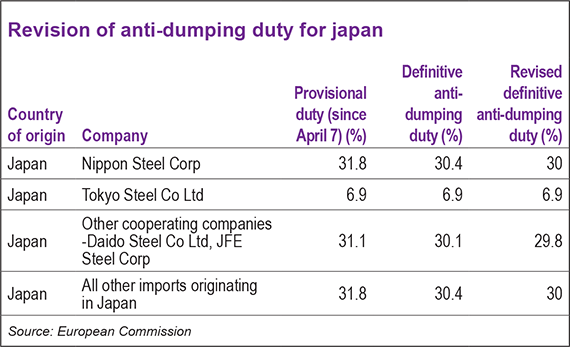
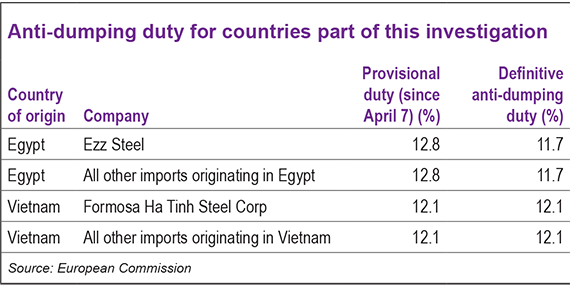
Meanwhile, AD duties for other countries covered in this investigation, including Egypt and Vietnam, were unchanged from the definitive rates announced on July 16, 2025.
While Egypt’s producers will pay 11.7% duty, Vietnamese exports to the EU are subject to a 12.1% AD duty. India, and Vietnamese exporter Hoa Phat, were exempted from any AD duties at the preliminary stage due to insufficient evidence of dumping.
EU buyers unfazed
“The change [in duties] is unlikely to affect buying interest in Europe,” a trade source told Fastmarkets.
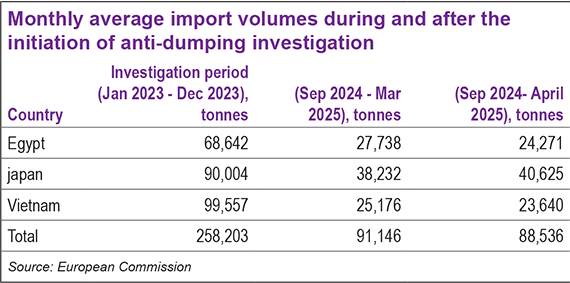
The Commission’s report noted a decline in imports of certain HRFS products into the EU. The monthly average shipments from Japan fell by more than half compared with the investigation period, while Vietnamese exports dropped even further (see table 3). The investigation covered imports from January to December 2023.
Circumvention risks flagged
The Commission warned that any attempts to bypass the duties, such as rerouting shipments through third countries, or flooding the market later, could prompt fresh investigations and expanded penalties.
The anti-dumping probe was initiated on 8 August 2024, following a complaint by European steel industry association Eurofer. The investigation covered imports from January to December 2023.


EU heavy plate round-up: European heavy plate prices stable on seasonal slowdown
Summer holidays largely neutered any potential for price movement across the European heavy plate markets in the week to 8 August, with McCloskey’s sources discussing developments in the segment’s low-carbon offerings.
The Northwest European spot market was working with prices between EUR660-690/t ex-works for s235 grade heavy plate – while the re-roller heavy Italian market lags, cited between EUR590-630/t ex-works.
Input prices for Italian re-rollers are increasing however, potentially lifting existing price floors in southern Europe, with import slab offers heard slightly higher at $510-515/t ex-Asia and Brazil, considered sourceable at a $500/t CFR minimum. Recent US tariff intensifications were said to be a primary factor in the increased availability of Brazilian-origin slabs – also heard purchased in strong volumes from German integrated producers recently to stockpile ahead of the Carbon Border Adjustment Mechanism’s definitive stage in January.
McCloskey’s conversations with sources largely surrounded the increased visibility of low-carbon heavy plate in Europe in lieu of usual market activity during the holiday period, A Bulgarian electric-arc furnace (EAF) producer is reportedly asking for a EUR100/t premium for its certified green heavy plate production, with this target matched in the market by other existing EAF plate producers such as in Slovenia or Macedonia.
Market participants did not see much chance of achieving EUR100/t premia for low-carbon plate sales, perceiving the majority of relevant deals from the EAF mills as trading without any – or a very minimal – green premium. Where premiums are negotiated, volumes were said to be small, with purchase prices specific to the budget of the dependent project and rarely exceeding green plate premiums of EUR50/t – considered by distributors to be a more realistic estimation of the low-carbon value-add.
Maria Tanatar Associate Director, Steel and Green Steel
Benjamin Steven Journalist, Steel


European coil and green steel round-up: Northwest European coil rises despite seasonal lull
Firmer mill offers saw Northwest European coil prices jump in the week to 8 August following the market’s latest round of offer price increases, with trading back at levels not seen since early June.
McCloskey’s sources across the steel supply chain reported deals for hot-rolled coil (HRC) at EUR580-590/t ex-works or delivered Northwest Europe toward the end of the week – a bullish signal for a domestic market that has been languishing under compounding pressures of low demand and aggressive import penetration.
While the ongoing holiday period means that substantive volumes are unlikely to shift for a couple of weeks, transactions at higher price levels will reinforce mill attempts to bring prices above red lines through the latter half of 2025, and in preparation for September restocking.
In southern Europe, where import pressures are traditionally higher, the market failed to see the same gains as in the North, seeing only slight increases to transactional levels last reported between EUR530-540/t ex-works. Buyers were said to be absent from the market, enjoying holidays without giving HRC offers at EUR 570-580/t ex-works or delivered much interest.
Imports were reportedly available at offer prices of EUR500/t CIF Italy from Indonesia; at EUR520/t CFR from India; EUR530-540/t CFR from Algeria; or duty-inclusive from Turkey at EUR530-540/t CFR.
Producers and distributors similarly perceived high stock levels across the European market, though some suggested that improving end-consumer sales for delivery in Q1 2026 would require more substantive restocking, or at least wind down inventories at a pace more amenable to increases in market liquidity going forward.
Any improvement in demand should operate in tandem with declining import attractiveness as the market expresses more bullish sentiments for the rest of the year. Import lead times are encroaching on duty-liabilities under the Carbon Border Adjustment Mechanism, and the rumoured early replacement of the EU’s steel safeguard measures also introduces too high a degree of risk for many of Europe’s steel importers.
That said, while the rumour of an early replacement to Europe’s steel trade defenses is rightfully premised upon domestic steel association Eurofer’s campaigning on the matter, nothing has been confirmed or persuasively indicated by European authorities, leading some to doubt the practicalities.
“Mid-2026 – when the old measures expire – is more realistic for the safeguard replacements,” said a mill source. “I don’t really see how the Commission has enough time to get everything sorted for January.”
Regardless, the narrative alone will somewhat deter importers from taking speculative opportunities on international steel sourcing for as long as it survives, potentially especially true of larger trading companies hit by new quota clearance burdens when the UK revised its own steel safeguards with near-imminent effect earlier in June.
Green Steel
Silence pervades the green steel market amid the summer lull, with McCloskey’s reduced carbon marker – calculated on the basis of all surveyed green HRC premia – now standing at its lowest level since April, at EUR52.97/t.
Premium indications from distribution remain range-bound between EUR70-100/t, though sources considered prices at the higher of said range as pretty optimistic in the current market given the presently subdued nature of green steel demand.
| European coil and green steel prices | Term | Marker | Change |
| Weekly Northwest Europe steel coil | |||
| Northwest Europe ex-works HRC | EX-WORKS | 585 | 25 |
| Northwest Europe ex-works CRC | EX-WORKS | 665 | 0 |
| Northwest Europe ex-works HDG | EX-WORKS | 670 | 0 |
| Weekly South Europe steel coil | |||
| Italy ex-works HRC | EX-WORKS | 540 | 5 |
| South Europe CIF HRC | CIF | 520 | 0 |
| Weekly Green steel | |||
| Green Northwest Europe HRC premium (scopes 1-3 CO2 0.8t) | 80 | 0 | |
| Green Northwest Europe ex-works HRC (scopes 1-3) | EX-WORKS | 665 | 25 |
| Green HRC premium (scopes 1-2 CO2 0.5t) | 80 | 0 | |
| Green Northwest Europe ex-works HRC (scopes 1-2) | EX-WORKS | 665 | 25 |
| Green HRC reduced carbon price (scopes 1-3) | 52.97 | -6.16 |
Maria Tanatar Associate Director, Steel and Green Steel
Benjamin Steven Journalist, Steel

France’s steel trade weakens in early 2025, while metal industry output edges up in June
In the January–May 2025 period, France recorded declines in both steel product imports and exports, according to data from the French Ministry of Economy, Finance and Industry.
Basic steel product and ferroalloy imports totaled €3.91 billion, down 12.7% year on year. Key categories included €852 million of steel pipes and tubes (-6.3%), €225.18 million of cold rolled steel bars (+3.9%), €283.34 million of cold rolled steel strip (-9.7%), €211.73 million of cold drawn wire (-3.8%), and €1.11 billion of metal structures and parts (-5.4%).
Exports of basic steel products and ferroalloys reached €4.01 billion in the same period, representing a 4.9% drop compared to the previous year. France shipped €524.89 million of steel pipes and tubes (-8.9%), €189.03 million of cold rolled steel bars (-0.9%), €265.54 million of cold rolled steel strip (-23.9%), €124.47 million of cold drawn wire (-13.9%), and €372.02 million of metal structures and parts (-0.6%).
Meanwhile, the latest figures from France’s National Institute of Statistics and Economic Studies (INSEE) show that manufacturing output in June 2025 increased 3.5% month on month, following a 1.2% decline in May. In the April–June quarter, manufacturing output was up 0.2% year on year and 0.7% compared to the previous quarter.
Production in the manufacture of basic metals and fabricated metal products rose 0.2% in June after falling 2.4% in May. The motor vehicles, trailers and semi-trailers sector saw a 1.1% monthly increase in June, reversing a 1.9% drop in May. In contrast, construction output fell 0.4% month on month in June, following a 0.5% decrease in May, and was 1.1% lower in the April–June quarter compared to the first quarter.

Klöckner anticipates rising shipments
Klöckner & Co expects a considerable increase in steel shipments in the third quarter, in comparison with the corresponding 2024 period.
The distribution group’s expectation is driven by continued robust demand at its US subsidiary Kloeckner Metals Americas. Additionally benefiting from a higher price level in North America, the company expects considerably higher revenue compared to the prior-year quarter.
In Q2, shipments were on par with the prior-year quarter at 1.2 million tonnes, In North America, the company was able to increase shipments to a record level of 762,000t, while weak demand in Europe led to shipments falling to 402,000t, from 423,000t. Consolidated revenue fell to €1.6 billion ($1.9 billion), from €1.8 billion, due to lower market prices.
Net income increased considerably, marking a turnaround to the prior-year quarter – it came to €2 million in Q2, after a net loss of €23m in Q2 2024.
During a conference call streamed from Klöckner’s Düsseldorf headquarters, chief executive Guido Kerkhoff also addressed questions about the company’s commitment to low-emission steel, following ArcelorMittal’s suspension of energy transition investments in Germany.
Klöckner introduced its brand Nexigen three years ago, and Kerkhoff emphasised that “we are happy we positioned ourselves at an early stage”. He said the conversion “is a question of cycles” and that conversions need substantial time. “It remains to be seen in what waves a transition will prevail; you cannot make a prediction,” Kallanish heard him say.
Christian Koehl Germany

Assofermet sees CBAM-driven potential flats price rebound
Market sentiment in the flat steel segment is not entirely negative, says Italian steel trade association Assofermet. A potential rebound from current low price levels cannot be ruled out in the coming weeks, supported by expectations surrounding Carbon Border Adjustment Mechanism (CBAM) implementation and mounting cost pressure on steel producers.
However, distributors and first-stage processors continue to face significant challenges, as declining demand coincides with rising production and logistics costs. At the same time, the market remains under strong pressure from Far East producers, the association says in its most recent note sent to Kallanish.
“Geopolitical tensions, the slowdown of the Chinese economy, and US protectionist policies continue to weigh on the economic climate, hindering any potential recovery in demand across Europe. Adding to these challenges are the effects of controversial EU environmental policies, which are having a negative impact on several steel-consuming sectors,” the note says.
Carbon tubes and plates have shown signs of recovery, helping to offset the continued weakness in stainless steel within the same product categories. In the long products segment, the decline in merchant bar has been offset by a solid performance in beams, keeping the segment relatively stable. “The current context gives the impression of a potential turning point,” Assofermet notes.
At the international level, although major conflicts remain unresolved, some mixed signals are emerging that suggest a potential path towards diplomatic solutions.
Natalia Capra France

EU first-half imports fall despite longs, semis surge
EU steel imports fell 6% on-year in the first half of 2025 to 14.82 million tonnes, although intake of long products grew, while semi-finished steel imports surged, Kallanish notes.
Flat products intake in H1 fell 12.5% to 9.3mt, with carbon steel hot rolled coil down 26% to 3.51mt, metallic coated sheet down 7% to 1.998mt, and cold rolled coil down 15.5% to 1.09mt, according to preliminary data from the European Commission’s Directorate-General for Taxation and Customs Union.
However, intake of organic coated sheet, electrical steel sheet, carbon steel HR sheets and plates, and stainless steel flats all increased in the period. Most notably, organic coated sheet imports were up 22% to 486,793t, while stainless HRC and CRC intake rose 36% and 62% respectively to 92,624t and 313,855t. Non-grain and grain-oriented electrical steel sheet imports grew 26% and 24% respectively to 153,046t and 128,966t.
Longs imports in H1 rose 6% to 3.94mt. Although intake of rebar and wire rod declined, imports of non-alloy and alloy merchant bar and light sections rose 15% and 117% respectively to 352,688t and 390,502t. Intake of angles, shapes and sections grew 48% to 153,957t.
Semis imports surged 65% in H1 to 171,456t.
The preliminary data does not indicate import origins.
As for imports specifically of products under steel safeguard measures into the EU, tonnage in H1 amounted to 13.49mt, down 7.5% on-year. This was despite a huge jump in intake of category 3A electrical sheets (other than GOES), as well as increases in imports of multiple stainless steel categories, category 12 non alloy and other alloy merchant bars and light sections, and category 17 angles, shapes and sections of iron or non alloy steel.
Adam Smith Austria