

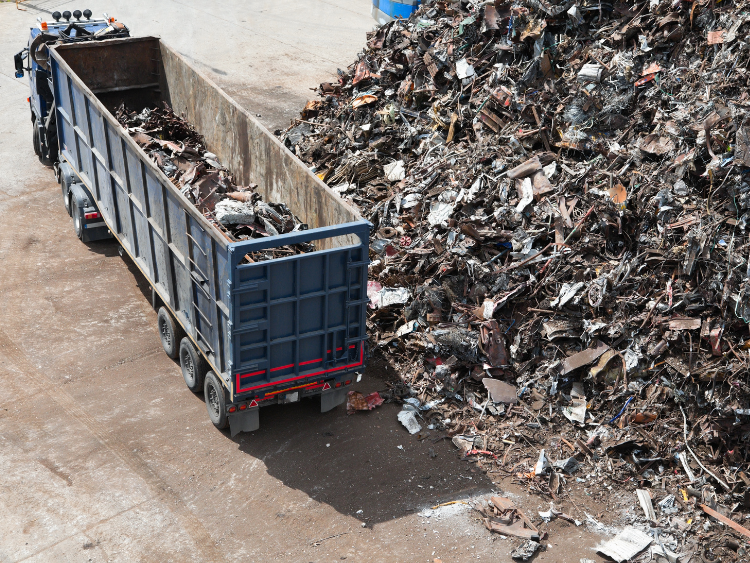
EU should tackle declining consumption, not scrap: Assofermet
Scrap demand in Europe is notably lagging behind supply, according to Italian steel trade association Assofermet. The European recycling industry collects around 100 million tonnes/year of waste metal, with the union effectively utilising about 80%, leaving 20% unutilised.
Unlike Italy, where a significant majority of steel production relies on electric arc furnaces, the remainder of European steel is predominantly produced through blast furnaces. The 20% scrap exported “is not a theft that is perpetrated to the steelmaking sector but rather the consequence of the structural decline in European steel production,” Assofermet president Cinzia Vezzosi said at Made in Steel in Milan attended by Kallanish last week.
“As the production decreases, the availability of that type of material [scrap] increases,” she added.
In order for the industry to continue to have technologically sophisticated recycling businesses, they must maintain their operational margins and be allowed to export the surplus of scrap.
Assofermet is urging the European Commission to take this perspective into account when evaluating its steel action plan. Scrap is not merely a resource, said Vezzosi; it holds strategic importance and is available for the European steelmaking industry.
This comes in response to European steelmakers’ attempts to ban scrap exports. Steelmakers are struggling to secure a ban on the export of 18 million tonnes of scrap that departs from Europe annually, with Antwerp being a significant point of departure.
“We have been engaged in discussions for 11 years regarding a duty equivalent to the CO2 that has been paid on that scrap. The scrap is directed towards nations that are excluded from the ETS protocols, thereby gaining an unfair competitive advantage over us. We have managed … to have this approved in the European Parliament. Then when we returned to the Commission, the Germans obstructed it,” Gozzi said at the trade show (see Kallanish passim).
Meanwhile, Assofermet believes the Steel & Metals Action Plan is not addressing the industry’s key issues. The proposed measures are vague and only outlined in general terms.
“The Plan focuses on issues and aspects that affect production but does not consider, except in a completely lateral way, the main problem that is causing the decline of the European steel industry: the lack of demand … It is now crucial to enhance the market demand that has diminished over the years …[and] prevent EU steel production from further declining, damaging the entire supply chain, including end-users,” the association says in a note.
Natalia Capra France


Marcegaglia conveys cautious optimism, eyes Fos upstream integration
Antonio Marcegaglia is cautiously optimistic about European steel demand and pricing amid a highly uncertain landscape for the remainder of the year.
At Made in Steel in Milan last week, he told Kallanish he does not anticipate any decline in European demand, which will largely align with last year’s figures. Additionally, Europe may experience a positive impact from the German government’s decision to accelerate spending. The volume of imports is likely to remain limited due to the implementation of safeguard measures, the Carbon Border Adjustment Mechanism (CBAM), and additional duties.
In the latter half of 2025, Marcegaglia anticipates a gradual recovery in demand, contrasting with supply which is expected to remain stable. Consequently, pricing may stabilise at slightly higher levels compared to current figures.
The fluctuating dollar is the primary reason for the current decline in coil import prices. However, constraints on import volumes are mitigating the impact of this price reduction. The disparity between imported and European domestic coil prices is now becoming significant, but Marcegaglia claims that despite pressure from imports, there is no indication that European prices will decline, because of narrow margins.
Downstream margins were under pressure in the first quarter. However, the company recorded an improvement in February and March. Overall, Marcegaglia has observed a marginally improved performance in stainless steel relative to carbon steel.
The current climate of uncertainty has resulted in a noticeable deceleration in both private and public investment. Additionally, the decline in consumer goods consumption has hampered demand. The imposition of tariffs is adversely impacting global trade, which constitutes a crucial component of demand within the steel sector. Inventory levels have remained relatively low, and the first quarter has shown satisfactory performance regarding shipments, Marcegaglia observed.
“You build up your shipments day by day with a very short-term view. This again does not help prices and does not help margins … Demand is not so good, but also not so bad – but, price wise, we are seeing an increase from the very low levels of November last year,” Marcegaglia said.
“From those lows we can say that prices have been going up; but again, the Trump administration and the depreciation of the dollar are raising concerns regarding the sustainability of the price growth trend, so there is a kind of pause in the price increase momentum. In some areas, this is still going on; for example, in the tubes segment … but in other segments, prices are stagnating,” he added.
Seasonality is likely to provide a beneficial impact. The market may witness a gradual recovery in prices, as the current absolute price levels, particularly in Europe, are not significantly elevated, he adds.
Marcegaglia confirmed to Kallanish the firm is increasing investment in the relaunch of its For-sur-Mer steel mill, in southern France, formerly known as Ascometal, to €800 million ($902m), a “bold but necessary” move. “It is a partial upstream integration for both carbon and stainless steel,” he explained.
Stainless melting will continue to be carried out at the Sheffield unit, but re-rolling will happen in Fos. The project will cover approximately 30% of Marcegaglia’s needs of coil and slab procurement, which has been strongly impacted by the uncertainty associated with duties and the unpredictability regarding the future supply of steel in Europe, particularly as EU production trends down.
“Will there be enough melted steel in Europe in five to ten years time? I think it’s very wise and sound to have a partial integration of our needs and supply chain,” Marcegaglia noted. He added the company is negotiating long-term electricity pricing with the French government and EDF. Groundbreaking is planned for the beginning of next year.
Natalia Capra France

Knauf Interfer invests in strip galvanizer
German steel distributor Knauf Interfer has acquired a majority stake in the H. D. Lenzen Group, based in Hagen. It is thereby strengthening its Steel division by expanding its portfolio in strip finishing, Kallanish hears from the company.
H.D. Lenzen was founded in 1985 and has two high-performance sites in Hagen. According to Knauf Interfer, it is recognised as one of the world’s leading suppliers of electrolytically galvanized precision steel strip. It serves international customers from sectors including the automotive, furniture, electrical and construction industries.
Peter and Philipp Plobst, the current managing directors, will remain associated with the companies as shareholders and in leadership roles.
The transaction also involves Lenzen subsidiary Galvano, which has been refining metal strip at its site in Halver, North Rhine Westphalia, for 100 years.
Knauf Interfer Cold Rolling focuses on the production of cold-rolled steel across a wide range of grades, as well as electrolytic tin-plating and galvanizing at its Iserlohn plant, previously named Giebel.
Christian Koehl Germany

CBAM extras must be discussed in supply chain to prevent major disruption of steel trade in 2026
The CBAM for imported products was proposed by the EU to prevent carbon leakage within the EU Emissions Trading System (ETS), and was expected to be implemented from January 1, 2026.
Despite the short time-frame, European steel market participants were still digesting important details on how the mechanism will be administered.
Effectively, CBAM will come into force on January 1, but the fiscal implications will only become effective in May 2027.
“The EU delayed the operational handing of CBAM until May 2027 because the [electronic] platform for handing the certificates is not ready for trading,” Alexander Julius, president of European steel distributors’ association EUROMETAL, said during his presentation in Milan.
The price of CBAM certificates will be linked to ETS prices. For example, EU carbon emissions allowance prices hovered around €71.52 ($80.49) per tCO2e in January this year, peaked at more than €81 per tCO2e in mid-February, and then dropped below €60 per tCO2e in early April.
Under CBAM, those involved will need to buy certificates on the EU platform and can also resell those which are not used, Fastmarkets understands.
There are actual values of CO2 in imported goods, and the European Commission has also introduced default values that can be accepted in the future and will be set in the system. But the default values will be higher than the actual values, Fastmarkets understands.
To import steel when CBAM is in effect, customs-authorized companies need to be registered with the platform to be able to pay for CBAM certificates.
Initially, CBAM declarations will need to be done for Scope 1-2 emissions, but eventually also for Scope 3.
Declarants will be held liable for declaring incorrect emissions values.
Therefore, to provide more transparency, non-EU suppliers can register their installations on the EU platform to declare their Scope 1-2 emissions. But this will have to be checked by EU verifiers and certification companies.
“This is a good plan because not every declarant can risk registering [CO2 emissions] independently,” Julius said.
There will be around 100,000 companies that will be authorised on the EU platform to buy CBAM certificates, he estimated.
Dangerous misunderstanding
But while some buyers felt that the delay of CBAM certificates purchases may relieve some immediate financial pressure, that impression was faulty because the exposure to financial risk remained the same.
“The problem with this [delay of certificates sales] is that we don’t know what will be the exact CO2 values under ETS,” Julius said.
“It’s a cashflow issue,” he added, “because in 2027 the declarant will have to buy all the certificates for the goods that have been fiscally cleared in 2026. And the declarant has to build [financial] reserves. And CBAM certificate prices must be displayed in the final pricing.”
In the first year of CBAM – 2026 – Importers will have to pay for only 2.5% of embedded emissions, but this rate will gradually increase to 100% of grey emissions by 2034.
Therefore, the costs of handling imports will dramatically change next year, and buyers should start to prepare now.
“Everything that has been ordered from non-EU countries for the second half of 2025 will be fiscally treated on January 1, 2026, will be subject to CBAM and CBAM extras,” Julius said.
High extras for carbon emissions-intense steel
The complexity of CBAM might become a significant burden for smaller business, with intermediary companies simply unable to digest the costs.
“In the future, we will need much more stronger cooperation in the supply chain between importing companies, processing companies [and] up to the end-user company,” Julius said.
“We made calculation based on our imports volumes in 2024,” a buyer in Northern Europe said, “and CBAM handing costs are estimated to be €6.5 million [$7.3 million]. This is totally unmanageable.”
A buying company will need to be familiar with the system to be able to take the cost factor into consideration. Extras will have to be paid for imported steel with higher emissions, bringing additional costs of round €56 per tonne, Julius said.
One way to address the issue could be the introduction of “emissions surcharges” – adapting contracts to include advance emissions-tracking coordination between mills, customers and logistics partners, and to consider the use of digital systems for emissions reporting and certificate management.
“Nobody is willing to pay [emissions] extras, but under CBAM steel prices will increase dramatically,” Julius said. “These extras need to be discussed in the supply chain.”
What’s next?
In the fourth quarter of 2025, the European Commission will introduce CBAM amendments, including a potential extension of its scope downstream and additional anti-circumvention measures.
The proposed amendments will be in three areas – to address the problem of carbon leakage for CBAM goods exported from the EU to third countries; to introduce a CBAM scope extension to certain steel downstream products, to address the risk of carbon leakage being pushed further down the value chain; and to propose anti-circumvention measures, including those against resource shuffling.
While steel imported into the EU to produce finished goods will be subject to CBAM regulations, some steel derivatives – products made from steel, such as auto parts, cookware, nails or furniture. – can be imported directly without falling under the scope of CBAM. But this carbon leakage might do further damage to the already-suffering manufacturing industry in the EU, trade sources said.
“Instead of bringing the steel coil, beam, section or whatever from Asia and processing it in the EU,” a mill source said, “we buy the ready-made steel structure without quota, without anti-dumping duty and CBAM. That’s killing our downstream industry.”


75th Anniversary of the Schuman Declaration and EUROMETAL’s legacy in the European project
Today marks the 75th anniversary of the Schuman Declaration — the visionary proposal that placed coal and steel at the core of a unified Europe and laid the foundations for decades of peace, prosperity, and collaboration across the continent.
At EUROMETAL, we proudly reflect on the fact that our own roots are closely tied to this foundational moment. In the same year — 1950 — just months after Robert Schuman’s historic speech laid the foundation for peace through coal and steel cooperation, steel and metal stockholders came together in Paris to establish FIANATM – Fédération Internationale des Associations de Négociants en Aciers, Tubes et Métaux, on 7 December. Their vision was to unite national associations of steel, tube, and non-ferrous metals merchants to support industrial recovery, foster cross-border trade, and reinforce economic cooperation — the very principles that underpinned the European project.
In 1999, FIANATM merged with Brussels-based FENA, the Fédération Européenne des Négociants d’Aciers, to create EUROMETAL, the European Federation of Associations of Steel, Tube and Metal Merchants.
From the beginning, we have been part of Europe’s industrial backbone — and today, we continue to serve as the voice of steel distribution across the continent.
Our members — stockholders, service centers, and traders — are critical to the functioning of the EU internal market. We connect producers with end-users, ensure supply chain flexibility, and are actively supporting the green and digital transitions that will shape Europe’s next industrial era.
Seventy-five years after the Schuman Declaration, we remain convinced that the future of Europe depends not only on its ability to produce, but also on its ability to connect, distribute, and transform — fairly, efficiently, and sustainably.
At EUROMETAL, we honour the legacy of those who helped build post-war Europe. We are proud of our place in this history, and we are fully committed to helping shape its future — grounded in industrial strength, market openness, and shared prosperity.

EUROMETAL at Made in Steel 2025: driving the future of European steel
Three intense and inspiring days at Made in Steel in Milan have come to a close — and EUROMETAL was proud to be part of the conversation shaping the future of our industry.
Yesterday, our President Alexander Julius, participated in the panel discussion “Road to the Future: Decarbonizing the European Steel Industry While Remaining Competitive.” He addressed the pressing implementation of the Carbon Border Adjustment Mechanism (CBAM), the uncertainty still surrounding its application, and the urgent need to inform and prepare all actors across the steel supply chain.
The session brought together key voices from across Europe and the global steel industry in a powerful exchange on how to balance decarbonisation efforts with economic competitiveness.
Over the course of the fair, EUROMETAL had the opportunity to meet with members of the EUROMETAL Presidency, connect with numerous members and associates, and engage with colleagues, partners, and industry stakeholders — both exhibitors and visitors — at this essential gathering for Southern Europe’s steel sector.
A special thanks to Siderweb for organising this outstanding event. Thank you to all who contributed to these meaningful discussions. See you at the next edition!


UK industry welcomes US-UK trade deal eliminating 25% import tariff on steel, aluminum
UK industry associations have welcomed the US decision to eliminate the 25% import tariff on imports of UK steel and aluminum as part of a landmark bilateral free trade agreement announced May 8.
The agreement, unveiled in separate statements from the US and UK governments, is expected to provide a welcome boost for the UK metals industry, which continues to suffer from low margins arising from weak demand, high production costs and a highly competitive import market.
In a statement released shortly after the agreement was announced, UK Steel commended the UK government for its perseverance in securing an agreement that allows for the resumption of UK steel exports to the US.
According to UK Steel, the UK exported around 180,000 mt of semi-finished and finished steel to the US, representing approximately 7% of the UK’s total steel exports.
While acknowledging that the removal of tariffs offers some welcome respite for the industry, UK Steel warned that US tariffs on the rest of the world still represented a threat to UK steel producers through potential trade diversion and heightened import pressure.
“This deal will offer major relief to the UK steel sector at a time when it is battling numerous other challenges, not least global overcapacity, high energy costs and weak demand, said UK Steel’s director general, Gareth Stace.
“The impact of US steel tariffs is not limited to UK exports, but also the damaging consequences of trade diversion from other markets. Bolstering the UK’s trade defences is therefore also paramount,” he said.

The UK Aluminium Federation, or ALFED, also welcomed the US-UK trade agreement, describing it as “an important moment for UK aluminum producers.”
According to customs data, the UK exported around 7,100 mt of semi-finished and finished aluminum products to the US in 2024, representing approximately 3% of the UK’s global export total.
Acknowledging that the agreement offers greater certainty for the UK aluminum industry, as well as downstream important industries such as automotive and aerospace, ALFED warned that aluminum producers continue to face ongoing headwinds, including high energy costs and tightening emissions regulations.
ALFED noted the ongoing impact of the US tariffs on the UK aluminum recycling industry, with higher US demand for imported aluminum scrap serving to drive up UK domestic prices while undermining the country’s ability to retain high-quality secondary material for remelting and reuse.
“This ‘scrap leakage’ weakens the foundations of a viable circular economy and risks placing further pressure on UK decarbonisation goals,” the statement said.
Market participants surveyed by Platts said they saw little immediate impact from the agreement on aluminum prices, noting that UK exports to the US are modest relative to global trade volumes.
“The UK isn’t a big player, so I don’t think there will be any immediate impact on premiums,” said a trader.
Despite the limited impact, market participants acknowledged that the US-UK trade agreement raises the prospect of similar US trade agreements being announced within the coming weeks.
“It has made people question who else might get an [aluminum] exemption, as there had been so many comments that any exemptions would undermine the whole US tariff strategy,” the same trader said.
Another trader said it demonstrated that aluminum exemptions “are on the table for the US.”

Further downstream, Mike Hawes, CEO of the UK Society of Motor Manufacturers & Traders, described the free trade agreement as “great news for the industry and consumers.”
Hawes said the reduction of US tariffs on UK cars from 27.5% to 10% across a set quota of 100,000 vehicles would provide much-needed relief for the UK auto industry.
“We hope that [the agreement] will lead to broader and deeper cooperation that reduces barriers to trade still further, charting a path to economic growth for both nations,” he said.
Platts, part of S&P Global Commodity Insights, assessed UK steel hot-rolled coil at GBP535/mt DDP West Midlands on May 8, stable week over week.
Author Euan Sadden


EU hot-rolled coil quota exhausted by South Korea
The EU’s safeguard import quota for hot-rolled coil has been exceeded by South Korea, according to European Commission data May 8.
This comes after the EC reduced quota levels per country, effective April 1.
The initial quota amount for South Korea in the first quarter was 184,310 mt, which was reduced to 161,144 mt for Q2.
A 25% duty will now apply to any additional HRC imported from the country.
Despite this exhaustion by South Korea, quota levels for Turkey, India, Serbia, the UK, and other countries remain above 50%.
Platts, part of S&P Global Commodity Insights, assessed imported HRC in Northern Europe May 8 at Eur540/mt CIF Antwerp, down Eur15 over the month, the lowest level since Jan. 21.
Platts assessed the Southern Europe import price May 8 at Eur530/mt CIF Southern Europe, down Eur15 over month, the lowest level since Jan 13.
The price differential versus domestic HRC prices has widened since new safeguard measures came into effect, which could suggest that imports may be starting to look more attractive.
Some sources have also cited that import offers from some Asian suppliers are becoming increasingly more competitive, which has put pressure on the domestic market.
Platts assessed domestic HRC in Northern Europe May 8 at Eur645/mt ex-works Ruhr, stable day over day.

EU HRC prices remain rangebound amid bearish sentiment, regulation concerns
European hot-rolled coil prices remained stable May 8 as the domestic and import markets faced pressure.
“The market is pretty depressed, we’re probably going to see some price drops from the domestic guys, and on the imports as well,” a trader said.
There is also growing skepticism over the implementation of a Carbon Border Adjustment Mechanism and whether it will be delayed, with one trader confused over its impact on the domestic market. The same trader cited, however, that it would cause the import market to become quieter.
The source also highlighted the market’s reluctance to accept carbon credits, saying it’s an extra risk that the market is not ready to deal with yet.
Demand for European HRC remains relatively low, and a trader source does not expect much material to be custom-cleared in December due to weak demand.
On imports, a deal was heard coming from Algeria at $600/mt CFR Italy.
Platts, part of S&P Global Commodity Insights, assessed HRC ex-works Italy at Eur620/mt and HRC CIF Southern Europe at Eur530/mt, both stable with May 7.
Platts assessed HRC in Northwest Europe at Eur645/mt EXW Ruhr May 8 and imported HRC in Northern Europe at Eur540/mt CIF Antwerp May 8, both stable with May 7.

EU consults on US steel countermeasures, scrap exports
The European Commission has launched a public consultation on a new list of US-origin steel imports that could become subject to EU countermeasures. It is also consulting on possible restrictions on EU exports of steel scrap to the US, Kallanish notes.
EU negotiations with the US to find an alternative solution to tariffs are ongoing “both at political and technical level”, the Commission says. However, the bloc “continues to prepare potential countermeasures to defend its consumers and industry, in parallel with the negotiations and in case these fail to deliver a satisfactory outcome. While the public consultation is a necessary step in this process, it does not automatically result in the adoption of countermeasures.”
The tonnages of scrap exported to the US are much larger than the volumes of steel the EU imports from that trading partner. EU scrap exports to the US under HS code heading 7204 were at 189,827 tonnes in 2024, according to Eurostat data. This was down significantly from 694,975t in 2023 and 318,327t in 2022.
Compared to its list published 12 March of US-origin products that could be subject to EU countermeasures, meanwhile, the latest list includes a vast range of flat, long, stainless and other alloy finished steel products. However, the impacted tonnages are insignificant.
The most-imported of the affected products is HS code 7225, which includes alloy hot and cold rolled, and coated strip and plate, as well as electrical steel. This saw imports of 12,732t from the US in 2024, down from 20,279t a year earlier and 15,543t in 2022.
Previously, the products proposed for inclusion in these measures were various HS code 7302 rail products, 7304 seamless pipe products and 7305 and 7306 welded pipe classifications. The tonnages were also low. It is unclear whether these products have now been removed from consideration for potential countermeasures.
The scrap export restrictions are likely to have a larger impact, if US tariffs succeed in their aim of increasing domestic industry capacity utilisation, as higher steel output will require more scrap feedstock. However, the US has substantial supply of its own – after the EU, it is the largest supplier of seaborne scrap.
Adam Smith Poland