

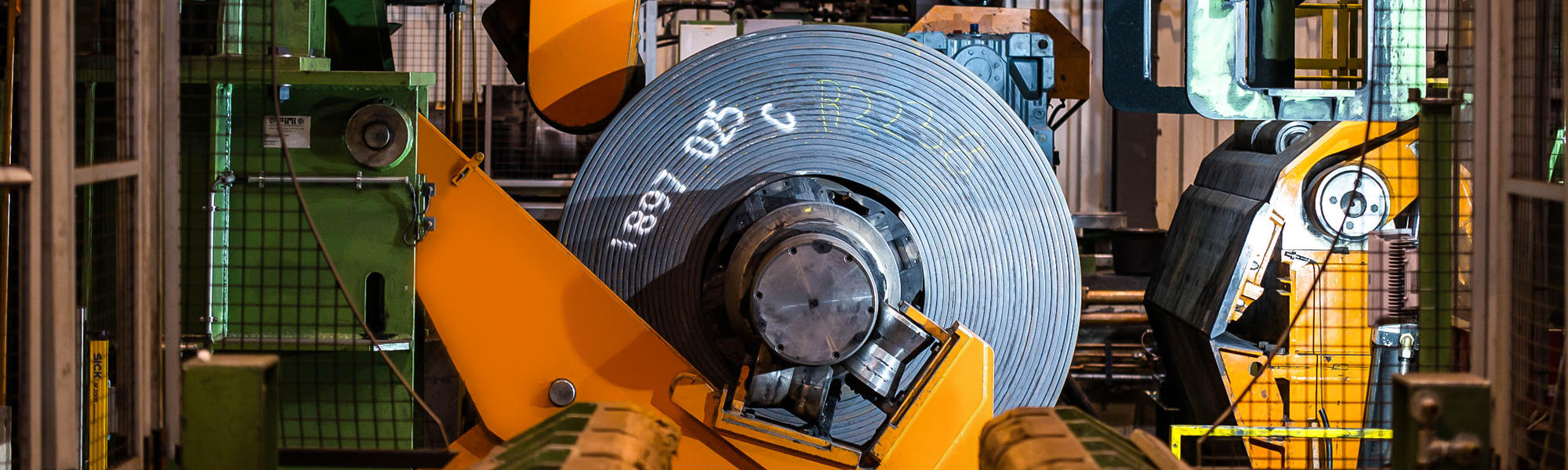
EU re-rollers increase prices on costlier HRC
Multiple Italian re-rollers, along with tube manufacturers in various European nations, are enacting price increases of €50/tonne ($52), industry sources tell Kallanis
The increase is effective immediately and is considered essential for margin recovery, given the unsustainable nature of current prices versus costs. Production costs for re-rollers are on the rise, influenced by escalating prices of hot rolled coil in Europe, coupled with additional import restrictions stemming from the EU’s safeguard measure review initiated this week.
Protectionist measures are affecting major coil processors and tubemakers, who procure substantial coil tonnages each year from third countries to meet their extensive processing requirements.
A significant number of re-rollers in Europe are expected to carry out extended production halts to align supply with demand during the holiday period.
Multiple sources confirm to Kallanish that production will cease for approximately three to four weeks. Given the present low inventory levels, the production halts are likely to result in diminished product availability, with shortages expected for specific grades.
The market is quiet after buyers finalised their purchases for December. January contract values, however, are expected to rise in accordance with the price hikes.
European HRC prices have increased in contracts to an average of €560-570/t base delivered, while derivative prices in Italy have shown stability, with tube discounts flattening on-month at 47-48 points.
ArcelorMittal is increasing coil prices by €20/t in Europe for delivery in the new year. Lead times at the steelmaker’s plants in Europe are now extended to February and March. For the few February allocations left of HRC, new asking prices are at €630/t base delivered. Prices for hot-dipped galvanised coil are also being pushed up, to €750/t base delivered.
The European Commission’s investigation will determine whether the EU safeguard measure on steel imports needs amending to reflect recent market developments, following a request by 13 Member States. The investigation will be concluded by 31 March 2025. Any resulting decision may become applicable as of the start of a new quarter – 1 April 2025 – including with a new TRQ volume.
Natalia Capra France


EU exempts Vietnam stainless producer from countervailing duties
The European Commission has exempted one Vietnamese supplier from EU countervailing duties on imports of stainless steel cold-rolled flat products, Kallanish notes.
It previously imposed duties on stainless steel cold-rolled flat products from Indonesia, Taiwan, Turkey, and Vietnam.
As no evidence was found that Lam Khang’s stainless steel cold-rolled flat products benefited from subsidies, the company has been granted an exemption from countervailing duties. Duties previously collected from Lam Khang-origin imports are to be refunded, with the amendment effective from 18 December and retroactively applicable from 8 May 2024.
Requests for exemptions from Trinox Metal Sanayi ve Ticaret A.Ş. (Turkey) and Yongjin Metal Technology (Vietnam) have meanwhile been rejected.
The EU’s definitive countervailing duty applies to CN codes 7219 31 00, 7219 32 10, 7219 32 90, 7219 33 10, 7219 33 90, 7219 34 10, 7219 34 90, 7219 35 10, 7219 35 90, 7219 90 20, 7219 90 80, 7220 20 21, 7220 20 29, 7220 20 41, 7220 20 49, 7220 20 81, 7220 20 89, 7220 90 20 and 7220 90 80.
Exemptions apply to the following producers:
| Country | Company |
| Taiwan | Chia Far Industrial Factory Co., Ltd. |
| Taiwan | Tang Eng Iron Works Co., Ltd.
Tung Mung Development Co., Ltd. Walsin Lihwa Corporation Yieh United Steel Corporation Yuan Long Stainless Steel Corp. |
| Türkiye | Posco Assan TST Celik Sanayi A.Ş. |
| Vietnam | Posco VST Co., Ltd.
Lam Khang Joint Stock Company |
Elina Virchenko UAE

Vallourec sells former German plant property
Vallourec has entered into an agreement to sell the majority of its Düsseldorf Rath property to CTP, Europe’s largest publicly-listed industrial property developer, Kallanish learns from the French pipemaker.
This will involve the sale of the approximately 900,000 square meter property for €155 million ($126.6m). The site was home to Vallourec’s primary tube production operations in Germany, which closed at the end of 2023 as part of the New Vallourec plan.
The transaction is expected to close around year-end, subject to customary closing conditions, including CTP’s receipt of the waiver of the city’s pre-emption right, the pipemaker notes.
“This transaction marks a major milestone for Vallourec, as we have now finalised the closures and sales of all of the major European assets targeted by the New Vallourec plan in less than three years,” says Vallourec chief executive Philippe Guillemot. “As a reminder, 80-100% of cash flows generated in the second half of 2024, including the proceeds from the sale of this facility, will be eligible for return to shareholders.”
Earlier, Vallourec announced it is divesting a logistics hub in Indonesia as part of its initiative to concentrate on its main operations (see Kallanish passim). The pipe manufacturer plans to divest its interests in PT CPPI and PT SCN, referred to as the Logistics Group, to CKB Logistics, a subsidiary of ABM Investama Tbk, for an estimated €20m.
Vallourec is also partnering with Advanced Supply Management Operations (Asmo), a joint venture between DHL and Saudi Aramco formed earlier this year, with a view to increasing its Middle East and North Africa market share.
Svetoslav Abrossimov Bulgaria

Erste: European automotive suffers loses, Chinese industry booms
European automotive producers are losing out on the Chinese market, which is still crucial for their sales, according to Erste Group research.
In the past five years, the share of German brands in the Chinese market has decreased by 6 percentage points. “Earlier, for example, Volkswagen sold about a third of its global car production in China in 2023. Over the last ten years, passenger car production in Asia has increased by 33%, and in China even by 68%. By contrast, it has fallen by 11% in Europe and by 24% in Germany,” Erste notes in a report.
Moreover, Europe’s share of global passenger car production has fallen from 28% to 23%, while Asia’s has risen from 56% to 68% during 2012-2023, the document shows.
“The share of European passenger car production in total world production is falling, but European countries are still among the world’s major car manufacturers: Seven of the top-15 passenger car manufacturers are from Europe,” Erste Group notes. “Fortunately, Chinese companies have not yet established themselves in Europe. The most difficult situation today is in the German car industry. The point is that, in Germany, the unit labour costs in the automotive industry are two times higher than in Italy or Spain and three times higher than in the Czech Republic and other CEE countries.”
The most delicate situation is at Volkswagen, whose management plans to close up to three –of 10 – German factories, cut VW employee wages by 10% and conduct layoffs. The unions, on the other hand, want the carmaker to give pay rises, Kallanish notes.
According to the bank, one option is to move production to a cheaper foreign country. “This is already happening, as German production of passenger cars reached a peak before Covid-19 in 2016. It has been declining ever since. On the other hand, in countries like the Czech Republic and Slovakia, passenger car production has been rising,” the report observes.
Global motor vehicle production reached its all-time high in 2017, with 97 million motor vehicles produced worldwide, 70% of which were passenger cars, Erste Group says. Then came the pandemic and production fell by a quarter by 2020.
Production reached 93m units last year and was only 4% below the 2017 record.
Svetoslav Abrossimov Bulgaria

Tony Harris appointed new head of SSAB Europe
Tony Harris has been appointed new head of SSAB Europe effective 1 February 2025, Kallanish hears from the Swedish company. He transitions into this role from his current position as head of sales and business development at SSAB Europe.
Harris has a commercial background at both small and medium-sized enterprises and multinational corporations, SSAB notes. His expertise covers not only sales and business development but also operations and general management, the company adds.
Since joining SSAB in 2014, following the merger with Rautaruukki, Harris has served as a key member of SSAB’s European management. Upon assuming his new role, he will also join SSAB’s executive committee. He will succeed Olavi Huhtala, who has announced his retirement.
“Tony has played a crucial role in driving SSAB Europe’s progress, demonstrating a deep understanding of our company’s operations and culture,” says SSAB chief executive Johnny Sjöström.
Christian Koehl Germany

Italian plate market enters quiet period with cautious hopes for price recovery in Q1
In Italy, trading picked up slightly in the past week, with buyers finalizing their bookings for the first quarter ahead of the year-end.
But trading was slow in general, and producer sources said they were getting 20-40% fewer orders in November-December compared with the same period last year.
As Fastmarkets reported earlier, Italian plate producers were trying to increase prices for new rolling and were targeting offers of €650 ($682) per tonne ex-works for the first quarter.
Some suppliers said they have had limited success, managing to seal higher prices in bookings with some clients.
But another supplier said that higher prices could have been sealed mainly for project business, while the spot market remained weak.
“For small- and medium-sized businesses, there is a struggle; there is fierce competition downstream. We will see if distributors and steel service centers manage to [increase] prices downstream in the new year,” a supplier source said.
Most buyer sources estimated tradeable prices at no higher than €630 per tonne ex-works in the week to Wednesday, claiming that some suppliers were still accepting lower prices to fill gaps in order books, particularly for commodity grades.
Deals were reported at €630-640 per tonne ex-works during the assessment week.
As a result. Fastmarkets’ weekly price assessment for steel domestic plate, 8-40mm, exw Southern Europe was €630-640 per tonne on Wednesday, narrowing upward by €10 per tonne from €620-640 per tonne on December 11.
Domestic suppliers were taking prolonged production stoppages in December and January, and industry sources expressed hopes that the move might help to balance the market so the Italian rerollers would be able to achieve higher prices in new-year trades.
The recent news about the safeguards review, announced by the European Commission on Tuesday December 17, also sparked some cautious optimism among sellers.
No details have been revealed yet about the potential changes to steel safeguard measures, but sources familiar with the matter said that quarterly quotas for some origins will likely be reduced and/or new individual quotas might be imposed.
Sources suggested that the Commission’s move will further limit appetite for overseas bookings and therefore support a rebound in European prices in the medium to long run.
“We are heading into [an] era of global trade wars and growing protectionism. Looks like reliance on domestic mills will only increase in 2025,” a buyer in Italy said.
Sources said that interest in overseas plate has already been somewhat cooled by talks about a potential anti-dumping investigation, and the recent safeguard news announcement might result in stronger reliance on European plate.
Some suppliers — notably South Korea, Indonesia and India — have significantly increased heavy plate shipments to the EU in 2023-2024.
Notably, in January-October 2024, total quarto plate deliveries from South Korea to the EU amounted to 640,513 tonnes, compared with 618,070 for the entire year of 2023, Global Trader Tracker (GTT) data showed. In 2022, South Korea shipped only 357,504 tonnes of plate to the bloc.
In the first ten months of 2024, India supplied 439,415 tonnes of quarto plate to the bloc, compared with 349,901 tonnes for the entire year of 2023.
In January-October 2024, quarto plate deliveries from Indonesia to the EU stood at 302,109 tonnes, compared with 328,894 for the entire year of 2023.
Offers of February-shipment plate to Italy from South Korea and Indonesia were heard at €570-580 per tonne CFR.


ArcelorMittal increases flat steel prices in Europe
Notably, HRC offer prices from ArcelorMittal with lead times in February-March were heard at €630 ($661) per tonne ex-works or delivered in Northern Europe, according to sources.
This is up from the producer’s most recent offer for HRC heard at €600 per tonne ex-works in November-December.
Sources familiar with the matter told Fastmarkets that the mills had seen some pick-up in orders in recent weeks due to restocking, reaching levels of €580-590 per tonne ex-works or delivered in deal for January delivery coil.
Besides, the recent news about safeguards review, announced by the European Commission on Tuesday December 17, also sparked some cautious optimism among sellers.
“The appetite for import [HRC] has already been lower in recent months due to the anti-dumping probe against HRC from [Egypt, India, Japan and Vietnam] and the changes to safeguards made in July; it takes some time to clear up what’s in the pipeline, what’s sitting imports, but by the end of the first quarter [of 2025], the lack of imports will start to be visible [in Europe],” a buyer source said.
Another source suggested that the move was made due to some progress with long-term contracts negotiations with end users, notably in the automotive sector.
Notably, several industry sources reported some closures of half-year contracts for the first half of 2025 with a discount of €70-80 per tonne versus the second half of 2024, sources told Fastmarkets.
Initially, automakers were seeking for a triple-digit discounts of €100-150 per tonne, Fastmarkets reported.
Some contracts were heard done at €650-670 per tonne compared with €730-750 per tonne from the second half of 2024, sources told Fastmarkets.
For the full-year contracts, one source reported a discount of €80-90 per tonne versus full-year 2024 contracts.
Buyer sources told Fastmarkets that it remains to be seen whether the new levels would be sealed in deals, considering still-weak end-user demand.
“That’s a traditional move [from ArcelorMittal] to increase prices ahead of the year end. Will see how the market evolves in January,” one buyer in Europe said.
“It’s difficult to increase steel prices against the very low consumption,” a distributor said. “And we don’t see consumption increasing in the next couple of months, so it will be difficult for the EU mills to increase [steel] prices on a long-term basis just based on lower imports,” they added.
Fastmarkets calculated its daily steel hot-rolled coil index domestic, exw Northern Europe at €561.13 per tonne on Tuesday, down by €0.75 per tonne from €561.88 per tonne on Monday.
The index was down by €0.30 per tonne week on week and by €1.37 per tonne month on month.

EU starts reviewing safeguard measures on certain steel product imports
The European Commission has started a functioning review of safeguard measures on imports of 26 steel product categories after receiving a request from 13 member states, according to a Dec. 17 notice in the Official Journal of the EU.
A definitive safeguard measure on certain steel products was imposed on Jan. 31, 2019, for an initial three-year period and was then prolonged until June 30, 2024, after a prolongation review investigation
The EC then undertook a second prolongation review on June 24, 2024, resulting in its further extension until June 30, 2026.
The current safeguard measure is based on historical trade flows and consists of a tariff-rate quota. Once the relevant TRQ is exhausted, a duty of 25% is levied.
The EC said the November request from the 13 member states included evidence of changed circumstances since the last review of the measure.
“In particular, the request contains information regarding the contraction in EU demand for steel, resulting in widening gaps with the current level of duty-free quota volumes,” it said, adding that it showed that China’s higher steel export to major regions had pushed exports from other markets to the EU.
It said this called for a reassessment of the allocation and management of the TRQs.
The product categories included non-alloy and other alloy steel products — hot-rolled and cold-rolled sheets and strips, quarto plates, merchant bars and light sections, wire rods and cold-finished bars — and stainless products — HR and CR sheets and strips, HR quarto plates, bars and light sections and wire rod.
It also included electrical sheets, metallic-coated sheets, organic-coated sheets, tin mill products, rebars, angles, shapes, and sections of iron or non-alloy steel, sheet piling, railway material, gas pipes, hollow sections, seamless stainless tubes and pipes, other seamless tubes, large welded tubes, other welded pipes, and non-alloy wire.
The EC review would assess, based on evidence from interested parties, whether any adjustment to the measure was warranted to adapt to market evolution and align with stakeholder interests.
As part of the review, the EC made questionnaires for EU producers and users available and called for written submissions from interested parties by Jan. 10, 2025. It also said it would allow interested parties to comment on other parties’ submissions.
The EC planned to conclude the review by March 31, 2025, adding that any resulting decision could become applicable from April 1, 2025, including a new TRQ volume.
Platts, part of S&P Global Commodity Insights, assessed domestic HRC prices in Northern Europe at Eur560/mt ex-works Ruhr Dec.16, down 19% since the start of 2024.


Moselle river closure blocks steel, metal trade in Germany
Around 70 ships remain affected by the closure of a section of the Moselle river in western Germany, disrupting shipments of steel, aluminum and other commodities, according to the federal Waterways and Shipping Administration.
A ship loaded with around 1,500 mt of scrap cargo crashed into Muden lock on Dec. 8 while on its way to Luxembourg, damaging the lock on the Moselle, which is one of the busiest tributaries of the Rhine, said Eric Oehlmann, head of the directorate-general for the administration, known as WSV, in a Dec. 13 statement.
S&P Global Commodity Insights contacted the WSV for an update Dec. 16, but had not yet received a response by the time of publication.
Oehlmann said the WSA Mosel-Saar-Lahn was working to repair the lock damage and find solutions so that the affected ships could leave the Moselle as quickly as possible.
“The collision of a ship with the Muden Moselle lock is a serious incident with significant consequences,” he said. “The collision with the gate shows the great importance of our waterways for the economy and the supply of our society.”
He said the WSV had responded quickly to try keep the consequences for all system partners as low as possible and would be working over the upcoming holidays.
“Intensive work is currently being carried out to find solutions to enable the ships to continue their journey,” Oehlmann said, adding that the gate wings were recovered Dec. 12 and the second inspection lock was installed, with preparations being made to drain the lock chamber with pumps to examine the damage in the lower gate area.
‘Logistical worse-case scenario’
The Saarland arm of WV Stahl, Stahl-Verband-Saar, posted on LinkedIn Dec. 12 that repair work on the damaged lock was expected to take until March 2025, which would disrupt steel and other metal trade flows across Europe.
“The forecast that the Moselle locks in Muden would not be repaired until March 2025 shocked us. In order to limit the economic damage to companies in the Saarland steel industry as much as possible, the repair work must be pushed forward with all its might,” Stahl-Verband-Saar said in the post.
“The failure of the lock leads to a total failure and complete paralysis of the waterways, thus making the delivery of raw materials and the shipment of products on this important transport route impossible. Now we have the logistical worst-case scenario,” it added.
Stahl-Verband-Saar said it had been campaigning for the expansion of Moselle locks for years, as the bottleneck problem was well known.
There had not yet been much impact on the market, with one Benelux scrap recycler telling Commodity Insights there was not much being affected at the moment.
A German scrap recycler also said he had yet had to divert any shipments from the Moselle.
EU HRC prices inch down on lower offers
European hot-rolled coil prices inched down Dec. 17 as some mills lowered their offers for January-February delivery in order to fill production.
“Mills reduced domestic offers to fill January-February production,” a Germany-based distributor said.
Offer levels for March delivery remained at Eur600/mt ex-works Ruhr, sources said.
“Yes, mills have raised offers for January-February delivery,” another Germany based distributor source said. “However, for March they ask 600 plus. For the first half year 650, which they have achieved in some cases.”
Market activity has been limited, as most participants are heading into the holidays, sources said. “Prices are stable with no movement in market activity,” a Germany-based service center source said.
“The market has been very weak,” an Italy-based distributor said. “Everybody is waiting for the last day of activity, which is Friday, Dec. 20.”
Platts assessed Northwest European HRC at Eur555/mt ex-works Ruhr, down Eur5 day over day.
Meanwhile, Platts assessed Southern European HRC at Eur555/mt ex-works Italy, stable day over day.
The interest in imported HRC remained low due to comparable domestic prices, as well as concerns around safeguard duties and longer lead times.
“Import prices are not that interesting,” the Germany-based source said. “Quota, safeguard duties and tariffs are all concerns, making imports unattractive to buyers.”
Platts assessed imported HRC in Northwest Europe at Eur540/mt CIF Antwerp, stable day over day.
Meanwhile, Platts assessed imported HRC in South Europe at Eur535/mt CIF Italy, down Eur5 day over day.