

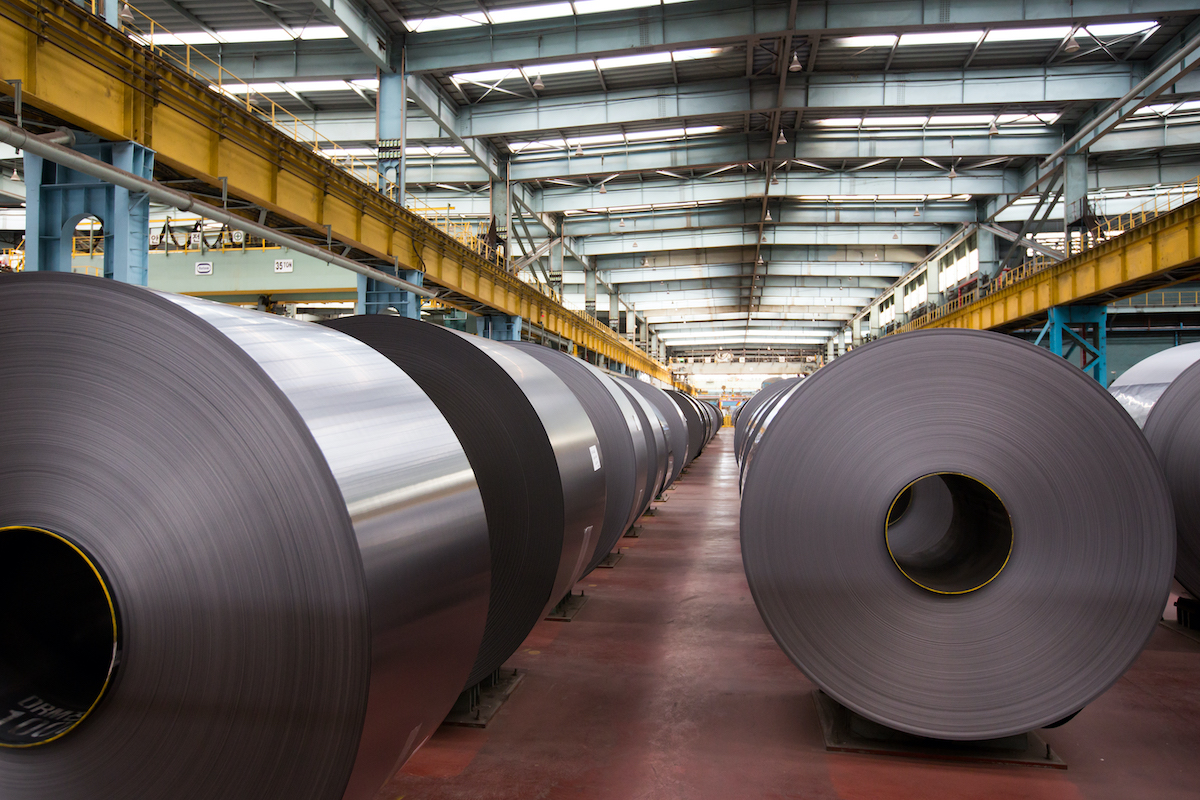
UK considers CRC tariff quota revocation
The UK Trade Remedies Authority (TRA) is reviewing whether the tariff-rate quota measure on category 2 steel – cold rolled coil – imports should be revoked, following an application made by Tata Steel UK. The authority’s preliminary view is the change in UK market conditions warrants the revocation.
The product in question falls under HS codes 72091500, 72091690, 72091790, 72091891, 72092500, 72092690, 72092790, 72092890, 72099020, 72099080, 72112320, 72112330, 72112380, 72112900, 72119020, 72119080, 72255020, 72255080, 72262000 and 72269200.
The current safeguard measure is due to expire on 30 June 2026.
The application suggests that as a result of a lasting change of circumstances, UK producers would cease to suffer serious injury if the safeguarding remedy were revoked.
Tata Steel ceased ironmaking in the UK in September and plans to resume crude steelmaking via the electric arc furnace route only in late 2027 (see Kallanish passim).
The period of investigation is set as 1 January 2024 to 21 October 2024. The quota measure was extended on 1 July 2024, but the relevant period of investigation for that extension review ended on 31 March 2023. Interested parties must submit comments by 24 November.
“Based on the application received from TSUK, and the evidence provided by them, it is the TRA’s preliminary view that the conditions in Regulation 35A(4) apply and that a recommendation should be made to the Secretary of State to revoke the definitive safeguarding measure of Category 2 steel products,” TRA concludes.
Separately, the Secretary of State for Business and Trade has accepted the TRA’s recommendation to maintain the 60.4% anti-dumping duty on imports of steel ropes and cables from China, protecting the UK’s £36 million ($45.6m) industry. The measure was among those inherited from the EU. The TRA conducted a transition review to establish whether it was still suitable for the UK’s needs.
In its final recommendation, the TRA recommended the anti-dumping measure be maintained for a further five years until 21 April 2028. The 60.4% duty also applies to some South Korean and Moroccan producers; however, the remainder from these jurisdictions are levied with zero duty.
Adam Smith Poland


Old scrap uptake challenges EU steel sector: Assofermet
The European steel sector should allocate resources towards innovation and technology to enhance the utilisation of old scrap, Italian steel trade association Assofermet president Cinzia Vezzosi tells Kallanish.
Anticipated trends indicate that old scrap from demolition grades will constitute the predominant portion of metal waste in the coming years. This shift is largely attributed to the manufacturing and steel sectors’ forecast of a decline in metal waste, driven by advancements in technological innovation that enable companies to minimise their waste output.
The European steel industry is characterised by ageing mills and EAFs. High-quality scrap can be obtained from the scrap sector, but the procurement and processing of certain scrap qualities, such as the high E40 shredded automotive grade represents a significant cost for merchants.
The purchase of car bodies entails substantial expense, alongside the investment in equipment and skilled personnel required to process material and effectively refine it into high-quality scrap. But there is reluctance from steelmakers to pay a premium for this material.
The utilisation of lower-quality demolition scrap is contingent on steelmakers’ investment in innovation and the adoption of new EAFs.
Steelmakers are instead allocating resources towards the acquisition of new shredders to enhance vertical integration and reduce reliance on external suppliers.
Direct reduced iron exhibits similar characteristics. New DRI capacity is being introduced in Europe and substantial investment will facilitate the establishment of new facilities. The challenge of sourcing high-quality DRI is anticipated to become significant, given the limited availability of high-grade iron ore.
Steelmakers should allocate resources towards innovation to effectively utilise lower iron content DRI, Vezzosi believes.
The Italian scrap sector is poised to allocate capital towards enhancing equipment capabilities. The availability of scrap is projected to decline in the upcoming years while old scrap is expected to significantly increase as new EAFs in Europe are set to replace the traditional blast furnace method.
“It is crucial for steelmakers to accelerate the revamping of their steelmaking processes in order to adapt to a more effective and lower quality scrap usage,” Vezzosi comments.
“Countries like Turkey and the US have made significant investments in advanced EAFs and latest generation equipment designed to utilise older and lower quality scrap, while maintaining the integrity of the finished product. We should follow their example,” she adds.
Natalia Capra France

CRC keeps lagging behind in northwest Europe
As coil prices consolidate in northwestern Europe, cold rolled coil activity stands out as being particularly slow.
One French trader bemoans the worrying silence on the CRC market. “When we send offers to our customers, we do not get any feedback whether they are interested at all. Normally, they give you at least some reply so that you know what’s going on,” he tells Kallanish. “But then, silence is an answer in itself, isn’t it?”
He believes his customers are also lacking feedback from their buyers. He sees prices for imports of CRC at around €690/tonne ($727) cfr Antwerp, following the recent uptick. This is not competitive with European offers that keep sitting at around €650/t ex-works, still defying the hike announcement of €40/t that came in early October.
One German buyer points out that CRC has, over time, become very much the domain of importers, while EU mills have lost interest in it. “They have built up so much galvanizing capacity here that they prefer going for the zinc version right away, no matter if with hot-rolled or cold-rolled base material,” he says.
A German analyst, too, notes that domestic prices for CRC have picked up minimally, but by less than he had expected, while hot rolled coil has risen by 2% since the beginning of the month to over €560/t. Looking ahead, however, he predicts an increase for both products by 7% until December, and possibly by a bit more for galv.
Christian Koehl Germany

Spanish HRC market weakness persists on lower demand
The Spanish hot rolled coil market continues to experience persistent weakness, driven by lower demand and a stagnant industrial environment as it moves into the third week of November. Most market participants anticipate challenging conditions for the rest of the year, Kallanish understands from local service centre sources.
“Demand from major consuming sectors has consistently fallen short of expectations throughout the year,” one supplier notes. “Activity remains far below the usual ‘normal’ level, and the industry has been in a complicated situation since the summer. The outlook for the rest of the year is not optimistic.”
A key factor contributing to the slump is reduced consumption in the automotive sector, which is weighing on the HRC market. The solar energy sector, meanwhile, is also experiencing uncertainty, with many primarily private projects remaining on hold.
“HRC sales in Spain remain weak. Major service centres are resisting offers below €590-600/tonne, but with pressure from international markets, they are likely to adjust their prices in the coming weeks,” another market source comments.
Spanish mills are currently quoting S235JR grade HRC at around €570-580/t ($602-612) ex-works, with some producers already preparing to reduce offers by €10/t. Meanwhile, HRC import prices have remained stable for nearly a month at €580-590/t cfr, which has limited their appeal to Spanish buyers.
Todor Kirkov Bulgaria

European Commission Economic Forecast: a gradual rebound in an adverse environment
After a prolonged period of stagnation, the EU economy is returning to modest growth, while the disinflation process continues.
The European Commission’s Autumn Forecast projects GDP growth in 2024 at 0.9% in the EU and 0.8% in the euro area. Economic activity is forecast to accelerate to 1.5% in the EU and to 1.3% in the euro area in 2025, and to 1.8% in the EU and 1.6% in the euro area in 2026.
Headline inflation in the euro area is set to more than halve in 2024, from 5.4% in 2023 to 2.4%, before easing more gradually to 2.1% in 2025 and 1.9% in 2026. In the EU, the disinflation process is projected to be even sharper in 2024, with headline inflation falling to 2.6%, from 6.4% in 2023, and to continue easing to 2.4% in 2025 and 2.0% in 2026.
The 🍁 Autumn 2024 #ECForecast projects GDP growth in 2024 at 0.9% in the 🇪🇺EU and 0.8% in the 💶euro area.
In 2025, growth in the EU is expected to pick up to 1.5%, as consumption picks up and investment is set to rebound.
ℹ️ Full forecast: https://t.co/IjdBlJEjyb pic.twitter.com/S07pnzFf3h
— EU Economy & Finance (@ecfin) November 15, 2024
Growth to accelerate as consumption picks up and investment rebounds
After resuming growth in the first quarter of 2024, the EU economy continued to expand throughout the second and third quarters at a steady, albeit subdued, pace.
Employment growth and recovery in real wages continued to support disposable incomes, but household consumption was restrained. A still high cost of living and increased uncertainty following the repeated exposure to extreme shocks, compounded with financial incentives to save in a context of high interest rates, led households to save an increasing share of their income. At the same time, investment disappointed, with a deep and broad-based contraction across most Member States and asset categories in the first half of 2024.
The restraint to consumption appears to be loosening. As the purchasing power of wages gradually recovers and interest rates decline, consumption is set to expand further. Investment is expected to rebound on the back of strong corporate balance sheets, recovering profits, and improving credit conditions. The impulse of the Recovery and Resilience Facility and other EU funds will also drive an increase in public investment over the forecast horizon.
Overall, domestic demand is projected to drive economic growth going forward. In 2025 and 2026, exports and imports are expected to grow at broadly the same pace, implying a neutral contribution to growth by net trade.
The disinflationary process continues
The disinflationary process that started towards end-2022 continues despite a slight pick-up in inflation in October, largely driven by energy prices.
Price pressures in services remain high, but are projected to moderate as from early 2025, driven by slowing wage growth and an expected pick-up in productivity, and supported by negative base effects. This sets the stage for inflation to fall towards target in late 2025 in the euro area and in 2026 in the EU.
Labour market remains strong, with record-low unemployment
The EU labour market held up well in the first half of 2024 and is expected to remain strong. Employment growth in the EU is set to continue, although at a slower pace, from 0.8% in 2024 (0.9% in the euro area) to 0.5% in 2026 (0.6% in the euro area).
In October, the EU unemployment rate reached a new historical low of 5.9%. In 2024 as a whole it is projected to stand at 6.1% (6.5% in the euro area) and to edge further down thereafter, reaching 5.9% in 2025 and 2026 (6.3% in the euro area).
Declining deficits on the back of fiscal consolidation
As many Member States work to lower their debt ratios, the EU general government deficit is set to decline in 2024 by around 0.4 pps., to 3.1% of GDP, and to 3.0% in 2025. In 2026, the positive economic momentum is projected to reduce the deficit further to 2.9%. In the euro area, the deficit is forecast to decrease from 3.0% in 2024 to 2.9% in 2025 and 2.8% in 2026.
The aggregate debt-to-GDP ratio of the EU is, however, projected to edge up, from 82.1% in 2023 to 83.4% in 2026. This follows an almost 10 pps. decrease between 2020 and 2023, and reflects the effect of still elevated primary deficits and rising interest expenditure, that are no longer offset by high nominal GDP growth as inflation eases. In the euro area, government debt is forecast to rise from 88.9% of GDP in 2023 to 90% in 2026.
Uncertainty and risks increase
Uncertainty and downside risks to the outlook have increased. Russia’s protracted war of aggression against Ukraine and the intensified conflict in the Middle East fuel geopolitical risks and risks to energy security. A further increase in protectionist measures by trading partners could upend global trade, weighing on the EU’s highly open economy.
On the domestic front, policy uncertainty and structural challenges in the manufacturing sector could entail further losses of competitiveness and weigh on growth and the labour market. Moreover, delays in the implementation of the RRF or a stronger than expected impact from fiscal consolidation could further dampen the resumption of growth. Finally, the recent floods in Spain illustrate the dramatic consequences that the increasing frequency and scope of natural hazards can have not only for the environment and the people affected, but also for the economy.
Background
This forecast is based on a set of technical assumptions concerning exchange rates, interest rates and commodity prices with a cut-off date of 31 October. For all other incoming data, including assumptions about government policies, this forecast takes into consideration information up until, and including, 25 October. Unless new policies are announced and specified in adequate detail, the projections assume no policy changes.
The European Commission publishes two comprehensive forecasts (spring and autumn) each year, covering a broad range of macroeconomic and fiscal variables for all EU Member States, candidate countries, EFTA countries and other major advanced and emerging market economies.
Source: ec.europa.eu

Nippon Steel Trading strengthens European presence with new London office
Nippon Steel Trading Corporation announces the establishment of a new London office, operating under Nippon Steel Trading Austria GmbH. The office officially opened its doors in November 2024.
This strategic move positions Nippon Steel Trading closer to key customers in Western and Northern Europe. London’s status as a major European hub allows for efficient and rapid service across the region.
The London office will play a vital role in bolstering sales within promising sectors like renewable energy, hydrogen, and other decarbonization technologies. Additionally, they will focus on high-performance materials for the aviation industry.
The London office will be led by Hayato Tsuchiya, who also serves as President of Nippon Steel Trading Austria. Kohtaroh Morioka will assume the role of Office Representative.
Source: nst.nipponsteel.com

Italian plate prices decline in stagnating market
Italian heavy plate prices are experiencing a downward trend, attributed to reduced domestic demand and competitive, low-cost import offers, Kallanish notes.
The market is quiet, according to mill and distributor sources. Order intake is persistently low. A mill source reports that sales in September and October registered a slight improvement compared to previous months; however, tight margins and inadequate profit continue to pose significant challenges.
Producers are quoting a lead time of about two weeks. Large customers continue to purchase in limited quantities. A small distributor claims he is buying also in small quantities, primarily from producers’ stocks.
According to one source, the EU imported approximately 180,000 tonnes of plate in October. This level has been the monthly average for the past six months. Local demand continues to be met by low-cost imports from Southeast Asia. However, buyers are reporting that Asian suppliers are now raising prices, meaning values of imported and local material are largely the same.
At present, domestic S275 grade plate is priced in the range of €590-610/tonne ($620-641), while S355 is at €620/t ex-works. Producers are asking for €650/t for 355 grade.
Current booking prices for Asian slab are flat on-month at around $520-530/t cfr Italy.
Natalia Capra France

Tata Nederland to import Norway hydrogen, export CO2
Tata Steel Nederland plans to import zero-emission hydrogen from Norway for use in the steelmaking process and also export captured CO2 to Norway for permanent storage.
The steelmaker has signed an agreement with CO2 and hydrogen transportation firm ECOLOG, along with Norwegian producer Gen2 Energy and the Port of Amsterdam, to explore the import of liquid hydrogen.
The hydrogen would be produced in Norway from hydropower and then cooled to liquid form and shipped in specialised vessels owned by ECOLOG. This is imported into the Port of Amsterdam and converted back into a gaseous state before being delivered to Tata Steel and other companies via a planned pipeline network.
A second agreement has been signed by Tata Steel and ECOLOG, along with Horisont Energi, the Port of Amsterdam, OCAP, the Norwegian bank DNB, and ABN AMRO, to explore a corridor for CO2 exports to Norway.
“In the production of steel, even in the new green steel installations, a small amount of CO2 is still emitted. This quantity of CO2 is only a fraction of what is emitted in the production of coal-based steel,” Tata Steel Nederland says in a note sent to Kallanish.
The CO2 will be captured at Tata Steel and other companies in the region. The cold energy released during the conversion of liquid hydrogen to gas at ECOLOG’s Port of Amsterdam terminal will be used to liquefy the CO2 at the same location. In this form, the CO2 can be transported by ship to Horisont Energi’s import terminal in Norway, where it will be permanently stored. This creates a liquid hydrogen/CO2 corridor, with efficient management of energy.
Adam Smith Poland

Tibnor delivers SSAB Zero Steel for Norway’s First Electric Supply Ships
A Norwegian shipyard will be the first to use SSAB Zero steel for ship-building, Kallanish learns from the Swedish mill group.
SSAB Zero is SSAB’S proprietary brand made from recycled steel and produced with fossil-free electricity and biogas. The Salthammer shipyard in Vestnes has ordered it for two 30-metre electric-powered supply ships.
Norwegian shipping services company AQS Rederi AS has commissioned two Coastern 28eH supply ships from the shipbuilder, which will be used for fish farming tasks. Both vessels feature a newly developed design from Tomra Engineering AS. SSAB subsidiary Tibnor will deliver a total of 300 tonnes of SSAB Zero Salthammer Båtbyggeri in two batches.
The ships will have electric propulsion, powered by 2,000 kWh and 1,600 kWh batteries respectively. The Coastern 28eH is a versatile supply ship with large cranes, efficient deck equipment and a bollard pull of over 25 tonnes.
“It’s great to have Salthammer aboard on our journey toward fossil-free value chains. SSAB Zerois a great material for new generation electric-powered supply ships. We will deliver the steel in 6-15mm thick steel sheets, and the batch for the first ship will leave already in November,” says Svein Johansen, sales director at Tibnor.
Christian Koehl Germany

Market conditions remain weak across steel longs market; no recovery in sight, according to IREPAS outlook
Some sources in the Italian market said that the minimum price for rebar had increased, but other sources reported stability in the market.
Fastmarkets price assessment for steel reinforcing bar (rebar) domestic, exw Italy was €560-580 ($694-615) per tonne on Wednesday, stable since October 23.
According to some sources, the price floor has risen by €10-20 per tonne to €570-580 per tonne, but others said workable prices were still present in the market at lower levels.
“We are still seeing a price of €580 per tonne, but before the end of the month producers believe they will [see higher prices],” one buyer source said, citing stable scrap prices and increasing energy costs.
But other sources reported stability.
“Rebar price offers are around €580 per tonne, but major producers are still offering at €560-570 per tonne so it is difficult to close orders at the new price. Demand is not so good these days. Customers are not in buying mode; they prefer to wait and see,” a second buyer source told Fastmarkets.
Meanwhile, Fastmarkets’ price assessment for steel reinforcing bar (rebar), domestic, delivered, Spain was €580-600 per tonne on Wednesday, stable week on week.
Market conditions were reported to be stable in the Spanish domestic market.
“Everything is very calm. Major mills have not increased prices. In terms of imports, the ports are full and while third countries have increased prices, Spanish customers are not interested. Locally you can still see very low prices and weak activity,” a producer source told Fastmarkets.
Some sources reported bids at lower than €580 per tonne, but these price levels were not considered workable.
Southern European wire rod
Fastmarkets’ price assessment for steel wire rod (mesh quality), domestic, delivered Southern Europe was €600-610 per tonne on Wednesday, narrowing downward by €20 per tonne from €600-630 per tonne the previous week.
IREPAS’ short-range November outlook
Sentiment and outlook remained depressed in the steel longs market across Europe, according to the short-range outlook published by IREPAS on November 8, 2024.
Stringent regulatory challenges, high energy costs, high interest rates, challenging logistics and geopolitical uncertainty continued to drive weak demand, the report said.
A drastic reduction in private and public investment has significantly affected consumption in the construction sector.
“The building industry is experiencing a tsunami with order books as empty as they were 15 years ago. Unfortunately, no light at the end of the tunnel is anticipated in 2025,” the report said.
