


European HRC prices remain largely stable amid quiet conditions
Steel mills in Northern Europe were trying to keep spot prices high ahead of negotiations with the automotive industry for the second half of 2024, Fastmarkets understands. Therefore, HRC producers were reluctant to grand discounts despite the slow demand.
Northern European mills continued to aim for €660 ($717) per tonne ex-works for July-delivery HRC, while buyer estimates of the tradable level were no higher than €640 per tonne ex-works.
Lead times were five to six weeks, according to Fastmarkets’ sources.
Fastmarkets calculated its daily steel hot-rolled coil index domestic, exw Northern Europe, at €638.33 per tonne on Monday, unchanged from May 17.
The index was down by €1.67 per tonne week on week but up by €12.83 per tonne month on month.
Fastmarkets’ corresponding daily steel hot-rolled coil index domestic, exw Italy, was calculated at €633.33 per tonne on Monday, up by €0.41 per tonne from €632.92 per tonne on May 17.
The index was down by €1.67 per tonne week on week but up by €13.33 per tonne month on month.
Suppliers in Italy continued to offer HRC in the range of €660-670 per tonne delivered, equivalent to €650-660 per tonne ex-works.
An integrated mill in Italy was heard to already be offering July-delivery HRC, but according to buyer sources, some tonnages for the end of June might still be available.
Fastmarkets sources estimated the tradeable market level to be in the range of €620-640 per tonne ex-works.
But trading in Italy was also quiet at the beginning of the week, and no major deals were heard in the market, Fastmarkets understands.
Import offers from Vietnam were heard at €600-610 per tonne CFR Italy.
India was heard offering HRC at $650-660 per tonne CFR Italy.
These prices were similar to the levels offered by the same destinations at the end of last week. But Italian buyers then estimated the tradeable market level at €560-570 per tonne CFR.

US removes Section 232 tariff exemptions for 12 steel and aluminum products
The US will remove Section 232 import duty exemptions for six steel products and six aluminum products that were previously granted duty-free status due to their inclusion in the Commerce Department’s list of General Approved Exclusions, Commerce’s Bureau of Industry and Security said May 20.
Steel products again subject to the US’ 25% Section 232 tariff include those categorized under US Harmonized Tariff Schedule codes 7211296080, 7209900000, 7216330090, 7209270000, 7216100010 and 7208380015, according to a final rule published in the Federal Register.
Aluminum products again subject to the 10% Section 232 tariff include those categorized under HTS codes 7609000000, 7604210010, 7604291010, 7601209080, 7607116010 and 7604295090.
| Steel, aluminum products removed from Section 232 GAE | |
| HTS Product Category Description | HTS Number |
| Flat-Rolled High-Strength Steel Of A Width >600 Mm, In Coils, Not Further Worked Than Hot-Rolled, Of A Thickness >3 Mm But <4.75 Mm | 7208.38.0015 |
| Flat-Rolled Iron Or Nonalloy Steel, Not Coils, 600 Mm Or More Wide ,Cold-Rolled (Cold-Reduced),Over 0.5Mm But Not Over 1Mm Thick, Not Clad Plated Or Coated | 7209.27.0000 |
| Flat-Rolled Iron Or Nonalloy Steel, Coils Or Not, 600Mm Or More Wide, Cold-Rolled, Not Clad, Plated Or Coated, Nesoi | 7209.90.0000 |
| Flat-Rolled Iron Or Nonalloy Steel, 300 To Under 600Mm Wide, Cold-Rolled, Not Clad, Plated Or Coated, 1.25Mm Or Less Thick, 0.25% Or More Carbon | 7211.29.6080 |
| Angles, Shapes And U Sections, Iron Or Nonalloy Steel,Hot Rolled, Hot Drawn,Less Than 80Mm High | 7216.10.0010 |
| Othr H Sections Iron Or Nonalloy Steel Hot-Rolled 80 Mm Or More High | 7216.33.0090 |
| Aluminum Alloy, Sheet Ingot (Slab) | 7601.20.9080 |
| Aluminum Alloy Hollow Profiles, Heat-Treatable Industrial Alloys | 7604.21.0010 |
| Aluminum Alloy Profiles, Heat-Treatable Industrial Alloys, Not Hollow | 7604.29.1010 |
| Aluminum Alloy Bars And Rods Having Other Than Round Cross Section, Nesoi | 7604.29.5090 |
| Aluminum Foil, Boxed, Weighing Lt=11.3 Kg, Of A Thickness Gt 0.01 Mm And Lt=0.15 Mm, Rolled, Not Backed | 7607.11.6010 |
| Aluminum Tube Or Pipe Fittings (Couplings,Elbows Sleeves) | 7609.00.0000 |
The changes are effective July 1.
The US implemented the steel and aluminum tariffs on imports from all countries in March 2018 by utilizing a provision in the Trade Expansion Act of 1962 allowing the government to impose tariffs in response to alleged national security threats.
The duties have since been modified over the years for specific countries and products. For instance, Canada and Mexico are exempt from the duties while the tariff has been modified to a quota system for the EU.

Cumulatively, US imports of the 12 subject products for which the duty exemptions are now revoked have more than tripled since the 2018 tariffs. Total import volume for these products was over 1.2 million mt in 2023, compared with about 340,000 mt in 2017, according to Commerce data.
Tariff exclusion filing
In August 2018, Commerce authorized a system in which importers could request shipments of specific products to be excluded from the Section 232 tariffs if certain criteria were met, such as a lack of domestic capability to supply a product at necessary quality specifications. Domestic producers are eligible to challenge exclusion requests. With no challenge, the exclusion request has a greater chance of being approved by Commerce.
Commerce has since published five interim final rules and collected public feedback to improve the exclusion request process.
One of these interim rules, issued in late 2020, established a GAE list of 123 steel and aluminum products that would automatically be exempt from the tariffs without the need for importers to file a tariff exclusion request. The list included imported products that were frequently granted exemptions without challenges from domestic producers. The objective of the GAE list was to reduce the number of exclusion request filings, which number in the thousands.
Some industry participants have criticized the tariff exemption process and GAE list for weakening the intent of the Section 232 duties. Others argue that the filing process is burdensome, with significant resources necessary to file, review and challenge the high volume of request filings. For instance, Commerce said the upcoming removal of the 12 subject metal products from the GAE could result in an increase of 1,000 exclusion request submissions per year.
Commerce already removed 30 GAE products in 2021 in response to industry feedback. In August 2023, the department proposed changes to exclusion criteria and introduced a list of General Denied Exclusions, products that were not eligible for tariff exemptions.
The GAE list now contains 81 steel and aluminum products.
Author Nick Lazzaro, nick.lazzaro@spglobal.com


EUROMETAL brought together steel experts in Zurich to discuss decarbonization and distribution
EUROMETAL together with the Swiss federations SSHV and VSEMH organized a Steel Day in Zurich.
This event, attended by 45 steel experts, addressed decarbonization and distribution challenges. The permanent interaction and dialogue throughout the conference demonstrated the need and importance of these events.
The conference featured speakers such as Diana Gutjahr from metal.suisse and Ernst Fischer AG, Guido Kerkhoff from Klöckner & Co, Gregorio Bani from SIPRO Steel Solutions, Matthew Watkins and Aaron Kearney-Keaveny from CRU, Julia Bolotova from Fastmarkets and Marco Micciché from Eusider Trading.
The day before, participants were invited to take part in a visit from the company Hans Kohler AG, a leading stainless steel trading company in Switzerland. It primarily sells semi-finished products such as pipes, sheets and steel bars as well as pipe connections, screws and fasteners made of corrosion-resistant stainless steel.
This event was sponsored by Swiss Steel Group with the support of metal.suisse, the Swiss Center for Steel Construction (SZS), the company Hans Kohler AG and the Austrian federation ARGE Stahl- und Metalldistribution.
Green steel transition in focus: Key takeaways from EUROMETAL Steel Day in Zurich
EUROMETAL Steel Day Zurich


Hans Kohler AG visit


British Steel bags Turkey rail contract
British Steel has won a multi-million-pound contract to supply rail to Turkey. It will deliver tens of thousands of tonnes of track for a new high-speed electric railway connecting Mersin with the cities of Adana, Osmaniye and Gaziantep.
It will help create a lower-emission transport link between Turkey’s second-largest container port and inland cities more than 150 miles away, with the project expected to reduce CO2 emissions by more than 150,000 tonnes/year, the steelmaker says.
UK Export Finance (UKEF), the UK government’s export credit agency, has underwritten €781 million ($847m) of financing to support construction of the 286km railway.
“This is the start of what we expect to be a new unique partnership between British Steel, UKEF and international contractors,” British Steel commercial director – rail Craig Harvey says in a note sent to Kallanish. “The ability to combine world-leading quality rail with a world-leading finance solution for supply into global markets and networks is an unparalleled supply chain solution. Looking forward, we are very excited about what this will achieve.”
The first shipments of rail will be transported from British Steel to Turkey in the second quarter. It is manufactured in Scunthorpe and is 60E1 in grade R260, each at 36 metres in length.
Adam Smith Poland


German rebar benders struggle in brutally competitive market
The standstill in the German house-building market has distributors and benders of rebar battling for orders in a brutally competitive environment.
“Benders can hardly sell for a higher price than they paid to the mills,” a manager at a large distribution group tells Kallanish. He explains that companies the size of his need a margin of €150/tonne ($163). This includes obvious services like cutting and bending, and delivering, costs like transport and handling, but also for the scrap waste from cutting, which means lost value. “After all, I get less money per tonne from the scrap yard than I paid to the mill.”
Another buyer echoes the former manager’s complaints, but also indirectly blames him for making a bad game worse. According to that buyer, the big bender groups have recently come one step down, chasing for business that usually belongs to the smaller players.
“We are, ourselves, one of the bigger small players, but our upper limit for a job is 2,000 tonnes, and that’s where the big ones normally start,” he notes. Smaller local benders have a monthly tonnage of 700t, he explains, and very clearly accuses the big benders of ruining prices, as they have the financial cushions to help them survive.
Base prices for rebar have occasionally dropped below €370/t – or €635/t delivered – which brings mills to their pain threshold. However, the price deterioration downstream is worse. “Even if mills’ prices were €50 lower, we would still not break even,” the buyer complains.
For one month, his company tried to charge the price it would need to get away with minimal damage, and communicated this to its customers. “But it did not work; they would not place orders,” he concludes.
Christian Koehl Germany

Polish steel rebar prices inch up on improved demand from construction sector
Polish mills offered rebar this week at 2,700 zloty ($689) per tonne CPT, Fastmarkets understands. This was the price that most local mills have been targeting since the end of April.
Sources told Fastmarkets that, for bigger volumes, small discounts of 20-30 zloty per tonne were possible. But for a few hundred tonnes, mills would keep the price at 2,700 zloty per tonne CPT.
Consequently, market participants estimated the tradeable market price in the range of 2,670-2,700 zloty per tonne CPT.
Based on the current offers and market sources’ estimations, Fastmarkets’ weekly price assessment for steel reinforcing bar (rebar), domestic, cpt Poland, was 2,670-2,700 zloty per tonne on Friday, up by 20 zloty per tonne from 2,650-2,680 zloty per tonne on May 10.
In the secondary market, lower prices were heard, in the range of 2,650-2,670 zloty per tonne CPT and even at 2,600 zloty per tonne CPT.
“In April, Polish mills produced rebar at lower prices, and now this cheap material is in the secondary market,” a distributor source told Fastmarkets.
The same source added that the mills had sold good volumes at last month’s lower prices, and now they could keep prices comparatively high.
A second distributor source told Fastmarkets that the price increase on Polish rebar was supported by the slight improvement in demand from the construction sector, the main consumer of long steel products.
“I think the residential construction subsector is keeping rebar prices up,” the source said, adding that some delayed residential projects had moved forward in the second quarter of the year.
The residential construction subsector in Poland will be also supported by the continuation of the government’s program granting low-interest rate loans to first-time home buyers. The details of the new program have yet to be finalized, so its effects will only be seen in the third and the fourth quarters of the year, according to the second distributor source.
The source added that there were still only a few significant infrastructure projects, and any improvement in this field was expected only at the end of the year.
In any case, the Polish zloty remained comparatively strong, making rebar import offers more attractive to the local market.
On May 17, €1 was trading for 4.26 Polish zloty. In comparison, one month before, €1 was trading for 4.34 Polish zloty. And on May 17, 2023, €1 was trading for 4.49 zloty.
It was rumored that a sizeable cargo of rebar was booked from Germany to Poland at €610 ($663) per tonne CPT. The rumored price was €16-19 per tonne lower compared with the price buyers could eventually achieve from Polish mills for large volumes.
This information was not confirmed by the market, however.
Published by: Darina Kahramanova


Cinzia Vezzosi elected president of ASSOFERMET
The Italian national trade association for the steel, metal, scrap and hardware trading, distribution and pre-processing sectors, Assofermet, elected this week new leadership at the headquarters of Confcommercio Milan.
Cinzia Vezzosi of the Zetamet S.a.s. company was elected President of Assofermet, while Michele Ciocca of Aarte Distribuzione Italia S.r.l. is the new Vice President of the association.
“I feel so honoured to announce that I have been elected President for the next 3 years term! After 76 years of history, Assofermet tracks a new path and entrust the lead of the National Association to a woman! Glass ceiling broken. Big thanks to all voting Members for their unconditioned support”, Cinzia Vezzosi shared on social media.
In addition to the association leaders, the sector positions were also voted on, together with the new members of the technical committees:
Assofermet Acciai
President: Paolo Sangoi | Sangoi S.p.A.
Vice President: Davide Ferrari | SiderFerrari S.r.l.
Other elected members of the Steel Technical Committee:
Andrea Gabrielli | Gabrielli SpA
Lorenzo Biagi | Marcegaglia Carbon Steel SpA
Michele Alberti | Alberti Lamiere Srl
Riccardo Benso | Albasider SpA
Michele Ciocca | Aarte Distribuzione Italia Srl
Marco Galbiati | Galbiati Srl
FIlippo Vaghetti | Metalsider SpA
Giorgio Carlo Arturo Rosa | Rosa & CSpA
Alessandro Bettuzzi | Oiki SpA
Alessandro Fossati | Gamma Trade SA
Gian Pietro Alberti | Seaway Srl
Giuliano Beato | Beato Edoardo Materiali Ferrosi Srl
Laila Matta | Trans Commodities Italia Srl

Liberty, CISDI China agree on feasibility study for new EAF mill in Hungary
Liberty Dunaújváros, the Hungarian steelworks owned by Liberty Steel and previously known as Dunaferr, has signed a contract with CISDI Engineering to finalize the feasibility study that will lead to the installation of an electric arc furnace, according to Liberty Steel.
CISDI, a Chinese company offering engineering, procurement and construction services to the steel industry, will supply a 1.5 million mt/year EAF using its patented technologies, Liberty Steel said in a May 16 statement.
Liberty Steel in September 2023 signed a memorandum of understanding with the Hungarian government and CISDI to re-equip the met coal-based plant in Dunaújváros with electric arc furnace technology.
The ensuing contract signed in Shanghai underpins Liberty Dunaújváros’s transformation from a blast furnace-based steelworks to an EAF mill. The scope of the project will also including the installation of secondary metallurgy units and hot strip mill upgrade required to produce coil products for the automotive sector.
Swapping the existing furnaces for an EAF will not affect the Dunaújváros mill’s capacity. Equipped with the two blast furnaces, it can make up to 1.2 million mt/year of melt iron and 1.6 million mt/year of steel, but its transformation will reduce direct CO2 emissions by 80%, Liberty Steel said May 16.
The furnaces at the Dunaújváros steelworks remain idle. It is currently operating its rolling mills on a campaign basis, but aims to restart one blast furnace once the market conditions allow, a UK-based spokesperson for Liberty Steel told S&P Global Commodity Insights May 17.
The project has the support of the Hungarian and Chinese governments and will be funded by Chinese banks led by CITIC Bank and backed by China’s Export and Credit Insurance Corp., or Sinosure.
First Chinese EAF in Europe
Liberty Steel does not disclose the cost of the project, which includes the first EAF in Europe built from Chinese equipment.
“There is a rolling mill in Albania, Kurum, that was supplied by a Chinese company, but I am not aware of any other European steelworks based on Chinese equipment,” a source close to one of the European steel plant manufacturers told Commodity Insights. “Liberty’s supplier choice is down to cost. It’s 30% cheaper to source equipment in China than to order it from the likes of Danieli or Primetals.”
Chinese steel companies themselves often choose to import EAF technologies from the EU, he added.
“[Dunaújváros] will be the first China-made EAF in Europe, but China has a lot of expertise in making steel, including via that route, so this should not be a concern,” Marcel Genet, managing director of Paris-based consultancy Laplace Conseil, told Commodity Insights.
“The idea that no quality strip could be made in scrap-fed EAFs is supported by integrated steel producers, while one of the best quality strip manufacturers, Arvedi, has been making its products from EAF steel for decades,” Genet said. “High purity scrap and up to 20%-30% of imported direct reduced iron in the furnace charge will enable a quality fine enough to suit automotive applications.”
The Dunaújváros reconstruction — in the range of other investments — is owed to Hungary, along with Serbia, being picked by the Chinese authorities, as strategic partners for its Belt and Road Initiative, Genet said.
Following their May 9 talks in Budapest, President Xi Jinping and Hungarian Prime Minister Viktor Orbán committed to elevate the China-Hungary relationship to a strategic partnership, advancing cooperation in clean energy and infrastructure, including the modernization of the railway between Budapest and Belgrade as part of the Belt and Road Initiative, China’s Ministry of Foreign Affairs says on its website.
Katya Bouckley
European HRC prices fairly stable as trading activity remans muted
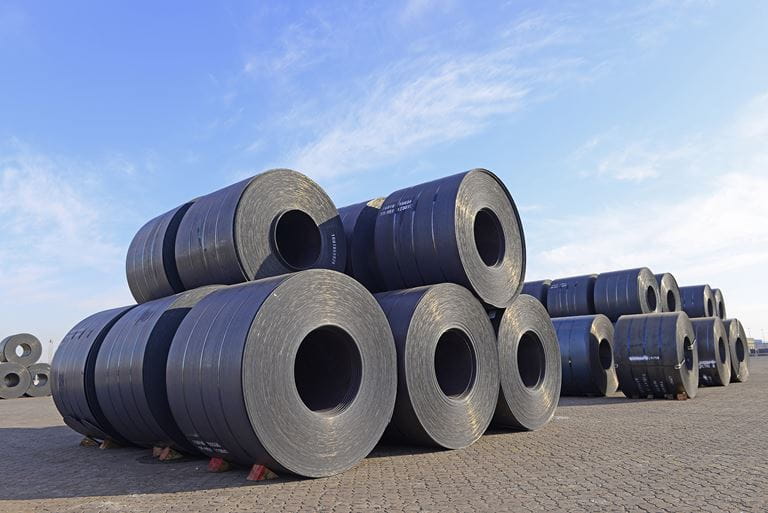
Trading activity in the European hot-rolled coil market remained low on May 17 and prices remained fairly stable.
Real demand has remained low, and distributors have been avoiding building stocks, focusing on purchases of volumes needed to fill gaps in their portfolios.
Despite limited trading activity, market sources believe that prices would remain stable in the short run.
“The market is very quiet. Demand from every end-user segment is low and distributors avoid bookings,” a German service center said. “I do not think that the prices would decline as the mills understand that the lower prices would not drive sales up.”
Platts assessed domestic prices for hot-rolled coil in Northwest Europe up Eur5/mt on the day at Eur635/mt ex-works Ruhr on May 17.
Deals were reported at Eur630-640/mt ex-works Ruhr.
Tradable values have been reported at Eur630/mt ex-works Ruhr.
The lowest offers were reported at Eur630-640/mt ex-works Ruhr.
Platts assessed domestic prices for hot-rolled coil in South Europe at Eur625/mt ex-works Italy on May 17, unchanged on the day.
Tradable values have been reported at Eur620-630/mt ex-works Italy and offers at the equivalent of Eur640/mt ex-works Italy.
Interest in imported HRC from Asia was limited due to longer lead times, uncompetitive prices and risks related to possible changes in the safeguard measures after a review that is scheduled to end by June 30.
The lowest offers from Turkey were reported at Eur620/mt CIF Italy, including anti-dumping duties, and offers from Asia were heard at Eur610-630/mt CIF Italy.
Maria Tanatar | Devbrat Saha

Green steel transition in focus: Key takeaways from EUROMETAL Steel Day in Zurich
Demand for green steel to rise swiftly in 5-10 years, supply to remain tight
Demand for green flat steel is expected to increase to around 49 million tonnes in 2030, Guido Kerkhoff, chief executive officer at Klöckner & Co SE said during his presentation, quoting BCG data.
Over 45 million tonnes of new green steelmaking capacities — via electric-arc furnace (EAF) or EAF-DRI (direct-reduced iron) production — are expected to come online in Europe in 2025-2030, however, a delay of about 15 million tonnes in capacity expansion in expected until 2030.

“Customers’ willingness to pay makes the difference in tight markets,” Kerkhoff said.
Industry sources estimated that green steel volumes traded in Europe were below 100,000 tonnes in 2023, with most estimations coming at around 50,000-70,000 tonnes.
Very few suppliers were able to offer “physically-produced green steel, with emissions proved by Environmental Product Declarations [EDPs] below 1 tonne of CO2 per 1 tonne of steel [for Scope 1,2,3],” according to one distributor.
“One can reach net-zero [emissions] with [carbon] offsets, but some buyers refuse to deal with such steel, claiming it has been ‘green-washed’,” a second distributor said.
Premiums for EAF-produced green steel with emissions for Scope 1,2 and 3 carbon emissions below 0.8 tonnes per 1 tonne of steel were reported at €200-350 ($217-381) per tonne in the week to Friday May 17.
Buyer sources estimated tradeable values for such steel at €100-150 per tonne.
Fastmarkets’ weekly assessment of the green steel domestic, flat-rolled, differential to HRC index, exw Northern Europe was €150-250 per tonne on Thursday, stable week on week.

Transparency is a decisive criteria in green steel sourcing
In the past several year, European steel producers have accelerated their decarbonization efforts, and the new market for steel with a reduced carbon footprint has emerged.
Major suppliers are offering their own green steel brands with lower carbon footprint — XCarb, Arvzero, SSAB Zero, Bluemint, Greentec, etc. — however, there is no common standard for green steel in the industry yet.
“Product Carbon Footprint (PCF) is the only criterion for comparability in order to meet growing customer demand for transparency along the entire values chain,” Kerkhoff said.

“We need a coordinated approach from the entire sector, a simple approach that is applicable to all members,” Andreas Steffes, executive manger at Handel Schweiz, said during his presentation.
PCF Declaration is set to create transparency on emissions in the supply chain, tracking emission under Scope 1 and 2 (direct emissions generated by an entity or its subsidiaries and indirect emissions from energy used by an organization) and upstream Scope 3 (indirect emissions that occur from sources beyond a company’s control) as well.
“With a PCF declaration, no more emission estimates are required from customer side… [PCF declarations] include emissions from raw material extraction to [the material’s] arrival at the customer’s factory gate,” Kerkhoff added.
Customers become more demanding
Customers’ requirement for carbon footprint in steel products are “steadily increasing.”
For example, automaker BMW aims to be climate-neutral no later than 2050, with the share of recycled content in their products set at a minimum 95% and the approach “use EAF steel whenever possible,” Stefan Feichtinger, senior manager ESG corporate technology at Swiss Steel Group, said during the meeting.

For Volvo, the goal is to have 25% recycled and bio-based content in the new car models by 2025 and 35% by 2030.
Currently, 40% of European steel is produced from scrap (EAF-route), with a steel footprint of around 700 kg CO2 per tonne. Mainly long steel products are being produced via such route.
Around only about 1% comes from from DRI-EAF (1.3-1.4 tonnes of CO2 footprint) while the rest of steel is produced by conventional blast furnace-basic-oxygen furnaces (BF-BOF) (2-2.3 tonnes of CO2 content), and the majority of flat steel products are produced via BF-BOF.
Fastmarkets has recently launched consultations to lower the threshold for the carbon emissions content for its weekly green steel premium and daily inferred green steel price in Europe, to lower the upper threshold for both assessments, following feedback from the market.
Fastmarkets proposes to change the maximum carbon emission content to 800 kilograms per 1 tonne of steel, down from 1 tonne previously.
Raw material supply challenges
The gradual shift from conventional BF-BOF route to either EAF or EAF-DRI poses many challenges for the steel sector.
DRI-EAF route requires high-quality iron ore, with a high Fe percentage and low impurities, and less than 5% of global iron ore supply is suitable for production, Stefan Feichtinger said, quoting iron ore supplier BHP.
The solutions could be:
- Development of mines
- Further processing of existing ores to improve the grade
- Technological solutions: DRI-ESF-(electric-smelting furnace)-BOF, fluidized bed reduction that allows for lower grade ores
Another big challenge could be increased demand for scrap to feed new EAF capacities. To feed new flat steelmaking capacities, companies would need to buy high-quality scrap grades with lower impurities that are suitable for flat steel production.
EU is the largest net scrap exporter in the world. Scrap export volumes from the bloc were 18.5 million tonnes in 2023, a 7% increase vs 17.4 million tonnes a year before.
Starting in 2025, the export of ferrous and non-ferrous metal scrap to non-Organization for Economic Co-operation and Developed (OECD) countries will require consent by obtaining formal approval from non-OECD countries to export ferrous and non-ferrous scrap. These recipient countries must also demonstrate their ability to manage the scrap effectively, ensuring responsible handling and recycling.
This change could transform the EU from a net scrap exporter to an importer within five years.

Steel is not part of the problem, but part of the solution
Steelmaking generates approximately 8% of the worldwide carbon emissions, according to the World Steel Association.
However, the carbon footprint of steelmaking is still lower compared with other industries — such as carbon fiber with around 20 tonnes CO2 per 1 tonne of carbon fiber, and aluminium, with 5-8 tonnes of CO2 per 1 tonne.
In addition, steel is a recyclable product and remains in the material’s cycle.
With modern technologies, environmentally friendly “green” steel can be produced and used by different industries. The use of green steel only pushes up the price of the end-product marginally, Guido Kerkhoff said.
Notably, for the automotive industry, the use of green steel products would only push the car price up by 0.3-0.7%, and by 1.7-3.6% for home appliances. For onshore and offshore wind towers, the costs would rise by 1.6-3.4% and by 2.6-5.5% respectively.
“Steel is part of the solution [in decarbonization journey] and contributes significantly to the decarbonization of the value chain in many industries,” Guido Kerkhoff said.