


Supply shortages push up European stainless steel prices despite sluggish demand
Fastmarkets’ monthly price assessment for stainless steel cold-rolled sheet 2mm grade 304 transaction domestic, delivered North Europe, was €2,550-2,650 ($2,700-2,805) per tonne on Friday, up from €2,500-2,600 per tonne on September 1.
A shortage in the stainless steel flat products market is the reason prices are moving up, despite the disappointing demand, a producer source told Fastmarkets.
“[The shortage] is due to many [market participants] deciding to stop importing from Thailand and instead opting to buy from Europe. Big mills are offering material for shipment in November-December, which means material won’t be available to the end-user market before January 2024,” the producer source said.
October’s price increase is the first increase since February and the first price change since July.
There was no reason for the upward trend to stop in the coming months and distributors will be faced with a “pursuit to survive,” the producer source said.
And a distributor source said: “We’ve never been so uncertain as we are now, because of the macro-economic situation – because of Germany and because there is no demand. Everyone is in waiting mode.”
The distributor raised concerns about the closed nature of the market – in which suppliers can set prices and decide production levels.
“This situation is causing fear among distributors. We are waiting because [suppliers] are now increasing the prices, but the market is not [willing to] pay [those prices],” he said.
A second distributor hinted at potential “price dumping” and said: “If import materials decrease, we believe that a lot of the distributors will try to sell at any price.”
Fastmarket’s monthly stainless steel cold-rolled sheet 2mm grade 304 alloy surcharge domestic, Europe, was €2,193-2,212 per tonne on Friday, up from €2,179-2,209 per tonne one month earlier.
Surcharges for October will typically be based on alloy component costs between August 20 and September 21, when the average three-month daily official nickel price on the London Metal Exchange was $20,337 per tonne, a $740-per-tonne decline from $21,077 per tonne one month earlier.
Published by: Zdravko Cherkezov


Celsa takeover moves ahead, industrial partner sought
The Spanish government will need to approve the move, but the investment funds have agreed to the main request made by authorities: find an industrial partner to acquire a 20% stake in the group, Kallanish understands.
According to Spanish sources, if all goes smoothly, control of Celsa could pass to the new owners by mid-2024. Media reports suggest industrial partner candidates include Sidenor, Megasa, as well as Hierros Anon – the owner of Siderurgica Balboa.
Emanuele Norsa Italy

CBAM risks creating two-tier market: Assofermet meeting
Speaking at last week’s meeting organised by Italian steel trade association Assofermet in Rome, Gianclaudio Torlizzi said the right conditions do not exist to impose European green steel standards uniformly across all countries of the world.
Volatility is a key aspect of the post-pandemic market. “Today, companies find themselves operating in a completely different market than the one we were used to until a few years ago … We are witnessing new difficulties in business, and creating long-term strategies becomes particularly complex,” Torlizzi observed.
The event focused on sustainability and new challenges. “The theme of the conference underlines how much the green wave is changing the way of life and the way of doing business,” Assofermet says in a note obtained by Kallanish.
“For those who deal with steel, decarbonisation is an economic-financial and technological commitment strongly influenced by the political context,” notes merchant bar maker Beltrame’s chief commercial officer, Enrico Fornelli.
The CBAM mechanism could lead to an increase in steel import prices of around 15%. It currently applies only to some steel products, which impacts end-users and downstream companies, exposing them to unfair competition with importers of competing finished products who would face no restrictions or taxation, Assofermet stated last month.
If not radically revised, it risks undermining the competitiveness of an important part of the EU manufacturing sector.
The transitional CBAM period will expire on 31 December 2025. Until that time, buyers will have to fulfil only a part of the mechanism’s regulations. Assofermet hopes that before the start of the definitive period, on 1 January 2026, the EU will be able to modify the measure to reconcile the environmental transition with the economic consequences that arise from the implementation of the EU Green Deal and Fit For 55.
Natalia Capra France

Strategic partnership between Kaltenbach.Solutions and Fraunhofer IPA
Kaltenbach.Solutions GmbH has agreed on a strategic partnership in the field of sawing technology with the Fraunhofer Institute for Production Engineering and Automation (IPA) in Stuttgart. The aim of this joint project is to measurably and sustainably increase the efficiency of sawing machines used in steel and wood processing through the use of digital solutions.
Due to the great demand from the steel and wood processing industries, a solution for the simple digitization of sawing processes is being developed in the Sawing Technology business unit of the Fraunhofer IPA. With 1200 employees, the Institute for Manufacturing Engineering and Automation is one of the largest institutions in the Fraunhofer-Gesellschaft. Its research activities focus on the economic production of sustainable and personalized products. In the field of sawing technology, machines and production lines are tested under the direction of Tim Mayer, in addition to components, devices and processes. As a specialist in digital transformation in steel processing, Kaltenbach.Solutions is contributing its proven industry expertise to the agreed collaboration.
Sawing machines in industry are designed for maximum material capacity, which leads to high demands on the processing quality and the cost efficiency of the workflows. In the first step of the project, automatic data evaluation is planned for circular and band saws in trial operation on Fraunhofer IPA machines. Findings obtained here will subsequently be transferred to series operation. As part of the strategic partnership with Kaltenbach.Solutions, the aim is to achieve a sustainable increase in efficiency in the use of sawing machines through the use of digital monitoring.
Source: kaltenbach-solutions.com

ArcelorMittal Hamburg plans fourth-quarter stoppages, short-time working
ArcelorMittal Hamburg will implement short-time work for its staff in the fourth quarter, and stop production for two periods totalling five weeks.
In a letter sent to customers seen by Kallanish, the company cites weak domestic demand, especially in the construction industry, and persistently high electricity costs. The direct reduced iron plant in Hamburg faces particularly great challenges as one of the most energy-intensive steel industry locations in Germany, the firm notes.
After careful consideration and evaluation of all available options, the management says it decided on reducing production.
The first production stoppage is from 27 October to 12 November, with the second planned from 14 to 31 December. During this time, the entire plant will be closed and only operate with a minimal crew on site. The company has therefore asked customers to plan shipping of October orders ahead of time.
Christian Koehl Germany

Low consumption seen continuing in Italian longs market
Distributors and agents in Italy are lamenting a very bad September and October in terms of margins, sales and general activity. Some sources say that compared to last year, sales across flat and long products have dropped 35-40%.
On long products, one mill source forecasts consumption to remain at current levels, not only in the fourth quarter but also in Q1 2024. Talking about prices, a distributor tells Kallanish: “If they [producers] did not manage to push up coils [prices], with practically no possibility of importing, they will not manage in this quiet market to increase longs prices. We see very little activity downstream. Our clients have limited orders. From now until Christmas, sellers and buyers forecast prices to fall between €30-50/tonne depending on product.”
Merchant bar values are on a downward trajectory, losing some €30/t ($31) compared to September. Transactions are occurring at €300-320/t base ex-works. Including size extras, prices are hovering at €720-740/t.
Sections, the product that has been more stable compared to all other longs, is also weakening by €30/t on average versus September, under pressure from cheaper imported material. Its values now stand at €800-820/t on average.
However, sources are not pessimistic about the beams market and say that while apparent demand is absent, real demand continues to be reliable despite the steel sector downturn. Distributors are chasing orders and discounting heavily when possible.
Natalia Capra France
Italian plate demand dries up, prices decline
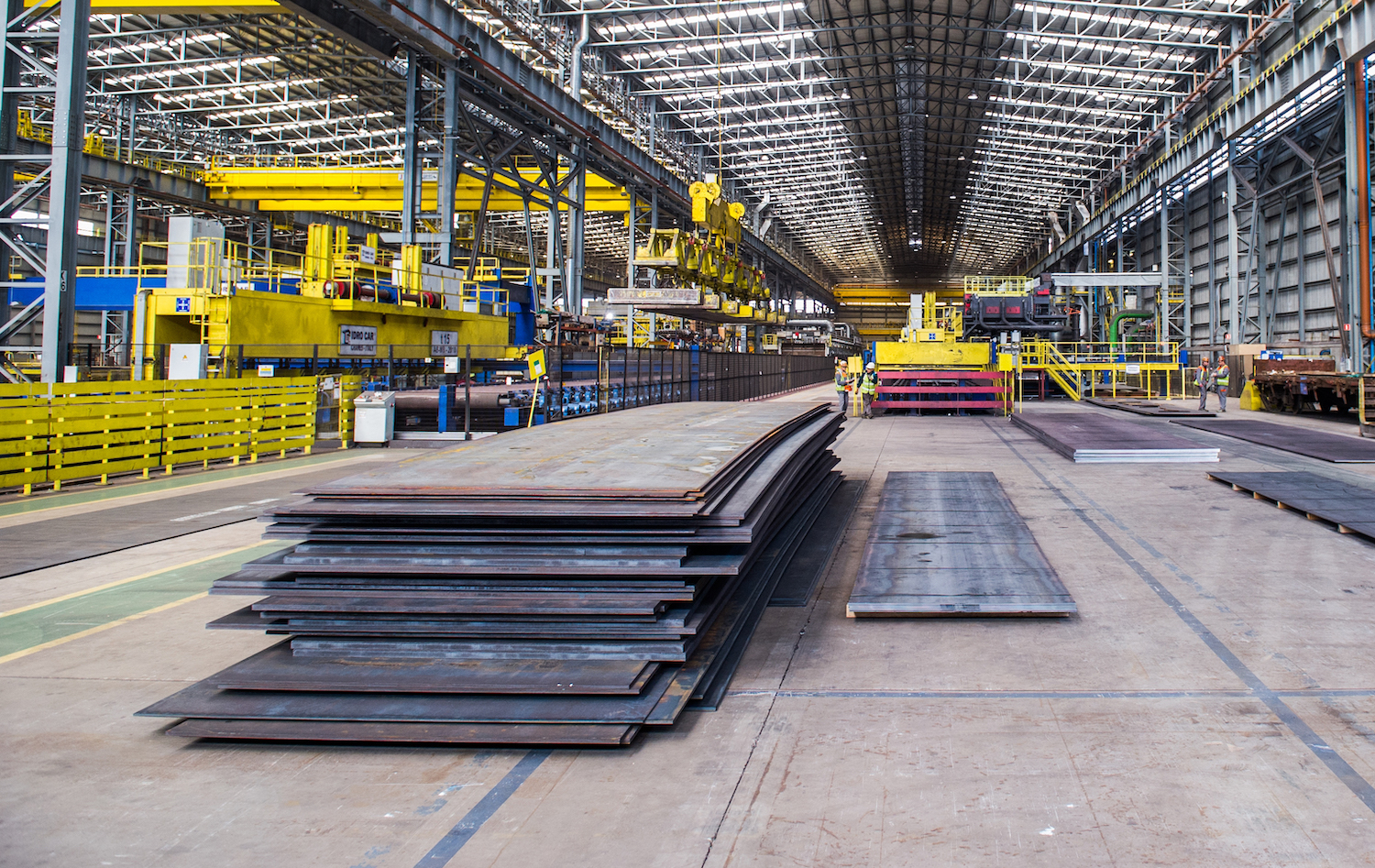
Italian plate prices are falling significantly compared to the beginning of September. Producers noted some return of demand in the last week of September and first days of October, following a long period of quiet and low sales.
At present, orders are drying up in Italy, but plate makers are selling to other European countries such as Poland and Ukraine. In the Italian domestic market, buyers are waiting for values to decline further, sources tell Kallanish.
Distributors are chasing orders. “A price war is starting where companies compete with each other by discounting material a lot,” one source says. Distribution firms are chasing margins and hoping to increase their turnover.
On average, S275 has declined to €650-670/tonne ($686-707) delivered, while S355 is being transacted at slightly below €700/t delivered. Sources forecast that some demand should return in November when Italian companies buy material for year-end delivery. A large service centre says the market is stuck and all flat and long product prices are falling.
Imported Asia-origin slab contracts in Italy are rumoured to have been done at $580/t cfr Italy, mostly stable compared to mid-September.
Natalia Capra France

Italian rebar buyers shun mill hike
Italian rebar deal prices were stable on-week and on-month amid continued low consumption. This follows a hike attempted in the last September week by local rebar makers, who pushed up prices by €50/tonne ($52), imitating other rebar producers in Europe, sources tell Kallanish.
Transaction values however remain at €280-310/t base ex-works. The high point of the range has increased by €10/t compared to last month, but €310/t is only being achieved for very low quantities. Including extras, domestic rebar is flat at €540-570/t base ex-works.
While producers are asking for €340-350/t base ex-works, agents and distributors are sceptical about any increase while consumption remains so low. Buyers continue to ask for 150-300 tonnes per week, with very few higher-volume contracts. Domestic mesh is meanwhile being sold at about €380-400/t, also unchanged. Buyers must add transport and around €300/t size extras.
One buyer says many infrastructure projects that should be funded by the national recovery fund (PNRR) will not be implemented due to the slow bureaucracy of the government. This means the funds will not be spent by 2026, a key requirement of the European Commission for the allocation of funds.
Natalia Capra France

EUROMETAL at 7th Steel Plate Conference Europe
EUROMETAL had the privilege of collaborating once again with Metal Expert at its 7th Steel Plate Conference Europe.
This unmissable event brought together the main European producers and distributors of Quarto Plates in the capital city of North Rhine-Westphalia, Düsseldorf.
[ Photos ]

Customers, producers will pay for green steel: SSAB
“However, we have to invest in green technologies, to be pioneers, and most of our customers agree that we must lower CO2 emissions,” he noted at the EUROMETAL regional meeting Nordics in Copenhagen last week attended by Kallanish.
“We have calculated that we will have to pay between SEK 7-8 billion [$636-727 million] by 2030 for gas emissions, if we continue to produce with the old technology. So, one way or the other, you will have to pay more for your steel, Thus, the producers, together with the customers, have to face this new reality,” he added.
According to him, the mechanical properties of steel are created in the downstream processes and will be the same as they are today. “The only difference is using fossil-free fuels, like hydrogen and electricity. We calculated that at SSAB, fossil–free iron and steel production will require 15 TWh of electricity per year. That corresponds to 9% of Sweden’s electricity generation in 2019,” Meier noted.
The firm’s plan is to reach commercial output of 1.3 million tonnes/year of fossil-free hot-briquetted iron in 2026 after delivering the first green steel to Volvo in 2021, he concluded.
Svetoslav Abrossimov Bulgaria